Your new post is loading...

|
Scooped by
dromius
January 27, 2015 7:02 AM
|
(via T. Lahaye, thx) Shan et al, 2015 Fragrant rice is favoured worldwide because of its agreeable scent. The presence of a defective badh2 allele encoding betaine aldehyde dehydrogenase (BADH2) results in the synthesis of 2-acetyl-1-pyrroline (2AP), which is a major fragrance compound. Here, transcription activator-like effector nucleases (TALENs) were engineered to target and disrupt the OsBADH2 gene. Six heterozygous mutants (30%) were recovered from 20 transgenic hygromycin-resistant lines. Sanger sequencing confirmed that these lines had various indel mutations at the TALEN target site. All six transmitted the BADH2 mutations to the T1 generation; and four T1 mutant lines tested also efficiently transmitted the mutations to the T2 generation. Mutant plants carrying only the desired DNA sequence change but not the TALEN transgene were obtained by segregation in the T1 and T2 generations. The 2AP content of rice grains of the T1 lines with homozygous mutations increased from 0 to 0.35–0.75 mg/kg, which was similar to the content of a positive control variety harbouring the badh2-E7 mutation. We also simultaneously introduced three different pairs of TALENs targeting three separate rice genes into rice cells by bombardment and obtained lines with mutations in one, two and all three genes. These results indicate that targeted mutagenesis using TALENs is a useful approach to creating important agronomic traits.
|
|
Scooped by
dromius
January 22, 2015 4:25 AM
|
Sommer et al, 2015 Genetic mouse models are critical for biomedical research to understand gene function and pathophysiology. In the last years, the generation of genetic mouse models has been revolutionized by the emergence of transcription activator-like effector nucleases (TALENs). TALENs are programmable, sequence-specific DNA-binding proteins fused to a non-specific endonuclease domain used as powerful tools for site-specific induction of DNA double-strand breaks. These result in disruption of the gene product of the targeted locus by mutations induced during repair by error-prone non-homologous end-joining. Alternatively, these DNA double-strand breaks can be exploited to integrate a user-defined sequence by homologous recombination if an appropriate repair plasmid is provided. In this review, we highlight the major technological improvements for genome editing in murine oocytes which have been achieved using TALENs, discuss current limitations of the technology, suggest strategies to broadly apply TALENs, and describe possible future directions to facilitate gene editing in murine oocytes.
|
|
Scooped by
dromius
January 19, 2015 6:07 AM
|
(via T. Schreiber, thx) Cerbini et al, 2015 Targeted genome engineering to robustly express transgenes is an essential methodology for stem cell-based research and therapy. Although designer nucleases have been used to drastically enhance gene editing efficiency, targeted addition and stable expression of transgenes to date is limited at single gene/locus and mostly PPP1R12C/AAVS1 in human stem cells. Here we constructed transcription activator-like effector nucleases (TALENs) targeting the safe-harbor like gene CLYBL to mediate reporter gene integration at 38%–58% efficiency, and used both AAVS1-TALENs and CLYBL-TALENs to simultaneously knock-in multiple reporter genes at dual safe-harbor loci in human induced pluripotent stem cells (iPSCs) and neural stem cells (NSCs). The CLYBL-TALEN engineered cell lines maintained robust reporter expression during self-renewal and differentiation, and revealed that CLYBL targeting resulted in stronger transgene expression and less perturbation on local gene expression than PPP1R12C/AAVS1. TALEN-mediated CLYBL engineering provides improved transgene expression and options for multiple genetic modification in human stem cells.
|
|
Scooped by
dromius
January 10, 2015 5:54 PM
|
US 8,921,332, covers “the use of a chimeric endonuclease to induce homologous recombination between a nucleic acid vector and the chromosomal DNA of the cell in vitro to modify a specific sequence”. This seminal invention is at the origin of most current nuclease-based precise gene editing technologies involving Zinc Finger Nucleases, TALEN™, Mega-TALE, BurrH Nucleases, as well as CRISPR, which all are chimeric endonucleases comprising a DNA binding sequence and a DNA cleavage domain with a recognition site of at least 12 base pairs.
|
|
Scooped by
dromius
January 10, 2015 4:03 PM
|
Baltes et al, 2014 Here, we use geminivirus-based replicons for transient expression of sequence-specific nucleases (zinc-finger nucleases, transcription activator–like effector nucleases, and the clustered, regularly interspaced, short palindromic repeat/Cas system) and delivery of DNA repair templates. In tobacco (Nicotiana tabacum), replicons based on the bean yellow dwarf virus enhanced gene targeting frequencies one to two orders of magnitude over conventional Agrobacterium tumefaciens T-DNA. In addition to the nuclease-mediated DNA double-strand breaks, gene targeting was promoted by replication of the repair template and pleiotropic activity of the geminivirus replication initiator proteins. We demonstrate the feasibility of using geminivirus replicons to generate plants with a desired DNA sequence modification. By adopting a general plant transformation method, plantlets with a desired DNA change were regenerated in <6 weeks. These results, in addition to the large host range of geminiviruses, advocate the use of replicons for plant genome engineering.
|
|
Scooped by
dromius
January 5, 2015 3:45 AM
|
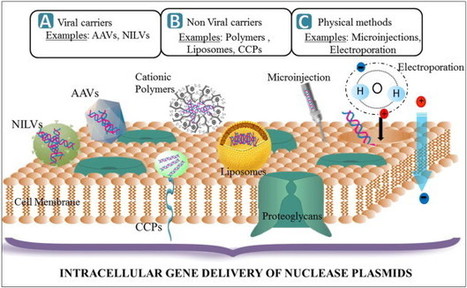
Ul Ain et al, 2014 Gene therapy by engineered nucleases is a genetic intervention being investigated for curing the hereditary disorders by targeting selected genes with specific nucleotides for establishment, suppression, abolishment of a function or correction of mutation. Here, we review the fast developing technology of targeted genome engineering using site specific programmable nucleases zinc finger nucleases (ZFNs), transcription activator like nucleases (TALENs) and cluster regulatory interspaced short palindromic repeat/CRISPR associated proteins (CRISPR/Cas) based RNA-guided DNA endonucleases (RGENs) and their different characteristics including pros and cons of genome modifications by these nucleases. We have further discussed different types of delivery methods to induce gene editing, novel development in genetic engineering other than nucleases and future prospects.
|
|
Scooped by
dromius
December 27, 2014 12:47 AM
|
GeneArt PerfectMatch TALs provide custom DNA- binding proteins designed for accurate DNA targeting and precise genome editing. Unlike other technologies that limit the choice of targets, or provide ambiguous results, GeneArt PerfectMatch TALs help enable the targeting of any locus in the genome. Previous versions of GeneArt Precision TALs required a thymine nucleotide (T) at the 5 ́ end of each target sequence. The 5 ́ T constraint limits the fl exibility of TAL effector target sites in the genome and prevents some specific sites in the genome from being targeted [1]. With our new GeneArt PerfectMatch TALs, the 5 ́ T requirement is removed, making it possible to design a TAL effector pair for anywhere in the genome, giving you broad fl exibility in target design. In addition, Thermo Fisher Scientific has recently secured rights to certain intellectual property around TALs, clarifying a path for you to move confidently forward and innovate.
|
|
Scooped by
dromius
December 23, 2014 3:47 PM
|
(via T. Lahaye, thx) Honarmand et al, 2014 Transcription activator-like effectors (TALEs), originating from the Xanthomonas genus of bacteria, bind to specific DNA sequences based on amino acid sequence in the repeat-variable diresidue (RVD) positions of the protein. By altering these RVDs, it has been shown that a TALE protein can be engineered to bind virtually any DNA sequence of interest. The possibility of multiplexing TALEs for the purposes of identifying specific DNA sequences has yet to be explored. Here, we demonstrate a system in which a TALE protein bound to a nitrocellulose strip has been utilized to capture purified DNA, which is then detected using the binding of a second distinct TALE protein conjugated to a protein tag that is then detected by a dot blot. This system provides a signal only when both TALEs bind to their respective sequences, further demonstrating the specificity of the TALE binding.
|
|
Scooped by
dromius
December 18, 2014 5:38 PM
|
Frock et al, 2014 Although great progress has been made in the characterization of the off-target effects of engineered nucleases, sensitive and unbiased genome-wide methods for the detection of off-target cleavage events and potential collateral damage are still lacking. Here we describe a linear amplification–mediated modification of a previously published high-throughput, genome-wide, translocation sequencing (HTGTS) method that robustly detects DNA double-stranded breaks (DSBs) generated by engineered nucleases across the human genome based on their translocation to other endogenous or ectopic DSBs. HTGTS with different Cas9:sgRNA or TALEN nucleases revealed off-target hotspot numbers for given nucleases that ranged from a few or none to dozens or more, and extended the number of known off-targets for certain previously characterized nucleases more than tenfold. We also identified translocations between bona fide nuclease targets on homologous chromosomes, an undesired collateral effect that has not been described previously. Finally, HTGTS confirmed that the Cas9D10A paired nickase approach suppresses off-target cleavage genome-wide.
|
|
Scooped by
dromius
December 16, 2014 6:48 AM
|
(via T. Schreiber, thx) Thomas et al, 2014 With the goal to generate and characterize the phenotypes of null alleles in all genes within an organism and the recent advances in custom nucleases, genome editing limitations have moved from mutation generation to mutation detection. We previously demonstrated that High Resolution Melting (HRM) analysis is a rapid and efficient means of genotyping known zebrafish mutants. Here we establish optimized conditions for HRM based detection of novel mutant alleles. Using these conditions, we demonstrate that HRM is highly efficient at mutation detection across multiple genome editing platforms (ZFNs, TALENs, and CRISPRs); we observed nuclease generated HRM positive targeting in 1 of 6 (16%) open pool derived ZFNs, 14 of 23 (60%) TALENs, and 58 of 77 (75%) CRISPR nucleases. Successful targeting, based on HRM of G0 embryos correlates well with successful germline transmission (46 of 47 nucleases); yet, surprisingly mutations in the somatic tail DNA weakly correlate with mutations in the germline F1 progeny DNA. This suggests that analysis of G0 tail DNA is a good indicator of the efficiency of the nuclease, but not necessarily a good indicator of germline alleles that will be present in the F1s. However, we demonstrate that small amplicon HRM curve profiles of F1 progeny DNA can be used to differentiate between specific mutant alleles, facilitating rare allele identification and isolation; and that HRM is a powerful technique for screening possible off-target mutations that may be generated by the nucleases. Our data suggest that micro-homology based alternative NHEJ repair is primarily utilized in the generation of CRISPR mutant alleles and allows us to predict likelihood of generating a null allele. Lastly, we demonstrate that HRM can be used to quickly distinguish genotype-phenotype correlations within F1 embryos derived from G0 intercrosses. Together these data indicate that custom nucleases, in conjunction with the ease and speed of HRM, will facilitate future high-throughput mutation generation and analysis needed to establish mutants in all genes of an organism.
|
|
Scooped by
dromius
December 10, 2014 12:46 PM
|
Kupecz, 2014 Recent developments in the prosecution of the CRISPR-Cas9 patent in Europe highlight the differences between the intellectual property regimes of Europe and the United States.
|
|
Scooped by
dromius
December 7, 2014 12:38 PM
|
(via T. Schreiber, thx) Zhang et al, 2014 Stable and efficient knockdown of multiple gene targets is highly desirable for dissection of molecular pathways. Because it allows sequence-specific DNA binding, transcription activator-like effector (TALE) offers a new genetic perturbation technique that allows for gene-specific repression. Here, we constructed a multicolor lentiviral TALE-Kruppel-associated box (KRAB) expression vector platform that enables knockdown of multiple gene targets. This platform is fully compatible with the Golden Gate TALEN and TAL Effector Kit 2.0, a widely used and efficient method for TALE assembly. We showed that this multicolor TALE-KRAB vector system when combined together with bone marrow transplantation could quickly knock down c-kit and PU.1 genes in hematopoietic stem and progenitor cells of recipient mice. Furthermore, our data demonstrated that this platform simultaneously knocked down both c-Kit and PU.1 genes in the same primary cell populations. Together, our results suggest that this multicolor TALE-KRAB vector platform is a promising and versatile tool for knockdown of multiple gene targets and could greatly facilitate dissection of molecular pathways.
|
|
Rescooped by
dromius
from Host Microbe Interactions
December 3, 2014 2:38 AM
|
Highlights •A unique k-mer database was used to identify unique targetable regions in human genome•A dystrophin frameshift was corrected using TALENs or CRISPR-sgRNAs in iPSCs•Genomic integrity tests identified minimum off-target mutagenesis by the nucleases•Dystrophin protein was detected by myogenic differentiation in the corrected iPSCs Summary Duchenne muscular dystrophy (DMD) is a severe muscle-degenerative disease caused by a mutation in the dystrophin gene. Genetic correction of patient-derived induced pluripotent stem cells (iPSCs) by TALENs or CRISPR-Cas9 holds promise for DMD gene therapy; however, the safety of such nuclease treatment must be determined. Using a unique k-mer database, we systematically identified a unique target region that reduces off-target sites. To restore the dystrophin protein, we performed three correction methods (exon skipping, frameshifting, and exon knockin) in DMD-patient-derived iPSCs, and found that exon knockin was the most effective approach. We further investigated the genomic integrity by karyotyping, copy number variation array, and exome sequencing to identify clones with a minimal mutation load. Finally, we differentiated the corrected iPSCs toward skeletal muscle cells and successfully detected the expression of full-length dystrophin protein. These results provide an important framework for developing iPSC-based gene therapy for genetic disorders using programmable nucleases.
Via Ryohei Thomas Nakano
|
|
|
Scooped by
dromius
January 27, 2015 6:56 AM
|
(via T. Schreiber, thx) Bloom et al, 2015 Genome modification platforms are fast becoming valuable tools for the development of novel therapies. The use of sequence-specific DNA binding proteins in conjunction with various effector domains enables targeted gene editing to be employed as a mode of therapy. Although this field of research has largely focused on the engineering and repair of mammalian genes, the technology may also be used to disrupt viral DNA or host factors associated with pathogenesis of viral disease. For persistent or latent infections, targeted mutagenesis of the episomal or proviral DNA could render the virus inactive. Alternatively, virus-resistant cells may be generated by disrupting the expression of host factors that are required for viral infection. This review highlights some of the approaches currently used to disable viruses, with a particular focus on TALENs and repressor TALEs for antiviral therapy.
|
|
Scooped by
dromius
January 20, 2015 5:45 AM
|
(via T. Lahaye, thx) Wang et al, 2015 The utility of CRISPR-Cas9 and TALENs for genome editing may be compromised by their off-target activity. We show that integrase-defective lentiviral vectors (IDLVs) can detect such off-target cleavage with a frequency as low as 1%. In the case of Cas9, we find frequent off-target sites with a one-base bulge or up to 13 mismatches between the single guide RNA (sgRNA) and its genomic target, which refines sgRNA design.
We did not find any off-target sites for the TALENs tested (Table 1). Two additional TALENs specific for the zinc finger (CCCH type), RNA-binding motif and serine/arginine rich 2 (ZRSR2) and microRNA 9-2 (miR-9-2) genes also failed to generate detectable off-target cleavage (Supplementary Fig. 1 and Table 1). In comparison, three out of six CRISPR-Cas9 nucleases had detectable off-target activities.
|
|
Scooped by
dromius
January 16, 2015 10:55 AM
|
(Via. T. Schreiber, thx) Nakajima and Yaoita 2015 Zinc-finger nucleases, transcription activator-like effector nucleases (TALENs) and the CRISPR/Cas (clustered regularly interspaced short palindromic repeats/CRISPR-associated proteins) system are potentially powerful tools for producing tailor-made knockout animals. However, their mutagenic activity is not high enough to induce mutations at all loci of a target gene throughout an entire tadpole. In this study, we present a highly efficient method for introducing gene modifications at almost all target sequences in randomly selected embryos. The gene modification activity of TALEN is enhanced by adopting the host-transfer technique. In our method, the efficiency is further improved by injecting TALEN mRNAs fused to the 3′UTR of the Xenopus DEADSouth gene into oocytes, which are then transferred into a host female frog, where they are ovulated and fertilized. The addition of the 3′UTR of the DEADSouth gene promotes mRNA translation in the oocytes and increases the expression of TALEN proteins to near-maximal levels three hours post fertilization (hpf). In contrast, TALEN mRNAs without this 3′UTR are translated infrequently in oocytes. Our data suggest that genomic DNA is more sensitive to TALEN proteins from fertilization to the midblastula (MBT) stage. Our method works by increasing the levels of TALEN proteins during the pre-MBT stages.
|
|
Scooped by
dromius
January 10, 2015 5:49 PM
|
Jones 2015 Genome editing opens up opportunities for the precise and rapid alteration of crops to boost yields, protect against pests and diseases and enhance nutrient content. The extent to which applied plant research and crop breeding benefit will depend on how the EU decides to regulate this fledgling technology.
|
|
Scooped by
dromius
January 7, 2015 9:44 AM
|
(via T. Lahaye, thx) Kubik & Summerer 2014 We report engineered transcription-activator-like effectors (TALEs) as the first DNA-binding molecules that detect 5-methylcytosine (mC) at single-nucleotide resolution with fully programmable sequence selectivity. This is achieved by a design strategy such that a single cytosine (C) in a DNA sequence is selectively interrogated for its mC-modification level by targeting with a discriminatory TALE repeat; other Cs are ignored by targeting with universal-binding TALE repeats.
|
|
Scooped by
dromius
December 27, 2014 12:50 AM
|
Bacman et al, 2014 For more than a decade, mitochondria-targeted nucleases have been used to promote double-strand breaks in the mitochondrial genome. This was done in mitochondrial DNA (mtDNA) homoplasmic systems, where all mtDNA molecules can be affected, to create models of mitochondrial deficiencies. Alternatively, they were also used in a heteroplasmic model, where only a subset of the mtDNA molecules were substrates for cleavage. The latter approach showed that mitochondrial-targeted nucleases can reduce mtDNA haplotype loads in affected tissues, with clear implications for the treatment of patients with mitochondrial diseases. In the last few years, designer nucleases, such as ZFN and TALEN, have been adapted to cleave mtDNA, greatly expanding the potential therapeutic use. This chapter describes the techniques and approaches used to test these designer enzymes.
|
|
Scooped by
dromius
December 24, 2014 7:57 AM
|
Sun et al, 2014 Transcription activator–like effectors (TALEs) are becoming powerful DNA-targeting tools in a variety of mammalian cells and model organisms. However, generating a stable cell line with specific gene mutations in a simple and rapid manner remains a challenging task. Here, we report a new method to efficiently produce monoclonal cells using integrated TALE nuclease technology and a series of high-throughput cell cloning approaches. Following this method, we obtained three mTOR mutant 293T cell lines within 2 months, which included one homozygous mutant line
|
|
Scooped by
dromius
December 20, 2014 5:16 AM
|
This new volume of Methods in Enzymology continues the legacy of this premier serial with quality chapters authored by leaders in the field. Methods to assess mitochondrial function is of great interest to neuroscientists studying chronic forms of neurodegeneration, including Parkinson's, Alzheimer's, ALS, Huntington's and other triplet repeat diseases, but also to those working on acute conditions such as stroke and traumatic brain injury. This volume covers research methods on how to assess the life cycle of mitochondria including trafficking, fusion, fission, and degradation. Multiple perspectives on the complex and difficult problem of measurement of mitochondrial reactive oxygen species production with fluorescent indicators and techniques ranging in scope from measurements on isolated mitochondria to non-invasive imaging of metabolic function.Continues the legacy of this premier serial with quality chapters authored by leaders in the fieldCovers research methods in biomineralization scienceProvides invaluable details on state-of-the-art methods to assess a broad array of mitochondrial functions
|
|
Scooped by
dromius
December 18, 2014 5:28 PM
|
Cellectis plant sciences, a Minnesota-based company focusing on developing healthier food products, and the Two Blades Foundation (2Blades) today announced the execution of a non-exclusive cross-license agreement relating to TAL nuclease technologies. Pursuant to the agreement, 2Blades receives a license to TALEN™ technology for not-for-profit uses, including use in 2Blades’ humanitarian efforts to support subsistence farming, and for certain commercial applications related to the disease resistance programs of 2Blades. In addition, pursuant to the agreement, Cellectis plant sciences receives a license under 2Blades’ TAL Code technology related to nucleases for commercial uses in certain specified crop plants. Cellectis plant sciences has an option to expand its license to additional crops. Financial terms of the agreement were not disclosed.
|
|
Scooped by
dromius
December 16, 2014 3:24 AM
|
(via T. Schreiber, thx) Hu et al, 2014 Persistent HPV infection is recognized as the main etiologic factor for cervical cancer. HPV expresses the oncoproteins E6 and E7, both of which play key roles in maintaining viral infection and promoting carcinogenesis. While siRNA-mediated targeting of E6 and E7 transcripts temporarily induces apoptosis in HPV-positive cells, it does not eliminate viral DNA within the host genome, which can harbor escape mutants. Here, we demonstrated that specifically targeting E6 and E7 within host DNA with transcription activator–like effector nucleases (TALENs) induces apoptosis, inhibits growth, and reduces tumorigenicity in HPV-positive cell lines. TALEN treatment efficiently disrupted E6 and E7 oncogenes, leading to the restoration of host tumor suppressors p53 and retinoblastoma 1 (RB1), which are targeted by E6 and E7, respectively. In the K14-HPV16 transgenic mouse model of HPV-driven neoplasms, direct cervical application of HPV16-E7–targeted TALENs effectively mutated the E7 oncogene, reduced viral DNA load, and restored RB1 function and downstream targets transcription factor E2F1 and cycling-dependent kinase 2 (CDK2), thereby reversing the malignant phenotype. Together, the results from our study suggest that TALENs have potential as a therapeutic strategy for HPV infection and related cervical malignancy.
|
|
Scooped by
dromius
December 9, 2014 5:02 AM
|
(via T. Schreiber, thx) Solin et al, 2014 In this study we describe the molecular and cellular characterization of a zebrafish mutant that develops tumors in the optic pathway. Heterozygous Tg(flk1:RFP)is18 transgenic adults develop tumors of the retina, optic nerve and optic tract. Molecular and genetic mapping demonstrate the tumor phenotype is linked to a high copy number transgene array integrated in the lincRNA gene lincRNAis18/Zv9_00007276 on chromosome 3. TALENs were used to isolate a 147kb deletion allele that removes exons 2–5 of the lincRNAis18 gene. Deletion allele homozygotes are viable and do not develop tumors, indicating loss of function of the lincRNAis18 locus is not the trigger for tumor onset. Optic pathway tumors in the Tg(flk1:RFP)is18 mutant occur with a penetrance of 80–100% by 1 year of age. The retinal tumors are highly vascularized and composed of rosettes of various sizes embedded in a fibrous matrix. Immunohistochemical analysis showed increased expression of the glial markers GFAP and BLBP throughout retinal tumors and in dysplastic optic nerve. We performed transcriptome analysis of pre-tumorous retina and retinal tumor tissue and found changes in gene expression signatures of radial glia and astrocytes (slc1a3), activated glia (atf3, blbp, apoeb), proliferating neural progenitors (foxd3, nestin, cdh2, her9/hes1), and glioma markers (S100β, vim). The transcriptome also revealed activation of cAMP, Stat3 and Wnt signal transduction pathways. qRT-PCR confirmed >10-fold overexpression of the Wnt pathway components hbegfa, ascl1a, and insm1a. Together the data indicate Müller glia and/or astrocyte-derived progenitors could contribute to the zebrafish Tg(flk1:RFP)is18 optic pathway tumors.
|
|
Scooped by
dromius
December 7, 2014 5:01 AM
|
(via T. Lahaye, thx) Kabir et al, 2014 The conserved protein Rap1 functions at telomeres in fungi, protozoa, and vertebrates. Like yeast Rap1, human Rap1 has been implicated in telomere length regulation and repression of nonhomologous end-joining (NHEJ) at telomeres. However, mouse telomeres lacking Rap1 do not succumb to NHEJ. To determine the functions of human Rap1, we generated several transcription activator-like effector nuclease (TALEN)-mediated human cell lines lacking Rap1. Loss of Rap1 did not affect the other components of shelterin, the modification of telomeric histones, the subnuclear position of telomeres, or the 3′ telomeric overhang. Telomeres lacking Rap1 did not show a DNA damage response, NHEJ, or consistent changes in their length, indicating that Rap1 does not have an important function in protection or length regulation of human telomeres. As human Rap1, like its mouse and unicellular orthologs, affects gene expression, we propose that the conservation of Rap1 reflects its role in transcriptional regulation rather than a function at telomeres.
|