Your new post is loading...

|
Scooped by
Gerd Moe-Behrens
August 3, 2021 8:20 AM
|
|
|
Scooped by
Gerd Moe-Behrens
June 10, 2021 6:09 PM
|
Synthetic structures that grow artificial ‘organelles’ could provide insights into the operation of living cells.
|
|
Scooped by
Gerd Moe-Behrens
October 26, 2020 10:58 AM
|
Non-model bacteria like Pseudomonas putida, Lactococcus lactis and other species have unique and versatile metabolisms, offering unique opportunities for Synthetic Biology (SynBio). However, key genome editing and recombineering tools require optimization and large-scale multiplexing to unlock the full SynBio potential of these bacteria. In addition, the limited availability of a set of characterized, species-specific biological parts hampers the construction of reliable genetic circuitry. Mining of currently available, diverse bacteriophages could complete the SynBio toolbox, as they constitute an unexplored treasure trove for fully adapted metabolic modulators and orthogonally-functioning parts, driven by the longstanding co-evolution between phage and host. Non-model bacteria offer unique and versatile metabolisms for synthetic biology. In this Perspective, the authors explore the limited availability of well-characterised biological parts in these species and argue that bacteriophages represent a diverse trove of orthogonal parts.
|
|
Scooped by
Gerd Moe-Behrens
October 8, 2020 12:50 PM
|
DNA and RNA have been compared to "instruction manuals" containing the information needed for living "machines" to operate. But while electronic machines like computers and robots are designed from the ground up to serve a specific purpose, biological organisms are governed by a much messier, more complex set of functions that lack the predictability of binary code. Inventing new solutions to biological problems requires teasing apart seemingly intractable variables—a task that is daunting to even the most intrepid human brains.
|
|
Scooped by
Gerd Moe-Behrens
September 29, 2020 1:51 PM
|
Through advanced mechanistic modeling and the generation of large high-quality datasets, machine learning is becoming an integral part of understanding and engineering living systems. Here we show that mechanistic and machine learning models can be combined to enable accurate genotype-to-phenotype predictions. We use a genome-scale model to pinpoint engineering targets, efficient library construction of metabolic pathway designs, and high-throughput biosensor-enabled screening for training diverse machine learning algorithms. From a single data-generation cycle, this enables successful forward engineering of complex aromatic amino acid metabolism in yeast, with the best machine learning-guided design recommendations improving tryptophan titer and productivity by up to 74 and 43%, respectively, compared to the best designs used for algorithm training. Thus, this study highlights the power of combining mechanistic and machine learning models to effectively direct metabolic engineering efforts. In metabolic engineering, mechanistic models require prior metabolism knowledge of the chassis strain, whereas machine learning models need ample training data. Here, the authors combine the mechanistic and machine learning models to improve prediction performance of tryptophan metabolism in baker’s yeast.
|
|
Scooped by
Gerd Moe-Behrens
September 29, 2020 1:45 PM
|
Scientists at Lawrence Berkeley National Laboratory have developed a new tool that adapts machine learning algorithms to the needs of synthetic biology to guide development systematically. The innovation means scientists will not have to spend years developing a meticulous understanding of each part of a cell and what it does in order to manipulate it.
|
|
Scooped by
Gerd Moe-Behrens
April 4, 2020 4:23 PM
|
|
|
Scooped by
Gerd Moe-Behrens
January 16, 2020 6:15 PM
|
How anti-CRISPR proteins and other molecules could bolster biosecurity and improve medical treatments.
|
|
Scooped by
Gerd Moe-Behrens
January 14, 2020 5:32 AM
|
|
|
Scooped by
Gerd Moe-Behrens
January 9, 2020 7:08 PM
|
All viruses require strategies to inhibit or evade the immune pathways of cells that they infect. The viruses that infect bacteria, bacteriophages (phages), must avoid immune pathways that target nucleic acids, such as CRISPR–Cas and restriction-modification systems, to replicate efficiently1. Here we show that jumbo phage ΦKZ segregates its DNA from immunity nucleases of its host, Pseudomonas aeruginosa, by constructing a proteinaceous nucleus-like compartment. ΦKZ is resistant to many immunity mechanisms that target DNA in vivo, including two subtypes of CRISPR–Cas3, Cas9, Cas12a and the restriction enzymes HsdRMS and EcoRI. Cas proteins and restriction enzymes are unable to access the phage DNA throughout the infection, but engineering the relocalization of EcoRI inside the compartment enables targeting of the phage and protection of host cells. Moreover, ΦKZ is sensitive to Cas13a—a CRISPR–Cas enzyme that targets RNA—probably owing to phage mRNA localizing to the cytoplasm. Collectively, we propose that Pseudomonas jumbo phages evade a broad spectrum of DNA-targeting nucleases through the assembly of a protein barrier around their genome. The jumbo phage ΦKZ constructs a proteinaceous nucleus-like compartment around its genome that protects phage DNA from degradation by DNA-targeting immune effectors of the host, including CRISPR–Cas and restriction enzymes.
|
|
Scooped by
Gerd Moe-Behrens
January 8, 2020 4:16 PM
|
Cell-free technology can increase the ease and speed of discovery and better prepare the next generation of scientists for the challenges ahead.
|
|
Scooped by
Gerd Moe-Behrens
December 21, 2019 6:51 PM
|
Genome-scale engineering is an indispensable tool to understand genome functions due to our limited knowledge of cellular networks. Unfortunately, most existing methods for genome-wide genotype–phenotype mapping are limited to a single mode of genomic alteration, i.e. overexpression, repression, or deletion. Here we report a multi-functional genome-wide CRISPR (MAGIC) system to precisely control the expression level of defined genes to desired levels throughout the whole genome. By combining the tri-functional CRISPR system and array-synthesized oligo pools, MAGIC is used to create, to the best of our knowledge, one of the most comprehensive and diversified genomic libraries in yeast ever reported. The power of MAGIC is demonstrated by the identification of previously uncharacterized genetic determinants of complex phenotypes, particularly those having synergistic interactions when perturbed to different expression levels. MAGIC represents a powerful synthetic biology tool to investigate fundamental biological questions as well as engineer complex phenotypes for biotechnological applications. Genome-scale engineering is generally limited to single methods of alteration such as overexpression, repression or deletion. Here the authors present a tri-functional CRISPR system that can engineer complex synergistic interactions in a genome-wide manner.
|
|
Scooped by
Gerd Moe-Behrens
December 21, 2019 6:47 PM
|
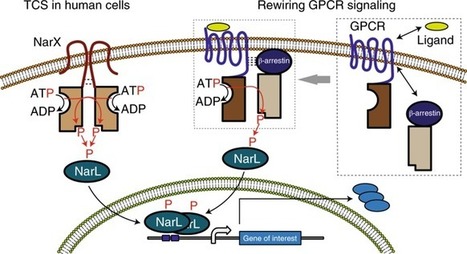
Augmenting live cells with new signal transduction capabilities is a key objective in genetic engineering and synthetic biology. We showed earlier that two-component signaling pathways could function in mammalian cells, albeit while losing their ligand sensitivity. Here, we show how to transduce small-molecule ligands in a dose-dependent fashion into gene expression in mammalian cells using two-component signaling machinery. First, we engineer mutually complementing truncated mutants of a histidine kinase unable to dimerize and phosphorylate the response regulator. Next, we fuse these mutants to protein domains capable of ligand-induced dimerization, which restores the phosphoryl transfer in a ligand-dependent manner. Cytoplasmic ligands are transduced by facilitating mutant dimerization in the cytoplasm, while extracellular ligands trigger dimerization at the inner side of a plasma membrane. These findings point to the potential of two-component regulatory systems as enabling tools for orthogonal signaling pathways in mammalian cells. Bacterial two-component signaling machinery has been reprogrammed for orthogonal signaling in mammalian cells that is triggered by small-molecule-mediated dimerization or ligand-induced GPCR/β-arrestin signaling.
|
|
|
Scooped by
Gerd Moe-Behrens
July 1, 2021 7:14 PM
|
MIT researchers designed the first synthetic biology circuit that relies exclusively on protein-protein interactions. These circuits can be turned on within seconds, much faster than other synthetic biology circuits.
|
|
Scooped by
Gerd Moe-Behrens
January 13, 2021 6:06 AM
|
New method enables electronic conversion of data into DNA
|
|
Scooped by
Gerd Moe-Behrens
October 14, 2020 5:35 PM
|
Bacteria initiate complicated signaling cascades from the detection of intracellular metabolites or exogenous substances by hundreds of transcription …
|
|
Scooped by
Gerd Moe-Behrens
October 8, 2020 12:49 PM
|
Engineered RNA elements are programmable tools capable of detecting small molecules, proteins, and nucleic acids. Predicting the behavior of these synthetic biology components remains a challenge, a situation that could be addressed through enhanced pattern recognition from deep learning. Here, we investigate Deep Neural Networks (DNN) to predict toehold switch function as a canonical riboswitch model in synthetic biology. To facilitate DNN training, we synthesize and characterize in vivo a dataset of 91,534 toehold switches spanning 23 viral genomes and 906 human transcription factors. DNNs trained on nucleotide sequences outperform (R2 = 0.43–0.70) previous state-of-the-art thermodynamic and kinetic models (R2 = 0.04–0.15) and allow for human-understandable attention-visualizations (VIS4Map) to identify success and failure modes. This work shows that deep learning approaches can be used for functionality predictions and insight generation in RNA synthetic biology. RNA can be used as a programmable tool for detection of biological analytes. Here the authors use deep neural networks to predict toehold switch functionality in synthetic biology applications.
|
|
Scooped by
Gerd Moe-Behrens
September 29, 2020 1:48 PM
|
Synthetic biology allows us to bioengineer cells to synthesize novel valuable molecules such as renewable biofuels or anticancer drugs. However, traditional synthetic biology approaches involve ad-hoc engineering practices, which lead to long development times. Here, we present the Automated Recommendation Tool (ART), a tool that leverages machine learning and probabilistic modeling techniques to guide synthetic biology in a systematic fashion, without the need for a full mechanistic understanding of the biological system. Using sampling-based optimization, ART provides a set of recommended strains to be built in the next engineering cycle, alongside probabilistic predictions of their production levels. We demonstrate the capabilities of ART on simulated data sets, as well as experimental data from real metabolic engineering projects producing renewable biofuels, hoppy flavored beer without hops, fatty acids, and tryptophan. Finally, we discuss the limitations of this approach, and the practical consequences of the underlying assumptions failing. Synthetic Biology often lacks the predictive power needed for efficient bioengineering. Here the authors present ART, a machine learning and probabilistic predictive tool to guide synthetic biology design in a systematic fashion.
|
|
Scooped by
Gerd Moe-Behrens
May 21, 2020 6:25 PM
|
|
|
Scooped by
Gerd Moe-Behrens
February 11, 2020 5:04 PM
|
We review recent advances in the design and expression of synthetic RNA sequences inside cells, to regulate gene expression and to achieve spatial loc…
|
|
Scooped by
Gerd Moe-Behrens
January 14, 2020 5:47 AM
|
|
|
Scooped by
Gerd Moe-Behrens
January 9, 2020 7:10 PM
|
As the first clinical-trial results trickle in, researchers look ahead to more sophisticated medical applications for genome editing.
|
|
Scooped by
Gerd Moe-Behrens
January 8, 2020 4:19 PM
|
Protein interactions guide most cellular processes. Orthogonal hetero-specific protein–protein interaction domains may facilitate better control of engineered biological systems. Here, we report a tunable de novo designed set of orthogonal coiled-coil (CC) peptide heterodimers (called the NICP set) and its application for the regulation of diverse cellular processes, from cellular localization to transcriptional regulation. We demonstrate the application of CC pairs for multiplex localization in single cells and exploit the interaction strength and variable stoichiometry of CC peptides for tuning of gene transcription strength. A concatenated CC peptide tag (CCC-tag) was used to construct highly potent CRISPR–dCas9-based transcriptional activators and to amplify the response of light and small molecule-inducible transcription in cell culture as well as in vivo. The NICP set and its implementations represent a valuable toolbox of minimally disruptive modules for the recruitment of versatile functional domains and regulation of cellular processes for synthetic biology. A set of orthogonal coiled-coil peptide heterodimers were developed to enable control of protein localization as well as transcriptional regulation by enhancing effector recruitment to TALE and CRISPR–dCas9 systems in mammalian cells and in vivo.
|
|
Scooped by
Gerd Moe-Behrens
December 27, 2019 5:22 PM
|
Modularity has been the subject of intense investigation in systems biology for more than two decades. Whether modularity holds in biological networks…
|
|
Scooped by
Gerd Moe-Behrens
December 21, 2019 6:51 PM
|
Thanks to the synthetic biology, the laborious and restrictive procedure for producing a target protein in living microorganisms by biotechnological approaches can now experience a robust, plian
|


 Scoop.it!