 Your new post is loading...

|
Scooped by
Gerd Moe-Behrens
March 29, 2022 6:23 PM
|
|
|
Scooped by
Gerd Moe-Behrens
March 3, 2022 7:43 AM
|
Mammalian cells were engineered with both a plant hormone system, which provides a
diffusive communication channel, and robust synthetic signaling pathways that allow
for population sensing and control through auxin.
|
|
Scooped by
Gerd Moe-Behrens
January 27, 2022 1:32 PM
|
The systematic design of functional peptides has technological and therapeutic applications. However, there is a need for pattern-based search engines that help locate desired functional motifs in primary sequences regardless of their evolutionary conservation
|
|
Scooped by
Gerd Moe-Behrens
January 21, 2022 10:37 AM
|
|
|
Scooped by
Gerd Moe-Behrens
November 25, 2021 5:10 PM
|
Deep-learning algorithms such as AlphaFold2 and RoseTTAFold can now predict a protein’s 3D shape from its linear sequence — a huge boon to structural biologists.
|
|
Scooped by
Gerd Moe-Behrens
November 16, 2021 8:09 PM
|
Protein-protein interactions play critical roles in biology, but the structures of many eukaryotic protein complexes are unknown, and there are likely many interactions not yet identified. We tak
|
|
Scooped by
Gerd Moe-Behrens
October 28, 2021 9:11 AM
|
13C metabolic flux analysis (MFA) has emerged as a powerful tool for synthetic biology. This optimization-based approach suffers long computation time and unstable solutions depending on the initial guess. Here, we develop a machine-learning-based framework for 13C fluxomics. S …
|
|
Scooped by
Gerd Moe-Behrens
October 16, 2021 7:25 PM
|
Electroactive bacteria produce or consume electrical current by moving electrons to and from extracellular acceptors and donors. This specialized process, known as extracellular electron transfer, relies on pathways composed of redox active proteins and biomolecules and has enabled technologies ranging from harvesting energy on the sea floor, to chemical sensing, to carbon capture. Harnessing and controlling extracellular electron transfer pathways using bioengineering and synthetic biology promises to heighten the limits of established technologies and open doors to new possibilities. In this review, we provide an overview of recent advancements in genetic tools for manipulating native electroactive bacteria to control extracellular electron transfer. After reviewing electron transfer pathways in natively electroactive organisms, we examine lessons learned from the introduction of extracellular electron transfer pathways into Escherichia coli. We conclude by presenting challenges to future efforts and give examples of opportunities to bioengineer microbes for electrochemical applications.
|
|
Scooped by
Gerd Moe-Behrens
September 20, 2021 6:36 PM
|
|
|
Scooped by
Gerd Moe-Behrens
September 3, 2021 3:16 PM
|
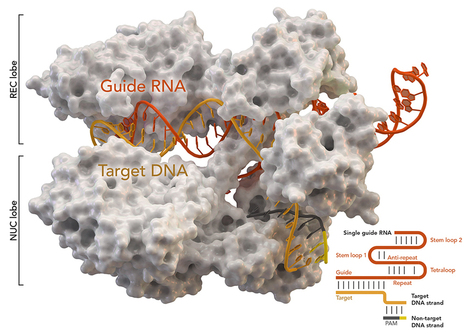
The common analogy for CRISPR gene editing is that it works like molecular scissors, cutting out select sections of DNA. Stanley Qi, assistant professor of bioengineering at Stanford University, likes that analogy, but he thinks it's time to reimagine CRISPR as a Swiss Army knife.
|
|
Scooped by
Gerd Moe-Behrens
August 26, 2021 2:48 PM
|
|
|
Scooped by
Gerd Moe-Behrens
August 19, 2021 4:52 PM
|
|
|
Scooped by
Gerd Moe-Behrens
August 3, 2021 8:21 AM
|
Targeted high-throughput DNA sequencing is a primary approach for genomics and molecular diagnostics, and more recently as a readout for DNA information storage. Oligonucleotide probes used to enrich gene loci of interest have different hybridization kinetics, resulting in non-uniform coverage that increases sequencing costs and decreases sequencing sensitivities. Here, we present a deep learning model (DLM) for predicting Next-Generation Sequencing (NGS) depth from DNA probe sequences. Our DLM includes a bidirectional recurrent neural network that takes as input both DNA nucleotide identities as well as the calculated probability of the nucleotide being unpaired. We apply our DLM to three different NGS panels: a 39,145-plex panel for human single nucleotide polymorphisms (SNP), a 2000-plex panel for human long non-coding RNA (lncRNA), and a 7373-plex panel targeting non-human sequences for DNA information storage. In cross-validation, our DLM predicts sequencing depth to within a factor of 3 with 93% accuracy for the SNP panel, and 99% accuracy for the non-human panel. In independent testing, the DLM predicts the lncRNA panel with 89% accuracy when trained on the SNP panel. The same model is also effective at predicting the measured single-plex kinetic rate constants of DNA hybridization and strand displacement. DNA probes used in next generation sequencing (NGS) have variable hybridisation kinetics, resulting in non-uniform coverage. Here, the authors develop a deep learning model to predict NGS depth using DNA probe sequences and apply to human and non-human sequencing panels.
|
|
|
Scooped by
Gerd Moe-Behrens
March 6, 2022 9:20 AM
|
Genetic networks mimic electronic circuits to perform a range of logic functions. Equipped with a series of eight small test tubes, the device glows green when it detects a contaminant. The number of tubes that glow depend upon how much contamination is present. If only one tube glows, then the w
|
|
Scooped by
Gerd Moe-Behrens
February 19, 2022 12:18 PM
|
Through synthetic biology, scientists can add novel functions to cells, such as the ability to produce new materials or detect and respond in specific ways to diseases. Though the applications are exciting, the process suffers from some inefficiencies—one of which Stanford University chemical engineer Xiaojing Gao is working to avoid.
|
|
Scooped by
Gerd Moe-Behrens
January 23, 2022 5:03 PM
|
|
|
Scooped by
Gerd Moe-Behrens
December 4, 2021 6:51 PM
|
Reconfigurable organisms and dissociated stem cells were simulated as elastic voxels using a version of a voxel-based soft-body simulator (40) modified to run on highly parallelized (GPU-based) computing platforms (SI Appendix, Fig. S5).
|
|
Scooped by
Gerd Moe-Behrens
November 18, 2021 7:42 AM
|
Synthetic biology has the potential to transform cell- and gene-based therapies for a variety of diseases. Sophisticated tools are now available for both eukaryotic and prokaryotic cells to engineer cells to selectively achieve therapeutic effects in response to one or more disease-related signals, …
|
|
Scooped by
Gerd Moe-Behrens
October 28, 2021 9:11 AM
|
The emerging community of cell-free synthetic biology aspires to build complex biochemical and genetic systems with functions that mimic or even exceed those in living cells. To achieve such functions, cell-free systems must be able to sense and respond to the complex chemical signals within and out …
|
|
Scooped by
Gerd Moe-Behrens
October 22, 2021 7:40 PM
|
One of the most remarkable features of biological systems is their ability to adapt to the constantly changing environment. By harnessing principles o…
|
|
Scooped by
Gerd Moe-Behrens
September 21, 2021 7:09 AM
|
This work presented an application of genetic distributed computing, where an abstract computational problem was mapped on a complex truth table and solved using simple genetic circuits distributed among various cell populations. Maze generating and solving are challenging problems in mathematics an …
|
|
Scooped by
Gerd Moe-Behrens
September 9, 2021 7:17 AM
|
Synthetic biology has brought about a conceptual shift in our ability to redesign microbial metabolic networks. Combining metabolic pathway-modularization with growth-coupled selection schemes is a powerful tool that enables deep rewiring of the cell factories’ biochemistry for rational bioproduction.
|
|
Scooped by
Gerd Moe-Behrens
September 2, 2021 12:45 PM
|
Scientists discover on-off switch for bacteria that breathe electricity
|
|
Scooped by
Gerd Moe-Behrens
August 20, 2021 5:31 PM
|
|
|
Scooped by
Gerd Moe-Behrens
August 3, 2021 8:23 AM
|
We present the Infobiotics Workbench (IBW), a user-friendly, scalable, and integrated computational environment for the computer-aided design of synthetic biological systems. It supports an iterative workflow that begins with specification of the desired synthetic system, followed by simulation and …
|


 Scoop.it!














https://www.science.org/doi/10.1126/science.abj5170