


SynBioFromLeukipposInstitute
130.0K views |
+2 today
 Your new post is loading...
 Scoop.it! 
Synthetic biology is making a name for itself all over the world and is now coming to Finland as well. 
Scoop.it!
|


|
Scooped by
Gerd Moe-Behrens
September 2, 2014 7:41 PM
|
Scoop.it!

Research and Markets ( http://www.researchandmarkets.com/research/mhn7lj/global_synthetic ) has announced the addition of the "Global Synthetic Biology Market (Products, Technologies, Applications and Geography) - Size, Share, Global Trends, Company Profiles, Demand, Insights, Analysis, Research, Report, Opportunities, Segmentation and Forecast, 2013 - 2020" report to their offering.
Gerd Moe-Behrens's insight:
#SyntheticBiology is estimated to reach $38.7 billion by 2020 http://bit.ly/1uw1j7B
|
|
Scooped by
Gerd Moe-Behrens
September 2, 2014 7:37 PM
|
Scoop.it!

U.S.National News and Information (2014/07/29 Building the Foundation for Future Synthetic Biology Applications with BRICS : http://t.co/kFkAnFPyzY)...
|
|
Scooped by
Gerd Moe-Behrens
September 1, 2014 3:54 PM
|
Scoop.it!

Biology + Engineering = Synthetic Biology (Image Credit: Shutterstock / Tarchyishnik Andrei ) At first glance, the terms ‘synthetic’ and ‘biology’ seem lik (Check out these DIY synthetic biology projects: http://t.co/0zoAC6oDsf...
|
|
Scooped by
Gerd Moe-Behrens
September 1, 2014 3:53 PM
|
Scoop.it!
Synthetic biology A protein code to target RNA
Nature.com
The genetic code, by which RNA sequence is translated into protein, was a seminal discovery in molecular biology.
|
|
Rescooped by
Gerd Moe-Behrens
from SynBioFromLeukipposInstitute
September 1, 2014 3:52 PM
|
Scoop.it!

1st Baojian Ding Synthetic biology Mini Symposium February 13th 2014
Blue Hall, Ecology B... (Synthetic Biology Mini Symposium in Lund 13 Feb!...
|
|
Rescooped by
Gerd Moe-Behrens
from TAL effector science
September 1, 2014 3:47 PM
|
Scoop.it!
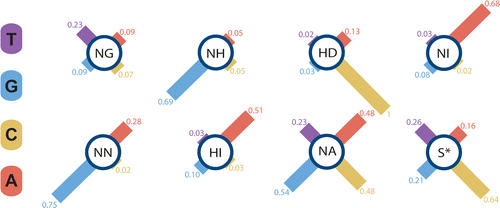
(via T. Lahaye, thx)
Moore et al, 2014
Transcription activator-like effectors (TALEs) are proteins secreted by Xanthomonas bacteria to aid the infection of plant species. TALEs assist infections by binding to specific DNA sequences and activating the expression of host genes. Recent results show that TALE proteins consist of a central repeat domain, which determines the DNA targeting specificity and can be rapidly synthesized de novo. Considering the highly modular nature of TALEs, their versatility, and the ease of constructing these proteins, this technology can have important implications for synthetic biology applications. Here, we review developments in the area with a particular focus on modifications for custom and controllable gene regulation.
Via dromius

dromius's curator insight,
March 13, 2014 4:30 AM
Table 2 gives an overview over assembly methods and their required time effort.
|
|
Scooped by
Gerd Moe-Behrens
September 1, 2014 3:45 PM
|
Scoop.it!

Abstract. Inspired by the developments of synthetic biology and the need for improved genetic tools to exploit cyanobacteria for the production of renewable bioproducts, we developed a versatile platform for the construction of ...
|
|
Scooped by
Gerd Moe-Behrens
August 30, 2014 7:01 PM
|
Scoop.it!
Gerd Moe-Behrens's insight:
iEthereum
This is a new Project I started : An easy to use Ethereum iPhone and iWatch implementation for the general public. You are welcome to join me. Please follow me on GiyHub
http://bit.ly/1pfxovB
If you like to support me, my BTC address is:
1KnikzSG7fnRfG76DxjLZyrbvw8fS9nisw
I think ethereum is a great platform for biohacker and for Ethereum is the platform I will use for my CytoComp project see building a decentralized company: http://bit.ly/1qSEScZ (An ethereum Dapp implementing of the structure of an organization wherein the decision making authority does not sit with a central figure or group designed for all organizations with interest in such structure) and DNA analysis Dapp ( Ethereum Dapp for secure sharing and analysis of your personal DNA data both for self trackers and people with diseases with underlying genetic alterations)http://bit.ly/1B4J5xP
|
|
Scooped by
Gerd Moe-Behrens
August 29, 2014 9:13 AM
|
Scoop.it!

Gerd Moe-Behrens's insight:
I am following tight the developments at Reddcoin - I think their idea of a social currency where you can show your love of a contributor in social media with a tip. Today ReddCoin announced a paper where they further develop their ideas.
A new social currency model by Reddit - this can potentially revolutionize science publishing. We can direct publish and can get payment, if we have done great work - instead of that the authors have to pay and publishing companies make the big money....
*Proof of Stake Velocity: Building the Social Currency of the Digital Age*
by
Larry Ren
"Proof of Stake Velocity (PoSV) is proposed as an alternative to Proof of Work (PoW) and Proof of Stake (PoS) to secure the peer-to-peer network and confirm transactions of Reddcoin, a cryptocurrency created specifi- cally to facilitate social interactions in the digital age. PoSV is designed to encourage both ownership (Stake) and activity (Velocity) which directly correspond to the two main functions of Reddcoin as a real currency: store of value and medium of exchange. Reddcoin can also function as the unit of account in heterogeneous social context. The technological aspects of PoSV are presented after a detailed review of existing designs. The eco- nomic aspects of Reddcoin are then analysed. Finally the unique position of Reddcoin as a digital social currency in the competitive landscape of cryptocurrencies is discussed."
http://bit.ly/VSlfG6
|
|
Scooped by
Gerd Moe-Behrens
August 28, 2014 6:52 PM
|
Scoop.it!

After months of work, the SynBio Axlr8r demo day at the Science Gallery in Dublin made history as the first of its kind in the world.
|
|
Scooped by
Gerd Moe-Behrens
September 3, 2014 5:32 PM
|
Scoop.it!
75000 views! Awesome.
Gerd Moe-Behrens's insight:
Thanks so much to everybody :-)
BTW If you like our work at Leukippos you can support us with BTC
1KnikzSG7fnRfG76DxjLZyrbvw8fS9nisw
|
|
Scooped by
Gerd Moe-Behrens
September 3, 2014 5:19 PM
|
Scoop.it!
Check our new video! This is an emulsion of fluorescent bacteria and beeswax http://youtu.be/4IgNmKaGdbU
|
|
Scooped by
Gerd Moe-Behrens
September 2, 2014 7:37 PM
|
Scoop.it!

Investors back big rounds for therapy and tool developers. (Synthetic #biology #goes for #scale: VCJ http://t.co/Qsc9tu2cw8)
|
|
Scooped by
Gerd Moe-Behrens
September 1, 2014 4:07 PM
|
Scoop.it!

The team behind Midven's Rainbow Seed Fund, a £24m early stage venture capital pot for UK tech companies, said synthetic biology is now providing an "exciting investment opportunity".
|
|
Scooped by
Gerd Moe-Behrens
September 1, 2014 3:54 PM
|
Scoop.it!

Synthetic biology firms becoming attractive to investors – MidvenInsider MediaCompanies in the field of synthetic biology were developing out of the laboratory and into the commercial world, according to Dr Andrew Muir, Rainbow Seed Fund's...
|
|
Rescooped by
Gerd Moe-Behrens
from Papers
September 1, 2014 3:52 PM
|
Scoop.it!

A major goal of synthetic biology is to build reliable, predictable networks of molecular and cellular components that can work as new biological devices capable of, for example, sensing chemicals, manufacturing drugs or even fighting disease. However, achieving such goals entails the production of complex synthetic biocircuits, which requires synchronization of multiple components. Although synchronization is well established in electronics1, synchronizing living cells is a major challenge, because it demands correlation of different phenomena that may be taking place on different temporal and spatial scales. (...) Prindle et al. report that such coupling has been achieved in cells of the bacterium Escherichia coli.
Synthetic biology: Biocircuits in synchrony
Ricard Solé & Javier Macía
Nature (2014)
http://dx.doi.org/10.1038/nature13224 ;
Rapid and tunable post-translational coupling of genetic circuits
Arthur Prindle, Jangir Selimkhanov, Howard Li, Ivan Razinkov, Lev S. Tsimring & Jeff Hasty
Nature (2014)
http://dx.doi.org/10.1038/nature13238
Via Complexity Digest
|
|
Rescooped by
Gerd Moe-Behrens
from SynBioFromLeukipposInstitute
September 1, 2014 3:47 PM
|
Scoop.it!


Gerd Moe-Behrens's curator insight,
February 4, 2014 12:48 PM
by
Alireza Mashaghi • Cees Dekker
"Cells proliferate by division into similar daughter cells, a process that lies at the heart of cell biol- ogy. Extensive research on cell division has led to the identification of the many components and control ele- ments of the molecular machinery underlying cellular division. Here we provide a brief review of prokaryotic and eukaryotic cell division and emphasize how new approa- ches such as systems and synthetic biology can provide valuable new insight."
http://bit.ly/1aZrcI6
|
|
Scooped by
Gerd Moe-Behrens
September 1, 2014 3:46 PM
|
Scoop.it!

Rewiring Nature With Synthetic Biology
Discover Magazine
Bioengineer Drew Endy shares his vision to reprogram biology as a precision manufacturer — and possibly change civilization as we know it. By Anil Ananthaswamy.
|
|
Scooped by
Gerd Moe-Behrens
August 30, 2014 10:32 PM
|
Scoop.it!

#iEthereum
An easy to use Ethereum iPhone and iWatch implementation for the general public
If you like the project you can donate BTC here… - Gerd Moe-Behrens - Google+
|
|
Scooped by
Gerd Moe-Behrens
August 29, 2014 5:52 PM
|
Scoop.it!
This is the presentation video of Paris Saclay iGEM team in the communication workshop organized by Paris Bettencourt iGEM team in the French iGEM meeting 20...





A Challenge to the Current IP Framework? http://bit.ly/YfHrM5