How do you say pecan? Do you say

 Your new post is loading...
 Scoop.it! 
"Naif al-Mutawa, creator of comic book series THE 99, spoke with Al-Monitor about the recent death threat by the Islamic State and how US President Barack Obama's enemies became his."
Seven years after the Kuwaiti psychologist and entrepreneur first launched his comic book series based on the 99 attributes of Allah, he's facing a sudden onslaught of death threats, fatwas and lawsuits (his comic books were highlighted in this TED talk on cultural change in the Islamic World). His US distributor, meanwhile, continues to sit on a TV deal, in part because of pressure from conservative bloggers who object to any positive description of Islam. Tags: Middle East, religion, Islam.

Bob Beaven's curator insight,
March 19, 2015 2:56 PM
It is very difficult to be trapped between two cultures, as this article shows. Mutawa tried to create a positive image for Islam by creating a group of comic superheros entitled the "ninety nine". However, this not only backfired in the Middle East but also in the United States of America. Radical Muslims, including the IS, are upset by his actions and the Islamic State even called for his head on twitter. In the US, on the other hand, conservatives believe that his comic, and the subsequent cartoon that was to be developed from it, were going to create a sense of radicalism in children. The conservatives in the US even went as far to say that it would encourage them to become suicide bombers. Yet, before all these outbursts started about Mutawa's project, the Saudi's believed it was alright, and Obama praised it. This just shows how intolerance to an idea can come from more than one direction. In a sense, this shows that race and culture are very controversial, and it also shows that understandings of the same thing can vary upon the region one lives in.

Jared Medeiros's curator insight,
March 29, 2015 4:23 PM
This could have been a great way for Muslim customs to be taught to a whole new demographic of people all over the world. People are very uneducated all across the globe when it comes to religions outside of their own. Anytime you can show a side of your culture to a large audience to change a negative perception it should be taken advantage of. 
Chris Costa's curator insight,
October 21, 2015 2:55 PM
I love this. In a world where there are so many negative stereotypes being portrayed in the media, it's refreshing to see someone leading the fight of presenting the truth in a way that's easily consumable for mass media. I find it disgusting that conservative groups have actively fought against the production of these comics because they do not want their young children "exposed to militant Islam." Seriously? You feel threatened by a religion indoctrinating your children because they are so young, because you don't want it replacing the religion you're indoctrinating your children with at such a young age? I find it sickening that people actively want to perpetuate incorrect stereotypes to fit their own agenda, as they are actively aware of their ignorance and EMBRACING it! It's unbelievable. I can only imagine how frustrated Naif must feel- to Westerners, he's a religious extremist, and to the Middle East he's presented as a Zionist. He's attempting to keep the middle ground in one of the most polarizing issues of the 21st century, and I wish him all the luck in the world. What he's doing is necessary for reconciliation and eventual progress, but he is certainly being punished for it in the short-term. I'll have to give his comic a look, and hopefully his show is still on Netflix as well.
Scoop.it!

Is the American obsession with individual freedom really such a great idea? What other cultures know about how to make good choices.
Scoop.it!

Nasty green slime poisoned water in Ohio last summer, and it's becoming a regular thing in the region — and around the world. The problem is agricultural pollution, but some Ontario farmers are trying to try to cut back on the pollution that leads to the slime. Via Dean Haakenson
Scoop.it!

Don't underestimate the value of sitting around a campfire, listening to stories, singing songs and letting yourself stare mesmerized into the flickering flames. These activities may have played an essential role in early societies.
Scoop.it!
Learn about the Jewish dietary laws of kashrut (kosher), why we observe these laws, the various foods and combinations that are forbidden, and the certification of kosher foods.
Scoop.it!

The Democratic Republic of Congo is potentially one of the richest countries on earth, but colonialism, slavery and corruption have turned it into one of the poorest

Zavier Lineberger's curator insight,
March 31, 2018 4:47 PM
(Africa) This article chronicles why the Democratic Republic of the Congo is among the lowest ranked countries on the Human Development Index despite its plethora of resources. The inciting action leading to DRC's modern problems is slavery. The Portuguese promoted internal warfare to topple the advanced Kingdom of Kongo in the late 1400s to allow better access to slaves. Later, the Congo's vast natural resources would actually be their bane; Europeans would be attracted to the land's fertile river soil, gold, diamonds, oil, and other minerals. The British and Belgian conquered the region ruthlessly first for rubber, then copper for WWI, then uranium for WWII, all the while keeping the Congolese subjugated without rights.
When the DRC gained independence in 1960, there was no framework or educated citizens who could provide stability and civil war predictably ensued, leading to a dictator unchallenged by the modernized world because of his sale of resources. Several African countries invaded, leading to hundreds of domestic and foreign militants fighting in chaos. Now, there is almost no infrastructure. The country's problems go back hundreds of years to a series of inhumane foreign interventions powered by the DRC's wealth potential. 
Matt Danielson's curator insight,
November 19, 2018 1:45 PM
It is mind blowing sometimes to look at a country at face value having that much wealth yet being poor. There has been a struggle in the Congo for hundreds of years ranging from colonialism, to civil war, to today with rebel groups fighting for mineral control. The issues of needing minerals from the Congo, with its unstable corrupt government, will always lead to rebel groups (or the government itself) creating conflict to attain resources for wealth.

Kelvis Hernandez's curator insight,
December 14, 2018 1:30 PM
Why are so many resource-rich countries such as the Democratic Republic of Congo so poor and unstable? More modern reasons like the corruption, the dictators, and wars come to mind sure, but what put countries like the DRC is these positions? Naturally, it all goes back to colonialism and slavery. The second that Europeans learned of the immense resources they carve up the territory, they have a skirmish to see who gets a bigger slice, and oppress the people so there is no chance of rebellion. In the DRC after Belgium finally left the Congolese had none of their own who were trained or had the experience to run a nation. I am sure there are people fighting for the best of the country, but when you have been kicked down for so long by so many peoples it is tough to get back up.
Scoop.it!

Today's volume of immigrants, in some ways, is a return to America’s past.

Lena Minassian's curator insight,
February 4, 2015 6:56 PM
This article was very interesting to look at. I had knowledge that the majority of the immigrant population came from Mexico but it gave a different perspective to see it on a map. The one aspect that caught my attention was how the map of the United States looked like in 1910. The majority of the immigrants back then came from Europe, mainly Germany. Germany was the top country birth among U.S. immigrants because it was very dominating. 
Felix Ramos Jr.'s curator insight,
February 5, 2015 2:12 PM
Many people in 2015 feel that immigration-reform is an absolute must for America. They usually use words like, "illegal", "terrorists", or "welfare-recipients" to try and scare the rest of the country into thinking immigration has spiraled out of control. Immigration definitely has a different make-up from a hundred years ago, but that doesn't equate to it being a problem.
An article like this puts much into perspective. What most naive and ignorant immigration-reformers might not now before reading this article is that the proportion of our current population has a fewer percentage of immigrants than back in 1910. This fact is totally opposite from the picture that some critics try to draw, essentially, comparing immigration to millions of fire-ants invading our country.
Most immigrants now come from Latin America, whereas, in 1910 they came from Germany. By reading the article, common sense will tell you that there might be more of a "racism" problem than an "immigration" problem in America. 
Benjamin Jackson's curator insight,
September 16, 2015 1:03 PM
Its interesting to me how the primary source of immigrants only shifts from Germany to Mexico in the 1990's, as opposed to when the country was cut in half in the fifties or during WWII. I had always thought that those events would limit German immigration more, however it appears that the primary reason for the shift is more due to the recent (relatively) drug war which erupted in Mexico.
Scoop.it!
http://www.ted.com Hans Rosling had a question: Do some religions have a higher birth rate than others -- and how does this affect global population growth? ...

Juliette Norwood's curator insight,
January 13, 2014 9:21 AM
This can be viewed in the perspective of a citizen of an LDC. In LDCs, there are religions that cause the woman to be subservient to men. A higher birth rate could be the cause. If these small religions were to distribute and be adhered to, there could possibly be a spike in the birth rate.
Scoop.it!

Why knowing where countries are in Africa matters for how the rest of the world thinks about Ebola.
Cultural and media norms that often refer to Africa as one entity rather than an 11.7 million-square-mile land mass comprised of 54 countries and over 1.1 billion people who speak over 2,000 different languages. This cultural confusion means that, when a dangerous virus like Ebola breaks out, Americans who are used to referring to “Africa” as one entity may make mistakes in understanding just how big of a threat Ebola actually is, who might have been exposed to it, and what the likelihood of an individual contracting it might be. This Ebola outbreak is wreaking havoc on African economies beyond the three most heavily affected by Ebola, and that damage is completely avoidable. The East and Southern African safari industry provides a good example. Bookings for safaris there — including for the famed Great Migration in Kenya and Tanzania — have plummeted due to the Ebola outbreak. These actions are based in fear, not reality.
Tags: Ebola, medical, diffusion, Africa, regions, perspective.

Lora Tortolani's curator insight,
March 18, 2015 9:36 PM
It doesn't surprise me that the average person doesn't know his geography. It shocks the hell out of me that a college would put themselves in a situation to look that stupid! Do your research people.
Jared Medeiros's curator insight,
March 29, 2015 5:08 PM
This is another example of stereotyping taking its course through Africa. Even though I am aware of the size and diversity of Africa, I was guilty of associating Ebola with the whole continent and not just the affected areas. Same thing goes with the AIDS virus and other things, such as poverty. Articles are great for people in other parts of the world to read to better educate them on the size and diversity of Africa and that there are many different ways of life in its 54 countries. 
Raymond Dolloff's curator insight,
December 15, 2015 12:44 AM
The Ebola epidemic over the last year put everyone in the world on high alert, not just those who lived in Sierra Leone and many countries in West Africa. It is important to understand how the virus spread so quickly and the advancements made to treat the virus. Geography played a big part of the spread of the virus. Because Africa, and the countries are far from modern medical technology, many non-profit organizations like Doctors without Borders were dispatched to those affected areas to help show and train physicians there the proper techniques on how to treat infected people with Ebola. That's why on the map one can see a far range of countries who treated infected people in facilities that were built to handle cases of Ebola. |
Scoop.it!
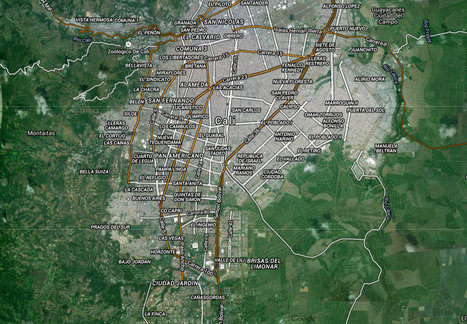
Just how much of the world's cropland can we really call urban? That's been a big mystery until now.
Now, a study published in the journal Environmental Research Letters has an answer: Somewhere around 1.1 billion acres is being cultivated for food in or within about 12 miles (20 kilometers) of cities. Most of that land is on the periphery of cities, but 16.6 percent of these urban farms are in open spaces within the municipal core.

Evan Margiotta's curator insight,
March 20, 2015 2:42 PM
This is a perfect application of how Von Thunen model still applies today. Von Thunen mapped how crops were distributed around cites. The crops near the city were labor intensive while the crops farther away from the city were labor extensive. Von Thunen's model is often disputed today in a world with such fast transportation, but this study shows that it still applies today. Unit 5 Agriculture 
Ellen Van Daele's curator insight,
March 22, 2015 3:34 PM
This research explores the concept of urban agriculture and the water supply needed and used. It came up with surprising results that state that 80% of urban agriculture is in the developing world and 40% of urban agriculture is in or near cities.
The research also covered water supply, stating that most of urban agriculture relies on irrigation. This is especially true in South Asia, and since the water resources are already scarce, the farmers have to compete for water with the government. 
Raychel Johnson's curator insight,
March 22, 2015 7:55 PM
Summary: This article is mostly about how much of our agriculture is grown within 20 miles of a city. It turns out 40% of agriculture is grown in this proximity of a city, and this mostly occurs with irrigated agriculture in South Asia. Most of these urban farms are in the developing world as well.
Insight: This article relates to the von Thunen model because it directly talks about the rings that occur around a city, although it is a skewed version of it. I think this is also a good example of how cities have changed since the developing of the von Thunen model, showing that developed countries are supporting the idea of urban agriculture.
Scoop.it!

Long before the Interstate Highway System, the country's mishmash of independent trails officially became part of a numerical system.
Scoop.it!

Almost 10 years ago, a young Pakistani woman was held down by her mother-in-law while her husband and father-in-law threw acid on her. Some 150 operations later, Bushra Shafi is working as a beautician in a hair salon in Lahore, started by a hairdresser who was moved to help victims of acid attacks when one of them came into her salon and asked simply: "Can you make me beautiful again?"
Felix Ramos Jr.'s curator insight,
April 24, 2015 11:19 AM
It is absolutely mind-boggling how any human being could do something like this to a fellow human. What is even more sad is how the Pakistani government essentially treats it as a non-issue with very few prosecutions of the perpetrators. But luckily this sad story has a silver-lining. A salon owner has opened her doors to acid-victims, not only to try and fix their scars, but also by employing them as beauticians. It's a sad and evil story that has spawned a very positive and beautiful situation. We need more people like the salon owner in this world. 
Gene Gagne's curator insight,
November 18, 2015 12:57 PM
Does this have to do with the Dowry? Is this the area where the brides family pays the grooms family so the brides family gets rid of her and the grooms family gets her so the brides family pays installments and if the installments are not fulfilled then there are accidental fires. This was not accidental though but I wonder if the installments were met. 
Tanya Townsend's curator insight,
November 20, 2015 4:43 PM
The BBC's Shaimaa Khalil thought she knew the "typical" victim of an acid attack in Pakistan. "I think before I spoke to women who were victims of acid attacks, it was easy for me to generalize and assume they were from poorer backgrounds and largely uneducated," she says..... It so easy to paint a whole culture with a broad brush but once again these attacks do not define their culture. This article with all its sadness had such a positive message of hope and survivial.
Scoop.it!
Larry Lessig's MayDay Super PAC is funding candidates in this year's midterm elections who have pledged to support campaign finance reform. Lessig is not att...
Scoop.it!
In which John compares and contrasts Greek civilization and the Persian Empire. Of course we're glad that Greek civilization spawned modern western civilizat...
Scoop.it!
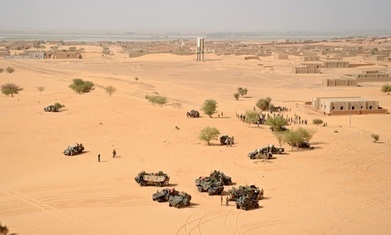
"The Sahel’s ability to produce food is not keeping pace with its growing population, and global warming will only exacerbate the imbalance, according to a new study. Among the 22 countries making up the arid region in northern Africa, the population grew to 471 million in 2010 from 367 million in 2000, a jump of nearly 30%. As the population grew rapidly, the production of crops remained essentially unchanged. Using satellite images to calculate annual crop production in the conflict-ridden Sahel belt, south of the Sahara desert, the researchers then compared output with population growth and food and fuel consumption."
Tags: Africa, Sahel, population, environment, water, ecology, environment depend, weather and climate, sustainability, agriculture, food production.
Raymond Dolloff's curator insight,
December 15, 2015 12:22 AM
If a country has a big population growth, the resources that it has if they are already scarce may become devastating. As the population of Sahel does increase, the amount of food resources will not have the proper time to react to the growth. Granted it may take a while for agricultural crops to grow and many citizens may face hard times facing finding food, but their hardships will be overcome by farmers trying to produce more crops to help ease that hardship. 
Martin Kemp's curator insight,
December 17, 2015 2:38 PM
this seems like an alarmingly common problem in the world today with population growth happening at an alarming rate in many parts of the world. most notably india and china. as well as in sahel, if your population grows by 100 million in 10 years it will be impossible to keep up and be able to provide for that many people in such a reletively short time. 
Stevie-Rae Wood's curator insight,
December 9, 2018 3:34 PM
Also known as the African Transition Zone, this region is one of the harshest areas on the planet. So it is no wonder that the Sahel is having trouble feeding the population influx. It is a very Arid climate making food production difficult if lacking the technology to make this desert terrain work, which the Sahel does lack. The global warming that is taking is also going to have a terrible effect on the Sahel if there population trends continue. They need help, mostly how to make this area sustainable for the people that live here.
Scoop.it!

"By 2025, the developing world, as we understand it now, will be home to 29 megacities. We explore the latest UN estimates and forecasts on the growth of these 'cities on steroids', and take a look at the challenges and opportunities megacities present for the tens of millions living in Lagos, Mexico City and Dhaka."

Katelyn Sesny's curator insight,
October 31, 2014 11:48 AM
This article asks and answered the question of how and when we will reach a time and place where we live will be limited (as we weigh down the world)? -UNIT 1
Scoop.it!
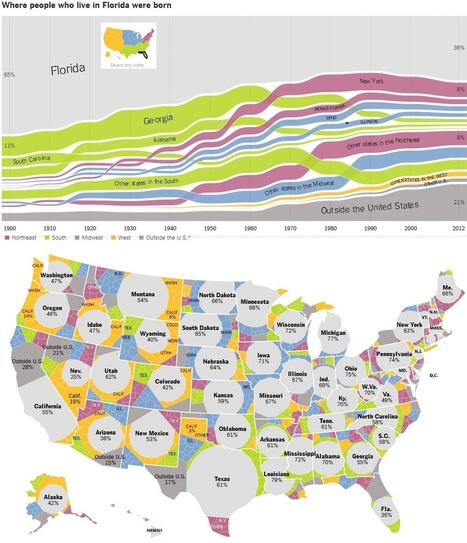
Charts showing how Americans have moved between states for 112 years.

samantha benitez's curator insight,
November 22, 2014 2:51 PM
Charts showing how Americans have moved between states for 112 years. helps show the nature of change around the United States and its impact in the enviorment.
Scoop.it!
Almost everywhere on the world, international migration is a hot topic. Most of the time the debate about migration is fierce and charged with prejudices and... Via Natalie K Jensen

Sierra_Mcswagger's curator insight,
September 10, 2014 10:02 AM
This video is primarily talking on the widely known topic of migration. 3 percent of the worlds population is living away from there place of birth. The push of migration from places include poverty, war, and environmental disasters. The migration pull in some places are because of economic opportunity, and political freedom. Migration is increasing, and is thought of as a bad thing.(s.s.) 
Aurora Rider's curator insight,
October 7, 2014 8:59 PM
This video is great for going over the many different aspects that go along with migration. It talks about what migration is and the reasons why people migrate known as push and pull factors. It talks about the different types of migration such as asylum seakers and illegal immigration. It mentions the disadvantages and advantages of migration.
Katelyn Sesny's curator insight,
October 31, 2014 12:27 PM
A great YouTube video- discussing the controversy of international migration among other things that fall into place of the disapproval of international migration. -UNIT 2
Scoop.it!

The news that a second nurse was infected in Dallas and that she was cleared to fly the day before showing symptoms raised questions about officials’ ability to control the disease.
|