


"In this Feed the Future video, narrator Matt Damon discusses the importance of increasing food production around the world and notes the importance of equipping women with the right tools, training, and technology to see as much as a 30 percent increase in food production. To feed our growing population we need to increase food production by 70 percent before 2050. Women make up the majority of the agricultural workforce in many areas of the world."

SoRo class
5.2K views |
+0 today
 Your new post is loading...
 Scoop.it! World Religions Christianity Islam Judaism Hinduism Sikhism Budhism Spread of Religions by time from 3000 BC to 2000 AD. Discover the origin of religions Per... 
Scoop.it!
An animated infographic mapping the war in Congo: mineral wealth, militias and an epic march
Scoop.it!
Evil Baba Bandook kidnaps the polio health worker and steals the polio vaccines and hides them in the mammoth clock tower with the help of his giant robot (R...
Scoop.it!

"Google is usually one of the first places students turn to when tasked with an assignment. Whether it’s for research, real-time results, or just a little digital exploration … it’s important they know how to properly Google. Lucky for teachers (and students, of course), Google has a handy set of lesson plans that are just waiting to be unleashed upon the leaders of tomorrow.
"While I understand there’s a LOT more to research than just Googling, it’s important to note that this is where nearly all students start their research. Therefore, it’s a critical skill if they’re going to start down the right paths.
"Below are 15 lesson plans courtesy of Google designed to make students better online researchers. They’re organized by difficulty and meant to help students (and everyone) become better online searchers." Via Jim Lerman

Tanyam's curator insight,
February 23, 2015 5:10 PM
I have not read all of this, but I have seen some ideas in here we could use in both our face to face and online teaching. Interesting to read the criteria Google use to evaluate resources

Catherine Buckman's curator insight,
December 16, 2014 2:22 PM
Interesting short video explaining Hadley Cells and why the earth rain forests on Equator and deserts above and below. 
Jason Schneider's curator insight,
January 28, 2015 10:27 PM
Deserts are pretty much important for bringing warm air towards the equator which cools and causes rain to form rain forests. As the cool air hits the stratosphere, it warms up again because of it's hot temperature and it spreads throughout the stratosphere 30 degrees north and 30 degrees south in latitude from the equator. When it dries, it lowers back to earth forming a dry desert. I now notice that there are no deserts along the equator and there are rain forests pretty much along the equator. The Hadley Cells are pretty much like cycles allowing rain forests and deserts to occur.
Scoop.it!
"Physicist Geoffrey West has found that simple, mathematical laws govern the properties of cities — that wealth, crime rate, walking speed and many other aspects of a city can be deduced from a single number: the city's population. In this mind-bending talk from TEDGlobal he shows how it works and how similar laws hold for organisms and corporations."

Built 4 Betterness Ed van den Berg's curator insight,
December 14, 2014 3:17 PM
Not surprisingly the DNA of cities is a follow-up of human DNA and understanding this will explain and predict how the body of a city will develop! 
SRA's curator insight,
April 16, 2015 2:10 AM
The idea that cities are just organisms that are satisfying the laws of biology is interesting. Especially because Physicist Geoffrey West brings the idea of Scalability which by definition is, the ability of a system, network, or process to handle a growing amount of work in a capable manner or its ability to be enlarged to accommodate that growth. What’s mind blowing to me is that the system that is referred to here is human interaction. We create these cities through our interaction and experience. With a growth rate of 1,000,000 people every year the math adds up to an agreeable 15% rise in income levels, patents, and super creative people every year which is undoubted a win for civilization and society. But with that we must keep in mind also this means a 15% increase in things like deadly disease, crime, poverty, and ecological issues leading to further degradation of our planet. This unbounded growth means the system is destined to collapse. The math behind cities doesn't lie if we don’t prepare cities have a fate to die like every other organism in Biology. So it is up to us to create and innovate to sustain this growth and avoid the collapse. But we must do so at a forever increasing pace. Which subsequently is also part of another system predetermined to collapse. What I mean is what happens when we cannot innovate fast enough to sustain this growth? - Caleb Beckett 
BrianCaldwell7's curator insight,
April 5, 2016 8:14 AM
While corporations rise and fall, it is quite rare for a city to entirely fail as an economic system. Huge cities have some negative consequences, but the networks that operate in the city function more efficiently on economies of scale in a way that offsets the negatives. Increasing a city's population will continue to improve the economies of scale (larger cities have higher wages per capita, more creative employment per capita, etc.). However, this growth requires major technological innovations to sustain long-term growth.
Tags: urban, planning, megacities, industry, economic, scale, TED, video.
Scoop.it!

"If you think the United States is every immigrant's dream, reconsider. Sure, in absolute numbers, the U.S. is home to the most foreign-born people — 45.7 million in 2013. But relatively, it's upper-mid-pack as an immigrant nation. It ranks 65th worldwide in terms of percentage of population that is foreign-born, according to the U.N. report 'Trends in International Migrant Stock.' Whether tax havens and worker-hungry Gulf states, refugee sanctuaries or diverse, thriving economies, a host of nations are more immigrant-dense than the famed American melting pot. Immigrants make up more than a fourth (27.7 percent) of the land Down Under; two other settler nations, New Zealand and Canada, weigh in with 25.1 and 20.7 percent foreign-born, respectively. That's compared to 14.3 percent in the United States."
Tags: migration, population, USA, Australia, Oceania.

Benjamin Jackson's curator insight,
December 14, 2015 12:16 PM
the us is not the choice nation of nations. it is not the most sought nation for migrants. that means we must be doing something right or wrong. 
David Stiger's curator insight,
December 5, 2018 11:25 AM
Facts put major cultural issues into perspective. The facts found in this NPR article indicate that much of the world - and not just the United States - is grappling with immigration issues. Although the U.S. has the largest foreign-born population in raw numbers, it does not make up as large a percentage as the overall population as some other nations. Compared to the U.S.'s immigrant population of 14.3%, Australia's foreign-born subgroup makes up 27.7% while New Zealand's hit 25.1%. That is over one-fourth of the entire population in each country.
Australia and New Zealand are ideal as they are both relatively safe, stable, progressive, and economically developed nations that have room to grow. The issue, especially for Australia, is taking in high numbers of unskilled workers who can be difficult to integrate into the economy. The U.S., mainly from the right, has also complained about this trend. Many migrant workers, however, are filling low-wage, unskilled jobs that non-immigrant workers shun and have no desire for. Considering that immigrants who fill these jobs earn their keep, pay taxes, and stimulate the economy by spending their money outweighs the potential economic burden. The truth of the matter is that natives in Australia and the United States are more fearful of the cultural, social, ethnic, religious, and linguistic changes that often take place when outside groups settle within a new country. This diversity can surely enrich a society. It can also stress out traditionalists, fearful of change, and cause social unrest and animosity. The important thing for Americans to understand is that we are not the only country wrestling with a globalized world in which people transcend boundaries, diversity is on the rise, and change happens. Just look to Oceania. 
Matt Danielson's curator insight,
December 12, 2018 4:34 PM
With some countries having as many as 25% of people being foreighn born I wonder how much of this diversity could cause social upheaval. As we learned in class sometimes cultural differences can cause major issues in a country, and often times without a major culture tying every one together the country will inevitably split up or have civil strife similar to what we see in parts of Europe from mass migration. I wonder what effect migration will have in places like Australia 5-10 years from now. Especially if the cultures these immigrants come from are drastically different then Australian culture.
Scoop.it!
Animating the changing shape of the world population pyramid. For more multimedia content from The Economist visit our website: http://econ.st/1xqEZhX.

Deanna Metz's curator insight,
March 1, 2016 8:05 PM
This is an incredibly powerful and remarkably well-done video by the Economist (see related article here) that is reminiscent of a TED-ED lesson on the importance and value of population pyramids. This video goes nicely with this article from the World Bank entitled "The End of the Population Pyramid" which highlights the demographic changes that will be reshaping global demographics in the next 50-100 years. Tag: population, declining population, demographic transition model, video, APHG. 
Damon Recagno's curator insight,
October 12, 2017 11:52 AM
Here is a quick introduction to the shifting population demographics and why there is a Declining Natural Growth Rate.
This video is a good way of introducing the topic of Cities and Countries Methods for Tackling a Declining Natural Growth Rate because it provides insight on why many locations around the world are currently experiencing a declining natural growth rate. 
Teresa Morante Arona's comment,
October 13, 2017 9:35 PM
Gret Video, but why do you think there is such a diverse shift in population demographics?
Scoop.it!

Three 21st-century words that are driving the nation's most dynamic municipalities
Scoop.it!
Got the audio here - http://www.bbc.co.uk/programmes/p01slnp5 The person doing the voice is Andrew Jack who is a dialect coach.
Tags: language, culture, English, UK.

Sascha Humphrey's curator insight,
April 6, 2014 4:33 AM
He's really quite good, and the seamless change of dialect is quite impressive! 
Melissa Marshall's curator insight,
April 9, 2014 10:19 PM
This is a really interesting video for understanding regional dialect differences!
Scoop.it!

If you're feeling particularly nationalistic, or just want to see how consistently you speak like your friends and neighbors, here are all the dialect quizzes that I could find. Find out what your dialect most resembles, and, in many cases, help science at the same time!
Tags: language, culture, English.

Julia Kang's curator insight,
November 6, 2014 8:42 PM
Enligsh dialects looks interesting! If I have a chance later, I want to know more about it :) 
Courtney Barrowman's curator insight,
November 12, 2014 11:07 AM
Take a few of these quizzes and be ready to share your reaction to your results!
Scoop.it!
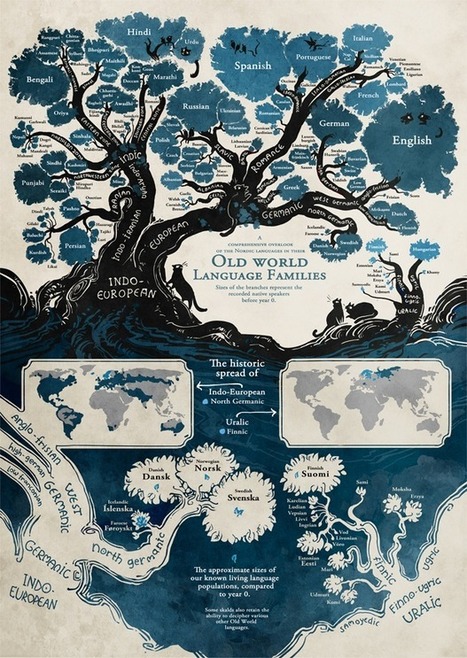
"When linguists talk about the historical relationship between languages, they use a tree metaphor. An ancient source (say, Indo-European) has various branches (e.g., Romance, Germanic), which themselves have branches (West Germanic, North Germanic), which feed into specific languages (Swedish, Danish, Norwegian). Minna Sundberg, creator of the webcomic Stand Still. Stay Silent, a story set in a lushly imagined post-apocalyptic Nordic world, has drawn the antidote to the boring linguistic tree diagram."

16s3d's curator insight,
November 8, 2014 3:29 PM
Racines communes, connexions et interactions entre les langues sont visualisées dans cette infographie.
Infographie en haute définition: http://mentalfloss.com/sites/default/files/196.jpg 
Sreya Ayinala's curator insight,
December 2, 2014 9:50 PM
Unit 3 Cultural Patterns and Processes (Language) The image shows how many languages are related and have many common ancestors. Languages are grouped into language families and are even more broadly categorized. Language is a huge part of culture and it is the way that people communicate amongst each other. There are hundreds of languages in our world, but as globalization and pop culture diffuse many languages are being lost and no longer spoken. A good example of a dead language would be Latin. Many of our common day languages trace their roots back to Latin, but no one speaks Latin anymore. |
Scoop.it!

In the American city we want you to name, a Buddha statue purchased at a hardware store managed to turn an eyesore of a street corner into a shrine and gathering place.
Scoop.it!
An Economist videographic with a brief history of the Kashmir conflict. Added to www.audiovideo.economist.com in November 2009
Scoop.it!

Questionable sincerity aside, the recent pileup of apparent missteps by the retailer raises another question: Is the company doing it on purpose?
Scoop.it!

All over the world Muslims have begun their holiest month of the year by fasting from dawn until dusk each day, broken each evening by large, communal meals. The start of Ramadan is earlier each year because it is calculated based on the sighting of the new moon, which begins the Muslim lunar month. Muslims use the time to reevaluate their lives through the scope of Islamic doctrine.
Scoop.it!
The glories of Ancient Rome are explored in ROMAN CITY, based on David Macaulay's acclaimed book. This animated and live-action video recounts life in Verbon...
Scoop.it!
"Farm exports to the U.S. from Mexico have tripled to $7.6 billion in the last decade, enriching agribusinesses, distributors and retailers.

Jake Red Dorman's curator insight,
December 17, 2014 11:36 AM
It’s crazy to see how desperate some of these people are to get working and how much they do for such a little reward. These people are working longer and harder than probably all Americans and they are barely surviving. They work for survival. It’s hard for some of these people to stay healthy, especially in the harsh conditions and tight living spaces that these people have to deal with on an everyday basis. 
Brian Wilk's curator insight,
March 22, 2015 2:10 PM
Corporations are always looking for the cheapest base product to import. Unfortunately for the laborers of Mexico, their country does not enforce globally accepted standards of labor. The US cannot police other countries' policies and procedures, but we can educate our own consumers about the working conditions behind the product they buy. The consumers then have a choice; do they want to pay 49 cents a pound for bananas or 99 cents. What is more important, the health and welfare of the employee who picked the produce or the financial well-being of the consumer who purchases it? This obviously is big business for Mexico and the US should apply some pressure to motivate our friends south of the border to foster better working conditions for their employees. It would seem to me that Mexico could afford to pay their workers a little more and still be competitive given their proximity to the US. I think I will start buying my bananas from Ecuador....
Scoop.it!

"Self-taught Iranian photographer gains rare access to shoot religious buildings as they've never been seen. It's a side of Iran the rest of the world doesn't normally get to see -- the kaleidoscopically brilliant interiors of the country's intricately designed mosques.With beautiful mosaics and stained glass framed by powerful architecture, the buildings are astounding."
Tags: religion, culture, Islam, Iran, Middle East.

Molly McComb's curator insight,
March 21, 2015 4:25 PM
Showing the sacred spaces of Islam and how they are designed around the world. 
Lena Minassian's curator insight,
March 22, 2015 3:47 PM
This was one of my favorite articles. We usually are very used to seeing negative sides to the Middle East and this gave it a different spin. This shows breathtaking pictures of the Mosques in Iran. This architecture isn't like anything I've seen with all of the symmetry and colors. These photos were taken by a student and were not easily taken. You have to have an eye to capture moments like this and pictures like this are not always appreciated. the detail that went into creating and designing these mosques are really special and I would love to actually see something like this in person. 
Jared Medeiros's curator insight,
March 29, 2015 4:03 PM
Amazing photos of these mosques. The detail and color in some of these mosques are extraordinary. This kind of brilliance in color is something that is unexpected in this part of the world where everything seems to be so bland and alike in color or style. Its surprising that the mosques don't let professional take pictures with certain equipment inside but let tourists take photos. I would understand if the light from a camera could cause damage to the art, but these are the people who will be able to share these beautiful pictures with the rest of the world and show that there is more to Iran than what the outside may think.
Scoop.it!

"Create a Map of all the places you've been."

Joy Kinley's curator insight,
November 18, 2014 2:55 PM
This is a pretty cool visual representation of the different US states that you have visited.
Jason Schneider's curator insight,
January 27, 2015 12:28 AM
I haven't been to a lot of United States. I have been to Maine, New Hampshire, New York, Massachusetts, Connecticut, Rhode Island, Pennsylvania, New Jersey, Delaware, Maryland, Virginia, North Carolina & South Carolina. As we can see, I pretty much know New England pretty well. I would however, like to travel throughout the west side of the United States.
Scoop.it!

Surprising alternatives to "so what do you do?"—from New Orleans to New York.

Mr Steven Newman's curator insight,
April 24, 2014 2:33 PM
Love this scoop from Seth Dixon. A nice way to help kids understand sense of place .
Scoop.it!
"New York has long been a city of immigrants, but linguists now consider it a laboratory for studying and preserving languages in rapid decline elsewhere in the world."

Alexandra Piggott's curator insight,
November 4, 2014 4:30 PM
Is globalisation enabling the preservation and study of declining languages?
Courtney Barrowman's curator insight,
November 5, 2014 7:59 PM
I will be showing this in class DO NOT use it for your scoop it review--
unit 3
SRA's curator insight,
April 19, 2015 10:30 PM
Victoria Margo This article really caught my eye because at a young age I was taught to speak spanish and english at the same time, and now that I am older I realize how important it is to know two languages. I will forever be grateful that my parents took the time and made my sisters and I learn something different while growing up. Languages change over a long period of time and many times languages grow or die within time. Two main vocabulary words that I have not forgotten are Language divergence and Language convergence. Language divergence is the dividing of a language into many new languages. Language convergence is when two languages merge to become one. Both these definitions are extremely important when talking about how some languages will soon be extinct. I believe many languages have been endangered due to families and parents who do not continue speaking their language when they leave their original country/state. Language is very important to our world and society today. As stated from the short video clip, if you do not continue speaking your language then who will? I agree with that completely if you don't practice something over and over again how do you expect to get any better at it? This video was a great way to express the diffusion of languages and how families today still practice their language. This video made me think about and reflect on the video we watched in Geography class a couple weeks back because of the decline of all languages that we may not even be aware of. Many times it is hard to find older people who speak your native language but I also learned from the video we watched in class that it is possible if you are willing to try and continue something that is important to you. There are many different languages that connect to our world. I also liked how this article mentioned that New York is the city of immigrants, meaning New York is full of different cultures and unique language. Although this article/video does say that language has been endangered it can definitely be changed with a little knowledge of why this is happening. Geography and language tie in together quite well. I am hoping many languages can be saved for the future. |








Unit 5: Agriculture, Food Production and Rural Land Use
This video is about how women make up the majority of the agricultural workforce and that giving them access to land, water, markets, and technology could increase food production by 30%. This in return would help boost the economy. Places such as Kenya have given women the same resources as men and have seen a 22% increase in crop production. In Brazil, programs targeting women in agriculture have helped cut the population in extreme poverty by half and malnutrition by 73%. This video encourages people around the world to help give women the resources they need in order to increase the food production and economy.
This relates to unit 5 because it deals with agriculture and particularly women's roles in agriculture. This video explains how increased resources can help end world hunger. Women are not given as much opportunity as men and this video expresses need to invest in women's rights.
This article relates to my topics development and agriculture by showing how important it is that how equipping women with the right tool can make so much more food and how other countries should accept women and give them rights. Just like the video states women make up a majority of the world and countries need to take that advantage. Just like the video states women make up a majority of the world and countries need to take that advantage. Sooner or later the population will take over how much food we make, even with new technology we still might not make it fast enough or enough to support life on earth. The video states that we need to increase food production to 70% by 2050
In my opinion, this video really does touch base with how women are treated today in modern society and how they can become a really big impact on our food production if only they had the access to the same resources as men do. Then maybe we might have a chance to reach the goal what we need to in 2050.