


A great infographic that distills US higher ed student demographics and characteristics into a representative 100 students.
Via Society for College and University Planning (SCUP), Seth Dixon

 Your new post is loading...
 Scoop.it! A great infographic that distills US higher ed student demographics and characteristics into a representative 100 students. Via Society for College and University Planning (SCUP), Seth Dixon 
Scoop.it!
Crash Course World History is now available on DVD! Visit http://dft.ba/-CCWHDVD to buy a set for your home or classroom. You can directly support Crash Cour...
Scoop.it!
"In this video I look at some of the most complex international border. Of course, there are more complex borders in the world, but this video looks at some of my favourites."

ELAdvocacy's curator insight,
October 3, 2014 9:40 AM
There are so many reasons our immigrant students come to the United States. Some stories are so complex and painful it can be extremely difficult for Americans to understand.
Scoop.it!

Obviously, since I am choosing only one book per country AND only 80 countries, that leaves lots of countries unread and lots of books overlooked. I can't, in any way, provide an exhaustive list of...
Scoop.it!
Central Asia is full of lands whose names end in -stan. A certain powerful North American country has a related name. How? It's not your standard explanation...

Richard Aitchison's curator insight,
February 25, 2018 5:37 PM
This video comes at your fast and might need to re play it a couple of times to get the full gist of it. However, how it explains why all of the Stan's are there in Central Asia makes a lot more sense now. We have to look at the linguistic orgins of the word stan and the video traces that then connects it the rest of the current world. Stan is formed from the old Iranian root *sta- "to stand, stay," and means "place where one stays," i.e. homeland or country. Names such as Afghani-stan, Tajiki-stan, Hindu-stan are formed by adding this suffix. So by seeing that root of origin it makes sense that other countries have -land in it or states like we have here. It is always interesting how words and languages change over time and we lose track of the original meanings and we also take for granted it does not sound like something we know that it must be different or just wrong.

Katie Kershaw's curator insight,
March 14, 2018 2:44 PM
My original reaction to this video was that the names of almost all countries are completely unoriginal, very literal, and pretty boring. We are all just saying “place” of whichever group occupies the country. I liked the fact that this video pointed out that when Westerners think of the ending “stan” they associate it with foreignness and often it can be used in a racist way. However, as the video points out, the word state, stead, and land come from the term -Stan. This shows how languages evolved and spread from Central Asia and the Middle East, all the way to North America. It also shows how names can cause conflict. For instance, if you live in a Turkmenistan, but do not consider yourself to be Turmeni, it is almost like you live in a country that doesn’t accept or acknowledge your background. At the same time, places like Kurdistan use the term to describe themselves as independent and the land of the Kurds, but this cannot be recognized because technically they are a part of Turkey. Pakistan’s name is interesting because it is an acronym for all of the regions of the country and also means “pure land”. This video shows how one basic word can impact language and physical geography all over the world.

James Piccolino's curator insight,
March 24, 2018 9:56 AM
This is genuinely one of the most interesting things I have learned so far in this course. It answers questions I did not even know I was pondering. It is a little like looking at a board and suddenly being handed a pair of glasses, everything becomes so much clearer and makes so much more sense. It is an insight to a culture I rarely get to be exposed to, as it goes for many others.
Scoop.it!
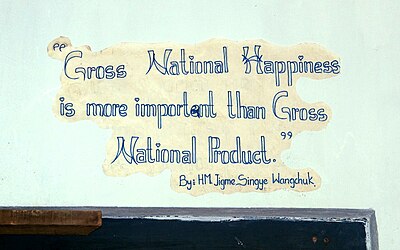 Gross National HappinessThe assessment of gross national happiness ( GNH; Wylie: gyal-yong ga'a-kyid pal-'dzoms) was designed in an attempt to define an indicator and concept that measures quality of life or social progress in more holistic and psychological terms than only the economic indicator of gross domestic product (GDP).
Scoop.it!

China’s gastronomic traditions may have been developed over the course of several millennia. But if central planners have their way, the country’s cuisine will soon be restyled with the help of a relative interloper: the humble spud. Via Joy Kinley

Joy Kinley's curator insight,
January 9, 2015 8:27 AM
China is pushing the growth and use of potatoes or as they are called in China, Earth Beans (which is a good name for them). There are many different types of potatoes and they are a good source of nutrition and relatively easy to grow. The problem is any time you change the culture, and food is a part of culture, their is resistance.
Scoop.it!
In which John Green teaches you about the Crusades embarked upon by European Christians in the 12th and 13th centuries. Our traditional perception of the Cru...
Scoop.it!
In which John Green teaches you the history of Christianity, from the beginnings of Judaism and the development of monotheism, right up to Paul and how Chris...
Scoop.it!

"A new report released by the Pew Research Centre has found that the proportion of Catholics in Latin America has dropped 25% since 1970. One of the primary drivers for the rise in the numbers leaving the Catholic Church? Conversion to Protestantism."

Jason Schneider's curator insight,
January 28, 2015 5:00 PM
I've watched Passion of the Christ and one thing that I've learned was that the language that was spoken in Jerusalem was Latin. Regardless of whether someone was raised Catholic or Protestant, they still practiced the Christianity faith. Also based on one scoop that I looked up, Christianity was spread overseas from Europe to Latin America (South America). 
Lena Minassian's curator insight,
February 4, 2015 7:11 PM
This article was interesting to read because it shows a different aspect of Latin America and touches on religion. It states that the portion of the area that is Catholic has dropped 25% since 1970 because the Protestant percentage has gone up and reached 19%. The reason that the Protestant percentage has risen is because many of those individuals have converted when the majority of them have been raised Catholic. These individuals all have different reasons as to why they converted over but this jump is more recent and continues to grow. 
Norka McAlister's curator insight,
February 14, 2015 7:45 PM
The rate of people who religiously identify as Catholics has decreased sharply in the last forty years. In Latin America, where majority of population exhibit strong beliefs in Catholicism, citizens are rapidly shifting to different religions such as Protestant, or denouncing their religion all together. New generations are skeptical to believe in God. However, the new century has also brought about different issues, where practicing Catholics are reportedly victims of sexual abuse, sometimes by their parish priest. Furthermore, younger generations are more open minded and accepting of controversial topics such as gay marriage, homosexuality, and lesbianism. Demographic patterns have shifted these large communities and suffered a decrease of numbers equal to approximately 20%. With new innovations, technologies, and different patterns of living, the Catholic Church is being overlooked by more communities as a preferred religion.
Scoop.it!

From
mic

The whole hip-hop community has finally taken Azalea to task for building her career by stealing black musical sounds and styles and using her whiteness to sell them to the masses. In the process, she has done little to actually give back to the hip-hop community except be flagrantly offensive. And black hip-hop artists aren't standing for it any longer. Via Seth Dixon

Lydia Tsao's curator insight,
March 24, 2015 12:17 AM
This is a very interesting article. I do agree with her critics that she is culturally insensitive. She has made numerous racist about not only black people, but Hispanic and Asian people too. This is another of example of cultural appropriation, and this demonstrates cultural conflicts. On one side, the people of hip-hop culture are criticizing her. One the other side, Iggy Azalea is defending herself from the cultural divide that exist between her and the real of the hip-hop community. I think this is also an example of cultural assimilation. Because Azalea grew up primarily listening to hip-hop and moved to areas of the U.S. with very high black populations, she has in a way assimilated to the hip-hop culture, though not completely. 
zane alan berger's curator insight,
March 25, 2015 7:41 PM
This article is about the success of rapper Iggy Azalea with her shattering records and proceeding to be a nominee for a multitude of awards. On the other hand, however, it notes her large collection of critics against her overwhelming "control" of the hip-hop community. (POP CULTURE) |
Scoop.it!
Thanks to The Kwongan Foundation at the University of Western Australia for supporting this video: http://www.plants.uwa.edu.au/alumni/kwongan MinuteEarth is...
Scoop.it!
Maps-of-War is a multimedia site dedicated to producing diverse, creative visuals that enhance our understanding of war and its history.
Scoop.it!
More complex international borders in this follow up to part 1.

Danielle Lip's curator insight,
April 7, 2015 9:13 PM
Borders seem to be a problem whether you live in one continent or another, everyone wants power and control but not everyone can gain it. This video focuses and goes into depth about enclave and exclave borders, showing the irregularity of the borders in different areas that causes conflicts and problems. An example of a problem that the citizens have to deal with is that some villages can not leave due to the road blocks due to the borders. I can not imagine not being able to leave a certain area for all that time, I would go insane and I imagine those people are as well. International borders power has to be split somehow and not everyone can always come to an easy decision because parts of the land are claimed but the people do not have any control of it. Irregular borders cause more trouble than they are worth in my opinion. The final interesting fact about this video was that you learn that Tajikistan and Kyrgyzstan are the two locations that have the most irregular border, these places must have the most conflict and problems. These borders are in places such as Germany, South Asia, China, Belgian, Sweden and Central Asia. 
Nicholas A. Whitmore's curator insight,
December 17, 2015 5:17 PM
A fascinating look into the complexity of borders. It is always important to keep in mind when looking at maps that the borders are neither permanent or defined as it exists in reality. Borders on world maps are rough estimations of what the borders actually are for they can't depict precise details on such a large scale. Furthermore regional/local maps sometimes do not whether as to conform to the border misconception unfortunately. In Central Asia as defined int he video the border were primarily a result of the Soviet Unions attempts to divided ethnic minorities reducing their power (primarily Stalin). As a result the countries after the collapse proceeded to claim the ethnic groups which created enclaves within each-other. As long as these groups are on peaceful terms this kind of thing isn't an issue. Unfortunately it does make the peoples lives in the enclaves slightly more difficult due to having to cross the border twice to see the rest of your country. This kind of thing was even done to the Jews in the first century AD who like the Russians wanted to eliminate or at least reduce attempts at revolution by the local populace. Hopefully Central Asia has or will make the lives of these enclaves easier. 
David Stiger's curator insight,
October 28, 2018 8:56 PM
I think it's fair to say that people in general take maps for granted. The devotion and reverence for the written word - specifically the published written word - prevents people from realizing that much of the world is a social construct. Geographically, borders are social constructs - sometimes loose agreements between different groups of people to establish territorial boundaries in order to claim resources. This video, which speaks to the complicated reality of territorial enclaves and 'exclaves,' illustrates how borders are social constructs. They can often be illogical, awkward, and highly disputable. Examining the several exclaves and enclaves shared between Armenia and Azerbaijan is evidence of the geopolitical mess that disputed borders create. What is most fascinating about this case is the assessment of how Joseph Stalin tampered with international borders as a geopolitical strategy in order to sow instability and weakness. This strategy allowed the the Soviets to more easily conquer and subjugate foreign peoples - all in the name of proletariat revolution.
Scoop.it!

Old maps and historic resources for Vermont, including 1850's County Wall Maps, F.W. Beers Atlases, and pictoral bird's eye views.
Scoop.it!

Hundreds of churches around Europe have closed or are threatened by plunging membership, posing a question for communities: What to do with the once-holy, now-empty buildings?

Louis Mazza's curator insight,
February 26, 2015 8:09 PM
Europe’s Empty churches going on sale is not upsetting to me, unless they are being used as skateboard parks. The main reason to the church’s closings are a rise in secular beliefs. With less people attending and making tributes to the churches they are given no choice but to shut down. These are buildings of great archaic integrity and I think that they should be sold to museums or to state governments as holy sites or something to that effect. These buildings should be preserved because they are a giant standing living history of this world. But as of now skate ramps and parks occupy these churches and may be damaging them. 
Edgar Manasseh Jr.'s curator insight,
March 7, 2015 9:25 PM
Empty buildings now turned into just churches used for fun, or by the picture skateboarding. Europe is always known as the power house especially during their colonial period, when they colonized Africa and brought some of their religious beliefs towards the Africans. Europe is filled with big catholic traditions tracing back to the past, but now with this going on its a very sad state seeing something so significant in history in the European community go to waste.. 
Stevie-Rae Wood's curator insight,
October 28, 2018 3:02 PM
Europe back in the day used to be highly religious. Everyone went to church and participated in religious ceremonies. Europe was so heavily populated at one point that to accommodate to all the people many churches were built. However, in todays world religion is on the decline in this once secular society. With all these empty churches they are using up valuable space. So these churches are being sold off and converted into useful buildings in the eyes of modern society's. An example of what these buildings of worship are being converted into are skate parks, because it related to todays youth. I think it is sad that these churches are being sold and converted into new modern buildings. However, there structures are being kept in tacked. This means that what the church stood for is still staying alive in our destructive modern world.
Scoop.it!

The clerics are delivering a growing number of fatwas against what they see as insidious dangers. Liberal Muslims are annoyed by what they say is moral micromanaging. Via Joy Kinley
Joy Kinley's curator insight,
January 6, 2015 10:13 AM
Different regions have their own interpretations of religion. Local customs and beliefs are incorporated and the leaders own vision of religion. Currently Malaysia has some conservative leaders issuing decrees.
Scoop.it!

Awesome, fun, interesting videos and graphics about stuff that matters.
Scoop.it!
Crash Course World History is now available on DVD! Visit http://dft.ba/-CCWHDVD to buy a set for your home or classroom. You can directly support Crash Cour...
Scoop.it!
In which John Green explores exactly when Rome went from being the Roman Republic to the Roman Empire. Here's a hint: it had something to do with Julius Caes...
Scoop.it!

The Industrial Revolution gets credit for kicking off the world's human population explosion, but new research suggests we should look further back.
“If you dig further in the past," Stutz told Emory University, "the data suggest that a critical threshold of political and economic organization set the stage around the start of the Common Era. The resulting political-economic balance was the tipping point for economies of scale: It created a range of opportunities enabling more people to get resources, form successful families, and generate enough capital to transfer to the next generation.” Tag: population.

Evan Margiotta's curator insight,
January 3, 2015 7:29 PM
Homo Sapiens evolved around 130,000 to 160,000 ago, so why did it take until 1804 to reach 1 billion and only 195 years to reach 6 billion? The Industrial Revolution is usually agreed upon as the major catalyst for this population boom. However, WHY is the Industrial Revolution given credit for the population boom and what else could have caused this? Population growth began with cities which in this case refers to any sort of settlement. Food surplus allows for people to do other things than hunt and gather. This allowed for the creation of population centers, society, hegemonic class systems, and the economy. As long as their was a food surplus there could be a population surplus. So the better people were at getting/making food, the more the population grew. So the population boom could actually be attributed to the ability to create a food surplus. The agriculture revolution spured this allowing for the domestication of farm animals and primitive farming equipment. The population to continue to grow. The industrial revolution made these technologies many times better. This allowed for a greater food surplus resulting in a stronger economy and standard of living which ALL results in ... A FASTER GROWING POPULATION. |






Check this out in detail!