


May 7 marks the National Day of Prayer.

 Your new post is loading...
 Scoop.it! 
Summary: This article is about how women are a large part of the workforce, yet are not treated as so. They are paid less than men and are given less opportunities in the work place. Via Elle Reagan 

Elle Reagan's curator insight,
May 26, 2015 9:48 PM
I absolutely think that women are not treated as equals to men in the workplace. To me, it's ridiculous that women are not paid the same wages as men who are doing the same job. The statistics show that women are hurting from this kind of gender inequality that seems to plague businesses. Women deserve to earn equal wages and to have the same opportunities as men.
Scoop.it!
"Precision agriculture" is revolutionizing farming as we know it. Taking advantage of information technology, farmers can now collect precise data about their fields and customize how they cultivate each square foot, boosting yields and reducing waste. Big data is the key to the future of the green revolution.
Scoop.it!
In which John Green examines the French Revolution, and gets into how and why it differed from the American Revolution. Was it the serial authoritarian regim...
Scoop.it!

In a city rapidly running out of cemetery space, Jews are looking to a 2,000-year-old solution.
Scoop.it!

From
www

Could an iron fish, made out of recycled car parts and put into the cooking pot, be a solution to the world's iron deficiency problems?
Scoop.it!

His critics say he has led his country into an autocratic cul-de-sac, but his fans point to the stability he brought after Yeltsin and way he has stood up to the west
Scoop.it!

In Islamic culture, geometric design is everywhere: you can find it in mosques, madrasas, palaces, and private homes. And despite the remarkable complexity of these designs, they can be created with just a compass to draw circles and a ruler to make lines within them. Eric Broug covers the basics of geometric Islamic design.
Scoop.it!
Learned helplessness can prevent people from achieving their goals, something I've experienced first hand. Check out Audible: http://bit.ly/AudibleVe More wa...
Scoop.it!
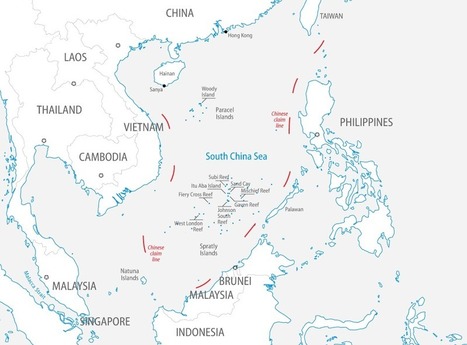
The U.S. Department of Defense’s latest assessment of the Chinese military provided new detail on China’s land reclamation efforts on several of the islets that it occupies in the South China Sea. These include Fiery Cross Reef, Gaven Reef, Johnson South Reef, Mischief Reef, and Subi Reef in the Spratly archipelago. By December 2014, the report estimated that China had reclaimed as much as 500 acres of new land, creating full-fledged islands where only coral reefs or sand spits existed before. Since then, China has only accelerated its efforts, expanding the total land area that it has reclaimed to 2,000 acres and building military facilities, ports, and at least one airstrip on the islands.

Marc Meynardi's curator insight,
May 13, 2015 1:49 AM
By doing so, China is not only digging land, but also preparing futur heavy discord. It's so strange : China critisize US hegemony and try to balance it. As result, China is having the same agressive attitude that US Bush era. Of course, not using bombs, but "pacifically" invading south China Sea. 
Gene Gagne's curator insight,
December 1, 2015 8:15 PM
I was wondering with the world being 80% ocean how much ocean can be transformed into land with these man made islands. Once again creating military strategic posts.
Scoop.it!

Multifamily dwellings in high-density areas are changing the concept of neighborhood.
Tags: housing, urban, place, neighborhood, spatial, density.

Sreya Ayinala's curator insight,
May 26, 2015 10:13 PM
Unit 7 Urban The article describes a vertical neighborhood which is similar to an apartment, but instead has multiple family residences stacked on top of each other. This type of a community helps decrease land use and increases communication between people and creates a sense of community. The residents often interact, see each other, and form deep bonds that would be difficult to do in a street of single family homes. As land prices skyrocket and living in a city becomes more expensive the main solution used by architects is to build up. The sky is the limit and there is plenty of space in the sky providing an ideal space for people to live and expand into. However, with the increase of skyscrapers and multi storied buildings, air pollution increases due to the height of the building and any smoke or waste released from the building. 
Shane C Cook's curator insight,
May 27, 2015 5:16 AM
How cool is it that our world is changing every second? Some would say that it sucks and that we need to slow down. But why slow down, so much innovation is happening and we are at the front seat of it. People live differently now rather than sticking with old traditions and it is neat to see how they adjust to high-density areas.
Scoop.it!
In which John Green teaches you about one of the least funny subjects in history: slavery. John investigates when and where slavery originated, how it change...

Joy Kinley's curator insight,
May 7, 2015 11:34 AM
For those of you needing AP Human Geography review this is a good one. 
Michael Martin's curator insight,
May 9, 2015 6:36 PM
Hey students: Check out this Prezi for REVIEW. Yay! |
Scoop.it!

From
www
We represent each language within black borders and then provide the numbers of native speakers (in millions) by country. The colour of these countries shows how languages have taken root in many different regions Via Charles Tiayon
Joy Kinley's curator insight,
May 28, 2015 2:13 PM
This is a really cool visual to see the differences in the languages spoken now.
Scoop.it!

From
www
An analysis of mortality records uncovered the most distinctive cause of death in each state. In Texas, it's tuberculosis. In Maine, the flu. And in Nevada, it's "legal intervention."
Scoop.it!

"More than 60 percent of Utah’s residents are Mormons, who typically abstain from alcohol, caffeine and tobacco. With those vices frowned upon, candy is an acceptable treat. Hispanics like Hershey’s Cookies ’n Creme bars in disproportionate numbers, and Minnesotan buy six-packs of Hershey bars at higher rates than any other Americans, particularly in the summer (think s’mores)."
Tags: food distribution, place, food, religion, ethnicity.

Ethan Bernick's curator insight,
May 26, 2015 8:29 PM
Each region of the USA varies at different degrees. The distribution of Mormons in Utah greatly increases the amount of candy consumed in the area. This could be a perceived region.
Shane C Cook's curator insight,
May 26, 2015 9:15 PM
Me as a mormon completely understand the desire of candy. Yes alcohol, drugs, tobacco, ect is frowned upon but what intrigues me the most is how candy is so dominant in that region. 
Eden Eaves's curator insight,
May 27, 2015 1:08 PM
More than 60 percent of Utah’s residents are Mormons, who typically abstain from alcohol, caffeine and tobacco. With those vices frowned upon, candy is an acceptable treat. Hispanics like Hershey’s Cookies ’n Creme bars in disproportionate numbers, and Minnesotan buy six-packs of Hershey bars at higher rates than any other Americans, particularly in the summer (think s’mores).
Scoop.it!
After viewing news photographs from China for years, one of my favorite visual themes is "large crowds in formation."
Scoop.it!

Beginning in the 1950s, cities demolished thousands of homes in walkable neighborhoods to make room for freeways.
At the time, this was seen as a sign of progress. Not only did planners hope to help people get downtown more quickly, they saw many of the neighborhoods being torn down as blighted and in need of urban renewal. But tearing down a struggling neighborhood rarely made problems like crime and overcrowding go away. To the contrary, displaced people would move to other neighborhoods, often exacerbating overcrowding problems. Crime rates rose, not fell, in the years after these projects. By cutting urban neighborhoods in half, planners undermined the blocks on either side of the freeway. The freeways made nearby neighborhoods less walkable. Reduced foot traffic made them less attractive places for stores and restaurants. And that, in turn, made them even less walkable. Those with the means to do so moved to the suburbs, accelerating the neighborhoods' decline.
Shane C Cook's curator insight,
May 27, 2015 4:00 AM
It is really interesting to see how urbanization has affected not just us today but our parents and grandparents. Of course with innovation includes consequence whether good or bad it happens. Go America! 
Ryan Tibari's curator insight,
May 27, 2015 10:16 AM
Industrialization changed not only the physical face of cities, but also the social. Innovations such as highways have caused transportation to become widely easier, allowing people from all different regions of the city to travel easily back and forth from place to place.
Scoop.it!
"La Marseillaise" (English: "The [Song of] Marseille") is the national anthem of France. It was written and composed by Claude Joseph Rouget de Lisle in 1792...
Scoop.it!
From
ed
We typically experience
Scoop.it!
My PhD: http://www.physics.usyd.edu.au/super/theses/PhD(Muller).pdf It is a common view that "if only someone could break this down and explain it clearly en...
Scoop.it!

The May 12 7.3 magnitude aftershock was one of many that followed the April 25 earthquake that shook Nepal. Why is this part of the world such a hotbed of tectonic activity?

Chris Costa's curator insight,
November 30, 2015 9:16 AM
Geography determines human activity, and not the other way around; that has been the theme of this course, and it holds true as we look at the devastating impacts of earthquakes in the nation of Nepal. Sitting right over one of the most active plate boundaries in the world, with the Indian subcontinent being violently forced under the rest of Asia, Nepal is therefore the home of both the infamous Himalayan Mountains and numerous earthquakes, varying in severity and frequency. As violent and as costly as they are, violent earthquakes are just another part of life in Nepal, as are other natural events in other parts of the globe, and the people who call it home adjust their lives accordingly, through a variety of means. However, nothing can prepare anyone for the extremes of earth's power, and the violent earthquake that shook the nation to its very core in May has left behind a great deal of human suffering and destruction. I hope that those who lost their homes and businesses are already well along on their path to recovery, although I don't think it's possible to every truly heal from such a traumatic experience, at least not completely.
Scoop.it!
Thousands of widows have been making their way to the holy city of Vrindavan in northern India to spend the rest of their lonely lives. Cast out by their families, or simply alone in the world, some travel hundreds of miles to get there.
Tags: gender, India, SouthAsia, culture.
Eden Eaves's curator insight,
May 24, 2015 5:10 PM
There are 15,000 widows living in the city of Vrindavan and most of them come from over 1300 km away; West Bengal. After their husbands death, these women have been beaten and tortured by their own children for money they don't have and have had to escape to this holy city for safety where, even though they are away from the beatings, they much beg and sing for money. Many wish for death over this humiliation. A woman, capable of bringing life into the world, should never be treated like this and especially by her own family.
Shane C Cook's curator insight,
May 27, 2015 4:32 AM
It is crazy to think Indian families would abuse these widows, but what questions me is the reason to flee for spiritual fulfillment. I understand why one would leave because their family betrayed them but why spiritual fulfillment?
Scoop.it!
From
vimeo
"LIVING IN THE AGE OF AIRPLANES is a story about how the airplane has changed the world. Filmed in 18 countries across all 7 continents, it renews our appreciation for one of the most extraordinary and awe-inspiring aspects of the modern world." airplanesmovie.com

Courtney Barrowman's curator insight,
May 21, 2015 10:41 AM
Summer reading KQ3 What are the major contributing factors to environmental change today? key concept of transportation, globalization, diffusion, industry 
BrianCaldwell7's curator insight,
April 5, 2016 8:11 AM
I was absolutely delighted to see this film on the big screen...it was as visually stunning as any film I'd ever seen. I and my young children were mesmerized. So much of the modern world that we take for granted is absolutely revolutionary. This is a great teacher's guide to teaching with this film. Tags: transportation, globalization, diffusion, industry, economic, video, National Geographic, visualization.
Scoop.it!
Safe, cost-effective refinements in hydraulic fracturing (also known as fracking), horizontal drilling and other innovations now allow for the production of ...
|






