"Following moves that began last October, when Google began allowing Google Apps users access to Google+, the company announced today several more features which are aimed at pushing Google-branded social experiences deeper into the business world."
Continuing its expansion into what seems every realm of the internet, Google is slowly moving towards pleasing the enterprise user. Adding private updates that can only be shared with certain people within a network, as well as Google Hangouts for private meetings, Google+ could be giving Yammer a run for its money.
Sam Altman, Loopt CEO, says that, “As a general rule, I expect good things of people that start companies before they can get drivers licenses.”
This free service started by two 15-year-olds is a true example of the entrepreneurial spirit that is seen in younger and younger people these days as well as sign of the future of business,
I wouldn't be surprised if this is true. A recent study says that the number one smartphone use is checking the weather.
It might not mean that this is the thing we do most, but I do think that it's something I personally do the most consistently each and every day (maybe even multiple times).
Customer Relationships - Instinct tells us that "humanizing" a brand—connecting it in the consumer's mind with a distinctive personality or an engaging personal narrative—is a good idea. But we don't have to rely on instinct. Research demonstrates how human interaction affects transactions, with lessons for marketers.
Iris Bohnet and Bruno Frey conducted an economic research study in 1999 called "Social Distance and Other-Regarding Behavior in Dictator Games." Two groups of students were recruited to participate in a series of social interactions in which members of the first group had to decide whether to share any portion of a sum of money—approximately $10—with a person in the second group.
When the first group knew nothing at all about those in the second group, participants offered, on average, only 26% of the money. When the moderators asked the second group to stand up—making them less anonymous to the first group—the offer increased to 39%. When the moderators shared personal information about those in the second group with those in the first, the average offer increased to 52%. And when members of the groups were introduced to one another, the average offer was 50%.
In other words, the greater the social distance, the less willing people were to hand over money.
So, there is now an organization that offers free plastic surgery to children who are bullied because of their appearance. What happened to teaching everyone to love themselves and accept who they are?
Facebook is testing a new option for users to save posts in mobile and desktop News Feed for later viewing, iMore and The Verge have discovered.
The feature has not rolled out to all users, but those in the test can bookmark items by clicking “save” on desktop and tapping and holding a story on iOS. If Facebook introduces this to all users, pages could see additional engagement on their posts, especially posts that include links or videos. Often times when users scroll through their feed, they don’t have the time or aren’t in the right environment to read a longer article or watch a video. Previously there was no easy, native way to bookmark these items for later, so pages were likely missing opportunities for fans to view and share their content.
We haven’t been able to test the feature for ourselves, but it seems that it will allow users to save stories on either mobile or desktop and then view them from another device by accessing the Saved feed from the Favorites panel on the left of News Feed.
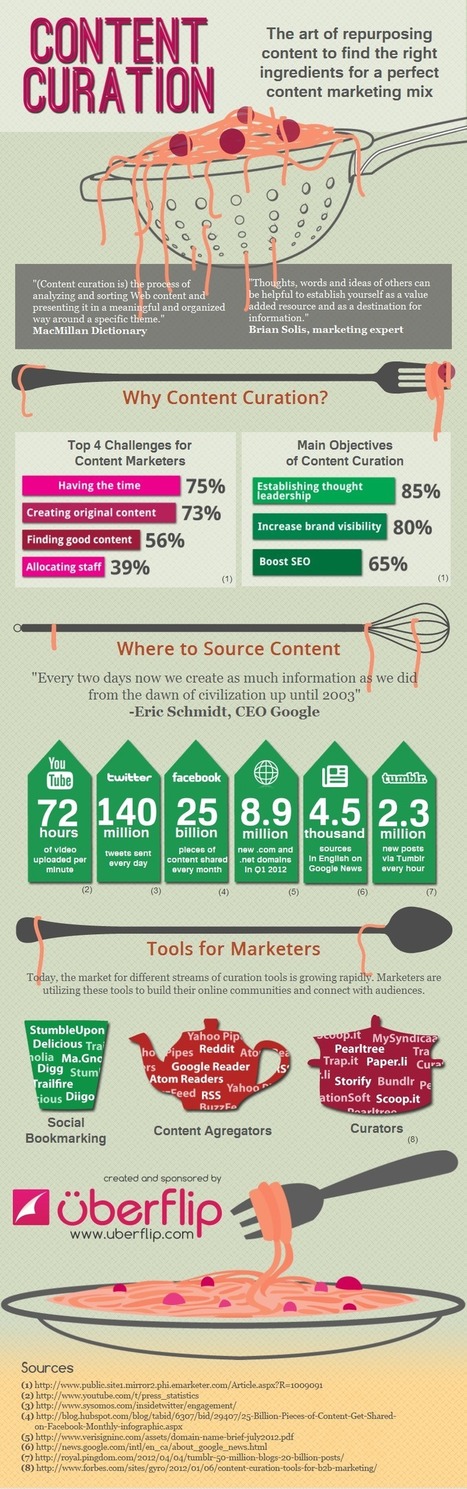
Uberflip have released this Infographic about the rise of content curation as a content marketing strategy, showing that curation can be used to increase visibility, boost SEO, and establish thought leadership – all in a cost-effective way and with limited resources.
Key Takeaways: - Creating original content is the biggest obstacle for 73% of content marketers. - 75% of marketers cannot justify spending the time needed to create original content for their audience. - There are a variety of tools developed within the past 3 years that can help marketers and content curators gather the most relevant content, re-purpose it, and present it to their audience in unique ways. - 85% of brands use content curation to establish thought leadership, and 80% say it enables them to increase brand visibility
After Mr. Justen, the creator of MyBizHomepage.com, fired his CTO, his website was hacked, presumably by the former employee and his colleagues.
What is the solution to this? The author talks about the illegitimacy of the CTO's identity, explaining that he had been living "off the grid" with no drivers license or credit cards. Why had Justin not checked up on this before hiring him?
Being hacked from an insider is hard to avoid - there is a level of trust that you need to place in your employees. But what happens when that trust is broken and it is too late?
Couple Dave and Carrie Kerpen were inspired to start events and marketing firm Likeable Media after they successfully got sponsors to fund their wedding.
"[A look] nside the minds of five distinguished entrepreneurs in hopes of providing some inspiration – to shine a light down the paths that have been carved by some of the world’s most successful business figures."
"This new life event for expecting a baby ... is another sign that Facebook is maturing as its original user base of college kids from 2004 start hatching little ones who can join Facebook 13 years from now."
Facebook took the wraps off Facebook Stories Thursday, a section designed “to celebrate the different stories that are coming out of Facebook,” according to a spokesperson’s description.
The first issue of Facebook Stories, which resides at facebook.com/FacebookStories, centers on “remembering.” A video at the top of the page tells the moving story of Mayank Sharm, who used Facebook’s “People You May Know” tool to contact old acquaintances and reconstruct his life history after being diagnosed with meningitis at age 27. A separate page serves up stories on memory from The New Yorker‘s archives, courtesy of the magazine’s librarians. Ari Shapiro, NPR’s White House correspondent, shares “one memory he’ll never forget,” and author and journalist Joshua Foer shares a list of books on memory that informed his own on the subject.
First, we saw Facebook fan pages, and now we are seeing tumblr blogs supporting James Holmes. His suppporters are now even called "Holmies."
An interesting debate: Should the companies be obligated to take down pages supporting things that are morally wrong but don't necessarily violate the terms of use?
To get content containing either thought or leadership enter:
To get content containing both thought and leadership enter:
To get content containing the expression thought leadership enter:
You can enter several keywords and you can refine them whenever you want. Our suggestion engine uses more signals but entering a few keywords here will rapidly give you great content to curate.


 Your new post is loading...