 Your new post is loading...

|
Rescooped by
Loïc Lepiniec
from Plant Sciences
June 20, 2015 3:05 AM
|
German authorities approve genome edited rape seed (canola) as non GMO
|
|
Rescooped by
Loïc Lepiniec
from Plant Sciences
June 16, 2015 2:27 AM
|
Depuis quelques années, de nouvelles méthodes d’ingénierie génétique ont été développées. Elles permettent de réaliser l’insertion ciblée d’un transgène ou de modifier spécifiquement la séquence d’un gène sans modifier son environnement génomique.
Via Saclay Plant Sciences
|
|
Rescooped by
Loïc Lepiniec
from Plant Sciences
June 11, 2015 8:22 AM
|
L’Université Paris-Saclay est une communauté d’universités et d’établissements (ComUE) telle que définie par la loi du 22 juillet 2013. Elle a été créée par décret du 29 décembre 2014 et fédère 18 membres fondateurs qui portent ensemble ce projet d’une grande université de classe mondiale.
Via Saclay Plant Sciences
|
|
Rescooped by
Loïc Lepiniec
from Plant Sciences
June 5, 2015 7:58 AM
|
|
|
Rescooped by
Loïc Lepiniec
from Plant Gene Seeker -PGS
May 28, 2015 9:54 AM
|
|
|
Scooped by
Loïc Lepiniec
May 21, 2015 7:24 AM
|
The bHLH transcription factor MYC2, together with its paralogues MYC3 and MYC4, is a master regulator of the response to the jasmonate (JA) hormone in Arabidopsis (Arabidopsis thaliana). In the absence of JA, JASMONATE ZIM (JAZ) proteins interact with the MYC proteins to block their activity. Understanding of the mechanism and specificity of this interaction is key to unravel JA signalling.
We generated mutant MYC proteins and assessed their activity and the specificity of their interaction with the 12 Arabidopsis JAZ proteins.
We show that the D94N mutation present in the atr2D allele of MYC3 abolishes the interaction between MYC3 and most JAZ proteins. The same effect is observed when the corresponding conserved Asp (D105) was mutated in MYC2. Accordingly, MYC2D105N activated target genes in the presence of JAZ proteins, in contrast to wild-type MYC2. JAZ1 and JAZ10 were the only JAZ proteins still showing interaction with the mutant MYC proteins, due to a second MYC interaction domain, besides the classical Jas domain.
Our results visualize the divergence among JAZ proteins in their interaction with MYC proteins. Ultimately, the transferability of the Asp-to-Asn amino acid change might facilitate the design of hyperactive transcription factors for plant engineering.
|
|
Scooped by
Loïc Lepiniec
April 28, 2015 2:23 AM
|
|
|
Scooped by
Loïc Lepiniec
April 11, 2015 3:54 PM
|
|
|
Scooped by
Loïc Lepiniec
April 9, 2015 5:16 PM
|
INRA is looking to hire individuals with disabilities to work as junior and experienced research scientists and engineers.
|
|
Scooped by
Loïc Lepiniec
April 8, 2015 2:52 AM
|
|
|
Scooped by
Loïc Lepiniec
April 6, 2015 2:44 AM
|
Author Summary BP is a class-I KNOX transcription factor that controls normal inflorescence architecture development by repressing the expression of two KNOX genes, KNAT2 and KNAT6 . In this study, we showed that Arabidopsis BP directly interacts with the SWI2/SNF2 chromatin remodeling ATPase BRM. brm and bp mutants displayed similar inflorescence architecture defects, with clustered inflorescences, horizontally orientated pedicels, and short pedicels and internodes. Furthermore, BP and BRM co-target to KNAT2 and KNAT6 genes and repress their expression. This work reveals a new regulatory mechanism that BP associates with BRM in control of inflorescence architecture development.
|
|
Rescooped by
Loïc Lepiniec
from Plant Sciences
April 3, 2015 1:48 AM
|
Developing plant embryos depend on nutrition from maternal tissues via the seed coat and endosperm, but the mechanisms that supply nutrients to plant embryos have remained elusive. Sucrose, the major transport form of carbohydrate in plants, is delivered via the phloem to the maternal seed coat and then secreted from the seed coat to feed the embryo. Here, we show that seed filling in Arabidopsis thaliana requires the three sucrose transporters SWEET11, 12, and 15. SWEET11, 12, and 15 exhibit specific spatiotemporal expression patterns in developing seeds, but only a sweet11;12;15 triple mutant showed severe seed defects, which include retarded embryo development, reduced seed weight, and reduced starch and lipid content, causing a “wrinkled” seed phenotype. In sweet11;12;15 triple mutants, starch accumulated in the seed coat but not the embryo, implicating SWEET-mediated sucrose efflux in the transfer of sugars from seed coat to embryo. This cascade of sequentially expressed SWEETs provides the feeding pathway for the plant embryo, an important feature for yield potential.
Via CHAHTANE Hicham
|
|
|
Scooped by
Loïc Lepiniec
June 18, 2015 3:17 AM
|
Betalains, a small group of alkaloid pigments restricted to certain families of the Caryophyllales, have comparable optical properties and share similar histological locations in vegetative tissues with those of the more abundant anthocyanins. It has long been speculated that the two pigments are functional homologues in plant-environment interactions. Recent empirical evidence indicates that anthocyanins and betacyanins are both effective photoprotectants, are associated with increased tolerance to drought and salinity stress, and are efficient scavengers of reactive oxygen species in plants facing a variety of abiotic stressors. Nevertheless, the capacity of betalains to maintain a red colour irrespective of changes in vacuolar pH, their enhanced absorptivity of visible wavelengths, and their strong association with vacuolar ATPase activity, suggest that they may confer adaptive benefits not found in those species that produce anthocyanins. There remains much to be learned about the functional significance of betalains.
|
|
Rescooped by
Loïc Lepiniec
from Plant Sciences
June 12, 2015 7:00 AM
|
The gibberellin (GA) phytohormones play important roles in plant growth and development, promoting seed germination, elongation growth and reproductive development1. Over the years, substantial progress has been made in understanding the regulation of GA signalling and metabolism, which ensures appropriate levels of GAs for growth and development2. Moreover, an additional level of regulation may reside in the transport of GAs from production sites to recipient tissues that require GAs for growth. Although there is considerable evidence suggesting the existence of short- and long-distance movement of GAs in plants3,4,5,6,7,8, the nature and the biological properties of this transport are not yet understood. Here, we combine biochemical and conventional micrografting experiments in Arabidopsis thaliana to show that the GA precursor GA12, although biologically inactive by itself, is the major mobile GA signal over long distances. Quantitative analysis of endogenous GAs in xylem and phloem exudates further indicates that GA12 moves through the plant vascular system. Finally, we demonstrate that GA12 is functional in recipient tissues, supporting growth via the activation of the GA signalling cascade. Collectively, these results reveal the existence of long-range transport of endogenous GA12 in plants that may have implications for the control of developmental phase transitions and the adaptation to adverse environments
Via Saclay Plant Sciences
|
|
Scooped by
Loïc Lepiniec
June 10, 2015 2:26 AM
|
EXCLUSIF - Treize architectes sont mobilisés pour imaginer 16 stations de la ligne 15 du Grand Paris Express qui devront être prêtes d'ici 2022, entre Noisy-Champs et Pont de Sèvres. Aperçu en images de l'intérieur et extérieur de ces stations qui cherchent à être des espaces de vie autant agréables que praticables.
|
|
Scooped by
Loïc Lepiniec
June 1, 2015 2:14 AM
|
Author Summary In flowering plants it is hypothesized the complexity and the robustness of the auxin transcriptional response could be generated by a large number of paralogs encoding components of this signaling network. Yet, it is not known whether alternative embryophyte body plans can be patterned with a simpler auxin transcriptional machinery. We demonstrate that in the liverwort Marchantia polymorpha , the type rather than the number of components of the auxin transcriptional response pathway are sufficient to pattern a complex three-dimensional gametophyte with multiple tissue and cell types. In M . polymorpha , mutations in components of the auxin signaling pathway cause dramatic pleiotropic effects despite having a single class A activating AUXIN RESPONSE FACTOR ( MpARF1 ). This supports the hypothesis that auxin is context dependent and that it facilitates rather than specifies particular developmental processes. We show that auxin signaling is not necessary for survival but it is required to pattern the transition from two-dimensional to three-dimensional growth. This suggests that the evolution of the auxin transcriptional response was critical for the evolution of developmental complexity in land plants.
|
|
Rescooped by
Loïc Lepiniec
from Plant Sciences
May 23, 2015 3:56 AM
|
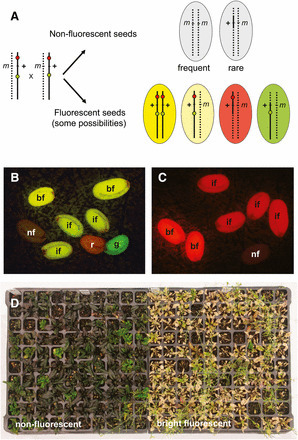
This paper summary is contributed by Dr. Clint Springer @clintspringer (http://www.sju.edu/about-sju/faculty-staff/faculty-experts/clint-springer-phd). Scott Poethig’s group at the University of Pennsylvania has created an excellent new tool for use in genetic analysis studies of Arabidopsis thaliana. Using the “traffic lines” they have created, one can use a pair of seed-expressed green and red fluorescent transgenes that flank the mutation of interest to identify the genotype of mutants without the need for phenotypic analysis. This powerful tool cuts mutant analysis time substantially in all mutant genotypes and provides a way of determining genotype if a visible phenotype is not present. Because of the coverage of the “traffic line” insertions across the genome, one could make use of this resource in classroom studies of plant genetics to examine segregating populations as well mutant analysis. The “traffic lines” are available in both the Columbia and Landsberg erecta genetic backgrounds and can be ordered from the The Arabidopsis Information Resource center. http://www.genetics.org/content/200/1/35.abstract
Via Mary Williams, Saclay Plant Sciences
|
|
Scooped by
Loïc Lepiniec
April 11, 2015 3:55 PM
|
Role of B3 domain transcription factors of the AFL family in maize kernel filling
|
|
Scooped by
Loïc Lepiniec
April 11, 2015 5:08 AM
|
|
|
Scooped by
Loïc Lepiniec
April 8, 2015 7:04 AM
|
Anthocyanin and proanthocyanidin (PA) are important secondary metabolites and beneficial to human health. Their biosynthesis is induced by jasmonate (JA) treatment and regulated by MYB transcription factors (TFs). However, which and how MYB TFs regulate this process is largely unknown in apple. In this study, MdMYB9 and MdMYB11 which were induced by methyl jasmonate (MeJA) were functionally characterized. Overexpression of MdMYB9 or MdMYB11 promoted not only anthocyanin but also PA accumulation in apple calluses, and the accumulation was further enhanced by MeJA. Subsequently, yeast two-hybrid, pull-down and bimolecular fluorescence complementation assays showed that both MYB proteins interact with MdbHLH3. Moreover, Jasmonate ZIM-domain (MdJAZ) proteins interact with MdbHLH3. Furthermore, chromatin immunoprecipitation–quantitative PCR and yeast one-hybrid assays demonstrated that both MdMYB9 and MdMYB11 bind to the promoters of ANS, ANR and LAR, whereas MdbHLH3 is recruited to the promoters of MdMYB9 and MdMYB11 and regulates their transcription. In addition, transient expression assays indicated that overexpression of MdJAZ2 inhibits the recruitment of MdbHLH3 to the promoters of MdMYB9 and MdMYB11. Our findings provide new insight into the mechanism of how MeJA regulates anthocyanin and PA accumulation in apple.
|
|
Scooped by
Loïc Lepiniec
April 6, 2015 3:59 PM
|
Climate change is accelerating plant developmental transitions coordinated with the seasons in temperate environments. To understand the importance of these timing advances for a stable life history strategy, we constructed a full life cycle model of Arabidopsis thaliana. Modelling and field data reveal that a cryptic function of flowering time control is to limit seed set of winter annuals to an ambient temperature window which coincides with a temperature-sensitive switch in seed dormancy state. This coincidence is predicted to be conserved independent of climate at the expense of flowering date, suggesting that temperature control of flowering time has evolved to constrain seed set environment and therefore frequency of dormant and non-dormant seed states. We show that late flowering can disrupt this bet-hedging germination strategy. Our analysis shows that life history modelling can reveal hidden fitness constraints and identify non-obvious selection pressures as emergent features.
|
|
Scooped by
Loïc Lepiniec
April 6, 2015 2:39 AM
|
Shoot branching is a primary contributor to plant architecture, evolving independently in flowering plant sporophytes and moss gametophytes. Mechanistic understanding of branching is largely limited to flowering plants such as Arabidopsis, which have a recent evolutionary origin. We show that in gametophytic shoots of Physcomitrella, lateral branches arise by re-specification of epidermal cells into branch initials. A simple model co-ordinating the activity of leafy shoot tips can account for branching patterns, and three known and ancient hormonal regulators of sporophytic branching interact to generate the branching pattern- auxin, cytokinin and strigolactone. The mode of auxin transport required in branch patterning is a key divergence point from known sporophytic pathways. Although PIN-mediated basipetal auxin transport regulates branching patterns in flowering plants, this is not so in Physcomitrella, where bi-directional transport is required to generate realistic branching patterns. Experiments with callose synthesis inhibitors suggest plasmodesmal connectivity as a potential mechanism for transport.
|
|
Scooped by
Loïc Lepiniec
April 3, 2015 1:46 AM
|
Author Summary The genomic content of regulatory genes such as transcription factors is surprisingly conserved between diverse animal species, raising the paradox of how new traits emerge, and are subsequently modified and lost. In this study we make a connection between the developmental basis for the formation of a fruit fly trait and the evolutionary basis for that trait’s origin, diversification, and loss. We show how the origin of a novel pigmentation trait is associated with the evolution of two regulatory sequences that control the co-expression of two key pigmentation genes. These sequences interact in unique ways with evolutionarily conserved Hox transcription factors to drive gene co-expression. Once these unique connections evolved, the alteration of this trait appears to have proceeded through changes to regulatory genes rather than regulatory sequences of the pigmentation genes. Thus, our findings support a scenario where regulatory sequence evolution provided new functions to old transcription factors, how co-expression can emerge from different utilizations of the same transcription factors, and that trait diversity was surprisingly shaped by changes in some manner to the deeply conserved regulatory genes.
|


 Scoop.it!













German authorities approve genome edited rape seed (canola) as non GMO,
http://www.testbiotech.org/sites/default/files/BVL%20Cibus.pdf