Your new post is loading...

|
Scooped by
Loïc Lepiniec
November 20, 2015 1:21 PM
|
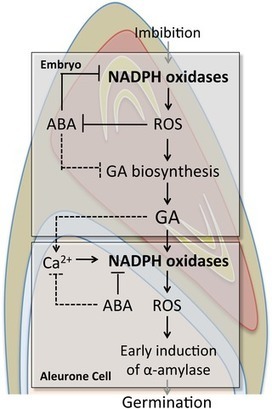
Reactive oxygen species (ROS) promote the germination of several seeds, and antioxidants suppress it. However, questions remain regarding the role and production mechanism of ROS in seed germination. Here, we focused on NADPH oxidases, which produce ROS. After imbibition, NADPH oxidase mRNAs were expressed in the embryo and in aleurone cells of barley seed; these expression sites were consistent with the sites of ROS production in the seed after imbibition. To clarify the role of NADPH oxidases in barley seed germination, we examined gibberellic acid (GA) / abscisic acid (ABA) metabolism and signaling in barley seeds treated with diphenylene iodonium chloride (DPI), an NADPH oxidase inhibitor. DPI significantly suppressed germination, and suppressed GA biosynthesis and ABA catabolism in embryos. GA, but not ABA, induced NADPH oxidase activity in aleurone cells. Additionally, DPI suppressed the early induction of α-amylase by GA in aleurone cells. These results suggest that ROS produced by NADPH oxidases promote GA biosynthesis in embryos, that GA induces and activates NADPH oxidases in aleurone cells, and that ROS produced by NADPH oxidases induce α-amylase in aleurone cells. We conclude that the ROS generated by NADPH oxidases regulate barley seed germination through GA / ABA metabolism and signaling in embryo and aleurone cells.
|
|
Scooped by
Loïc Lepiniec
November 19, 2015 4:04 PM
|
|
|
Scooped by
Loïc Lepiniec
November 18, 2015 4:45 PM
|
|
|
Scooped by
Loïc Lepiniec
November 18, 2015 4:02 PM
|
|
|
Scooped by
Loïc Lepiniec
November 18, 2015 1:43 PM
|
Gene expression is regulated by transcription factors (TFs), proteins that recognize short DNA sequence motifs1, 2, 3. Such sequences are very common in the human genome, and an important determinant of the specificity of gene expression is the cooperative binding of multiple TFs to closely located motifs4, 5, 6. However, interactions between DNA-bound TFs have not been systematically characterized. To identify TF pairs that bind cooperatively to DNA, and to characterize their spacing and orientation preferences, we have performed consecutive affinity-purification systematic evolution of ligands by exponential enrichment (CAP-SELEX) analysis of 9,400 TF–TF–DNA interactions. This analysis revealed 315 TF–TF interactions recognizing 618 heterodimeric motifs, most of which have not been previously described. The observed cooperativity occurred promiscuously between TFs from diverse structural families. Structural analysis of the TF pairs, including a novel crystal structure of MEIS1 and DLX3 bound to their identified recognition site, revealed that the interactions between the TFs were predominantly mediated by DNA. Most TF pair sites identified involved a large overlap between individual TF recognition motifs, and resulted in recognition of composite sites that were markedly different from the individual TF’s motifs. Together, our results indicate that the DNA molecule commonly plays an active role in cooperative interactions that define the gene regulatory lexicon.
|
|
Scooped by
Loïc Lepiniec
November 14, 2015 4:51 AM
|
Eukaryotes rely on efficient distribution of energy and carbon skeletons between organs in the form of sugars. Glucose in animals and sucrose in plants serve as the dominant distribution forms. Cellular sugar uptake and release require vesicular and/or plasma membrane transport proteins. Humans and plants use proteins from three superfamilies for sugar translocation: the major facilitator superfamily (MFS), the sodium solute symporter family (SSF; only in the animal kingdom), and SWEETs. SWEETs carry mono- and disaccharides across vacuolar or plasma membranes. Plant SWEETs play key roles in sugar translocation between compartments, cells, and organs, notably in nectar secretion, phloem loading for long distance translocation, pollen nutrition, and seed filling. Plant SWEETs cause pathogen susceptibility possibly by sugar leakage from infected cells. The vacuolar Arabidopsis thaliana AtSWEET2 sequesters sugars in root vacuoles; loss-of-function mutants show increased susceptibility to Pythium infection. Here we show that its orthologue, the vacuolar glucose transporter OsSWEET2b from rice (Oryza sativa), consists of an asymmetrical pair of triple-helix bundles, connected by an inversion linker transmembrane helix (TM4) to create the translocation pathway. Structural and biochemical analyses show OsSWEET2b in an apparent inward (cytosolic) open state forming homomeric trimers. TM4 tightly interacts with the first triple-helix bundle within a protomer and mediates key contacts among protomers. Structure-guided mutagenesis of the close paralogue SWEET1 from Arabidopsis identified key residues in substrate translocation and protomer crosstalk. Insights into the structure-function relationship of SWEETs are valuable for understanding the transport mechanism of eukaryotic SWEETs and may be useful for engineering sugar flux.
|
|
Scooped by
Loïc Lepiniec
November 14, 2015 4:46 AM
|
|
|
Rescooped by
Loïc Lepiniec
from Papers
November 11, 2015 2:54 AM
|
Robustness is the invariance of a phenotype in the face of environmental or genetic change. The phenotypes produced by transcriptional regulatory circuits are gene expression patterns that are to some extent robust to mutations. Here we review several causes of this robustness. They include robustness of individual transcription factor binding sites, homotypic clusters of such sites, redundant enhancers, transcription factors, redundant transcription factors, and the wiring of transcriptional regulatory circuits. Such robustness can either be an adaptation by itself, a byproduct of other adaptations, or the result of biophysical principles and non-adaptive forces of genome evolution. The potential consequences of such robustness include complex regulatory network topologies that arise through neutral evolution, as well as cryptic variation, i.e., genotypic divergence without phenotypic divergence. On the longest evolutionary timescales, the robustness of transcriptional regulation has helped shape life as we know it, by facilitating evolutionary innovations that helped organisms such as flowering plants and vertebrates diversify. Mechanisms of mutational robustness in transcriptional regulation
Joshua L. Payne and Andreas Wagner Front. Genet., 27 October 2015 | http://dx.doi.org/10.3389/fgene.2015.00322
Via Complexity Digest
|
|
Rescooped by
Loïc Lepiniec
from Plant development and evolution
November 9, 2015 9:25 AM
|
The DELLA protein REPRESSOR OF ga1-3-LIKE2 (RGL2) plays an important role in seed germination under different conditions through a number of transcription factors. However, the functions of the structural genes associated with RGL2-regulated germination are less defined. Here, we report the role of an Arabidopsis (Arabidopsis thaliana) cell wall-localized protein, Gibberellic Acid-Stimulated Arabidopsis6 (AtGASA6), in functionally linking RGL2 and a cell wall loosening expansin protein (Arabidopsis expansin A1 [AtEXPA1]), resulting in the control of embryonic axis elongation and seed germination. AtGASA6-overexpressing seeds showed precocious germination, whereas transfer DNA and RNA interference mutant seeds displayed delayed seed germination under abscisic acid, paclobutrazol, and glucose (Glc) stress conditions. The differences in germination rates resulted from corresponding variation in cell elongation in the hypocotyl-radicle transition region of the embryonic axis. AtGASA6 was down-regulated by RGL2, GLUCOSE INSENSITIVE2, and ABSCISIC ACID-INSENSITIVE5 genes, and loss of AtGASA6 expression in the gasa6 mutant reversed the insensitivity shown by the rgl2 mutant to paclobutrazol and the gin2 mutant to Glc-induced stress, suggesting that it is involved in regulating both the gibberellin and Glc signaling pathways. Furthermore, it was found that the promotion of seed germination and length of embryonic axis by AtGASA6 resulted from a promotion of cell elongation at the embryonic axis mediated by AtEXPA1. Taken together, the data indicate that AtGASA6 links RGL2 and AtEXPA1 functions and plays a role as an integrator of gibberellin, abscisic acid, and Glc signaling, resulting in the regulation of seed germination through a promotion of cell elongation.
Via CHAHTANE Hicham
|
|
Scooped by
Loïc Lepiniec
November 7, 2015 4:32 AM
|
Seed longevity, the maintenance of viability during storage, is a crucial factor for preservation of genetic resources and ensuring proper seedling establishment and high crop yield. We used a systems biology approach to identify key genes regulating the acquisition of longevity during seed maturation of Medicago truncatula. Using 104 transcriptomes from seed developmental time courses obtained in five growth environments, we generated a robust, stable coexpression network (MatNet), thereby capturing the conserved backbone of maturation. Using a trait-based gene significance measure, a coexpression module related to the acquisition of longevity was inferred from MatNet. Comparative analysis of the maturation processes in M. truncatula and Arabidopsis thaliana seeds and mining Arabidopsis interaction databases revealed conserved connectivity for 87% of longevity module nodes between both species. Arabidopsis mutant screening for longevity and maturation phenotypes demonstrated high predictive power of the longevity cross-species network. Overrepresentation analysis of the network nodes indicated biological functions related to defense, light, and auxin. Characterization of defense-related wrky3 and nf-x1-like1 (nfxl1) transcription factor mutants demonstrated that these genes regulate some of the network nodes and exhibit impaired acquisition of longevity during maturation. These data suggest that seed longevity evolved by co-opting existing genetic pathways regulating the activation of defense against pathogens.
Heterotrimeric nuclear factors Y (NF-Ys) are involved in regulation of various vital functions in all eukaryotic organisms. Although a number of NF-Y subunits have been characterized in model plants, only a few have been functionally evaluated in crops. In this work, a number of genes encoding NF-YB and NF-YC subunits were isolated from drought-tolerant wheat (Triticum aestivum L. cv. RAC875), and the impact of the overexpression of TaNF-YB4 in the Australian wheat cultivar Gladius was investigated. TaNF-YB4 was isolated as a result of two consecutive yeast two-hybrid (Y2H) screens, where ZmNF-YB2a was used as a starting bait. A new NF-YC subunit, designated TaNF-YC15, was isolated in the first Y2H screen and used as bait in a second screen, which identified two wheat NF-YB subunits, TaNF-YB2 and TaNF-YB4. Three-dimensional modelling of a TaNF-YB2/TaNF-YC15 dimer revealed structural determinants that may underlie interaction selectivity. The TaNF-YB4 gene was placed under the control of the strong constitutive polyubiquitin promoter from maize and introduced into wheat by biolistic bombardment. The growth and yield components of several independent transgenic lines with up-regulated levels of TaNF-YB4 were evaluated under well-watered conditions (T1–T3 generations) and under mild drought (T2 generation). Analysis of T2 plants was performed in large deep containers in conditions close to field trials. Under optimal watering conditions, transgenic wheat plants produced significantly more spikes but other yield components did not change. This resulted in a 20–30% increased grain yield compared with untransformed control plants. Under water-limited conditions transgenic lines maintained parity in yield performance.
Via Christophe Jacquet
|
|
Scooped by
Loïc Lepiniec
October 27, 2015 6:30 AM
|
|
|
Rescooped by
Loïc Lepiniec
from Plant Genomics
October 26, 2015 1:40 PM
|
|
|
|
Scooped by
Loïc Lepiniec
November 20, 2015 2:08 AM
|
|
|
Scooped by
Loïc Lepiniec
November 19, 2015 2:08 AM
|
|
|
Scooped by
Loïc Lepiniec
November 18, 2015 4:03 PM
|
|
|
Scooped by
Loïc Lepiniec
November 18, 2015 3:42 PM
|
|
|
Rescooped by
Loïc Lepiniec
from SynBioFromLeukipposInstitute
November 15, 2015 2:36 AM
|
Two years ago I was a part of a group (Biology of Host-parasite Interactions, Institut Pasteur, Paris) that changed genome editing in the malaria community for the better (Nat. Biotechnol., 2014). Given the timing, it shouldn’t be a surprise that the CRISPR system was involved. Today, that same laboratory enjoys a successful edit rate of over 90% in their work editing the genome of Plasmodium falciparum (the parasite that causes malaria). I attribute their success to technical expertise, thoughtful single guide RNA (sgRNA) design, and the abnormally low GC content of the Plasmodium falciparum genome. To put this last point into perspective, the Plasmodium falciparum genome contains only 0.66 million targetable NGG PAM sites whereas the human genome has about 300 million. With such a sparsely targetable genome, off-targeting is less of a worry and on-targeting likely more efficient. These insights are hard to appreciate without computational support. Indeed, rational sgRNA design is not possible without relying on some kind of pre-analysis. At the end of 2014, I began developing software to make sgRNA design accessible to all. At the time I thought there was room for improvement and a year later it became quite clear that others thought the same. Since January 2013 there have been 33 CRISPR software tools published and documented by OMICtools. It must be confusing for a newcomer to decide on the right software to use. With so much choice the question I have is, how did we get here in the first place?
Via Gerd Moe-Behrens
|
|
Scooped by
Loïc Lepiniec
November 14, 2015 4:48 AM
|
Gene expression is regulated by transcription factors (TFs), proteins that recognize short DNA sequence motifs. Such sequences are very common in the human genome, and an important determinant of the specificity of gene expression is the cooperative binding of multiple TFs to closely located motifs. However, interactions between DNA-bound TFs have not been systematically characterized. To identify TF pairs that bind cooperatively to DNA, and to characterize their spacing and orientation preferences, we have performed consecutive affinity-purification systematic evolution of ligands by exponential enrichment (CAP-SELEX) analysis of 9,400 TF–TF–DNA interactions. This analysis revealed 315 TF–TF interactions recognizing 618 heterodimeric motifs, most of which have not been previously described. The observed cooperativity occurred promiscuously between TFs from diverse structural families. Structural analysis of the TF pairs, including a novel crystal structure of MEIS1 and DLX3 bound to their identified recognition site, revealed that the interactions between the TFs were predominantly mediated by DNA. Most TF pair sites identified involved a large overlap between individual TF recognition motifs, and resulted in recognition of composite sites that were markedly different from the individual TF’s motifs. Together, our results indicate that the DNA molecule commonly plays an active role in cooperative interactions that define the gene regulatory lexicon.
|
|
Scooped by
Loïc Lepiniec
November 12, 2015 1:43 PM
|
Background
The CRISPR/Cas9 system provides bacteria and archaea with molecular immunity against invading phages and conjugative plasmids. Recently, CRISPR/Cas9 has been used for targeted genome editing in diverse eukaryotic species.
Results
In this study, we investigate whether the CRISPR/Cas9 system could be used in plants to confer molecular immunity against DNA viruses. We deliver sgRNAs specific for coding and non-coding sequences of tomato yellow leaf curl virus (TYLCV) into Nicotiana benthamiana plants stably overexpressing the Cas9 endonuclease, and subsequently challenge these plants with TYLCV. Our data demonstrate that the CRISPR/Cas9 system targeted TYLCV for degradation and introduced mutations at the target sequences. All tested sgRNAs exhibit interference activity, but those targeting the stem-loop sequence within the TYLCV origin of replication in the intergenic region (IR) are the most effective. N. benthamiana plants expressing CRISPR/Cas9 exhibit delayed or reduced accumulation of viral DNA, abolishing or significantly attenuating symptoms of infection. Moreover, this system could simultaneously target multiple DNA viruses.
Conclusions
These data establish the efficacy of the CRISPR/Cas9 system for viral interference in plants, thereby extending the utility of this technology and opening the possibility of producing plants resistant to multiple viral infections.
|
|
Scooped by
Loïc Lepiniec
November 9, 2015 3:49 PM
|
|
|
Scooped by
Loïc Lepiniec
November 9, 2015 2:54 AM
|
Mature seeds of most of the higher plants harbour dormant embryos and go through the complex process of germination under favourable environmental conditions. The germination process involves dynamic physiological, cellular and metabolic events that are controlled by the interplay of several gene products and different phytohormones. The small non-coding RNAs comprise key regulatory modules in the process of seed dormancy and germination. Recent studies have implicated the small RNAs in plant growth in correlation with various plant physiological processes including hormone signalling and stress response. In this review we provide a brief overview of the regulation of seed germination or dormancy while emphasising on the current understanding of the role of small RNAs in this regard. We have also highlighted specific examples of stress responsive small RNAs in seed germination and discussed their future potential.
|
|
Scooped by
Loïc Lepiniec
November 6, 2015 3:38 AM
|
|
|
Scooped by
Loïc Lepiniec
October 27, 2015 6:34 AM
|
|
|
Rescooped by
Loïc Lepiniec
from Plant development and evolution
October 26, 2015 1:41 PM
|
"Plant survival depends on seed germination and progression through post-germinative developmental checkpoints. These processes are controlled by the stress phytohormone abscisic acid (ABA). ABA regulates the basic leucine zipper transcriptional factor ABI5, a central hub of growth repression, while the reactive nitrogen molecule nitric oxide (NO) counteracts ABA during seed germination. However, the molecular mechanisms by which seeds sense more favourable conditions and start germinating have remained elusive. Here we show that ABI5 promotes growth via NO, and that ABI5 accumulation is altered in genetic backgrounds with impaired NO homeostasis. S-nitrosylation of ABI5 at cysteine-153 facilitates its degradation through CULLIN4-based and KEEP ON GOING E3 ligases, and promotes seed germination. Conversely, mutation of ABI5 at cysteine-153 deregulates protein stability and inhibition of seed germination by NO depletion. These findings suggest an inverse molecular link between NO and ABA hormone signalling through distinct posttranslational modifications of ABI5 during early seedling development."
Via CHAHTANE Hicham
|