Your new post is loading...

|
Scooped by
Gilbert C FAURE
December 25, 2024 5:55 AM
|
The US Food and Drug Administration (FDA) has granted EndoQuest Robotics, a privately-held pioneer in the development of flexible endoluminal robotic technologies, an Investigational Device Exempti…...
|
|
Scooped by
Gilbert C FAURE
December 19, 2024 7:05 AM
|
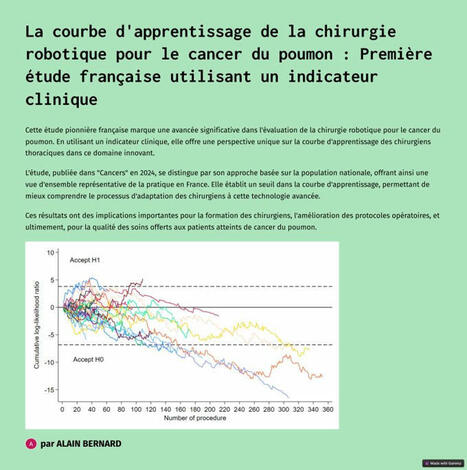
La chirurgie robotique
#Pierre-Benoit Pages #Jonathan Cottenet #Leslie Madeleine #Halim Abouhanna #Florian Dhérissard #Alain Bernard #Catherine…
|
|
Scooped by
Gilbert C FAURE
December 16, 2024 4:08 AM
|
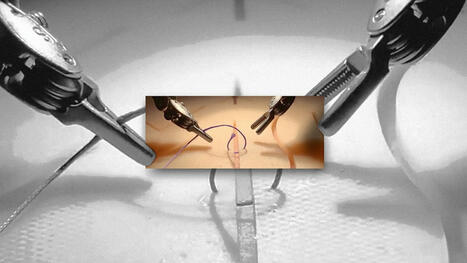
Long telesurgery record of the world.
|
|
Scooped by
Gilbert C FAURE
December 11, 2024 8:07 AM
|
Could robotic aortic valve replacement become a widespread alternative to SAVR or TAVI for the treatment of aortic valve disease?
|
|
Scooped by
Gilbert C FAURE
December 5, 2024 4:49 AM
|
The study included 212 adult spine surgery patients who had 1,211 pedicle screws placed using either robot-assisted or AR-assisted procedures.
|
|
Scooped by
Gilbert C FAURE
November 29, 2024 1:24 PM
|
A monthly roundup of healthcare-focused AI news and research...
|
|
Scooped by
Gilbert C FAURE
November 21, 2024 4:17 AM
|
“Imagine that you need to get surgery within a few minutes or you may not survive,” John Hopkins University postdoc student Brian Kim tells me over email. “There happen to be no surgeons around but there is an autonomous surgical robot available that can perform this procedure with a very high probability of success—would you take the chance?” It sounds like a B-movie scenario, but it’s now a tangible reality that you may encounter sooner than you think. For the first time in history, Kim and his colleagues managed to teach an artificial intelligence to use a robotic surgery machine to perform precise surgical tasks by making it watch thousands of hours of actual procedures happening in real surgical theaters. The research team says it’s a breakthrough development that crosses a definitive medical frontier and opens the path to a new era in healthcare. According to their recently published paper, the researchers say the AI managed to achieve a performance level comparable to human surgeons without prior explicit programming. Rather than trying to painstakingly program a robot to operate—which the research paper says has always failed in the past—they trained this AI through something called imitation learning, a branch of artificial intelligence where the machine observes and replicates human actions. This allowed the AI to learn the complex sequences of actions required to complete surgical tasks by breaking them down into kinematic components. These components translate into simpler actions—like joint angles, positions, and paths—which are easier to understand, replicate, and adapt during surgery. How they did it Kim and his colleagues used a da Vinci Surgical System as the hands and eyes for this AI. But before using the established robotic platform (currently used by surgeons to conduct precise operations locally and remotely) to prove the new AI works, they also ran virtual simulations. This allowed for faster iteration and safety validation before the learned procedures were applied on actual hardware. “All we need is image input, and then this AI system finds the right action,” Kim says. The da Vinci robots were also the source of the videos that the AI analyzed, using more than 10,000 recordings captured by wrist cameras during human-driven surgeries to learn three surgical tasks: Handling and positioning a surgical needle, carefully lifting and manipulating tissue, and suturing—all complex tasks that require fine, extremely sensitive control. This large-scale dataset enabled the AI to learn nuanced differences between similar surgical actions, such as the appropriate tension needed to handle tissue without causing damage. Those training videos are just a very small part of an extensive repository of surgical data. With nearly 7,000 da Vinci robots in use worldwide, there is a vast library of surgical demonstrations to observe and learn from, which the research team is now using to expand the AI’s surgical repertoire for a new, not-yet-published study. “In our follow-up work, which we will be releasing soon, we study whether these models can work for long-horizon surgical procedures involving unseen anatomical structures,” Kim writes, referring to complex surgical procedures that require adapting to the patient’s condition at any given time, like when operating on a serious internal wound. During development, the team worked closely with practicing surgeons to evaluate the model’s performance and provide critical feedback (particularly regarding the subtle handling of tissue), which the robot integrated into its learning process. Finally, to validate the model, they used a separate dataset not included in the initial training to create virtual simulations, ensuring the AI could adapt to new and unseen surgical scenarios before proceeding to test it in physical procedures. This cross-validation confirmed the robot’s ability to generalize rather than merely memorize actions, which of course is crucial given the number of potential unknowns that may arise in the operating theater. It all worked beautifully. The robot’s model learned these tasks to the level of experienced surgeons. “It’s really magical to have this model where all we do is feed it camera input, and it can predict the robotic movements needed for surgery,” Axel Krieger, assistant professor in mechanical engineering at Johns Hopkins and senior author of the study, says in an emailed statement. “We believe this marks a significant step forward toward a new frontier in medical robotics.” A breakthrough discovery One of the keys to this success is the use of relative movements rather than absolute instructions. In the da Vinci system, the robotic arms might not end up exactly where they are intended due to tiny discrepancies in joint movement that accumulate over multiple actions and can eventually lead to significant errors—especially in a sensitive environment like surgery. The team had to find a solution, so rather than depending on those measurements, it trained the model to move based on what it observes in real time while performing the operation. But the main innovation here is that imitation learning removes the need for manual programming of individual movements. Before this breakthrough, programming a robot to suture required hand-coding every action in detail. This method was also error-prone and a major limitation in advancing robotic surgery, Kim says. It limited what the robot could do because of the development effort, and the lack of flexibility that made it extremely difficult for robots to do new tasks. Imitation learning, however, allows the robot to adapt quickly to anything it can watch, learning similarly to a surgical student. “[We] only have to collect imitation learning data of different procedures, and we can train a robot to learn it in a couple of days,” Krieger says. “It allows us to accelerate toward the goal of autonomy while reducing medical errors and achieving more precise surgery.” To quantify how well the AI works, the researchers defined key performance metrics, such as precision in needle placement and consistency in tissue manipulation using a set of physical mock surgical environments, which included synthetic tissue simulators and surgical dummies. The results left them speechless. “The model is so good at learning things we haven’t taught it,” Krieger says. “For instance, if it drops the needle, it will automatically pick it up and continue.” Such adaptability is not only important to keep learning new skills but also crucial for handling unpredictable events in live surgeries, like an artery rupturing or a patient’s vitals changing suddenly. Additionally, the model demonstrated improved time efficiency, reducing the completion time for standard surgical tasks such as suturing by approximately 30%, which is particularly promising for time-critical operations. The future The scientists envision a scenario where these robots assist surgeons in high-pressure situations, enhancing their capabilities and minimizing human error. These future AI surgeons will significantly impact the availability of surgical care, making high-quality medical interventions available to a broader population. Initially, this would be especially true in underdeveloped areas lacking medical infrastructure. Diagnostics AI is already playing a role in making medicine more affordable in those zones of the world, so surgeons is the next logical step. Before all that happens, however, this autonomous learning AI needs to prove that it is reliable in any given situation, “at least as good or better than a human surgeon, statistically speaking,” Kim says. He tells me that one way to ensure safety is through statistics: “If the model is able to perform 1,000 surgeries without any complications—including really hard-edge cases—then that might be a decent way to measure its reliability.” Their work shows that if the model has been trained on similar situations, it is able to handle them. “The model is very good at generalizing and interpolating based on data it has been trained on before,” he says. If the model encounters a slightly different organ structure, it should be able to recognize it and interact appropriately, thanks to a training that is designed to generalize across a variety of anatomical and situational challenges, like patients’ anatomical differences, unexpected bleeding, or tissue abnormalities. Regulations and ethics There are also ethical and regulatory challenges that need to be addressed before such an AI can be deployed in real surgical environments without human oversight. The leap to autonomous surgical robots introduces new ethical concerns. There’s the issue of accountability: Who is going to be responsible if there’s a problem? The company that made the AI surgeon? The medical professionals supervising it (if there’s any supervision)? There’s also the question of patient consent, which will require educating both the person undergoing the surgery and the people around that person on what these AIs are, what exactly they can do, and what risks are posed in comparison to human surgeons. Kim admits that right now the future is in a gray area where everyone can merely speculate on what should or will happen. Regulatory authorities will have their hands full, from addressing accountability and ethical concerns when allowing AI surgeons to operate autonomously, to setting standards for obtaining informed consent from patients. But when choosing between having an emergency, lifesaving procedure performed by an autonomous surgeon or having no treatment because a human surgeon isn’t available (like in a remote location or an underdeveloped area), Kim argues that the better choice is clear. I can easily imagine a near future in which—given statistical proof that AI surgeons operate safely—people start choosing AI robots over their human counterparts. What’s next? Beyond the ethical and legal challenges, more work is needed to enable practical implementation. Hospitals will need to invest in infrastructure that supports AI robotic surgery, including physical hardware and technical expertise for operation and maintenance. Additionally, training medical teams to manage the process will be critical. They will need to understand the machine and when to intervention is necessary, eventually transitioning human surgeons from direct surgical tasks to roles focused on supervision and safety. At the practical level, the researchers envision a phased introduction, beginning with simpler, low-risk surgeries like hernia repairs and gradually advancing to more complex operations. A gradual approach will help validate the robot’s reliability while addressing regulatory and ethical concerns over time, as well as helping the population to trust AI to perform life-critical operations. “We are still in the early stages of understanding what these machines can truly achieve,” Krieger says. “The ultimate goal is to have fully autonomous surgical systems that are reliable, adaptable, and capable of performing surgeries that currently require a highly trained specialist.”
|
|
Scooped by
Gilbert C FAURE
November 21, 2024 4:16 AM
|
EndoQuest Robotics, a privately held medical device company and pioneer in the development of flexible endoluminal robotic technologies, has submitted an Investigational Device Exemption (IDE) appl…...
|
|
Scooped by
Gilbert C FAURE
November 16, 2024 4:13 AM
|
Novel scar-free robotic technology may define a new standard in minimally invasiv
|
|
Scooped by
Gilbert C FAURE
November 14, 2024 1:57 AM
|
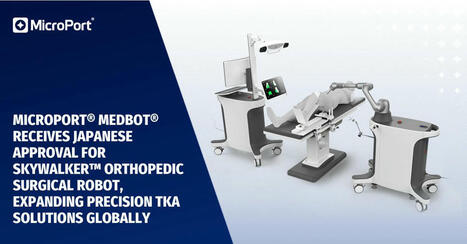
MicroPort MedBot innovative SkyWalker® Orthopedic Surgical Robot has received approval in Japan!
|
|
Scooped by
Gilbert C FAURE
November 7, 2024 6:36 AM
|
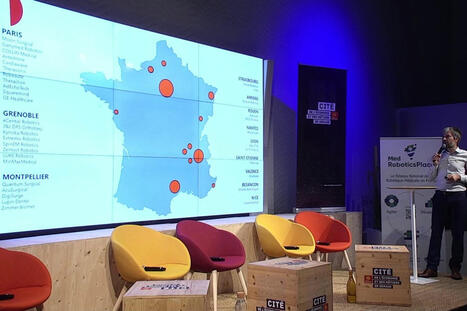
Let's map together the French ecosystem in medical robotics!
What medtech company in medical, surgical or intervential robotics I am missing in this… | 42 comments on LinkedIn
|
|
Scooped by
Gilbert C FAURE
November 1, 2024 6:44 AM
|
The field of orthopedic surgery has experienced transformative advancements over recent years, with robotic-assisted surgery emerging as a g...
|
|
Scooped by
Gilbert C FAURE
October 16, 2024 5:17 AM
|
Robotic surgery has revolutionized the field of medicine, offering unparalleled precision, less invasive techniques, and faster recovery times.However, despite its many advantages, robotic-assisted…...
|
|
|
Scooped by
Gilbert C FAURE
December 25, 2024 4:37 AM
|
🤖🩺 Fibot: The Intestinal Nanobot Revolutionizing Medicine
✅✅ Fibot, a biodegradable nanobot, is breaking new ground in medicine by delivering targeted drug… | 15 comments on LinkedIn
|
|
Scooped by
Gilbert C FAURE
December 19, 2024 6:57 AM
|
Toumai® single-arm single-port laparoscopic surgical robot
Since the first human clinical procedure in November 2022, the Toumai® Single-Arm Single-Port…
|
|
Scooped by
Gilbert C FAURE
December 11, 2024 8:08 AM
|
|
|
Scooped by
Gilbert C FAURE
December 10, 2024 7:51 AM
|
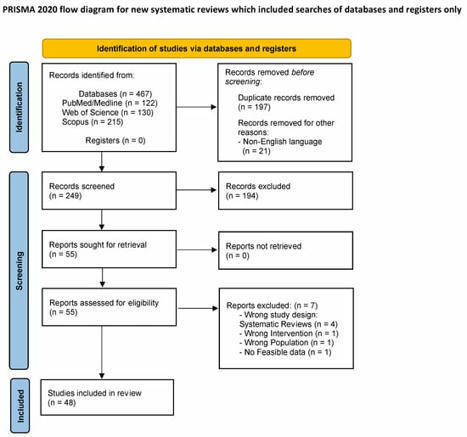
Background/Objectives: Robotic-assisted surgery has revolutionised modern medicine, enabling greater precision and control, particularly in microsurgical procedures. This systematic review evaluates the current state of robotic-assisted surgery across various specialties, focusing on four major...
|
|
Scooped by
Gilbert C FAURE
December 3, 2024 4:41 AM
|
Je ne le dirai jamais assez : en France, on est plutôt bien situé dans le panorama de la robotique chirurgicale et interventionnelle !
Un écosystème…
|
|
Scooped by
Gilbert C FAURE
November 21, 2024 1:31 PM
|
A New York woman diagnosed with COPD is the world's first recipient of a fully robotic double lung transplant. NYU Langone Health surgeons performed the groundbreaking procedure last month.
|
|
Scooped by
Gilbert C FAURE
November 21, 2024 4:16 AM
|
This paper presents the design of a multi-axis capacitive tactile force sensor with a fully decoupled output response for input normal and shear forces. A patterned elastomer is used as a dielectric layer between capacitive electrodes of the sensor that allows to achieve relatively higher...
|
|
Scooped by
Gilbert C FAURE
November 21, 2024 4:15 AM
|
The following is a summary of “Competency, Proficiency, and Mastery Learning Curves for Robotic Distal Pancreatectomy at 16 International Expert Centers,” published in the November 2024 issue of Surgery by Müller et al.
|
|
Scooped by
Gilbert C FAURE
November 14, 2024 3:29 AM
|
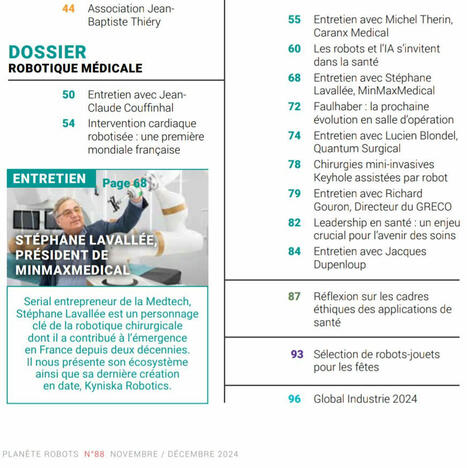
Y a -t-il un robot dans la salle d'opération?
Y aura-t-il encore demain un chirurgien ?
La robotique médicale à la Une du n°88 de Planète Robots.
J'ai le…
|
|
Scooped by
Gilbert C FAURE
November 8, 2024 5:13 AM
|
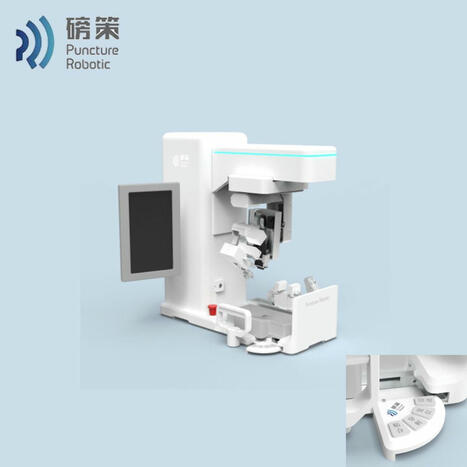
There is a new category of medical robots: automated blood drawing systems.
Founded in 2019 and with over $30 million raised since its incorporation…
|
|
Scooped by
Gilbert C FAURE
November 3, 2024 10:25 AM
|
Robotics for Eye Surgery
California-based startup Horizon Surgical Systems announced a $30 million Series A financing round led by ExSight Ventures and a…
|
|
Scooped by
Gilbert C FAURE
November 1, 2024 6:43 AM
|
robotic surgery, spinal fusion,surgical revision, pedicle screws, reoperation rate,meta-analysis comparison, literature review,surgical technique...
|


 Scoop.it!