Your new post is loading...

|
Scooped by
mhryu@live.com
August 14, 12:36 AM
|
The rapid increase in global plastic production over the past century has led to a severe environmental crisis, characterized by widespread contamination of terrestrial, freshwater, and marine ecosystems. Recently, microbial and enzymatic degradation has emerged as a promising alternative to conventional plastic waste management owing to its environmentally friendly nature and mild operational conditions. However, this approach still faces several critical challenges, including overinterpretation of degradation evidence, incomplete mechanistic understanding, and limited validation of true biodegradation. This review adopts a critical perspective to evaluate whether reported biodegradation is experimentally reliable and biologically meaningful. We synthesize recent advances in the biodegradation of both hydrolysable and non-hydrolysable plastics polymers, with specific emphasis on polymer-specific degradation mechanisms, analytical limitations, and methodological strategies for distinguishing genuine degradation from apparent surface deterioration. We further discuss emerging issues that determine practical relevance, including effects of contaminants in real plastic waste and divergent biodegradation behaviors of macroplastics and microplastics. By integrating mechanistic insights with rigorous evaluation criteria, this review provides a framework for advancing plastic biodegradation research from descriptive screening toward reliable validation and practical application.
|
|
Scooped by
mhryu@live.com
August 14, 12:26 AM
|
Saccharomyces cerevisiae is a keystone host for biomanufacturing, yet its metabolic engineering is often complicated by the crosstalk between heterologous pathways and native metabolism. In particular, allocating and balancing the universal reducing equivalents nicotinamide adenine dinucleotide (phosphate) (NAD(P)H) typically requires laborious genetic modifications. To address this challenge, we established an orthogonal redox cofactor infrastructure in S. cerevisiae based on nicotinamide mononucleotide (NMN(H)), which is decoupled from the host's NAD(P)H-based metabolism. Because NMN(H)-dependent pathway networks comprise only a small number of user-defined reactions, their optimization is substantially simplified. First, by rewiring glycolysis to eliminate NAD(P)H generation from glucose, we repurposed glucose as a dedicated electron source for NMNH reducing power. We then demonstrated that NMN(H) selectively drives the reduction of citral to citronellal, both unstable aldehydes, while suppressing the rapid over-reduction to alcohols observed with native cofactors without identifying or disrupting the numerous endogenous alcohol dehydrogenases in resting S. cerevisiae cells. Finally, we engineer S. cerevisiae to accumulate an intracellular NMN+ pool of ∼2.9 mM, comparable to NAD+ intracellular levels, enabling the first self-sustained, new-to-nature redox cofactor system in a eukaryotic organism. This work establishes NMN(H) as a functional third nicotinamide-based redox cofactor in yeast and provides a generalizable eukaryotic platform for orthogonal redox biocatalysis.
|
|
Scooped by
mhryu@live.com
August 14, 12:15 AM
|
Following advances in the field of natural language processing related to the transformer and the attention mechanism, many large language models have been trained using DNA and protein databases. While these models are designed for next-token prediction with the goal of generating novel sequences, researchers have found that the intermediate representations, or embeddings, of the DNA and amino acid sequences as they pass through these models can be mined for biological insights. Recently, more emphasis has been placed on studying the models' embeddings than model outputs. Genome language model embeddings have been used to predict the severity of single nucleotide variants, intron/exon boundaries, and anti-CRISPR activity. Protein language model embeddings have been used for predicting remote homology, protein structure, and protein function. These findings demonstrate that model embeddings provide a high-resolution, alignment-free framework for understanding the genome and proteome, and offer a transformative approach to enzyme engineering and functional genomics.
|
|
Scooped by
mhryu@live.com
August 13, 11:57 PM
|
For single-celled organisms, the cell envelope is the thin barrier between life and death, responding dynamically to both the ever-expanding self and the ever-changing environment. Failure to balance these responses can lead to disastrous consequences, such as lysis. In gram-negative bacteria, the cell envelope is tripartite, consisting of two lipid bilayers with the periplasm, an aqueous space containing the thin peptidoglycan sacculus, between them. The outer of these lipid bilayers—aptly called the outer membrane—is asymmetric, bearing phospholipids on the inner leaflet and lipopolysaccharide (LPS) on the outer leaflet. Surface-exposed, highly immunoreactive, and essential to nearly all tested gram-negative bacteria, the overall architecture of LPS is largely conserved, but its modifications are subject to a myriad of variations. LPS has been studied extensively for its roles in pathogenesis and immunobiology and as a target of potential novel antibiotics. However, LPS exists in both free-living and pathogenic bacteria, suggesting it plays a critical role in bacterial physiology independent of the host. This aspect of LPS biology and its contribution to overall gram-negative cell physiology remains an area of active investigation. Addressing this gap, here we describe recent work detailing the essential contributions of LPS to bacterial physiology: particularly its role in cell envelope rigidity, its contributions to outer membrane capacity and fluidity, and the mechanisms integrating LPS synthesis into diverse aspects of cell envelope biogenesis during growth and division. We end with a discussion of the subset of gram-negative organisms that survive—either naturally or through genetic manipulation—in the absence of LPS and the adaptations that make this possible.
|
|
Scooped by
mhryu@live.com
August 13, 11:23 PM
|
Fungal virulence factors (VFs) are proteins that support host colonization, tissue invasion, immune modulation, and disease progression. Identifying candidate VFs across pathogenic fungi can help characterize mechanisms underlying fungal-host interactions and prioritize proteins for experimental investigation. We developed FunVFPred, a machine learning framework that uses UniRep protein sequence embeddings, and multiple classifiers to predict candidate fungal VFs. Using experimentally validated VFs from human-pathogenic Candida species, the random forest model achieved 73.4% accuracy and a Matthews correlation coefficient (MCC) of 0.47 in 5-fold cross-validation. Evaluation on an independent Aspergillus fumigatus dataset yielded 85.7% accuracy and an MCC of 0.71, demonstrating the potential for cross-species prioritization of virulence-associated proteins. FunVFPred provides an accessible computational resource for investigating fungal pathogenicity and guiding the selection of candidate proteins for downstream experimental validation.
|
|
Scooped by
mhryu@live.com
August 13, 4:46 PM
|
Mechanistic model of phage-induced premature sporulation in spatially structured B. subtilis populations. The resulting dense sporulation ring acts as a physical barrier that abruptly halts plaque expansion, serving as a short-term collective defense mechanism for the bacterial population. Only the infection-induced model (Model V) fully recapitulated the experimentally observed spore density distribution.
|
|
Scooped by
mhryu@live.com
August 13, 4:25 PM
|
Lysine acylation has emerged as a rapidly expanding family of post-translational modifications PTM that directly links cellular metabolism to protein regulation. Beyond lysine acetylation, advances in mass spectrometry and chemical biology have uncovered a diverse repertoire of acyl modifications spanning short-chain, branched, unsaturated, aromatic, and dicarboxylic groups. Together these modifications establish lysine acylation as a molecular interface through which metabolic state can shape protein function, chromatin regulation, and cell signaling. Yet fundamental questions remain regarding their biological significance, enzymatic regulation, site specificity, and whether many acylations function as bona fide regulatory signals or reflect metabolite-driven mechanisms. Here, we synthesize the current understanding of the metabolic origins, structural and biochemical properties, and their writer, reader, and eraser systems that govern lysine acylations. We further highlight emerging chemical biology approaches for detecting, manipulating, and functionally interrogating acyl marks and discuss the conceptual and technological advances needed to distinguish closely related modifications and establish their causal biological roles.
|
|
Scooped by
mhryu@live.com
August 13, 4:09 PM
|
Biomass separation represents a critical bottleneck in Komagataella phaffii-based biopharmaceutical processes, as typically high cell densities of 40–50 % create significant operational, technical and economic challenges for harvest operations. Yeast cell aggregation (flocculation) provides a solution to accelerate cell sedimentation by increasing particle size, thus allowing to improve biomass-supernatant separation efficiency during both natural gravity settling and (continuous) centrifugation operations. This study demonstrates successful engineering of K. phaffii strains with an inducible flocculation phenotype using CRISPR/Cas9-based genome editing to integrate the Saccharomyces cerevisiae FLO1 (ScFLO1) gene under control of various regulatory elements, including methanol-inducible and derepressible promoters. Flocculation strength could be enhanced by implementing transcriptional positive feedback circuits based on the methanol-inducible AOX1 promoter. To address methanol-free production requirements, we developed alternative systems to retrofit PAOX1-based ScFLO1 expression and exploited the derepressible PDF promoter, offering broader compatibility with biopharmaceutical manufacturing facilities. Flocculating cells cultivated in a bioreactor demonstrated significantly improved sedimentation behavior, with considerably lower supernatant turbidity after short low-speed centrifugation or gravity sedimentation compared to non-flocculating controls. Crucially, cell flocculation had no negative impact on product amount and quality when expressing a multivalent NANOBODY® VHH molecule with pharmaceutical relevance. Thus, this work establishes the first genetically engineered flocculation system in K. phaffii compatible with recombinant protein production, providing the basis for an innovative approach to streamline harvest operations in biopharmaceutical processes.
|
|
Scooped by
mhryu@live.com
August 13, 4:02 PM
|
Subterranean estuaries (STEs) are key bioreactors regulating the quantity and chemical composition of groundwater-derived nitrogen (N) reaching coastal ecosystems. Yet, the microbial controls on N-cycling within these groundwater–seawater mixing zones remain poorly understood. We investigated the spatio-temporal variations in microbial communities and their N-cycling potential within an alluvial Mediterranean STE with high N concentration. We explored changes in microbial abundance, heterotrophic activity, taxonomic composition, and the abundance of N-cycling genes across groundwater samples collected at several depths and distances from the shoreline in winter and summer. Microbial abundance, activity, and diversity varied strongly across hydrochemical zones according to physicochemistry and aquifer depth but showed limited seasonality. Functional predictions suggested a complex, spatially structured suite of N pathways encoded by diverse taxa occupying different STE zones, and quantitative-PCR revealed niche partitioning between ammonia-oxidizing archaea, prevalent in fresh-groundwater, and bacterial denitrifiers enriched in deep-saline layers. Multiple linear model predictions showed a stronger fit for NO2− and NH4+ concentrations when using microbial properties than when using environmental variables, highlighting their importance for understanding N cycling in STEs. Our results suggest that the functional potential of the STE microbiome is complex and spatially structured across hydrochemical zones, explaining spatial variations in STE N-cycling.
|
|
Scooped by
mhryu@live.com
August 13, 3:49 PM
|
Cold chains are essential to food security and global health. At NanoFreeze, a Colombian start-up, we are developing a sustainable cold-chain preservation and energy-efficient refrigeration technology based on a bacterial ice-nucleation protein. Here, we reflect on how intellectual property, regulatory validation and strategic partnerships shaped our path from biological insight to translation in an emerging economy.
|
|
Scooped by
mhryu@live.com
August 13, 3:40 PM
|
Accurately characterizing metagenome-assembled genomes remains a substantial challenge due to the presence of sequencing errors, incomplete assembly and contamination. Here, we present MetaSBT, a tool for organizing, indexing and characterizing microbial reference genomes and metagenome-assembled genomes, demonstrated in this study using viruses. MetaSBT identifies clusters of genomes across all seven taxonomic levels using the Sequence Bloom Tree data structure, which relies on Bloom filters to index large amounts of genomes based on their k-mer composition. We built an initial set of databases composed of over 190,000 viral genomes from public sources, grouped into sequence-consistent clusters at different taxonomic levels. We defined over 40,000 candidate species, ~80% of which, to our knowledge, do not match viral species in reference databases to date. Furthermore, we showed that our databases are useful to existing quantitative metagenomic profilers to unlock the detection of unknown microbes and the estimation of their abundance in metagenomic samples. The open-source framework and databases are fully integrated into the Galaxy platform. A k-mer-based clustering framework is used for constructing a scalable, updatable taxonomy of viral genomes.
|
|
Scooped by
mhryu@live.com
August 13, 3:09 PM
|
Human microbiota is increasingly considered to shape health and disease, drawing interest of pharma and biotech industries in advanced models of in vitro human microbiome to streamline drug development. In this context, Universal-Bac3Gel represents a new generation of 3D biomaterials designed to mimic the properties of human mucus and biofilm features, including micro-gradients that replicate the heterogeneous environments colonized by microorganisms in the human body. To evaluate the suitability of Universal-Bac3Gel for studying clinically relevant species in antimicrobial resistance, the so-called ESKAPE pathogens (Enterococcus faecium, Staphylococcus aureus, Klebsiella pneumoniae, Acinetobacter baumannii, Pseudomonas aeruginosa, and Enterobacter cloacae) were cultured within this 3D environment. Bacterial growth was monitored at 24- and 48-h post-inoculation via spot plating, while viability, spatial distribution, and organization were assessed by confocal laser scanning microscopy. All ESKAPE strains successfully grew throughout the structure of Universal-Bac3Gel. Distinct 3D biofilm architectures were observed across species, ranging from diffuse colonization to compact microcolony formation, in agreement with species-specific biofilm patterns. Ciprofloxacin susceptibility assays revealed reduced susceptibility of bacteria cultured within Universal-Bac3Gel compared with their planktonic counterparts, supporting the development of biofilm-associated tolerance phenotypes. Consistent with these findings, crystal violet staining confirmed the accumulation of biofilm-associated biomass within the hydrogel. Notably, the platform's ready-to-use 96-well format allowed direct comparison of these high-priority pathogens under standardized conditions, highlighting species-specific biofilm traits that would be difficult to discern in conventional two-dimensional culture systems. This work highlights the versatility of Universal-Bac3Gel as a biofilm-relevant in vitro platform for studying pathogen colonization, biofilm development and antimicrobial susceptibility under controlled conditions.
|
|
Scooped by
mhryu@live.com
August 13, 2:55 PM
|
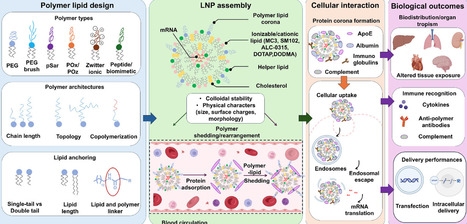
Lipid nanoparticles (LNPs) have rapidly emerged as the leading delivery platform for nucleic acid therapeutics due to their high encapsulation efficiency, scalable manufacturing, and clinical success in siRNA and mRNA medicines. Poly(ethylene glycol)-lipids ((PEG)–lipids) have been central to this progress by providing steric stabilization, size control, and tunable biodistribution. However, PEGylation also introduces important limitations, including complement activation, pre-existing and treatment-induced anti-PEG antibodies, and accelerated blood clearance, which increasingly constrain repeated and long-term dosing strategies. This review focuses on recent advances in PEG-alternative LNP designs, including non-PEG polymers, zwitterionic and biomimetic lipids, polypeptides, and structurally modified PEG analogues. We compare how polymer chemistry, anchor geometry, and grafting architecture influence LNP formation, physicochemical properties, biodistribution, cellular uptake, and immunological outcomes. Moreover, we discuss key challenges that remain in translating PEG-free and PEG-modified LNPs toward clinical application and propose future directions to better understand in vivo behavior and enable rational design of next-generation stealth LNPs. Overall, PEG lipid alternatives should not be viewed as simple PEG mimics, but as distinct surface-engineering materials that create new nano-bio interfaces and reshape LNP behavior in biological systems.
|
|
|
Scooped by
mhryu@live.com
August 14, 12:30 AM
|
Precision engineering of biological systems requires multi-layered control of gene expression, where translational regulation serves as a critical intermediary balancing response speed and metabolic cost. This review explores the multi-faceted landscape of translation engineering across its initiation, elongation, and termination phases. We evaluate how the architecture of the 5’-UTR and mRNA folding dictate initiation rates, how synonymous codon optimization and ribosome-stalling kinetics influence elongation speed, and how termination-level interventions, such as stop-codon readthrough and mRNA decay, modulate final protein yields. This review underscores the transition from trial-and-error tuning to the rational design of translational landscapes, offering a roadmap for developing sophisticated synthetic biological systems tailored for smart biomanufacturing and precision medicine.
|
|
Scooped by
mhryu@live.com
August 14, 12:23 AM
|
Marker-free genome engineering remains an important objective in the metabolic engineering of Komagataella phaffii, particularly for the construction of stable and regulatory-compliant industrial production strains. Here, we present MAPS, a marker-free auxiliary plasmid-assisted strain engineering system for K. phaffii, enabling antibiotic-free strain engineering and rapid assembly of multi-gene production strains. MAPS achieved integration efficiencies of up to 1.8% and facilitated the generation of stable recombinant strains without permanent selection markers. As a proof-of-principle application, we established a co-production platform combining intracellular biosynthesis of natural pigments with secretion of an industrial enzyme in a single fermentation process. Using beetroot (Beta vulgaris) betalain pigments as model metabolites and Candida antarctica lipase B (CalB) as an enzyme, strains were engineered for simultaneous pigment biosynthesis and protein secretion. This work further establishes betanin biosynthesis in K. phaffii. Formation of fully glycosylated betanin was confirmed by absorption spectroscopy and HPLC–MS analysis and required co-overexpression of Dorotheanthus bellidiformis betanidin-5-O-glucosyltransferase (DbGT) together with ascorbic acid supplementation. Using a derepressible promoter, CalB secretion was assessed before and after methanol-induced pigment production. Bioreactor cultivations yielded up to 215 mg L−1 betalain pigments in the culture supernatant. Importantly, betalain co-production did not adversely affect CalB secretion in shake-flask or bioreactor cultivations, and CalB could be efficiently purified from pigment-containing supernatants, demonstrating compatibility with downstream processing. Together, these results establish MAPS as a versatile platform for marker-free engineering of K. phaffii and its applicability for constructing multi-product production strains combining enzyme secretion and metabolite biosynthesis in a single microbial host.
|
|
Scooped by
mhryu@live.com
August 14, 12:06 AM
|
The high production cost of biosurfactants remains a major obstacle to their large-scale industrial application compared with synthetic surfactants. Although numerous studies have focused on optimizing biosurfactant production, the upstream isolation stage remains comparatively underexplored, despite its critical role in recovering efficient microbial producers. In this study, a multiparametric isolation strategy was developed to evaluate the influence of carbon source, carbon source concentration, pH, and temperature on the recovery of biosurfactant-producing bacteria from hydrocarbon-contaminated soil. The optimal isolation conditions were identified as diesel at 2% (v/v), pH 7, and 30 °C. Isolates recovered under these conditions were subsequently screened using hemolysis, oil spreading, drop collapse, and emulsification index (E24) assays. Among the 21 strains evaluated, strain 15 exhibited the strongest overall biosurfactant-related activity, including the highest E24 value and a marked reduction in surface tension to 25.10 ± 0.40 mN/m. Molecular identification based on 16S rRNA gene sequencing revealed 99.83% similarity with Rhodococcus ruber DSM 43338. These results demonstrate that optimizing isolation conditions can improve the recovery of promising biosurfactant-producing bacteria and reduce the selection bias associated with standard isolation protocols. Overall, this study highlights the methodological relevance of upstream isolation optimization as an effective strategy for biosurfactant screening and strain discovery.
|
|
Scooped by
mhryu@live.com
August 13, 11:44 PM
|
The topology of RNA therapeutics is emerging as a critical design dimension in precision oncology. Unlike linear mRNA, circular RNA (circRNA) lacks free ends, conferring exceptional resistance to exonuclease degradation and enabling sustained protein expression for days to weeks. Beyond their use as engineered therapeutics, endogenous circRNAs exhibit cancer-associated expression patterns and persistence in biofluids, supporting complementary roles in tumor biology and as candidate biomarkers for diagnosis and longitudinal disease monitoring. This review argues that circular topology should be viewed as an active pharmacologic variable, not merely a stability enhancement. We dissect recent advances in cap-independent translation initiation, including IRES elements and m6A-driven mechanisms, rolling-circle translation for multi-epitope vaccine design, and programmable stability circuits that integrate tumor-microenvironment cues such as miRNA signatures. Delivery innovations are equally transformative: antibody-guided lipid nanoparticles and engineered extracellular vesicles enable increasingly selective RNA delivery, while local depot formulations and organ-selective systemic routes expand therapeutic reach. Safety considerations are re-evaluated as double-edged tools—innate immunogenicity can serve as a self-adjuvant for cancer vaccines, whereas back-splice-junction neoantigens offer both vaccine opportunities and tolerance risks. Recent advances in scarless circularization, topology-sensitive purification, dsRNA depletion, and lyophilized formulations have begun to address key manufacturing bottlenecks, although clinical-scale recovery and process scalability remain insufficiently characterized. Key applications include circRNA cancer vaccines, transient CAR-T/NK cell engineering, tumor-suppressor replacement, and circRNA-encoded bispecific T-cell engagers. The field now requires real-time pharmacokinetic tracking, reproducible and scalable manufacturing, validated liquid-biopsy assays, and indication-specific regulatory pathways to translate circRNA from bench to bedside.
|
|
Scooped by
mhryu@live.com
August 13, 11:21 PM
|
Polynucleotide phosphorylase (PNPase) is a highly conserved exoribonuclease crucial for RNA degradation across all domains of life. In bacteria, PNPase is found in multi-protein ribonucleolytic complexes that include glycolytic enzymes. While evidence supports a link between RNA degradation and glycolysis in E. coli, the precise contribution of PNPase and the underlying regulatory mechanism remain unknown. Here we establish PNPase as a metabolic sensor that physically and functionally links glycolysis to RNA stability. We find that the intermediate of glycolysis, fructose 1,6-diphosphate, binds to and inhibits E. coli PNPase activity in vitro. This inhibition is confirmed in vivo, where increasing the levels of this metabolite compromises growth and globally prolongs RNA half-lives in an E. coli strain where PNPase is essential for growth. Bacterial two-hybrid and in vivo crosslinking followed by immunoprecipitation suggest potential interaction between PNPase and multiple glycolytic enzymes. Our results propose a mechanism where RNA phosphorolysis by PNPase, an energy-saving RNA degradation pathway, is directly modulated by a glycolytic metabolite and facilitated by metabolon association. This mechanism links the metabolic state of the cell to post-transcriptional control of gene expression. This regulatory system is likely exploited by other bacterial species relevant to human health, environment and industry, particularly those that rely on PNPase as the sole exoribonuclease. RNA degradation is linked to cellular metabolism, but the underlying mechanisms are not fully understood. Here, the authors show that the glycolytic metabolite fructose 1,6‑bisphosphate inhibits PNPase activity, connecting metabolic state to RNA stability and post‑transcriptional gene regulation in bacteria.
|
|
Scooped by
mhryu@live.com
August 13, 4:43 PM
|
Plant–microbe interactions are spatially organized processes. Increasing evidence suggests that nutrients play a critical role in this organization by not only acting as resources but also as spatial signals. In plants, nutrient perception and signaling are spatially patterned across tissues, while in microbes, local nutrient conditions guide colonization, metabolism, and function. These responses create heterogeneous interaction niches at the plant–microbe interface, but how they are coordinated across individual cells remains unclear. Recent advances in single-cell, spatial omics and nutrient mapping approaches now enable these processes to be resolved at cellular resolution. Here, we bring together current understanding of nutrient-guided plant and microbial responses and highlight emerging technologies that allow their integration. We then introduce a cell-state framework to interpret plant–microbe interactions as emergent properties of spatially coupled cellular responses linked through local chemical environments. This perspective provides a foundation for a more mechanistic and predictive understanding of plant–microbe interactions.
|
|
Scooped by
mhryu@live.com
August 13, 4:16 PM
|
For most organisms, we rely on the ability to observe them from birth to death in order to fully understand their ecology, life cycles, adaptations, and interactions with other organisms. For fungi, this is a challenge, and little is known about how old they can become and in what form they persist in the environment. In this opinion article, we highlight the complexity of determining the longevity of fungi. We provide an overview of how the age of fungal individuals and the persistence of mycelial structures have been measured in different groups of fungi. Finally, we propose ideas for advancing the study of fungal longevities and discuss how differences in fungal longevity and mycelial persistence can impact the ways we study and manage fungi in ecosystems.
|
|
Scooped by
mhryu@live.com
August 13, 4:05 PM
|
Lactic acid bacteria (LAB) are globally recognized for their essential roles in food fermentation and impact on human health. Recent evidence identifies bacterial extracellular vesicles (EVs) as unique functional entities, serving as key mediators in microbe-host interactions. LAB-EV biogenesis is primarily driven by mechanisms that compromise cell-wall integrity, including prophage-encoded holin-endolysin systems and autolysin activity. EVs as nano-sized particles exert diverse beneficial effects by inhibiting pathogens, shaping microbiota composition, reinforcing the intestinal epithelial barrier, and modulating host immunity. Their ability to cross biological barriers and reach distal organs also implies systemic impacts. Consequently, LAB-EVs are emerging as a versatile platform for next-generation postbiotics and delivery systems, capable of protecting and transporting bioactive compounds. The interpretation of the effects conveyed by LAB-EVs requires critical considerations regarding mechanistic depth and cargo heterogeneity. A so-far overlooked factor is the influence of bacteriophage elements, which can influence both biogenesis pathways and host immune signatures. To successfully transition toward industrial and clinical applications, research must shift from observational studies to rigorous mechanistic evaluations and standardized production strategies, such as the use of prophage-cured strains or the development of artificial EV-mimics. This review synthesizes recent advances in LAB-EV biology and outlines the considerations necessary to harness these nano-couriers as valuable tools in modern biomedicine and food science.
|
|
Scooped by
mhryu@live.com
August 13, 3:55 PM
|
The bacterium Rubellimicrobium mesophilum possesses a blue light-using flavin (BLUF)-coupled endonuclease III (BLUF-EndoIII) with potential endonuclease activity. Interestingly, the crucial amino acid residues (tyrosine, histidine, and tryptophan) responsible for BLUF photocycle and photodynamics are replaced by phenylalanine (Y5F), asparagine (H27N), and alanine (W87A) residues, respectively. In the present study, we investigated the impact of this evolutionary plasticity on BLUF photodynamics and the associated endonuclease activity. The results obtained showed that the residue exchanges within the BLUF domain influenced its functional aspects, including flavin binding, domain stability, recovery kinetics, and spectral characteristics. The evolutionary plasticity-induced changes in the flavin-binding pocket of the BLUF domain elevated the light-gated endonuclease activity associated with the EndoIII domain. Molecular docking analysis and spectroscopic studies confirmed the substrate-binding ability of BLUF-EndoIII. Elevated endonuclease activity suggested that the amino acid residues, previously deemed crucial for the BLUF photocycle, are indeed dispensable, and there might exist another pathway for BLUF domain activation and regulation of the associated endonuclease domain. Considering the role of endonucleases in bacterial defense, it is crucial to understand the BLUF photodynamics and mechanism of signal transfer to the downstream endonuclease domain. This understanding elucidates the functioning of the naturally occurring light-gated endonuclease BLUF-EndoIII in the bacterium Rubellimicrobium mesophilum.
|
|
Scooped by
mhryu@live.com
August 13, 3:44 PM
|
Soil biodiversity underpins ecosystem functioning and plant health, yet the incredible diversity of below-ground microorganisms remains largely overlooked in conservation efforts. This Comment outlines four key challenges to soil microbial conservation and emphasizes the importance of addressing them to safeguard soil biodiversity.
|
|
Scooped by
mhryu@live.com
August 13, 3:24 PM
|
The phylogeny of the Archaea continues to be revisited and revised as new groups are discovered and phylogenetic methods improve, but key questions about their early evolution remain unanswered. It has been suggested that the root of the Archaea may lie on, or potentially within, any of three major groups - the Euryarchaeota, TACK+Asgard clade, and DPANN, the last of which includes many host-associated and genome-reduced lineages. These root hypotheses make starkly different predictions about the nature of early archaeal evolution: for example, a root on or within DPANN might suggest a small-genome and host-associated ancestor, with methanogenesis, the hallmark metabolism of the Archaea, evolving later. Here, we investigate the position of the archaeal root and the nature of the last archaeal common ancestor using a range of phylogenetic approaches, including the best available site- and branch-heterogeneous substitution models, and new gene tree-species tree reconciliation models that capture changes in rates of gene duplication, loss and transfer across the phylogeny. Our analyses converge on a narrow archaeal root region at or near the base of the Euryarchaeota, supporting hypotheses in which the Last Archaeal Common Ancestor (LACA) was a complex, free-living (hyper-)thermophilic methanogen. We recover DPANN as the sister group to TACK and Asgard archaea, and suggest that their genome evolution has been characterised by episodes of genome streamlining and expansion, driven by gene loss and transfer. Key questions about the early evolution of archaea remain unanswered. Here, Huang et al. use improved methods of genome evolution to propose a euryarchaeal root for archaea, a methanogenic ancestor, and several episodes of genome reduction and expansion, with many symbionts having experienced extensive gene loss.
|
|
Scooped by
mhryu@live.com
August 13, 3:03 PM
|
Earth’s rotation produces day and night cycles that are a primary selective pressure driving the evolution of endogenous circadian clocks. Cyanobacteria are the most studied prokaryotic model, and their timekeeping core is a protein oscillator composed of KaiA, KaiB, and KaiC. This oscillator sustains a near-24 h rhythm independently of transcription–translation feedback, challenging the long-standing assumption that prokaryotes merely respond passively to environmental cues. Moreover, it offers unique insights into the evolution and operational logic of circadian clocks. This review summarizes advances in cyanobacterial circadian research. We first analyze the KaiABC oscillator’s molecular basis, including synergistic conformational changes, phosphorylation and dephosphorylation cascades, and temperature compensation, which confer robustness and tunability. We compare oscillator compositions across cyanobacterial lineages, showing evolutionary plasticity. We then outline input and output networks, clarifying how environmental signals reset the oscillator phase and how temporal information is relayed to downstream processes. We further explain how the clock coordinates photosynthesis, nitrogen fixation, respiration, and cell division through predictive regulation, temporal decoupling, and resource prioritization, thereby resolving metabolic conflicts and enhancing fitness under light and dark cycles. This framework provides a theoretical basis for microbial survival strategies in fluctuating environments and offers insights for synthetic biology circuit design. Finally, we discuss open questions, including coupling between the oscillator and the cell cycle, functional divergence among ecotypes, and roles at the community level. Further research on the cyanobacterial clock will help clarify general principles of biological timing and its evolutionary origins.
|