Your new post is loading...

|
Scooped by
mhryu@live.com
September 12, 7:48 PM
|
Iron is an essential trace element for most organisms on earth including bacteria. However, iron in the environment generally occurs in its ferric (Fe3+) form and is therefore not bioavailable. To capture ferric iron, many bacteria produce siderophores — a class of secreted secondary metabolites that scavenge iron from natural sources and allow iron uptake via specific transporters. As secreted molecules, siderophores inevitably affect other community members, and recent evidence suggests that siderophores play important roles in shaping interaction networks between strains and species in complex communities. In this review, we first explain how siderophores induce ecological interactions among bacteria ranging from mutualism to exploitation to competition. Subsequently, we elaborate on how physicochemical properties of siderophores, like production rates, diffusibility, stability, iron affinity, and chemical specificity, influence the type and strength of siderophore-mediated interactions. Finally, we introduce various scenarios to illustrate how siderophore interaction networks and community building can arise. We conclude our review by highlighting that our knowledge of siderophore interaction networks is restricted to a few taxa that were studied in detail, and that future work should break this limitation by studying the role of siderophore-mediated interactions at the microbiome scale.
|
|
Scooped by
mhryu@live.com
September 12, 4:52 PM
|
Precise manipulation of the gut microbiota is complex. This study explored its circadian regulation in ruminants via time-restricted feeding. We collected 287 fecal samples (every 6 h for 48 h) from 12 lactating cows under ad libitum, daytime-restricted, and nighttime-restricted feeding. Microbiota analysis revealed rhythmic fluctuations in hindgut bacterial populations. Under feeding restrictions, 39.25% of bacterial genera (e.g., Bifidobacterium, Prevotella) shifted rhythms in response to feeding time, while 3.90% (e.g., Succinivibrio) did not. Fecal short-chain fatty acids (SCFA) and ammonia nitrogen (NH3-N) concentrations also exhibited circadian rhythms, peaking 6 h apart. Metatranscriptomics showed daily dynamics in active bacteria, archaea, eukaryotes, and bacteriophages: active bacteria and bacteriophages peaked at 08:00 and 02:00, whereas active archaea peaked at 14:00. A more active microbial community coincided with high SCFA concentration (08:00), reflected by elevated expression of genes for carbohydrate-active enzymes, antibiotic resistance, virulence, and quorum sensing. Conversely, gene expression for nitrogen metabolism, sulfur metabolism, and bacterial secretion peaked with NH3-N (14:00). Our findings reveal circadian rhythm-responsive features and daily shifts in the active microbiome, offering a mechanistic basis for hindgut microbiome dynamics and fermentation in ruminants, with implications for microbiota manipulation in other mammals.
|
|
Scooped by
mhryu@live.com
September 12, 4:42 PM
|
Caffeic acid, a natural phenolic acid with antioxidant and antibacterial properties, is a high-quality natural additive widely used in various food processing. In this study, the probiotic E. coli Nissle 1917 was selected as the host for producing caffeic acid. First, the competitive branch of the precursor l-tyrosine was blocked, resulting in the mutant strain WNZ05. Then, the quorum sensing system was introduced into WNZ05 to dynamically supply l-tyrosine, which was used as a switch plasmid to coordinate the expression of FjTAL, hpaBC, and ycjP. The SAM5 gene was also introduced to reduce the intermediate products p-coumaric acid, achieving efficient flow of the metabolic pathway toward caffeic acid. Ultimately, the engineered strain produced 1.87 g/L caffeic acid in shake flasks and a record 13.92 g/L via fed-batch fermentation in a 2.5 L bioreactor, the highest microbial yield reported to date.
|
|
Scooped by
mhryu@live.com
September 12, 4:28 PM
|
Synthetic consortia is an emerging field in biotechnology, offering advantages such as division of labor between the individual members and reduced risk of contamination. Consortia combining phototrophic and heterotrophic bacteria are attractive, as phototrophs can utilize CO₂ and light energy to sustain growth. Several studies have explored such systems where sucrose is most commonly used as the provided carbon source. An alternative is acetate, a smaller two-carbon molecule produced as a by-product by many microorganisms, including the model cyanobacterium Synechocystis PCC 6803 (thereafter Synechocystis). Although acetate production during phototrophic growth is typically low, previous studies have demonstrated that metabolic engineering—specifically the introduction of phosphoketolase (PK) and overexpression of phosphotransacetylase (Pta)—enabled the development of a high-producing strain (WT_PKPa_RBS_BsPta_Δacs) capable of secreting significant levels of acetate into the medium. In this study, E. coli and Pseudomonas taiwanensis were engineered to produce 1-butanol, an industrially relevant bulk chemical, and cultivated using acetate as the sole carbon source. These strains were then individually co-cultivated with the previously engineered Synechocystis strain, WT_PKPa_RBS_BsPta_Δacs, forming two distinct consortia that were maintained for 42 days. Growth dynamics were successfully monitored, and acetate concentrations in the consortia were lower than in a corresponding axenic Synechocystis culture. At the same time, 1-butanol production was detected in the two co-cultures, demonstrating the feasibility of coupling photosynthetically derived acetate to heterotrophic production of a value-added bulk chemical.
|
|
Scooped by
mhryu@live.com
September 12, 4:23 PM
|
Genome and metagenome mining have uncovered large repertoires of predicted bacteriocin loci, but ecological interpretation has lagged behind discovery. This review uses bacteriocins as a focused model for a broader problem in antimicrobial gene prediction: sequence identifies encoded potential, but it does not establish expression, product deployment, target engagement, or community-level consequence. We distinguish four forms of bacteriocin “silence”: transcriptional silence, where loci are not detectably expressed under tested conditions; conditional silence, where expression or activity emerges only under specific environmental or social cues; phenotypic silence, where expression or product formation does not yield detectable activity in routine assays; and ecological silence, where activity is observed but its consequences for coexistence, exclusion, colonization, or community assembly remain unresolved. We also clarify how this framework extends previous reviews of bacteriocin diversity and microbiome-shaping roles by providing an inference-centered taxonomy that separates encoded potential from demonstrated ecological function. Finally, we propose a function-first roadmap for bacteriocin research, including condition-resolved transcriptomics and proteomics, promoter and cue-dissection experiments, expanded target panels, spatially structured assays, defined consortia and microcosms, producer/non-producer comparisons, and explicit tests of resistance, immunity, and fitness consequences. Treating predicted bacteriocin loci as hypotheses rather than conclusions will improve how the field moves from gene catalogs to causal ecological understanding.
|
|
Scooped by
mhryu@live.com
September 12, 3:53 PM
|
YdcI, a LysR-type transcription regulator, has been associated with various phenotypes related to stress response and metabolic adaptation in E. coli and Salmonella enterica.This work addresses regulation of specific target loci by YdcI as well as regulation of ydcI expression and YdcI synthesis in E. coli. DNA binding of YdcI to loci previously identified through ChIP-exo analysis in E. coli K12 was validated for 10 loci by electrophoretic mobility shift assays. Two of these loci, iraP and mqo, are regulated by YdcI as shown using promoter lacZ fusions, while regulation of the other loci is marginal, at least under the conditions tested. Our data suggest that YdcI acts as an H-NS antagonist at the H-NS repressed and (p)ppGpp-dependent stress-induced iraP promoter. Gene iraP encodes the RssB anti-adaptor protein IraP that prevents RssB-mediated targeting of RpoS for degradation. Gene mqo, which is repressed by YdcI, encodes the TCA cycle enzyme malate: quinone oxidoreductase. Other YdcI bound loci encode enzymes involved in the TCA cycle, as well as membrane transport proteins. Furthermore, the transcription of the ydcI gene itself is induced by the alarmone (p)ppGpp under phosphate stress conditions; it is not autoregulated, and a significant increase in YdcI protein levels occurs upon entry from early to mid-exponential growth phase. Taken together, aspects of regulation by YdcI and of ydcI expression as well as YdcI synthesis are presented that relate to its potential role in the response to abiotic stresses and control of metabolism in E. coli.
|
|
Scooped by
mhryu@live.com
September 12, 3:13 PM
|
Protein language models (pLMs) enable generative design of novel protein sequences but remain fundamentally misaligned with protein engineering goals, as they lack explicit understanding of function and often fail to improve properties beyond those found in nature. We introduce Reinforcement Learning from eXperimental Feedback (RLXF), a general framework that aligns protein language models with experimentally measured functional objectives, drawing inspiration from the methods used to align large language models like ChatGPT. Applied across five diverse protein families, RLXF improves generation of high-functioning variants beyond pre-trained baselines. We demonstrate this with CreiLOV, an oxygen-independent fluorescent protein, where RLXF-aligned models generate sequences with significantly enhanced fluorescence, including the most fluorescent CreiLOV variants reported to date. Our results indicate that RLXF-aligned models effectively integrate the evolutionary knowledge encoded in pre-trained pLMs with experimental observations, improving the success rate of generated sequences and enabling the discovery of synergistic mutation combinations that are difficult to identify through zero-shot or evolutionary approaches. RLXF provides a scalable and accessible approach to steer generative models toward desired biochemical properties, enabling function-driven protein design beyond the limits of natural evolution. Protein language models are powerful tools for generative protein design, but because they are trained solely on natural sequences, they often struggle to generate proteins with enhanced or non-natural functions. This work a general framework that aligns generative protein language models with experimentally defined functional objectives.
|
|
Scooped by
mhryu@live.com
September 12, 2:45 PM
|
Advances in soil microbiology have revealed that soil functions as a dynamic, living network that rapidly responds to plant physiological changes, coordinating signal transmission within farmland ecosystems. Under the framework of plant–soil feedback (PSF), plants can establish persistent soil legacies by modulating rhizosphere microbial communities, thereby conferring fitness benefits on subsequent plants. However, whether such below-ground legacy effects can operate across extended temporal scales and through spatially decoupled, soil-mediated pathways to regulate above-ground enemy recruitment (e.g., natural enemies of herbivorous insects) remains a fundamentally unresolved question. That is, the transduction mechanism by which below-ground microbial "inputs" are converted by plants into chemical-signal outputs, which ultimately determine the distribution and efficacy of natural enemies in ecosystems, remains poorly understood. Gao et al. recently addressed this question by investigating plant indirect defense mechanisms. Their study reveals an important and previously underappreciated ecological phenomenon: through PSF, foliar herbivory can enhance the capacity of undamaged plants to recruit parasitoid wasps. This mechanism effectively converts transient above-ground herbivore attacks into a durable, spatially decoupled defensive advantage. In traditional ecological theory, plant indirect defense primarily involves herbivore-induced plant volatiles (HIPVs) recruiting natural pest control species. However, such signals are subject to significant spatiotemporal limitations—they depend on sustained herbivore attack and rapidly dissipate. Prior work from this research team established that above-ground herbivory alters soil microbial communities and boosts plant defenses. The present study extends this line of inquiry by exploring the potential of soil-borne legacy to sustain natural enemy attraction over longer temporal and wider spatial dimensions.
|
|
Scooped by
mhryu@live.com
September 12, 11:01 AM
|
Peptides occupy a valuable niche between small molecules and biologics, but the clinical translation of de novo peptide designs requires rigorous scoring to simultaneously optimize target binding affinity alongside multiple developability traits, including stability, membrane permeability, aggregation propensity, and non-fouling behavior. Here, we evaluate two distinct approaches for scoring these candidates: classical chemical descriptors and modern deep learning representations derived from protein language and folding models. Assembling nine public datasets spanning five developability traits and four binding-affinity endpoints, we find sequence-derived chemical descriptors alone contain sufficient information to predict developability task labels effectively. Given their drastically lower computational cost and higher interpretability, classical machine learning models trained on these simple descriptors frequently match or approach the performance of complex deep learning architectures, emerging as a highly efficient and interpretable alternative for high-throughput scoring. Finally, for scoring binding affinity, we demonstrate that Boltz-2 pair representations capture the most information among the tested representations; however, the model's predictive power is confounded by a significant bias from the molecular weight of the peptides. Together, these results establish a comprehensive assessment of state-of-the-art methods for predicting both peptide developability and binding affinity, highlighting the enduring value of interpretable chemical descriptors alongside deep learning in the scoring and selection of de novo peptide designs.
|
|
Scooped by
mhryu@live.com
September 12, 10:51 AM
|
Metagenomic analyses can be performed at multiple analytical levels, including read-based, assembly-based, and genome-resolved approaches, each capturing complementary biological information while introducing distinct analytical biases and trade-offs. However, existing workflows are commonly optimized for a single analytical strategy, making it difficult to integrate these complementary representations within a unified, reproducible framework. Here we present Geomosaic, a modular framework that integrates complementary analytical representations of metagenomic data, from reads to genomes, within a single scalable, customizable, and reproducible workflow. Built on a graph-based architecture implemented in Snakemake, Geomosaic enables users to construct complete end-to-end workflows or execute individual analytical modules while selecting among interchangeable software packages. The framework supports read preprocessing, quality control, taxonomic and functional profiling, assembly, genome reconstruction, genome-resolved annotation, custom HMM-based analyses, and automated downstream result aggregation. Automatic generation of execution scripts, modular workflows, and multiple analysis entry points make Geomosaic accessible to researchers approaching metagenomic analyses for the first time, while providing the flexibility and control required by expert users. Native support for HPC environments enables efficient analysis of datasets ranging from individual projects to large-scale metagenomic surveys. Rather than treating read-, assembly-, and genome-resolved metagenomics as alternative analytical strategies, Geomosaic integrates them as complementary representations of the same biological system, allowing users to move seamlessly between community-wide patterns and organism-resolved functional interpretation. By combining workflow flexibility, computational reproducibility, standardized analysis-ready outputs, and extensive documentation, Geomosaic provides a unified platform for environmental metagenomic analyses and facilitates reproducible downstream ecological and evolutionary investigations.
|
|
Scooped by
mhryu@live.com
September 12, 10:31 AM
|
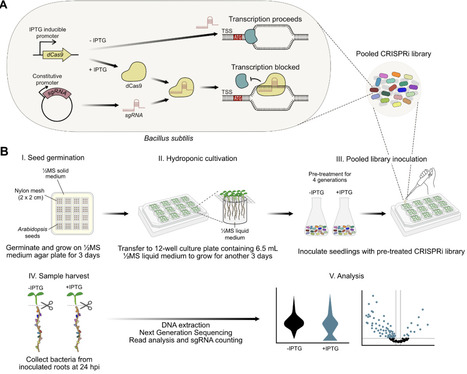
Bacillus subtilis is a known plant growth promoting rhizobacterium, yet, the genetic basis of effective root colonization remains understudied. Here, we applied genome-wide CRISPR interference sequencing (CRISPRi-seq) to systematically identify genes required for early Arabidopsis thaliana root colonization by the B. subtilis strain 3610 . Our genome-wide inducible CRISPRi library was used to screen for bacterial fitness during hydroponic root colonization. A complementary RNA-seq in the same conditions further revealed a distinct transcriptional state of root-associated cells. We identified 249 genes impacting root colonization. We reveal a critical role of cell envelope remodeling during early root association, specifically wall teichoic acid synthesis and D-alanylation. Moreover, we observed a metabolic shift toward TCA-cycle-driven aerobic growth with uptake of fructose, active repression of sporulation, competence and prophage programs, as well as induction of secondary metabolite biosynthesis. Our work establishes CRISPRi-seq as a powerful tool for dissecting bacterial-plant interactions relevant to sustainable agriculture.
|
|
Scooped by
mhryu@live.com
September 11, 2:14 PM
|
Automated protein function annotation remains challenging as sequence databases outpace curated labels and homology-based transfer fails for proteins lacking close relatives. We present GOlien, a scalable, composition-based method that annotates protein sequences using a Shannon-entropy k-mer model. Built from the CAFA3-based training split and evaluated on the held-out validation split, GOlien achieves micro‑averaged of 0.7317 (Biological Process), 0.7610 (Cellular Component) and 0.8295 (Molecular Function). Our tool offers a practical, complementary alternative to existing pipelines and extending annotation coverage for proteins. Availability and Implementation: The command line tool to submit FASTA files and retrieve predicted GO term annotations with the corresponding documentation is available at: https://github.com/probalytiq/golien-tool
|
|
Scooped by
mhryu@live.com
September 11, 1:55 PM
|
Phosphorus is an essential macronutrient for crop growth, but soil-available phosphorus is commonly lacking. Conventional chemical P fertilizers suffer from low utilization efficiency and dependence on finite phosphate rock reserves, necessitating the urgent development of green and efficient alternative strategies for phosphorus management. Phosphate-solubilizing microorganisms (PSMs) are capable of converting insoluble inorganic and organic phosphorus in soils into plant-available forms, thereby serving as key biological resources for enhancing phosphorus use efficiency, reducing dependence on chemical fertilizers, and promoting sustainable agricultural development. This review systematically covers the taxonomic diversity and multifaceted applications of PSMs, elucidates the mechanisms of inorganic P solubilization and organic P mineralization, and separately summarizes recent advances in functional genes involved in inorganic and organic P degradation. It further identifies key bottlenecks restricting PSM development and envisions the use of emerging technologies to transition PSM inoculants from empirical screening toward rationally designed precision deployment, thereby strengthening the scientific and technological foundation for enhancing phosphorus use efficiency and promoting green agricultural sustainability.
|
|
|
Scooped by
mhryu@live.com
September 12, 7:44 PM
|
Komagataella phaffii has emerged as an indispensable eukaryotic expression host for the production of industrial enzymes, food proteins, and therapeutic proteins owing to its Generally Recognized as Safe (GRAS) status, efficient protein secretion capacity, eukaryotic post-translational modification system, and high cell-density fermentation capabilities. In recent years, advances in genetic engineering tools, improved understanding of protein synthesis and secretion pathways in K. phaffii, and the development of systematic strategies for enhancing recombinant protein expression have further established this yeast as an effective eukaryotic expression system. This review summarizes the advances in the design and screening of expression cassette components, including promoters, signal peptides, and terminators, in recombinant strain engineering of K. phaffii. It also provides a comprehensive overview of the key molecular processes affecting protein synthesis and secretion, including transcription, translation, translocation, folding, post-translational modification, endoplasmic reticulum homeostasis, and vesicular transport, together with the corresponding engineering strategies to enhance expression performance. Based on this, strategies for optimizing high-cell-density fermentation are discussed. This review highlights the recent progress in emerging artificial intelligence (AI)-driven technologies applied to the optimization of K. phaffii expression systems, including AI-based protein sequence design and expression prediction, intelligent control of fermentation processes, and genome-scale metabolic modeling-guided strain engineering. Finally, current challenges and future perspectives of the K. phaffii expression system are discussed. Overall, this review systematically summarizes the optimization strategies and underlying mechanisms for recombinant protein expression in K. phaffii, aiming to provide a comprehensive reference for researchers and accelerate the deployment of efficient yeast cell factories across sustainable manufacturing and advanced bioprocess industries.
|
|
Scooped by
mhryu@live.com
September 12, 4:49 PM
|
Conventional wastewater-treatment technologies are energy intensive and can lead to high greenhouse-gas emissions. Microalgal–bacterial consortia (MBCs) could provide pollution removal with relatively low emissions, but have not been widely tested or deployed at scale. In this Review, we describe the use of MBCs in treating wastewater, exploring system types (attached, granular and floc), performance, mechanisms of action, factors that affect performance and carbon neutrality, and optimization strategies. The performance of MBCs has been tested at the bench scale with municipal, industrial and agricultural wastewater. Attached MBCs tend to have the highest removal capacities for organic matter and phosphorus, and properly managed floc MBCs can also maintain competitive removal efficiencies. Carbon-neutrality potential is not governed by system types but is primarily affected by the inherent organic loading of wastewater. System performance is affected by operational and environmental factors. For instance, temperature and working volume affect the pollutant-removal capacity of floc MBC systems, whereas stirring rate, photoperiod and pH primarily affect that of attached MBC systems. Artificial lighting, carbon dioxide supplementation, and material integration enhance MBC performance but require careful regulation. Future development of MBCs should tailor system configuration to pollutant-removal or carbon-neutrality goals. Microalgal–bacterial consortium systems can be used to treat wastewater while fixing carbon. This Review describes the basis and effectiveness of these systems.
|
|
Scooped by
mhryu@live.com
September 12, 4:36 PM
|
5-aminolevulinic acid (5-ALA) is a naturally occurring, metabolically active non-proteinogenic amino acid that serves as a key precursor for the biosynthesis of heme, chlorophyll, and vitamin B12. Due to its high biological activity and versatile physiological functions, 5-ALA has been widely applied in agriculture, medicine, and other sectors. With the rapid advances in metabolic engineering and synthetic biology, microbial cell factories have been developed as promising platforms for the efficient production of 5-ALA. This review summarizes recent progress in biosynthetic pathways and metabolic engineering strategies for enhancing 5-ALA production. First, the metabolic routes involved in 5-ALA biosynthesis are outlined. Subsequently, recent advances in engineering approaches, including enzyme engineering, pathway optimization, and cellular engineering, are highlighted. Finally, current challenges and future prospects for sustainable 5-ALA production are discussed. Overall, this review provides valuable insights to guide the rational design and optimization of microbial platforms for enhanced 5-ALA biosynthesis.
|
|
Scooped by
mhryu@live.com
September 12, 4:26 PM
|
Advances in molecular biology tools are essential for streamlining and accelerating genetic engineering of cells across industrial and academic applications. While CRISPR-Cas improves genome editing efficiency, current systems have limitations and are often host specific, which restricts their versatility. This study describes a versatile CRISPR-Cas9 system for genome editing in industrially relevant Bacillus species. By adapting the well-established pJOE8999 vector-based CRISPR-Cas9 genome editing system, we constructed an inducer-independent, broad-host-range genome editing system. It maintains the benefits of low toxicity to the target cell and the cloning host as well as the ease to use of a single-plasmid CRISPR-Cas9 system. We utilized the constitutive Sigma70-type promoter from the conserved veg gene of Bacillus, to develop and test the suitability of promoter variants of different strengths for Cas9 expression. Successful gene deletions in three different Bacillus species demonstrated the versatility of the modified system for this industrially important genus. This was further confirmed by the integration of a reporter gene fusion and the introduction of a single point mutation in the genome of Bacillus licheniformis. This one-step CRISPR-based transformation protocol developed in this study enables fast genome editing workflows with minimal hands-on time.
|
|
Scooped by
mhryu@live.com
September 12, 4:00 PM
|
Therapies targeting RNA are rapidly expanding, with 24 FDA-approved RNA therapeutics and over 130 currently in clinical trials, highlighting RNA’s growing role in drug discovery. In this context, transformer-based language models provide a scalable and cost-effective approach to accelerate RNA-targeted drug discovery by enabling the prediction of molecule–RNA binding affinities directly from sequence information. This study introduces DLRNA-BERTa, a RoBERTa-based framework that integrates RNA-BERTa and ChemBERTa-v2 to model molecule–RNA binding affinities. The framework includes six RNA class-specific models, aptamers, repeats, ribosomal RNAs, riboswitches, microRNAs, and viral RNAs, along with a general model for other RNA classes. DLRNA-BERTa outperformed existing approaches across different RNA classes on a randomly split validation dataset. On an independent and relatively diverse test set, the model achieved AUROC values of 0.57–0.59, demonstrating performance comparable to the other evaluated methods. Application of DLRNA-BERTa to a library of 3492 approved drugs identified 2859 compounds with predicted binding affinities (pKd ≥ 6) across 294 RNA targets, suggesting its potential utility for RNA-based drug repurposing and prioritization of candidate molecules for further investigation. To facilitate broader use and reproducibility, we provide a publicly accessible web application and API are https://huggingface.co/spaces/IlPakoZ/DLRNA-BERTa, enabling users to predict binding affinities between custom compounds and RNA sequences.
|
|
Scooped by
mhryu@live.com
September 12, 3:49 PM
|
RNA secondary structure is essential for understanding the functions of non-coding RNAs, ribosomal RNAs, and viral genomes. However, accurate prediction of long RNA structures remains challenging due to complex long-range interactions and the limited availability of long-RNA training data. We present UFold-X, a dual-branch deep learning framework that combines a convolutional encoder for local structure modeling with a Mamba-based Visual State Space Module for capturing long-range dependencies. A dynamic gating mechanism adaptively integrates the two branches according to sequence length. UFold-X was evaluated on multiple benchmark datasets containing RNAs up to 5000 nucleotides. To rigorously assess generalization, we introduced a cross-clan benchmark for long RNAs. Under this stringent setting, UFold-X achieved performance comparable to state-of-the-art classical approaches while achieving the best performance among deep learning-based methods. Additional cross-family and within-family evaluations further demonstrated robust transferability and competitive predictive performance. UFold-X also maintained excellent computational efficiency, requiring only 0.08 s per sequence on average. To assess biological consistency, we developed a SHAPE-based reactivity prediction variant (UFold-X-R) and an integrated metric, the Hybrid Reactivity-Pairing Score (HRPS). UFold-X-R showed strong agreement with experimental icSHAPE data and achieved the highest HRPS among all evaluated methods. A user-friendly web server is available at https://ufold-x.ai4bread.com.
|
|
Scooped by
mhryu@live.com
September 12, 2:50 PM
|
Bacterial antiviral immunity systems can be toxic to their hosts and must be tightly regulated. Immunity genes are often encoded by AT-rich mobile genetic elements subjected to silencing by nucleoid binding protein H-NS. Using RNA-seq, ChIP-seq, and chromosome 3D reconstruction with Micro-C, we find that H-NS binds and compacts bacterial immunity loci. H-NS deletion reveals antiphage activity in model E. coli strains generally considered phage-sensitive. Extending this approach to environmental isolates, we show that removal of H-NS silencing enhances defense, allowing bacteria to restrict phages with anti-defense proteins. We also discover Madara, a novel immunity system that complements the co-regulated BREX defense. Our results establish H-NS as a master regulator of bacterial immunity and highlight the importance of expression levels for anti-phage activity in native hosts.
|
|
Scooped by
mhryu@live.com
September 12, 11:03 AM
|
Mobile genetic elements (MGEs) drive horizontal gene transfer in prokaryotes, disseminating antimicrobial resistance genes (ARGs), virulence factors (VFs) and biosynthetic gene clusters (BGCs). Given their importance, there is a pressing need for a single, open source tool that annotates the MGE repertoire together with its functional cargo. We present MAP (Mobilome Annotation Pipeline), a Nextflow pipeline that predicts plasmids, viral sequences, prophages, integrons, insertion sequences, transposons, integrative and conjugative elements, and non-autonomous compositional outliers, removes redundant predictions, and labels genes within MGE boundaries. MAP outputs a GFF3 formatted file, a FASTA file of MGE sequences, and a combined report placing ARGs, VFs, toxins and BGCs in their mobilome context, enabling the identification of composite elements such as ARG-carrying integrons within plasmids. We demonstrate its use on genomes from the MGnify soil genome catalogue.
|
|
Scooped by
mhryu@live.com
September 12, 10:57 AM
|
Short overlaps of adjacent genes are widespread in bacterial genomes and have been proposed to contribute to coordinated gene expression through mechanisms such as translational coupling and ribosome re-initiation. However, their evolutionary dynamics and functional associations have been studied either in relatively small datasets or for individual taxonomic groups. Here, we performed a large-scale comparative analysis of bacterial gene overlaps to characterize their prevalence, structural diversity, evolutionary dynamics, and functional associations. We surveyed 3,998 representative bacterial genomes for short overlaps and analyzed a curated set of orthologous gene-pair clusters to reconstruct the evolutionary history of overlap gain and loss using ancestral-state inference. We confirmed that short overlaps are dominated by a small number of canonical configurations, while a substantial subset of orthologous clusters contained multiple overlap lengths or sequence motifs, indicating evolutionary flexibility. Reconstruction of ancestral states yielded repeated gains and losses of overlap within the same orthologous gene-pair lineages. Among clusters in which both states were sufficiently represented, we found no overall bias toward either overlap gain or loss. Finally, analyses of functional associations found no consistent enrichment of overlapping gene pairs among genes encoding interacting protein subunits, compared to closely spaced non-overlapping gene pairs. In contrast, metabolic linkage showed a modest positive association with overlap, although the magnitude of this association depended on the distance threshold used to define non-overlapping neighbors. These results identify short bacterial gene overlaps as evolutionarily labile features of gene organization rather than strongly conserved genomic states and emphasize the importance of distinguishing overlap from close genomic proximity when considering their functional significance.
|
|
Scooped by
mhryu@live.com
September 12, 10:44 AM
|
Bacterial virulence genes exhibit distinctive codon usage that may impose tRNA-modification requirements for efficient translation, but a comprehensive understanding is lacking. Here, a curated codon-tRNA modification map for Salmonella predicted six modifications that could preferentially support virulence gene translation. Mutant phenotypes in infected mice confirmed requirements for i⁶A37 and C5 modification of U34, whereas essential k2C34 could not be tested. Q34, Cm32/Um32, and Cm34 had limited impact consistent with weak decoding effects in other systems. Non-predicted tRNA modifications were not required. Synonymous reporter variants, proteomics, and targeted recoding demonstrated that virulence-associated codons directly conferred modification dependence. Additionally, four Leu-TTA codons in ssrB, the master regulator of Salmonella pathogenicity island 2 (SPI-2), contributed to MiaA-dependent SPI-2 gene expression. Extending our analysis to other pathogens predicted shared and divergent virulence dependencies consistent with published mutant phenotypes. Thus, codon usage explains tRNA-modification requirements for bacterial virulence.
|
|
Scooped by
mhryu@live.com
September 11, 2:32 PM
|
Ecological theory traditionally posits widespread trade-offs in organismal growth, survival, and reproduction. One core trade-off is the relation between maximum intrinsic growth rate (r) and carrying capacity (K), proposed as a key mechanism explaining species coexistence and the maintenance of biodiversity. To quantify how r relates to K in microbes, we analyzed more than 70,000 microbial growth curves in dozens of media conditions. In this set, we observed a strong positive correlation between r and K, challenging classic life-history expectations of a trade-off. This unexpected "trade-up" can be recovered by a model assuming a non-zero maintenance cost in cells. The model predicts a stronger trade-up under stress conditions that reduce growth rate, consistent with empirical data showing that salinity stress strengthens the trade-up. We also found that community assembly weakens but does not eliminate this positive r-K relationship. The robust growth-yield trade-up between species contrasts with patterns within species. Single-gene knockout datasets in E. coli and budding yeast show no or only weak r-K relationships. Together, our results suggest that the lack of strong trade-offs between growth rate and carrying capacity may be widespread across species, emphasizing the importance of alternative trade-offs and coexistence mechanisms beyond the classical r-K framework.
|
|
Scooped by
mhryu@live.com
September 11, 1:59 PM
|
Anaerobic fermentation with microbial communities is an emerging platform for converting lignocellulosic biomass to biofuels and bioproducts. The process relies on diverse anaerobic microbes that interact to deconstruct and convert lignocellulosic biomass into a range of products, such as volatile fatty acids (VFAs), through arresting methanogenesis during fermentation. However, defining the distinct functional roles played by various fungi and bacteria during anaerobic biodegradation remains poorly understood. Here, we performed parallel enrichment experiments from cow faeces, goat faeces, and anaerobic digester sludge, selecting for fungal or bacterial dominated communities that convert sorghum biomass into VFAs. Subsequently, we reconstructed metabolic networks across these enrichments using recovered bacterial metagenome-assembled genomes (MAGs), fungal isolate genomes, and genome-centric metatranscriptomics. This enabled direct comparison of the carbohydrate-active enzymes and fermentation pathways expressed by bacterial and fungal communities during lignocellulose conversion to VFAs. Our findings implicate diverse bacteria affiliated with the Bacteroidales and Lachnospiraceae in the direct conversion of lignocellulosic biomass to propionate and butyrate, respectively, whereas Neocallimastix-dominated fungal enrichments converted lignocellulose to lactate, acetate and formate. Analysis of carbohydrate-active enzymes revealed that bacterial and fungal communities primarily targeted the same dominant lignocellulosic substrates while employing distinct enzyme repertoires and multidomain carbohydrate-active enzyme architectures, highlighting complementary enzymatic strategies for accessing and deconstructing lignocellulosic biomass. We anticipate that these findings will help inform efforts to develop synthetic consortia with tailored functionality for low-cost conversion of lignocellulosic biomass to fuels and bio-based chemicals.
|