 Your new post is loading...

|
Scooped by
mhryu@live.com
February 23, 2018 4:42 PM
|
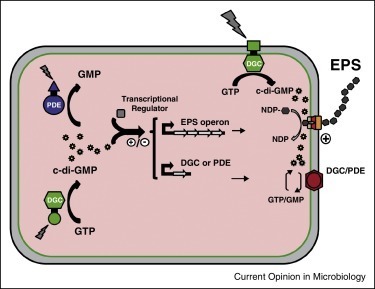
Nowadays, there is increasing interest for bacterial polysaccharides in a wide variety of industrial sectors. This is due to their chemical and reological properties, and also the possibility to be obtained by fermentation processes. Biosynthesis of a growing number of exopolysaccharides (EPS) has been reported to be regulated by the ubiquitous second messenger c-di-GMP in a limited number of bacterial species. Since most bacteria are yet unexplored, it is likely that an unsuspected number and variety of EPS structures activated by c-di-GMP await to be uncovered. In the search of new EPS, manipulation of bacterial c-di-GMP metabolism can be combined with high throughput approaches for screening of large collections of bacteria. In addition, c-di-GMP activation of EPS production and promotion of cell aggregation may have direct applications in environmental industries related with biofuel production or wastewater treatments.
|
|
Scooped by
mhryu@live.com
February 23, 2018 11:23 AM
|
|
|
|
Scooped by
mhryu@live.com
February 23, 2018 3:53 PM
|
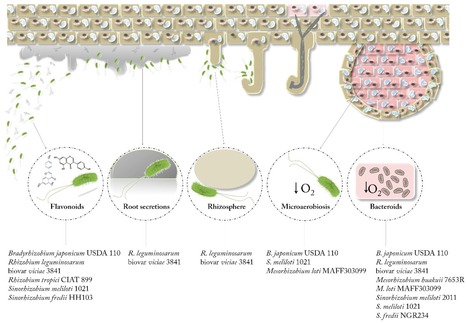
Simultaneous quantification of transcripts of the whole bacterial genome allows the analysis of the global transcriptional response under changing conditions. RNA-seq and microarrays are the most used techniques to measure these transcriptomic changes, and both complement each other in transcriptome profiling. In this review, we exhaustively compiled the symbiosis-related transcriptomic reports (microarrays and RNA sequencing) carried out hitherto in rhizobia. This review is specially focused on transcriptomic changes that takes place when five rhizobial species, Bradyrhizobium japonicum (=diazoefficiens) USDA 110, Rhizobium leguminosarum biovar viciae 3841, Rhizobium tropici CIAT 899, Sinorhizobium (=Ensifer) meliloti 1021 and S. fredii HH103, recognize inducing flavonoids, plant-exuded phenolic compounds that activate the biosynthesis and export of Nod factors (NF) in all analysed rhizobia. Interestingly, our global transcriptomic comparison also indicates that each rhizobial species possesses its own arsenal of molecular weapons accompanying the set of NF in order to establish a successful interaction with host legumes.
|
|
Scooped by
mhryu@live.com
February 23, 2018 11:19 AM
|
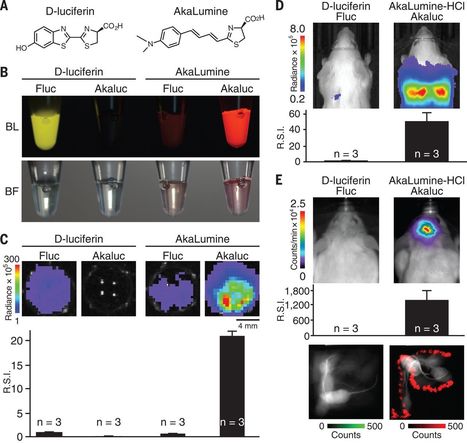
Bioluminescence imaging is a tremendous asset to medical research, providing a way to monitor living cells noninvasively within their natural environments. Advances in imaging methods allow researchers to measure tumor growth, visualize developmental processes, and track cell-cell interactions. Yet technical limitations exist, and it is difficult to image deep tissues or detect low cell numbers in vivo. Iwano et al. designed a bioluminescence imaging system that produces brighter emission by up to a factor of 1000 compared with conventional technology (see the Perspective by Nasu and Campbell). Individual tumor cells were successfully visualized in the lungs of mice. Small numbers of striatal neurons were detected in the brains of naturally behaving marmosets. The ability of the substrate to cross the blood-brain barrier should provide important opportunities for neuroscience research.
Science , this issue p. [935][1]; see also p. [868][2]
[1]: /lookup/doi/10.1126/science.aaq1067
[2]: /lookup/volpage/359/868?iss=6378
|










check "Cyclic (di)nucleotides: the common language shared by microbe and host"