 Your new post is loading...

|
Scooped by
mhryu@live.com
Today, 12:21 AM
|
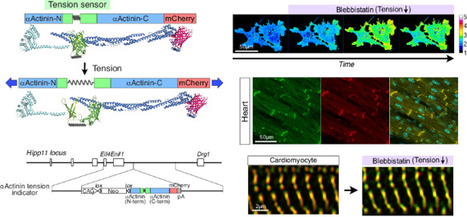
Since the emergence of molecular tension sensors, the understanding of mechanical forces has advanced substantially. However, visualizing molecular tension in mammalian tissues has remained challenging owing to the technical constraints of the Förster resonance energy transfer (FRET)-based molecular tension sensors. Here, we develop a molecular tension sensor based on circularly permuted EGFP with an elastic linker, which is inserted into either αActinin or αCatenin and then fused with mCherry at the C-terminus to simultaneously visualize tension and the amount of sensor protein. This single-fluorophore tension indicator enables subtle tension changes to be visualized simply from color tone under superresolution microscopy. We further generate H11 knock-in mice expressing these indicators, revealing a molecular-specific regulation of mechanical load within tissues. Thus, our molecular tension indicators provide a powerful approach for probing the complex and heterogeneous regulation of mechanical forces in vivo mammalian systems. FRET-free molecular tension indicators enable high-resolution visualization of tension in vivo, revealing that the regulation of mechanical forces is unexpectedly complex, molecule-specific and heterogeneous in live mouse organs.
|
|
Scooped by
mhryu@live.com
Today, 12:06 AM
|
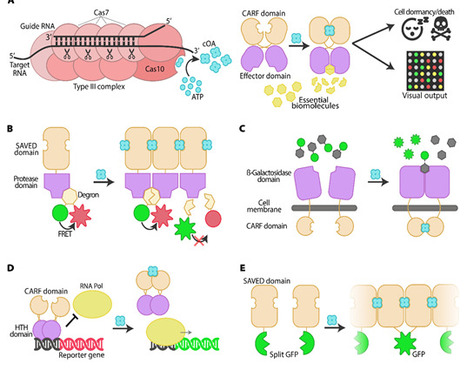
Over the past decade, CRISPR-Cas based biosensors have emerged as sensitive, specific and programmable platforms for nucleic acid detection, with applications ranging from diagnostic tools, environmental monitoring and various applications in fundamental research. The vast majority of these biosensors are currently limited to in vitro applications, highlighting the need for cellular platforms. Here, we provide a perspective on the potential of type III CRISPR-Cas systems as a platform for real-time RNA biosensing in living cells. We discuss the unique properties that distinguish type III from other CRISPR-Cas types, including their intrinsic cyclic oligoadenylate (cOA) signal amplification cascade, PAM-free RNA targeting and the extensive biochemical diversity of their downstream CARF and SAVED effector proteins. We outline the fundamental design principles of a genetically encoded type III cellular biosensor, comprising a programmable guide RNA, a multi-subunit sensing complex and a cOA-sensing effector protein capable of generating optical or electrochemical readout signals. A remaining challenge for type III cellular biosensors is the inherent cytotoxicity of canonical cOA-activated effectors. We propose several strategies to re-engineer these outputs towards non-cytotoxic reporter systems. While cellular biosensors present a natural route toward in vivo sensing, they face many challenges beyond the choice of the output signal and hardware strategy. We conclude that type III CRISPR-Cas is a promising platform for programmable real-time RNA sensing in living cells, utilizing its diverse modular effector outputs, representing a significant expansion of the CRISPR biosensor toolkit, while emphasizing appropriate deployment scenarios that enables full potential of these biosensors.
|
|
Scooped by
mhryu@live.com
October 13, 11:09 PM
|
Microbial N₂O reduction in acid soils became a conundrum when NosZ maturation was found to be impaired at pH ≤6 in both model organisms and soil communities. Yet, evolution appears to have repeatedly circumvented this constraint. Examples include the identification of two small proteins that enable maturation of canonical NosZ at low pH, as well as the Schinkia sp. isolated by G. He, M. E. Davin, S. Kolodney, E. Stutzman, et al. (Appl Environ Microbiol 92:e00069-26, 2026, https://doi.org/10.1128/aem.00069-26), which carries a unique repertoire of nosZ genes and grows by N2O respiration across pH 4.4–8.5. These discoveries help resolve the conundrum and may provide new options for mitigating N2O emissions.
|
|
Scooped by
mhryu@live.com
October 13, 4:40 PM
|
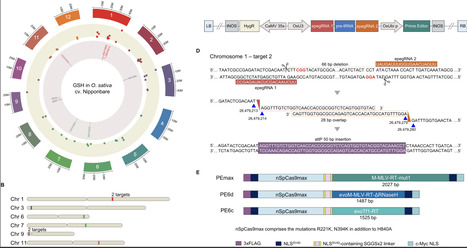
Precise, site-specific integration of large DNA sequences into plant genomes is a long-standing goal of crop biotechnology and synthetic biology, yet remains constrained by random insertion, inefficient homologous recombination, and gene targeting. Here, we present PrimeStack, a DSB-independent platform that integrates PE with the unidirectional large serine integrase Bxb1, leveraging evolved variants for enhanced activity, to achieve the programmable insertion of multigene, multikilobase cargos at predefined genomic safe harbors (GSH) in rice (Oryza sativa). Optimized prime editors first install attP landing sites with high fidelity and heritability followed by Bxb1-mediated recombination that generates irreversible integration of genetic information. PrimeStack enabled targeted large-cargo integration in regenerated rice plants with efficiencies of up to 45%, as determined by junction-specific PCR analyses. No obvious morphological differences from WT plants were observed at 5 weeks after transfer to soil under the evaluated conditions. We validate its utility by achieving targeted insertion of a carotenoid cassette at an experimentally confirmed genomic safe harbor. PrimeStack delivers a modular, site-specific gene stacking platform that enables predictable, multigene trait pyramiding and pathway construction at GSH, thereby accelerating the development of improved and resilient crop varieties, as well as scalable plant-based biomanufacturing and a powerful chassis for synthetic biology.
|
|
Scooped by
mhryu@live.com
October 13, 4:29 PM
|
Rhizosphere microbiomes are central to plant nutrition, pathogen suppression, and rhizosphere health, yet their functions remain difficult to predict from taxonomic composition alone. We argue that microbial siderophores offer a chemically explicit route from taxonomic associations to trait-based rhizosphere ecology. These structurally diverse iron-chelating metabolites link iron mobilization to ecological interactions across microbial, plant, and soil-fauna interfaces. In microbe–microbe systems, siderophore structure–receptor compatibility provides a well-established mechanism underlying resource sharing, competitive exclusion, and pathogen suppression. At plant and nematode interfaces, siderophore functions are increasingly evident, although recognition mechanisms remain less resolved. A siderophore-centered perspective can help move rhizosphere microbiome research from descriptive associations toward predictive, testable, and context-specific ecological engineering.
|
|
Scooped by
mhryu@live.com
October 13, 2:55 PM
|
The ability of plants to reprogram their metabolism in response to fluctuating environments, referred to as metabolic plasticity, is a key feature that enables sessile organisms to maintain growth, survival, and reproduction under changing conditions. As a mechanistic component of phenotypic plasticity, metabolic plasticity can buffer environmental perturbations and confer adaptive advantages. However, despite growing evidence for extensive metabolic remodeling under stress, the genetic and regulatory basis of this plasticity remains incompletely understood. Here, we review metabolic plasticity across major metabolic domains in plants, with emphasis on carbon, nitrogen, photorespiratory, and lipid metabolism, emphasizing how environmental cues and genetic regulation jointly shape metabolic responses. We conclude that, although metabolic plasticity is widespread in plants, its mechanistic and genetic basis remains incompletely understood; population-scale studies and mathematical modeling offer promising avenues to resolve this gap and extend current insights from model systems to crops.
|
|
Scooped by
mhryu@live.com
October 13, 2:31 PM
|
Enzyme-reaction retrieval prioritizes candidate biocatalysts for experimental follow-up, where recommendations should indicate catalytic compatibility and suitable pH and temperature conditions. Existing retrieval models optimize matching scores, whereas catalytic optima predictors are typically enzyme-level regressors because condition annotations are sparse. This separation leaves ranked pairs unevaluated for condition suitability and optima predictions without reaction context. We present GERO, a multimodal fusion framework integrating enzyme sequence semantics, sequence-derived pocket geometry, and molecular reaction representations through feature-gated fusion for condition-aware retrieval and catalytic optima estimation. We define the tolerance-restricted hit rate (Hit@k-TR), which requires both correct top-k retrieval and condition predictions within predefined tolerances. Across enzyme- and reaction-similarity splits, GERO improves Hit@k-TR over two-stage baselines under the primary tolerances. Benchmark examples and an iodinin biosynthesis case study illustrate candidate ranking and assay-condition estimation for experimental prioritizatio
|
|
Scooped by
mhryu@live.com
October 13, 2:19 PM
|
Plant-associated bacteria can enhance plant tolerance to abiotic stresses such as drought, salinity, nutrient limitation and heavy metal contamination. Although bacterial genes involved in plant abiotic-stress alleviation have been experimentally characterized in individual studies, the corresponding sequences and evidence remain dispersed across publications and general-purpose repositories, limiting their systematic reuse for the annotation of new microbial datasets. Here, we present microSTRESSdb, a curated database of genes experimentally tested for their roles in plant abiotic stress alleviation. Version 1.0 of this database contains 72 protein sequences spanning four abiotic stress categories, with metadata on gene product, source organism and accompanying literature. To detect homologues of these stress-associated genes in bacterial genomes and plasmids, we also provide the pipeline and web interface microSTRESS. This pipeline performs BLAST-based screening of input proteomes, integrates hit-level metadata, evaluates pathway completeness and generates interactive HTML reports summarising stress-category coverage, gene functions and a Stress Potential Index (SPI). As use cases, we applied microSTRESS to 3,028 genomes across Pseudomonas and Bacillus and showed that the genomes of the soil- and plant-associated strains contained homologues of several stress-associated genes. Next, we evaluated whether microSTRESS could transfer existing gene-level evidence to the prioritization of previously uncharacterized bacteria. In an Arabidopsis thaliana drought bioassay with 29 rhizosphere strains, higher drought-specific SPI values were associated with improved maintenance of plant biomass under water limitation, with this association being significant for Flavobacterium but not reaching significance for Pseudomonas. Together, microSTRESSdb and microSTRESS convert experimentally supported gene–phenotype evidence into a standardized and reusable framework for stress-oriented annotation, comparative analysis and genome-guided prioritization of candidate bacteria.
|
|
Scooped by
mhryu@live.com
October 13, 2:03 PM
|
Archaea play essential roles in global biogeochemical cycles, yet their diversity in environmental samples remains understudied. Limited coverage of universal primers towards archaea, their very low abundance relative to bacteria in the studied samples, inefficient cell lysis and the incompleteness of reference databases complicate archaeal 16S rRNA gene sequencing. Furthermore, standardization lacks due to the absence of commercially available mock communities. Here, we developed a mock community composed of mixtures of DNA from six archaeal and four bacterial strains with known genome sizes and 16S rRNA gene copy numbers. Five mock compositions with different archaeal–bacterial abundance ratios were used to evaluate two universal primer pairs and eight archaea-specific methods. The universal primer pairs detected all taxa but consistently overestimated bacterial abundance, indicating to be less suitable for environments where archaea are more dominant. Archaeal specific primer pairs showed variable specificity, with some exhibiting substantial bacterial co-amplification under certain conditions. The Arch349F–A806R primer pair demonstrated the highest archaeal specificity, the least technical variability, the most consistent agreement with expected mock compositions, and minimal artefactual amplification when applied to a complex bacterial mock community. To show its applicability on environmental samples, this method was applied on Boom Clay pore water samples, which indicated a much higher archaeal diversity than previously shown with a standard commercial method. Overall, this study showed the necessity of primer validation through mock communities and identified Arch349F–A806R as a promising primer pair for archaeal 16S rRNA gene sequencing, especially in samples containing methanogenic archaea.
|
|
Scooped by
mhryu@live.com
October 13, 1:48 PM
|
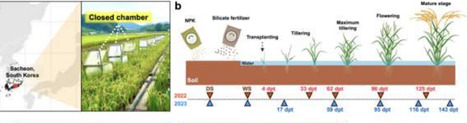
Methane emissions from rice paddies are a major source of greenhouse gases, and silicate fertilizer (SF) derived from blast furnace slag has emerged as an environmentally friendly amendment that reduces methane release. SF modifies the soil redox environment by supplying electron acceptors such as iron, but the microbial mechanisms underlying methane mitigation remain unclear. Here, we combined metagenomic profiling, microbial isolation, and greenhouse experiments to show that SF consistently enriched Burkholderia vietnamiensis together with the methanotrophs in the rice rhizosphere. Inoculation of B. vietnamiensis strain HU01 alone reproduced the methane-suppressing effect of SF and increased methanotroph abundance. Cell-free culture supernatants of HU01 stimulated the growth of Methylococcus geothermalis and Methylocystis parvus through secreted, low-molecular-weight, heat-stable metabolites. Although metabolic modeling predicted primary metabolites such as L-glutamate and cobalamin as candidate cross-feeding factors, LC–MS/MS analysis of the highly active fractions indicated that the robust bioactivity was primarily driven by a chemically complex metabolite mixture rather than these ubiquitous single compounds. These results provide direct evidence that enrichment of a single heterotrophic species can enhance methane oxidation by stimulating methanotroph activity through metabolite exchange. B. vietnamiensis HU01 represents a promising microbial resource for methane mitigation and illustrates how targeted heterotroph–methanotroph interactions can be leveraged for climate-smart rice cultivation.
|
|
Scooped by
mhryu@live.com
October 13, 12:51 PM
|
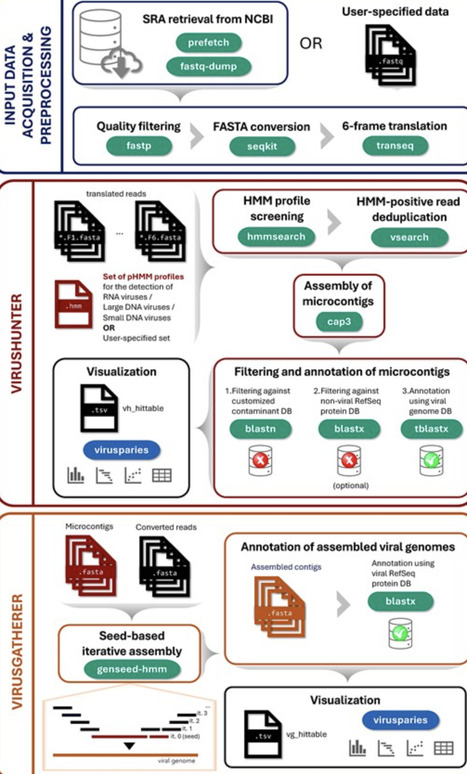
We present Virushunter and Virusgatherer, a bipartite computational workflow for discovering viral genomes from unprocessed next-generation sequencing data. Virushunter conducts a profile Hidden Markov Model-based sequence homology search for viral hallmark protein-coding sequence reads to construct microcontigs, which are used as seeds for targeted viral genome assembly by Virusgatherer. We showcase the application of Virushunter and Virusgatherer through an RNA virus-wide screen in 3348 bat transcriptome sequencing experiments from the Sequence Read Archive. Many of the discovered viruses are likely prototypes of new putative virus species, including a novel alphacoronavirus identified in a South American velvety free-tailed bat and a novel rhabdovirus in a European barbastelle bat. The tools are implemented as a reproducible Snakemake pipeline, which is available at https://github.com/lauberlab/VirusHunterGatherer.
|
|
Scooped by
mhryu@live.com
October 13, 12:44 PM
|
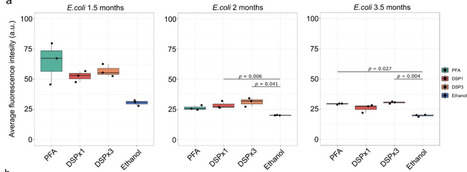
Phylogeny- or activity-based fluorescent labelling of microorganisms coupled with fluorescence activated cell sorting (FACS) is a powerful approach to rapidly isolate cells of interest from complex communities for targeted genomics. However, the method has not been widely adopted because standard paraformaldehyde or ethanol fixation procedures hamper nucleic acid recovery and/or long-term sample storage. Here, we present dithiobis(succinimidyl propionate) (DSP) as a reversible fixative for microbial cells that enables fluorescence imaging and DNA extraction and amplification for sequencing. DSP fixation is compatible with widely used fluorescence in situ hybridization (FISH) approaches and bioorthogonal non-canonical amino acid tagging, and can be applied to diverse sample types, where it consistently performed as well as paraformaldehyde. Furthermore, high-quality genomes were obtained from individual and multiple bacterial cells selectively extracted from complex samples using FISH-FACS. Thus, DSP is a dual-use fixative for microbiome imaging and sequencing, improving targeted microbial genomics.
|
|
Scooped by
mhryu@live.com
October 13, 12:07 PM
|
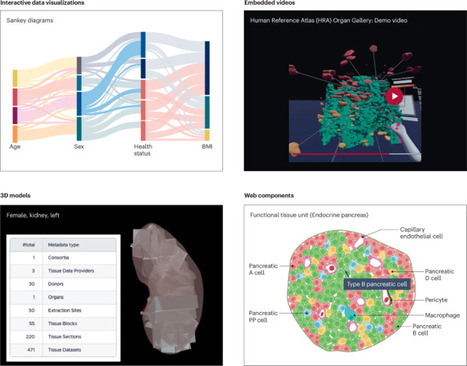
How biologists can make the most of supplementary materials for impact. To overcome the limitations of traditional supplementary items, companion websites can be created with relatively little effort today. These can function as dynamic, rich repositories for additional content, especially figures. They enable the authors to embed interactive visualizations, videos and annotated figures that are impractical to publish in static PDF form. They can also help readers navigate complex datasets and analyses by providing exploratory interfaces. Researchers may already be producing figures suitable for such sites during the research process; interactive plots, animated visualizations or exploratory tools can be valuable when shared alongside the paper.
|
|
|
Scooped by
mhryu@live.com
Today, 12:19 AM
|
Enzymes are indispensable biocatalysts in industrial processes, but their application is often restricted by narrow pH optima. Exposure to acidic or alkaline conditions alters the protonation states of ionizable residues, disrupts catalytic microenvironments and stabilizing interactions, and ultimately reduces activity, catalytic efficiency, or structural integrity. This limitation is particularly important in industrial sectors such as detergents, textiles, biorefineries, and therapeutic formulations, where operation under non-native pH conditions is frequently required. Conventional sequence-dependent strategies, including rational design, directed evolution, mutagenesis, truncation, fusion, and circularization, have improved enzyme pH tolerance in many cases, but they often require extensive screening, depend on detailed structural knowledge, or involve trade-offs between stability and catalytic performance. By contrast, sequence-independent stabilization strategies aim to preserve the enzyme performance without altering the primary catalytic sequence. Among these, co-expression with stabilizing partners and protein additive approaches represent promising molecular shielding concepts that may protect enzyme function under acidic or alkaline stress while offering practical advantages in simplicity, scalability, and process compatibility. This review critically examines these emerging sequence-independent approaches alongside established sequence-dependent methods and highlights their potential to enable broad pH tolerance and more robust industrial biocatalysis.
|
|
Scooped by
mhryu@live.com
October 13, 11:24 PM
|
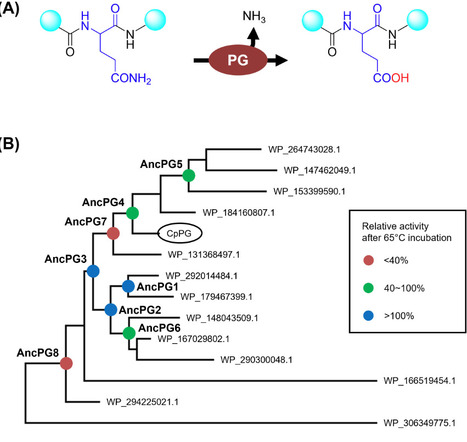
Protein-glutaminase (PG) from Chryseobacterium proteolyticum is an industrially valuable enzyme for protein deamidation; however, its application is limited because of insufficient thermal stability. Previous rational design studies have enhanced the thermostability of PG but often required labor-intensive, stepwise optimization. In this study, ancestral sequence reconstruction (ASR) was used to engineer thermostable PG variants in a single design step. Eight ancestral PGs were constructed, all of which exhibited enhanced thermal stability compared with that of the wild type. The most stable variant, AncPG1, had a melting temperature of 76.2°C, 13.6°C higher than that of the wild type. Mutational dissection identified five substitutions, N148G, N154D, L156Y, L168S, and D179S, that individually enhanced thermal stability and showed cumulative stabilizing effects when combined. These substitutions were predominantly located in surface-associated loop regions. Notably, although the ancestral variants showed reduced catalytic efficiency toward the small synthetic substrate Cbz-Gln-Gly, they retained reactivity toward macromolecular protein substrates when compared at equal activity units. Furthermore, AncPG1 showed greater absolute protein-substrate reactivity than WT CpPG under elevated temperature conditions. These findings provide further support for ASR as a strategy for generating thermostable enzyme variants with improved functional performance under elevated-temperature conditions.
|
|
Scooped by
mhryu@live.com
October 13, 11:07 PM
|
Episomal plasmids are widely used in yeast metabolic engineering for their flexibility and high transformation efficiency. However, their application in Yarrowia lipolytica is often limited by low copy number and insufficient genetic stability. In this study, a robust episomal plasmid that balanced genetic stability and protein expression capacity was developed in Y. lipolytica. The autonomously replicating sequence (ARS) elements were selected, and ARS1 was identified as a favorable element that balanced genetic stability and gene expression capacity. To improve plasmid copy number, different ubiquitin degrons were used to tune selection marker abundance, and Ubi-R-Δk-mediated marker resulted in an approximately fourfold increase in plasmid copy number (from ∼1 to ∼5 copies per cell). The copy number of the engineered plasmid was one of the highest‑copy episomal systems in Y. lipolytica. To further evaluate the engineered plasmid, we applied it to β‑carotene biosynthesis. The results showed that the β‑carotene titer was 3.43‑fold higher than that of the non‑optimized plasmid. Collectively, this work expands the episomal plasmid toolbox for Y. lipolytica and establishes a generalizable framework for robust protein expression plasmid engineering in non-conventional yeasts.
|
|
Scooped by
mhryu@live.com
October 13, 4:34 PM
|
Long-term fertilization alters nitrous oxide (N2O) emissions from paddy soils, but its effects on the ecological roles of distinct N2O-reducing clades remain unclear. Here, we investigated Clade I and Clade II N2O reducers using a 20-year field experiment with unfertilized control (CK), chemical fertilizer (NPK), and organic fertilizer (OF) treatments. Clade II dominated the community, accounting for 72.4% of nosZ reads and 83.3% of recovered nosZ-containing draft metagenome-assembled genomes (MAGs), and was enriched in carbohydrate-active enzyme (CAZy) genes. However, Clade I abundance explained more variation in soil N2O reduction potential than Clade II (R2 = 0.38 vs. 0.28). Structural equation modelling showed that fertilization enhanced soil carbon and nitrogen status, which strongly promoted Clade I abundance (β = 0.90). Clade I fully mediated fertilisation effects on N2O reduction potential, whereas Clade II showed only partial mediation. The two clades also exhibited contrasting vertical distributions: Clade I was relatively uniform throughout the soil profile, while Clade II displayed niche stratification, with different taxa dominating surface, middle, and deep layers. These results suggest distinct ecological strategies of the two N2O-reducing clades and long-term fertilisation differentially influences their distribution and contribution to the N2O sink function of rice paddy soils during the period examined.
|
|
Scooped by
mhryu@live.com
October 13, 4:22 PM
|
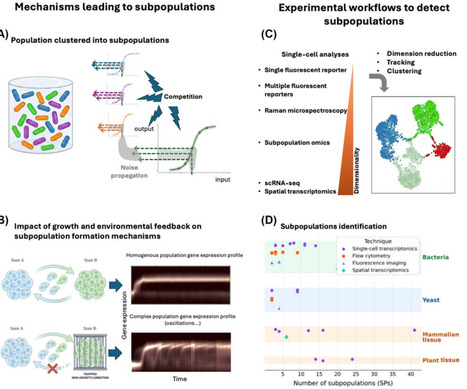
Cell populations underpin applications ranging from bioproduction and biotherapeutics to microbiome engineering and biocomputing. However, treating them as bulk quantities rather than as structured systems limits our understanding of population-level stability, productivity, and robustness. Cellular populations self-organize into coexisting subpopulations (SPs) representing phenotypically distinct states that emerge from the interplay of biological noise and selective pressures. We propose that networks of interacting SPs constitute a fundamental organizational layer for engineering stable cell population dynamics. Surveying published single-cell studies across bacterial, yeast, and mammalian systems, we show that populations consistently self-organize into a limited number of SPs. This dimensional reduction can be captured experimentally by clustering single-cell data and gives rise to scaling laws that link population structure to collective performance.
|
|
Scooped by
mhryu@live.com
October 13, 2:31 PM
|
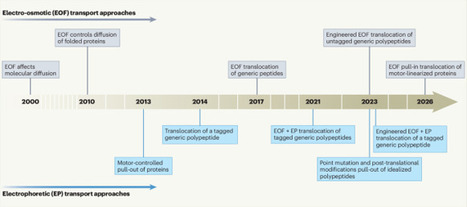
Nanopore protein sequencing has advanced from a theoretical ambition to a practical technology, overcoming major challenges in protein unfolding, transport and signal detection to achieve single-amino-acid and post-translational modification sensitivity. With both full-length and peptide-based approaches progressing towards commercialization, the field is now focused on scaling throughput and refining analysis tools to unlock a new generation of single-molecule proteomics.
|
|
Scooped by
mhryu@live.com
October 13, 2:19 PM
|
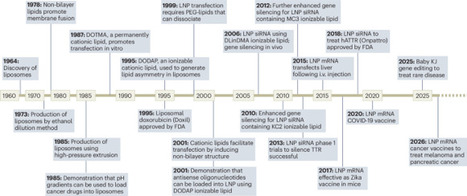
Curiosity-driven studies of lipid organization and lipid asymmetry in biological membranes led to scalable methods for making liposomes, efficient loading of drugs and ionizable cationic lipids. In turn, these advances led to lipid nanoparticles enabling the RNA medicine Onpattro and the COVID-19 mRNA vaccines, and they are now facilitating gene therapies that can potentially treat most human diseases. lnp
|
|
Scooped by
mhryu@live.com
October 13, 2:09 PM
|
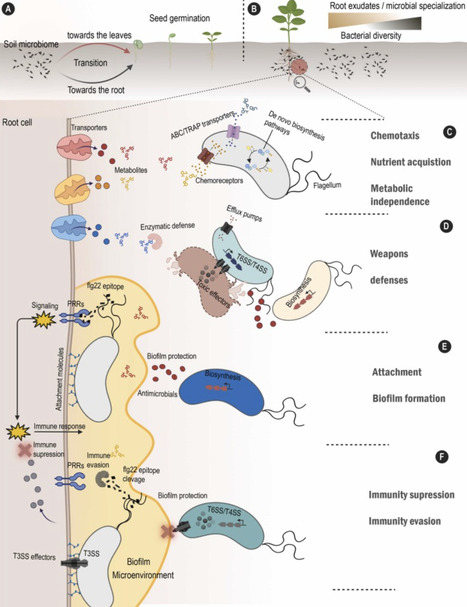
Plant-associated bacteria offer a sustainable alternative to chemical inputs in agriculture, yet the field performance of microbial inoculants remains inconsistent. A central but frequently overlooked cause is that bioprospecting pipelines still select strains on the basis of plant-growth-promoting activities, while the bacterial genetic traits that determine whether a strain can reach, colonize and persist in a given root compartment are rarely assessed. Previous reviews have largely catalogued growth-promoting functions or described root microbiome assembly from the plant's perspective, here we take the bacterium's. We trace the journey of a bacterium from bulk soil to its final niche and, at each stage, identify the genes and pathways (genetic determinants) that encode key bacterial traits involved, such as chemotaxis and motility, nutrient acquisition and metabolic independence, competitive and defensive arsenals, attachment and biofilm formation, evasion of plant immunity, and endophytic entry and persistence. Throughout, we use evidence from comparative genomics and metagenomics, (meta)transcriptomics, targeted mutagenesis and genome-wide screens such as Tn-seq, obtained in systems ranging from binary interactions to synthetic communities and natural soils. For each stage we examine the current state of knowledge, identify critical gaps, and propose avenues to deepen our mechanistic understanding of the bacterial traits involved in plant colonization. We argue that this mechanistic understanding is the missing foundation for developing inoculants with more consistent and robust performance across diverse agroecosystems.
|
|
Scooped by
mhryu@live.com
October 13, 2:01 PM
|
Fluorescence-based CRISPR diagnostic assays have become a popular platform for nucleic acid detection due to their programmability, configurability, specificity, and compatibility with standard laboratory equipment. However, reported enzymatic kinetic rates and limits of detection for CRISPR trans-cleavage assays vary by several orders of magnitude across the literature. This variation in performance parameters is coupled with, and exacerbated by, inconsistent calibration, incomplete correction of measurement biases, and nonstandardized or incomplete data analysis procedures. We present an experimental protocol and quantitative analysis framework for fluorescence-based enzyme assays using routine laboratory instrumentation, including thermocyclers and fluorescence microplate readers. Building on previous studies of CRISPR enzyme kinetics and fluorescence calibration, we describe procedures for flat-field and background correction; comprehensive fluorescence calibration, including correction for the inner filter effect; quantification and implications of reporter degradation; extraction of Michaelis–Menten kinetic parameters; and determination of assay's limits of detection. We provide step-by-step experimental guidelines and open-source Python implementations for each stage of the workflow. Using representative Cas12 trans-cleavage datasets, we demonstrate that explicit fluorescence calibration and correction procedures substantially reduce systematic bias in measured kinetic rates and improve consistency between experiments. Our framework aims to establish standardized practices for quantitative fluorescence-based CRISPR assays and provides researchers with practical tools for reproducible kinetic characterization and rational assay design.
|
|
Scooped by
mhryu@live.com
October 13, 1:34 PM
|
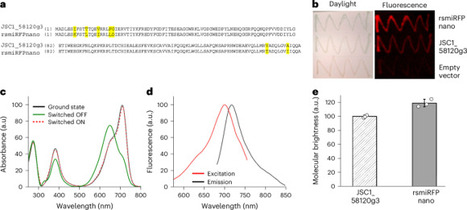
Using near-infrared photoswitchable photochromic genetically encoded probes, differential photoacoustic tomography (PAT) enables deep-tissue imaging with high resolution and sensitivity; however, current bacteriophytochrome-based probes are bulky multidomain proteins exceeding 55 kDa, which constrains their use for designing PAT molecular reporters. Here we engineer rsmiRFPnano, a compact cyanobacteriochrome-derived photoswitchable PAT probe. With a molecular weight below 19 kDa, rsmiRFPnano efficiently incorporates biliverdin, exhibits high extinction coefficients in both photochromic states and demonstrates robust performance in live cells. We established rsmiRFPnano-based reporters for NF-κB and AP-1 pathways, which display low basal activity and strong activation-dependent responses. These reporters effectively visualized acute inflammation using noninvasive PAT in vivo, further validated through cellular-level spatial omics mapping. We then created photoswitchable nanobody probes, rsNIR-Fbs, stabilized upon antigen binding and rapidly degraded otherwise, enabling selective photoacoustic immuno-imaging of intracellular antigens in vivo. Together, these results establish rsmiRFPnano as an ultracompact and versatile platform for molecular PAT. A small, photoswitchable and genetically encodable protein operating in the near-infrared window is reported for photoacoustic tomography applications.
|
|
Scooped by
mhryu@live.com
October 13, 12:46 PM
|
With the rapid growth of plastic production, plastic pollution has become increasingly widespread and persistent in the environment. This persistent pollution poses potential risks to ecosystems and human health. Microbial biodegradation offers a promising approach to plastic waste management because it operates under mild reaction conditions and has potential for sustainable application. This review summarizes recent advances in the major microbial groups involved in plastic biodegradation, methods for assessing degradation efficiency, underlying mechanisms, and strategies for improving degradation performance. Assessment methods are discussed, from physicochemical characterization to biochemical validation. Meanwhile, it emphasizes that real plastic biodegradation and degradation efficiency require multiple complementary lines of evidence to judge in a more complete and objective way. The complete process and molecular mechanisms of microbial plastic degradation are then described, including microbial attachment and biofilm formation, enzymatic degradation, intracellular metabolism, and mineralization of degradation products. In addition, it summarizes various efficiency optimization strategies for degradation, including plastic pretreatment, bioaugmentation, and regulation of environmental parameters. The lack of standardized assessment, limited practical translation, and ecological risks are the identified key challenges. Finally, standardized efficiency evaluation strategies, plastic upcycling, and emerging technologies for subsequent development were discussed. This review aims to provide a reference for understanding microbial plastic degradation.
|
|
Scooped by
mhryu@live.com
October 13, 12:39 PM
|
Microbial communities are the main drivers of global carbon cycling. Yet, predicting their respiratory responses to warming is challenging because the underlying mechanisms remain elusive. Here, we developed a spatially explicit model, integrating single-cell metabolism with metabolic exchange and endogenous heat production, to disentangle the mechanisms driving community-level temperature responses. We reveal that mutualism amplifies respiratory temperature sensitivity compared to isolated taxa, as exchanged metabolites sustain a secondary growth phase with higher respiratory demand, and this phase creates disproportionately large CO2; emissions under warming (apparent activation energy Ea; increases from 0.65 to 0.77 eV). Spatial structure amplifies this further through threshold effects, whereby diffusion limitation shifts from constraining to enabling mutualistic benefits as metabolic rates increase with temperature (Ea; increases to 1.18 ± 0.09 eV). Endogenous heat production drives additional amplification through positive feedback between local temperature rises and resource turnover rates (Ea; further increasing to 1.78 ± 0.14 eV). Collectively, our results demonstrate that community-level temperature responses are not determined by enzyme kinetics alone but emerge from the interplay of ecological, physical, and metabolic interactions. Our model provides a general framework for understanding the combined effects of the underlying mechanisms on microbial temperature responses. Future climate carbon models should incorporate these considerations to improve predictions.
|


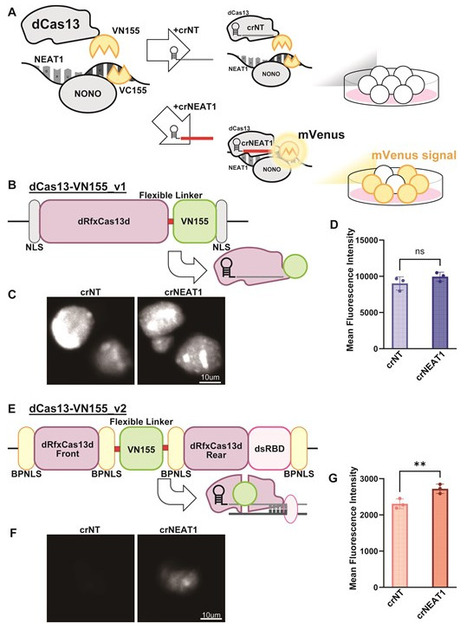















2st, rna-protein binding tool, fuse one half to dCas13 that binds RNA guided by a crRNA. The other half goes on the POI. the proximity means the protein is near the RNA that dCas13 is sitting on.