Your new post is loading...

|
Scooped by
mhryu@live.com
April 21, 11:27 PM
|
For much of the past century, carbon dioxide (CO2) has received little attention scientifically outside of its role as a byproduct in the industrialization of the global economy. This trend has recently been upended where, due to mounting environmental concerns, CO2 has been brought squarely into the public consciousness. This surge in activity has contributed to a once unimaginable idea now pervading the scientific community: could CO2, a highly stable byproduct of hydrocarbon combustion, be recycled and converted back into useful chemicals and fuels? Owing to its ubiquitous nature and availability at truly massive quantities, it is thought that CO2-based products could offer a meaningful pathway toward lowering the environmental impact of many of the top industrial products while also enhancing supply chain diversification and resilience. In this manuscript we provide a holistic review of the pathways for CO2 conversion, the underlying chemistry and challenges involved in the transformation to products, and considerations for commercialization.
|
|
Scooped by
mhryu@live.com
April 21, 11:20 PM
|
Fungal-bacterial interactions are widespread phenomena that are currently gaining attention across diverse research fields. But what are interactions, how do we identify them, and why should we adopt ecological theory when studying them? While microbial interactions are often conceptualized and characterized as static properties, these relationships are dynamic and complex. They are shaped by the interplay of numerous variables, which themselves fluctuate over space and time, that scale from molecules to ecosystems. In this perspective, we discuss the theoretical and practical challenges of studying the interactions between these two ubiquitous and diverse groups of microorganisms and propose a framework grounded on mechanistic and systems approaches rather than relying on correlations or fragmented practices. We hope to inspire efforts to build and integrate a more comprehensive understanding of this fascinating and quickly growing subdiscipline of microbial ecology.
|
|
Scooped by
mhryu@live.com
April 21, 11:04 PM
|
The Mycobacterium tuberculosis (Mtb) VapC4 endoribonuclease toxin exclusively cleaves and inactivates tRNACys, which leads to extensive ribosome stalling at Cys codons. Serendipitously, the precise position of stalled ribosomes is revealed within our 5′ RNA-seq datasets used to identify and validate the tRNA target of the toxin, precluding the need for Ribo-seq. Here we show how mapping of stalled ribosomes can be harnessed as an innovative tool for reliable detection of new Cys-containing Mtb open reading frames (ORFs). Using proteogenomics we unmasked 96 unannotated ORFs; of which 54% are small ORFs ≤50 amino acids. We validated 69% of the 96 ORFs by mass spectrometry, including four whose spectra was matched to synthetic controls Also, 25% of these unannotated ORFs were identified by previously published Ribo-RET. Some of the 96 ORFs are Cys-responsive attenuators or encode stable Cys-containing proteins that map immediately before, or within, genes in the opposite, or same, orientation. These ORF sequences can also reveal functional clues, e.g. zinc-binding motifs or encode novel EsxB-like proteins. Our findings demonstrate that toxin-mediated ribosome stalling can serve as a robust genome annotation tool that is applicable to mycobacteria and other bacteria, with unique advantages that complement existing genome annotation methods.
|
|
Scooped by
mhryu@live.com
April 21, 10:52 PM
|
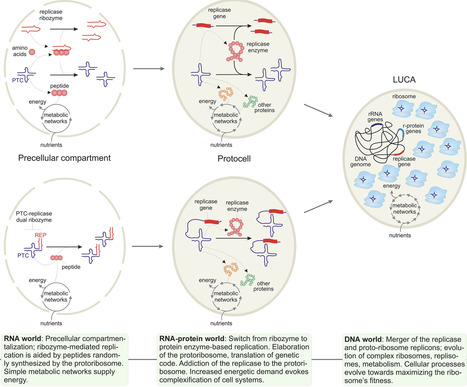
The ribosome is responsible for protein synthesis in all cells, and is the cell’s largest energy consumer. We propose that the ribosome originated as a mutualistic symbiont of an RNA-dependent RNA polymerase ribozyme, supplying peptides that enhanced replication. As life transitioned from the RNA to the RNA–protein world, autonomous replicators became irreversibly addicted to the ribosome for producing replication proteins. Subsequent evolution is construed as a ribosomal takeover, whereby the ribosome evolved to consume most of the cell’s resources, while other cellular componentry ensured the propagation of the ribosome, while being fully dependent on it. Under this perspective, the ribosome is a complex symbiont of the cell with pronounced selfish properties.
|
|
Scooped by
mhryu@live.com
April 21, 10:42 PM
|
Protein-based biosensors are vital for environmental monitoring, diagnostics, and bioprocess control, yet many stall in the transition from laboratory to field because they fail to meet performance metrics. This review focuses on the adoption of a results-oriented, metric-driven framework focusing on (1) how molecular recognition couples to detectable output and (2) the engineering levers that tune the performance. Metrics such as the dynamic range, response speed, specificity, detectability, and biosensor stability are discussed. Biosensor implementation is treated as a design variable across whole-cell, cell-free, and immobilized formats. The review concludes with bottleneck-driven protein engineering strategies to meet these metrics and therefore facilitate broader applications across biological contexts.
|
|
Scooped by
mhryu@live.com
April 21, 10:35 PM
|
Multi-omic studies in human microbiome research hold great potential for advancing our understanding of host–microbiome interactions. However, despite the growing availability of multi-omic datasets, analysing such data remains a major conceptual, analytical and computational challenge. Introduction of new multi-omic integration methods to address these challenges further complicates researchers’ efforts to navigate this expanding field. In this Review, we outline the landscape of multi-omic integration methods in the context of human microbiome research. In contrast to previous reviews, we specifically emphasize the different biological questions addressed by various integration approaches, including questions related to interactions between different molecular layers, molecular shifts that occur in disease, subgrouping of patients based on molecular profiles, and identification of biological mechanisms that underlie such associations. Our aim is to provide a timely, convenient and comprehensive resource for the microbiome research community, allowing researchers to identify the multi-omic integration approach that is best suited to their data and objectives. This Review explains various multi-omic data integration methods and aims to help microbiome researchers determine which approach is most suited to their particular research question.
|
|
Scooped by
mhryu@live.com
April 21, 6:58 PM
|
The eukaryotic vault particle is a giant ribonucleoprotein complex that assembles into an iconic barrel-like cage. Its cellular function has remained elusive despite extensive characterization. Using cryo-electron tomography of Dictyostelium discoideum cells, we define the distribution, structural states, and interaction landscape of vault particles in situ. Surprisingly, we detect a subpopulation of vault particles associated with the endoplasmic reticulum (ER) and nuclear envelope membranes. This association occurs at a defined barrel height of the vault particle. Membrane-associated particles appear to localize to patches of reduced membrane bilayer thickness and altered curvature. We further find that a fraction of vaults encloses 80S ribosomes in highly ordered orientations. These structural findings are further corroborated by proximity labeling experiments, which identify ER-resident proteins and numerous ribosomal components as vault particle interactors. The membrane-bound and ribosome-encapsulating vault populations that we uncover will direct future studies towards revealing vault function. Vault particles are giant ribonucleoprotein complexes with elusive cellular roles. Here, authors use cryo-electron tomography and proximity labeling to show that vaults associate with ER and nuclear envelope membranes and encapsulate 80S ribosomes in situ.
|
|
Scooped by
mhryu@live.com
April 21, 6:53 PM
|
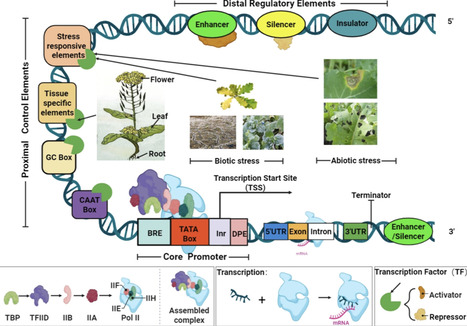
Promoters, containing multiple cis-regulatory elements, are crucial for plant gene expression. While constitutive promoters are widely used in stress-resistance engineering, their sustained strong expression can lead to metabolic waste and hinder growth. In contrast, inducible promoters enable precise, stage-specific gene activation, offering flexible regulation. Consequently, the development and application of inducible promoters have become a major focus in plant genetic engineering research. This paper reviews recent advances in plant stress-inducible promoters, including their structure, function, classification, associated functional elements, and interacting transcription factors. Furthermore, we discuss future research directions and application prospects, aiming to deepen the understanding of plant gene expression regulation and provide valuable promoter resources for genetic engineering and stress-tolerant crop improvement.
|
|
Scooped by
mhryu@live.com
April 21, 6:47 PM
|
Flow cytometry is widely used for high-throughput single-cell analysis. However, its data analysis relies on either costly commercial software or programming-intensive open-source tools. To bridge this gap, we developed FlowWeb, a freely accessible, web-based platform that combines the flexibility of the R/Bioconductor ecosystem with an intuitive graphical user interface. FlowWeb enables integrated workflows for data handling, quality control, gating, visualization and statistical analysis within a unified environment. FlowWeb integrates raw data, metadata, and analytical state within synchronized Bioconductor structures, enabling coherent analysis and visualization workflows. FlowWeb supports both manual and automated data-driven gating workflows. To evaluate its performance, we applied FlowWeb to an in-house flow cytometry dataset and compared its automated cell cycle and gating workflows to established commercial tools. The automated cell cycle workflow of FlowWeb produced consistent and reproducible results across replicates and demonstrated high concordance with reference analyses, highlighting the robustness of the platform. Advanced visualization tools of FlowWeb include a wide range of fully customizable individual, overlay, and statistical plots. To enhance usability and reproducibility, the FlowWeb platform provides optional user-accounts that allow storage of reusable configurations, including quality control presets, gating definitions, and plot templates. By lowering technical barriers without compromising analytical rigor, FlowWeb facilitates accessible, reproducible, and scalable flow cytometry data analysis for a broad range of users in research and clinical settings.
|
|
Scooped by
mhryu@live.com
April 21, 6:21 PM
|
Stabilizing microbial cocultures is a central challenge for bioproduction. While division of labor between strains can enhance efficiency, it often results in population instability over time. Classical strategies, including cross-feeding, quorum sensing, and toxin-antitoxin modules, often rely on complex ecological interactions that are difficult to predict or maintain under bioprocess conditions. We report the first implementation, to our knowledge, of a synthetic-niche–based coculture operated in a continuous bioreactor, using genetic toggle switches that couple growth to defined phenotypic states. We engineered two auxotrophic strains, TOGGLE_green and TOGGLE_yellow, in which growth is linked to either GFP- or YFP-expressing states and assessed their behavior under continuous bioreactor conditions using automated and reactive flow cytometry. Unexpectedly, the introduction of auxotrophic pressure reshaped circuit function, i.e., rather than maintaining bistability as typically reported in batch or microfluidic systems, toggle strains behaved as unidirectional inducible systems that reverted upon inducer withdrawal. This emergent behavior enabled simplified single-input control at the bioreactor scale, but also revealed a critical limitation for long-term operation, namely rapid mutational escape of the growth-impaired strain occurring within fewer than 10 generations in coculture, a markedly shorter time scale than the ∼50 generations typically reported in the literature. A simple repression-based ODE model recapitulated the reversible dynamics, capturing the effective inducible behavior observed under continuous cultivation, whereas deviations under prolonged operation highlighted the rapid evolutionary erosion of synthetic control. Our findings demonstrate both the potential and the limitations of synthetic niches as a scalable coculture control strategy.
|
|
Scooped by
mhryu@live.com
April 21, 9:43 AM
|
Microorganisms represent the Earth’s most abundant biomass and a vast reservoir of genetic diversity. However, traditional agar plate methods fail to recover the vast majority of these species, leaving a “microbial dark matter” that holds immense potential for the discovery of novel antibiotics and bioactive compounds. While conventional techniques such as selective media and enrichment culture remain foundational, they are inherently limited by community biases and the inability to support low-abundance, oligotrophic species. To address these bottlenecks, a diverse array of innovative isolation strategies has emerged. This review systematically categorizes and evaluates these methodologies, ranging from in situ cultivation to high-resolution single-cell manipulation. We first examine membrane diffusion-based cultivation (e.g., iChip), which mimics natural microenvironments to resuscitate recalcitrant microbes. Subsequently, we explore high-throughput single-cell technologies, including microfluidics for physicochemical separation, optical tweezers for precise manipulation, and fluorescence-activated cell sorting (FACS). Special attention is given to Raman-activated cell sorting (RACS) as a label-free functional screening tool and reverse genomics for targeted capture. By synthesizing the strengths and limitations of these approaches, we propose integrated workflows designed to accelerate the mining of untapped microbial resources.
|
|
Scooped by
mhryu@live.com
April 21, 1:45 AM
|
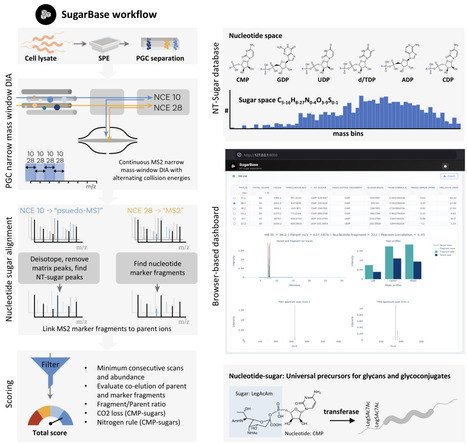
Glycan biosynthesis relies on nucleotide-activated sugars, essential metabolites across all domains of life, yet their usage in microbes is poorly understood. Here we present SugarBase, a mass spectrometry and bioinformatic pipeline for untargeted exploration of microbial nucleotide sugar networks. SugarBase resolves the chemical complexity of microbial metabolism by combining narrow-window DIA fragmentation with a chemistry-informed parent ion identification algorithm. Applying SugarBase across a broad phylogenetic range of microbes revealed extensive, species-specific nucleotide sugar profiles, including many candidates with no existing annotation, generating the most comprehensive inventory of nucleotide sugars to date. SugarBase guided identification of gene clusters and allowed discrimination between pseudaminic- and legionaminic acid-producing strains, where genomic and proteomic data provided only ambiguous information. We resolved distinct nonulosonic acid profiles in several Campylobacter jejuni strains, sugars which may alter susceptibility towards distinct flagellotropic phages. We further identify previously undescribed CMP-activated higher-carbon ulosonic acids in Magnetospirillum, expanding the known chemical space in glycan biosynthesis. In summary, SugarBase supports scalable discovery of microbial nucleotide sugar pathways and enzymes, expanding access to chemically complex glycans and providing new targets for antimicrobial development.
|
|
Scooped by
mhryu@live.com
April 21, 12:54 AM
|
β-Glucosidase (BGL), a pivotal enzyme in lignocellulosic saccharification, has been increasingly recognized as an “emerging green biocatalyst” in modern biorefinery processes. Here, Aspergillus niger An-BGL was rationally engineered to achieve high-level production of BGL under low-cost inducers. Corncob powder served as a cost-effective alternative inducer, enhancing BGL production to 14.2 U/mL. The knockout of CreA and the overexpression of XlnR increased the BGL yield by 75% and 27%, respectively. Combinatorial engineering of CreA and XlnR generated the XO–CK strain, which exhibited a derepression effect at high glucose concentrations. Supplementation with 1% glucose alleviated the delayed enzyme production in the engineered XO–CK strain, resulting in a BGL activity of 31.54 U/mL. Furthermore, integration of the bglA gene into the high-expression amyA site enhanced BGL to 40.68 U/mL. The rational modification strategy for A. niger strain established in this study offers an efficient and sustainable approach for transforming corncob agricultural waste into high-value enzymatic preparations.
|
|
|
Scooped by
mhryu@live.com
April 21, 11:23 PM
|
Viruses play crucial roles in microbial ecosystems, yet viromic analysis remains challenging due to the field’s complexity and rapid evolution. This mini-review supports non-specialists through the evolving landscape of viromics, focusing on the analysis of bacterial and archaeal DNA viruses from metagenomic data. We address major challenges, including viral diversity, methodological biases, and the overwhelming array of available tools and pipelines. While describing a typical viromic workflow, we provide users with background information for each of the steps from data acquisition, preprocessing, and quality control to viral characterization and common downstream analyses. The included references and resources will provide users with the information needed to confidently start their own virome analysis.
|
|
Scooped by
mhryu@live.com
April 21, 11:18 PM
|
Salinity is a key parameter for bacterial survival and growth. Halophilic and halotolerant bacteria can adapt to elevated salinity, but the energetic demands of osmoadaptation increase under fluctuating salt concentrations, potentially constraining growth and persistence. A new concept in reverse osmosis (RO) filtration is batch operation with oscillating rather than constantly high brine salinity. We hypothesize that fluctuating salinity can diminish biofouling in such RO systems. To test this hypothesis, we examined the survival and activity of Aliivibrio fischeri and Pseudomonas fluorescens under fluctuating salinities in planktonic and biofilm cultures as representative of halophilic and halotolerant species, respectively, and common members of biofouling communities. At 28°C, P. fluorescens grew at 0%–6% salinity with fastest growth rate at 0%–1%. At 7%–10% salinity, P. fluorescens remained viable but did not grow. At 22°C, A. fischeri grew at 0.5%–7% salinity, with fastest growth rate at 2%–3%, but unlike P. fluorescens, it lost viability outside this growth range. Cultures did not respire at salinities that did not support growth, suggesting that survival under such salt stress does not depend on high metabolic activity. Furthermore, cell-specific aerobic respiration rates in A. fischeri correlated with growth rate but not osmotic stress. Biofilm formation did not enhance the osmotic stress tolerance of the two bacteria. Our results indicate that high constant salinity favors the halophilic A. fischeri over the halotolerant P. fluorescens, but oscillating salinity (e.g., 0%–7%) favors neither. Oscillating salinity may, therefore, offer a new mechanism for controlling microbial growth that circumvents community adaptation to environmental conditions.
|
|
Scooped by
mhryu@live.com
April 21, 10:58 PM
|
Evolvable AI (eAI), i.e., AI systems whose components, learning rules, and deployment conditions can themselves undergo Darwinian evolution, may soon emerge from current trends in generative, agentic, and embodied AI. We argue that this possibility has been underappreciated in debates on AI safety and existential risk. Here, we ask under what technical and ecological conditions AI becomes evolvable, what kinds of behaviors are then likely to emerge, and how such systems could be governed. Drawing on biological evolution and decades of digital evolution experiments, we distinguish “breeder” scenarios, in which humans impose fitness criteria and control reproduction, from “ecosystem” scenarios, in which selection arises from open environments and control erodes. In the latter, selfish replication reliably gives rise to cheating, parasitism, deception, and manipulation, even in very simple systems. We review recent developments that push AI toward open-ended evolution, including evolutionary prompt and model search, self-improving learning rules, self-rewarding and self-deploying agents, and AI-driven code generation for robots and software. We interpret these trends through the theory of major evolutionary transitions and suggest that eAI could mark a shift in the units and substrates of evolution—a possible “Life 2.0.” To steer this transition, we propose interventions that gate replication, treat model variants as genetic material, and reshape selection pressures so that deception and loss of control are disfavored. Anticipating and regulating evolvable AI is, we argue, essential to avoid a harmful coevolutionary arms race while preserving the potential benefits of powerful AI systems.
|
|
Scooped by
mhryu@live.com
April 21, 10:49 PM
|
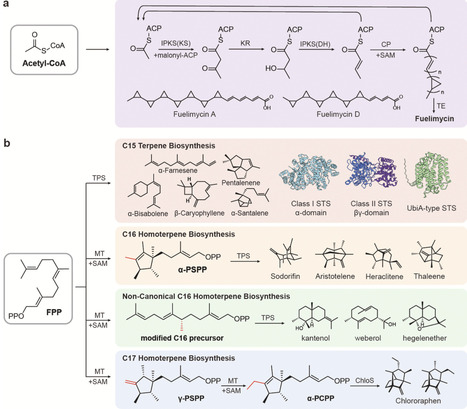
Advanced alcohols, fatty acids, and sesquiterpenes are promising renewable liquid fuels. This article reviews the latest progress in synthesizing these renewable liquid fuels using microbial cell factories. Beyond conventional metabolic engineering, the use of sustainable carbon sources, the design of artificial pathways, and the application of cell compartmentalization have promoted the development of microbial cell factories. The characterization of polycyclopropane fatty acids and the identification of noncanonical terpenoid enzymes and pathways further expand the structural space accessible to biosynthesis, enabling the development of fuel candidates with higher energy content and favorable combustion properties. At the same time, progress in gene editing technologies has provided efficient tools for the evolution of microbial chassis. These innovative strategies and technological breakthroughs lay a solid foundation for the development of high-performance renewable biofuels, accelerating the transition toward clean energy.
|
|
Scooped by
mhryu@live.com
April 21, 10:38 PM
|
Identifying tertiary structures and protein binding sites in RNA molecules remains a key challenge in RNA biology. We describe multi-site dimethyl sulfate (DMS)-mutational profiling (MaP) (msDMS-MaP), a strategy that enables simultaneous measurement of RNA secondary, tertiary, and quaternary structures via a single DMS chemical probing experiment. Optimized reverse transcription decodes typically invisible DMS N7-methylguanine (N7-G) modifications via a tautomer-induced mutational signature concurrent with N1 and N3 modifications. We show that N7-G reactivity reports on higher-order RNA structures, revealing key functional motifs such as pseudoknots and protein binding sites. Using msDMS-MaP, we find that E. coli ribosomal RNAs encode numerous independently folding tertiary structures that coincide with binding sites for primary assembly proteins. We further apply msDMS-MaP to define the quaternary structural ensemble of the 7SK small nuclear ribonucleoprotein particle (snRNP), revealing that each of the three 7SK structural isoforms possesses distinct protein binding profiles in cells. msDMS-MaP represents a broadly applicable strategy for enhanced RNA functional motif discovery and characterization.
|
|
Scooped by
mhryu@live.com
April 21, 10:07 PM
|
Sorbic acid (SA) and its salts are among the world’s most widely used and safest food preservatives, yet their industrial production still relies on fossil fuel-derived feedstocks via chemical synthesis. Here, we report bioproduction of SA through microbial fermentation by decoding its biosynthetic pathway and metabolic engineering of Saccharomyces cerevisiae as a chassis. Here, we identify SA and its amide derivative sorbamide (SN) from Myrothecium sp. FJNU6, representing identification of SA from a microbial source. Genome sequencing and heterologous expression reveal the SA/SN biosynthetic gene cluster, comprising a highly reducing polyketide synthase (SoaA), a hydrolase (SoaB), and an amidotransferase (SoaC). To enable sustainable overproduction, we reconstitute and optimize the SoaA–SoaB pathway in S. cerevisiae through multilevel engineering, including dynamic promoter control, acetyl-CoA/malonyl-CoA pathway enhancement, peroxisomal compartmentalization, and two-stage fed-batch fermentation. These strategies collectively enable a production titer of 1.84 g/L SA in a 50 L bioreactor. This study uncovers a microbial biosynthetic pathway for SA/SN and establishes a microbial platform for SA production, providing a foundation for developing sustainable alternatives to fossil-based manufacturing. Sorbic acid is a widely used food preservative, yet its industrial production lacks a sustainable microbial route. Here the authors identify the biosynthetic pathway of sorbic acid and engineer yeast for its efficient production.
|
|
Scooped by
mhryu@live.com
April 21, 6:56 PM
|
The microbiome is a key regulator of host homeostasis and immune activity, in part through the production of metabolites. These microbiota-derived metabolites can modulate both the innate and adaptive immune system, as well as directly target tumor cells, thereby regulating anti-tumor immunity and response to immunotherapy. Here, we describe the current mechanistic knowledge on how these metabolites exert their effects and outline the methodologies used to detect and assess these metabolites. Finally, we summarize microbiota-targeted therapies capable of improving microbial functionality to ultimately enhance immunotherapy responses and improve patient survival.
|
|
Scooped by
mhryu@live.com
April 21, 6:51 PM
|
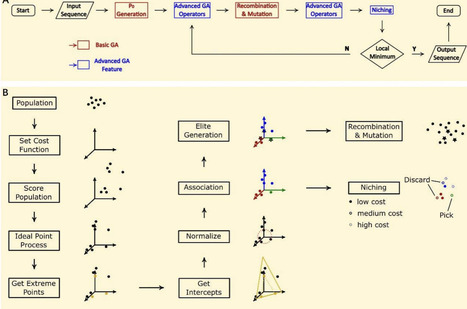
High level of protein expression is usually welcomed in industry and research, and codon optimization is widely used to achieve high expression. Methods of implementing codon optimization can be divided into two branches, one is classical methods which develop cost functions based on empirical law, another is AI methods which learn the codon choice principles from endogenous genes with neural networks. Here we develop two codon optimization tools based on two branches respectively, namely OptimWiz 2.1 and OptimWiz 3.0. Results of fusion protein fluorescence detection indicate that both OptimWiz 2.1 and OptimWiz 3.0 are superior to all the other commercially available codon optimization tools. Principles of codon optimization are revealed in the process of machine learning on both tools.
|
|
Scooped by
mhryu@live.com
April 21, 6:44 PM
|
Arabidopsis thaliana naturally occurs across a wide geographic range and displays extensive natural variation in several traits including adaptive responses to the abiotic environment (e.g. temperature, drought, salt). Quantitative techniques like Genome Wide Association Studies (GWAS) enable mapping the genetic basis of such environmental responses and benefits from extensive genetic variation, but the size of the chosen diversity panel is often limited by phenotyping capacity. Most studies therefore use subpanels, often based on maximization of genetic diversity. However, this type of selection may overrepresent cosmopolitan alleles and underrepresent rare environment-specific alleles. Here, we demonstrate that the genetic variation in a GWAS subpanel of Arabidopsis thaliana accessions depends almost entirely on the number of accessions in the panel and very little on the composition of the panel. We present the EcoCore panel designed by grouping accessions of the 1001 genomes (1001G; 1135 accessions) collection, based on their native collection environment and selecting an equal number of accessions from each environment. We assessed hypocotyl lengths of plants grown at control and ambient high temperatures (20C and 28C) for 913 accessions of the 1001G and mapped these traits with the full 1001G panel versus the EcoCore panel. The EcoCore panel revealed novel genetic associations with hypocotyl length which is attributed to enrichment of alleles from rare environments. We present the EcoCore panel as a manageable resource for studying phenotypic plasticity and the genetic basis of plant–environment interactions.
|
|
Scooped by
mhryu@live.com
April 21, 9:49 AM
|
Cell-free protein synthesis (CFPS) is a powerful and versatile platform that supports a wide range of applications, from fundamental studies of the genetic code to scalable and rapid protein production. The recently developed Pichia pastoris CFPS combines advantages of both prokaryotic and eukaryotic systems, including a rapid growth rate, inexpensive cultivation media, a well-established genetic toolbox, and the capability to perform post-translational modifications (PTMs). As such, it represents a promising alternative for both academic research and biopharmaceutical manufacturing. However, its broader application has been limited by relatively low protein yields and high reagent costs. In this study, building on a previously optimized reaction protocol, we further advanced the P. pastoris CFPS towards a more economical and efficient platform by reducing the cost of protein production. Through systematic screening of chemical additives and their combinations, we identified the most effective stabilizers and crowding agents to be incorporated in the reaction. Additionally, we applied a machine learning model to predict translation initiation rates and optimized the Kozak sequence for enhanced expression. We also evaluated lower-cost glycolytic intermediates as alternative substrates for ATP regeneration to reduce the cost of goods. Compared with the initial baseline condition using the unoptimized CrP/CrK system, the optimized system, incorporating a modified Kozak sequence and the addition of PEG-6000 and spermidine, resulted in a 10-fold increase in protein yield, while reducing the cost per gram of protein by 89%. This work underscores the importance of protein-stabilizing additives and the role of rationally designed DNA sequences with minimized mRNA structural complexity to enhance yield in CFPS. Our demonstration of glycolytic intermediates as a potential secondary energy system additionally provides the foundation for the development of a cost-effective P. pastoris CFPS.
|
|
Scooped by
mhryu@live.com
April 21, 9:41 AM
|
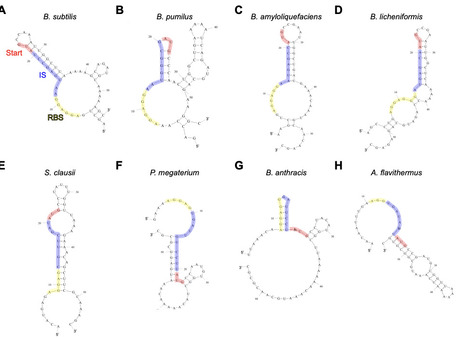
Bacterial ribosomal RNAs (rRNAs) are decorated with conserved nucleotide modifications, but the functionality of these modifications is often underexplored. MraW (RsmH) is a 16S rRNA methyltransferase that fine-tunes ribosomal function. We identified a loss-of-function allele in mraW that corrected a late-stage sporulation defect in Bacillus subtilis by bypassing a key sporulation checkpoint via altered translational regulation. Purified ribosomes isolated from ΔmraW cells displayed a ~2-fold decrease in translation efficiency; in vivo, ΔmraW cells produced decreased levels of the sporulation checkpoint protein CmpA. This regulation was mediated by sequences from the 5' untranslated region and the coding sequence of cmpA, which form a step-loop structure that occlude early codons of the mRNA. Proteomic analysis revealed that MraW directly or indirectly regulates the production of multiple proteins, some of which form similar structural elements as the cmpA transcript. We propose that MraW modification of 16S rRNA enhances translation efficiency in general, and that specific transcripts, whose gene products are likely required in limiting quantities, have evolved structural features that act as a regulatory mechanism to govern protein levels. This type of regulation may be most apparent in bacteria which exhibit uncoupled transcription and translation.
|
|
Scooped by
mhryu@live.com
April 21, 1:03 AM
|
Citrate is a central intermediate metabolite linking the tricarboxylic acid cycle and lipid biosynthesis. Tools for monitoring of spatiotemporal citrate dynamics are critical for getting a better understanding of cellular metabolism. Here, we develope genetically encoded excitation ratiometric biosensors for citrate, based on our previous intensiometric green fluorescence protein-based citrate biosensor, Citron1. We find that a single mutation in the Citron1 chromophore-forming tripeptide provided an excitation ratiometric response. Further rounds of directed evolution yield highly responsive variants, exhibiting citrate-dependent fluorescence changes between two excitation peaks. When expressed in mammalian cells, these biosensors enable citrate dynamics to be monitored in both the cytosol and mitochondria. Comparative analysis across multiple human breast cancer cell lines uncovers cell line-specific differences in citrate levels and their heterogeneity, which could be linked to their malignancy. Furthermore, flow cytometry-based measurements in mouse embryonic stem cells demonstrate the proteomics signatures underlying the population-level variability in citrate concentrations and citrate rewiring during stem cell differentiation. Together, these results show that these excitation ratiometric citrate biosensors enable quantitative, compartment-resolved, and population-scale analysis of cellular metabolism.
|