They’re boring. They’re useless. Everyone hates them. So why can’t we stop having meetings?


 Your new post is loading...
 Your new post is loading...
Your new post is loading...
 Scoop.it!
They’re boring. They’re useless. Everyone hates them. So why can’t we stop having meetings? 
No comment yet.
Sign up to comment
Scoop.it!

Women through the glass ceiling: gender asymmetries in Wikipedia
Scoop.it!

Leadership ain’t what it used to be. The image of a great white man at the top of the pyramid is, we can only hope, gone forever. The question now is, “What will take the place of that image?” What is leadership in a world of open boundaries, multiple differences, and massive interdependencies? Glenda explores these questions in this month’s ATTRACTOR. Via june holley
Scoop.it!
Nowadays, scientific challenges usually require approaches that cross traditional boundaries between academic disciplines, driving many researchers towards interdisciplinarity. Despite its obvious importance, there is a lack of studies on how to quantify the influence of interdisciplinarity on the research impact, posing uncertainty in a proper evaluation for hiring and funding purposes. Here we propose a method based on the analysis of bipartite interconnected multilayer networks of citations and disciplines, to assess scholars, institutions and countries interdisciplinary importance. Using data about physics publications and US patents, we show that our method allows to reveal, using a quantitative approach, that being more interdisciplinary causes -- in the Granger sense -- benefits in scientific productivity and impact. The proposed method could be used by funding agencies, universities and scientific policy decision makers for hiring and funding purposes, and to complement existing methods to rank universities and countries. Evaluating the impact of interdisciplinary research: a multilayer network approach http://arxiv.org/abs/1601.06075 Via Complexity Digest, june holley
Scoop.it!

James Glattfelder studies complexity: how an interconnected system -- say, a swarm of birds -- is more than the sum of its parts. And complexity theory, it turns out, can reveal a lot about how the economy works. Glattfelder shares a groundbreaking study of how control flows through the global economy, and how concentration of power in the hands of a shockingly small number leaves us all vulnerable. (Filmed at TEDxZurich.) Via june holley
Scoop.it!
From
arxiv

The identification of nodes occupying important positions in a network structure is crucial for the understanding of the associated real-world system. Usually, betweenness centrality is used to evaluate a node capacity to connect different graph regions. However, we argue here that this measure is not adapted for that task, as it gives equal weight to "local" centers (i.e. nodes of high degree central to a single region) and to "global" bridges, which connect different communities. This distinction is important as the roles of such nodes are different in terms of the local and global organisation of the network structure. In this paper we propose a decomposition of betweenness centrality into two terms, one highlighting the local contributions and the other the global ones. We call the latter bridgeness centrality and show that it is capable to specifically spot out global bridges. In addition, we introduce an effective algorithmic implementation of this measure and demonstrate its capability to identify global bridges in air transportation and scientific collaboration networks. Detecting global bridges in networks http://arxiv.org/abs/1509.08295 Via Complexity Digest
Liz Rykert's insight:
This paper looks useful from the perspective of finding and supporting key nodes who help the whole network connect.
Scoop.it!
From
www
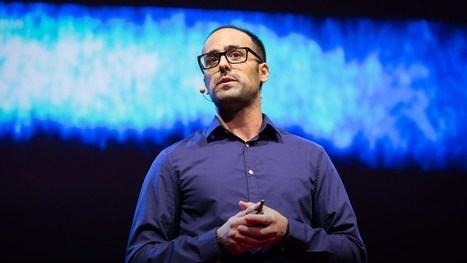
Liver cancer is one of the most difficult cancers to detect, but synthetic biologist Tal Danino had a left-field thought: What if we could create a probiotic, edible bacteria that was "programmed" to find liver tumors? His insight exploits something we're just beginning to understand about bacteria: their power of quorum sensing, or doing something together once they reach critical mass. Danino, a TED Fellow, explains how quorum sensing works — and how clever bacteria working together could someday change cancer treatment. Via Complexity Digest
Scoop.it!

From
scimaps
In an age of information overload, the ability to make sense of vast amounts of data and to render insightful visualizations is as important as the ability to read and write. The Atlas of Knowledge explains and exemplifies the power of visualizations not only to help locate us in physical space but also to help us understand the extent and structure of our collective knowledge, to identify bursts of activity, pathways of ideas, and borders that beg to be crossed. Atlas of Knowledge: Anyone Can Map Via Complexity Digest
Liz Rykert's insight:
I love tools for mapping things - the visual is always so powerful.

Complexity Digest's curator insight,
March 5, 2015 5:46 AM
See Also Information Visualization MOOC (http://ivmooc.cns.iu.edu ).
Scoop.it!

In turbulent markets, managers can build momentum for innovative strategies by rethinking the past, reconsidering present concerns – and reimagining the future.
Scoop.it!
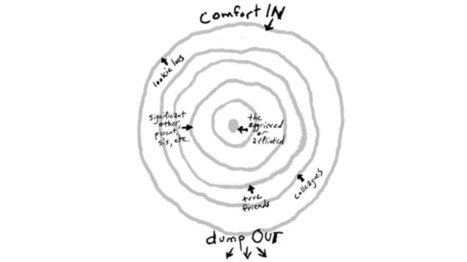
When Susan had breast cancer , we heard a lot of lame remarks, but our favorite came from one of Susan's colleagues. She wanted, she needed, to visit Susan after the surgery, but Susan didn't feel like having visitors, and she said so. Her colleague's response? "This isn't just about you."
Liz Rykert's insight:
Great article to share with people who get awkward when confronted with challenging situations. Great read.
Scoop.it!

In his newest and best book, the surgeon Atul Gawande lets us have it right between the eyes: no matter how careful we are or healthful our habits, like everyone else, we will die, and probably after a long period of decline and debility.
Liz Rykert's insight:
Review and description of the new book by Atul Gawande. Looks very interesting. I feel like these issues of care for the elderly and how we manage our deaths is one that needs so much more thought and attention and action. I am picking up this book based on this review. Here is the book: Being Mortal: Medicine and What Matters in the End by Atul GawandeMetropolitan, 282 pp., $26.00
|
Scoop.it!

Most companies say they want to attract a diverse workforce, but few deliver. The only solution may be a radical one: anonymity.
Scoop.it!
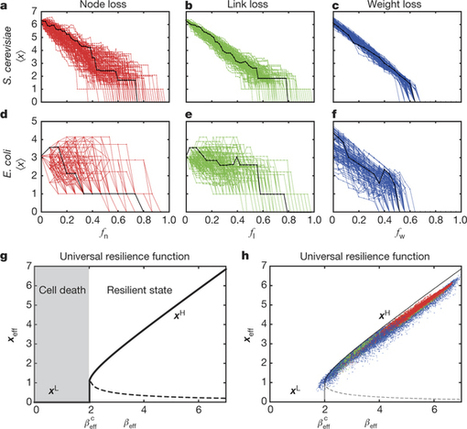
Resilience, a system’s ability to adjust its activity to retain its basic functionality when errors, failures and environmental changes occur, is a defining property of many complex systems. Despite widespread consequences for human health, the economy and the environment, events leading to loss of resilience—from cascading failures in technological systems to mass extinctions in ecological networks—are rarely predictable and are often irreversible. These limitations are rooted in a theoretical gap: the current analytical framework of resilience is designed to treat low-dimensional models with a few interacting components, and is unsuitable for multi-dimensional systems consisting of a large number of components that interact through a complex network. Here we bridge this theoretical gap by developing a set of analytical tools with which to identify the natural control and state parameters of a multi-dimensional complex system, helping us derive effective one-dimensional dynamics that accurately predict the system’s resilience. The proposed analytical framework allows us systematically to separate the roles of the system’s dynamics and topology, collapsing the behaviour of different networks onto a single universal resilience function. The analytical results unveil the network characteristics that can enhance or diminish resilience, offering ways to prevent the collapse of ecological, biological or economic systems, and guiding the design of technological systems resilient to both internal failures and environmental changes. Universal resilience patterns in complex networks Nature 530, 307–312 (18 February 2016) http://dx.doi.org/10.1038/nature16948 Via Complexity Digest, june holley

Marcelo Errera's curator insight,
February 21, 2016 9:37 PM
That's a very interesting study. Indeed it deserves to be in Nature. One might wonder, though, why such networks are formed in the first place.
Marcelo Errera's curator insight,
February 27, 2016 9:12 AM
( more thoughts on this paper)
That's a very interesting study. Indeed it deserves to be in Nature. One might wonder, though, why such networks are formed in the first place.
There is a constructal theory to explain the robustness of such networks. Check it out:
http://www.sciencedirect.com/science/article/pii/S001793101500664X ; (need subscription to IJHMT)

Gian77's curator insight,
April 8, 2017 7:56 AM
That's a very interesting study. Indeed it deserves to be in Nature. One might wonder, though, why such networks are formed in the first place.
Scoop.it!
Scoop.it!
Liz Rykert's insight:
Great looking free courses to help you learn about complexity and apply it to the social challenges you face.
Scoop.it!
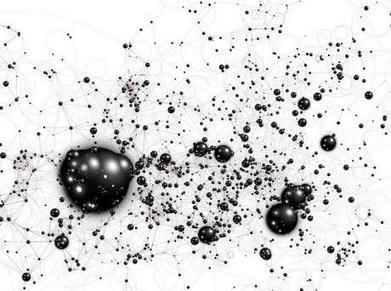
We must move to an understanding of networks as constantly changing and dynamic; no two 'links' are alike. Via june holley
Liz Rykert's insight:
Thanks June Holley for this scoop. It is a concise analysis of networks in the context of social movements in Europe.

Diego Mora's curator insight,
December 1, 2015 9:35 AM
Nuevas comprensiones de los movimientos sociales, de redes a sistemas dinámicos.
Scoop.it!

Interdisciplinary science must break down barriers between fields to build common ground.
Liz Rykert's insight:
Nature has a whole issue dedicated to interdisciplinary work. The challenges we face today require a "greater than the sum our parts" approach.
Scoop.it!
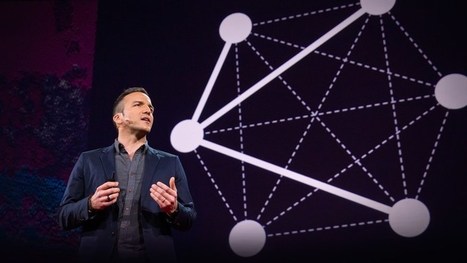
How does knowledge grow? Sometimes it begins with one insight and grows into many branches; other times it grows as a complex and interconnected network. Infographics expert Manuel Lima explores the thousand-year history of mapping data -- from languages to dynasties -- using trees and networks of information. It's a fascinating history of visualizations, and a look into humanity's urge to map what we know.
Liz Rykert's insight:
Great story told by Manuel Lima of how we have instinctively mapped knowledge over time and the shift we see today from hierarchies to networks.
Scoop.it!
Human societies use complexity -- within their institutions and technologies -- to address their various problems, and they need high-quality energy to create and sustain this complexity. But now greater complexity is producing diminishing returns in wellbeing, while the energetic cost of key sources of energy is rising fast. Simultaneously, humankind's problems are becoming vastly harder, which requires societies to deliver yet more complexity and thus consume yet more energy. Resolving this paradox is the central challenge of the 21st century. Thomas Homer-Dixon holds the CIGI Chair of Global Systems at the Balsillie School of International Affairs in Waterloo, Canada, and is a Professor at the University of Waterloo. https://www.youtube.com/watch?v=4Vf-y3mv57U Via Complexity Digest
Scoop.it!

The Scene. It was a case of art imitating life. Literally.After a Friday morning full of client appointments, I drove to the airport and boarded a flight to Orlando. I had booked myself into a “creative expression” workshop on a whim several days ago and was now headed to a weekend full of painting.Which is all very well and good – who wouldn’t savor two days in Orlando when leaving behind 5 degrees-below-zero weather at home? Just one problem.I don’t paint.At all.Haven’t picked up a paintbrush
Scoop.it!

As you read this, wiggle your toes. Feel the way they push against your shoes, and the weight of your feet on the floor. Really think ...
Scoop.it!
Building and Using the Theory of Collaborative Advantage
Liz Rykert's insight:
Useful article (book chapter) on building and managing inter-organizational networks.
|