



"Moral: The vector belongs to the spoils."
In 1963, two years after he penned his timeless classic The Phantom Tollbooth, Norton Juster w


 Your new post is loading...
 Scoop.it! "Moral: The vector belongs to the spoils." 
No comment yet.
Sign up to comment
Scoop.it!

Leadership Learning Community's curator insight,
February 23, 2014 6:31 PM
Some nice graphics in here.
Scoop.it!
Social: Why Our Brains Are Wired to Connect [Matthew D. Lieberman] on Amazon.com. *FREE* shipping on qualifying offers. We are profoundly social creatures – more than we know. In Social, renowned psychologist Matthew Lieberman explores groundbreaking research in social neuroscience revealing that our need to connect with other people is even more fundamental
Liz Rykert's insight:
Culture in a group or organization comes as a result of the patterns of relating over time. Learning more about why and how we connect is key.
Scoop.it!
Liz Rykert's insight:
Here is another Manifesto - this time from Kumu.io a newish service that helps people visualize networks. These Manifestos are a good place to look at simple rules guiding self-organization.
Scoop.it!
Irene Sanders Executive Director and Founder of the Washington Center for Complexity and Public Policy and author of "Strategic Thinking and the New Science: Planning in the Midst of Chaos, Complexity, and Change." http://www.youtube.com/watch?v=KXxs-JtvkkQ Via Complexity Digest
Liz Rykert's insight:
Loving these new video resources for understanding complexity and it applications.

Eli Levine's curator insight,
February 11, 2014 2:09 PM
A way cool panel discussion. I wish I could be a full practitioner of this new, empirically based governing and political strategic thinking. 
Luciano Lampi's curator insight,
March 23, 2014 9:16 PM
are our politicians aware of these concepts?
Scoop.it!

VisualComplexity.com is a unified resource space for anyone interested in the visualization of complex networks. The project's main goal is to leverage a critical understanding of different visualization methods, across a series of disciplines, as diverse as Biology, Social Networks or the World Wide Web.
Liz Rykert's insight:
Love this site - great collection of examples of visualizing networks of all kinds - human and otherwise.
Scoop.it!
Leadership Learning Community's curator insight,
February 5, 2014 3:23 PM
“Transformation is profound, fundamental change, altering the very nature of something. Transformational change is both radical and sustainable. Something that is transformed can never go back to exactly what it was before.” – excerpt from What is Transformation?
Scoop.it!

Young designers and design students today pursue the rewards of creativity
Liz Rykert's insight:
Interesting insights into the evolution of design as a profession, and intergenerational differences.
Scoop.it!

Complicity is an open access (free to all readers), peer-reviewed journal that publishes original articles on all aspects of education that are informed by the idea of complexity (in its technical, applied, philosophical, theoretical, or narrative manifestations). The journal strives to serve as a forum for both theoretical and practical contributions and to facilitate the exchange of diverse ideas and points of view related to complexity in education.
Via Complex Systems Digital Campus, Complexity Digest
Scoop.it!
Liz Rykert's insight:
Love this integrated way of thinking about Networked Leadership

june holley's curator insight,
January 13, 2014 10:03 AM
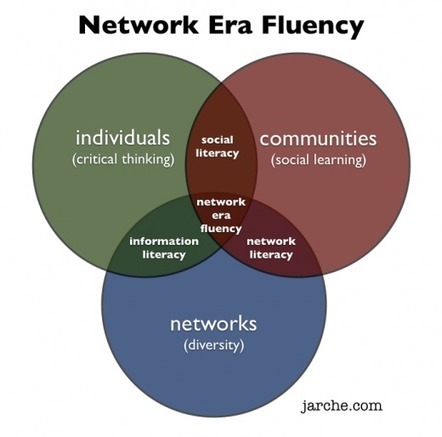
core skill for leaders " the core skill will be critical thinking, or questioning all assumptions, including one’s own. People will learn though their various communities and in doing so, develop social literacy. Information literacy will be developed by connecting to many networks. Diversity of our knowledge networks can foster innovation and improve our collective ability to adapt". |
Scoop.it!
Liz Rykert's insight:
Nice piece extolling need to shift facilitation focus to reflect emerging demands of the networks we all work within. Author references centralized, de-centralized and distributed facilitation. My fav quote? When Ed Mitchell refers to Distributed facilitation he says: "Now we’re cooking with psychaedelic rocket fuel." :)
Scoop.it!
In October, 140 grantmakers met to explore the role of networks in scaling impact and what grantmakers can do to support them. A central theme that emerged f... Via june holley
Liz Rykert's insight:
Important to see the role grant makers can take....
Scoop.it!
Liz Rykert's insight:
Thanks for a great piece on Leaders and Networks Prucia and the Folks at PlexusInstitute.org!
Scoop.it!

I’ve noticed lately that my mind has been wandering a lot so I wanted to see how attention works and how to manage it better. It turns out a lot of us have wandering minds and struggle to stay focused. In fact, when we’re reading, our minds typically wander anywhere from 20 to 40 percent [...]
Liz Rykert's insight:
So relevant - finding ways to find focus - yeah!
Scoop.it!
Liz Rykert's insight:
I am always looking for better ways to measure things like networks that can sometimes be difficult to get right - this looks useful.
Scoop.it!
The Social Labs Revolution: A New Approach to Solving our Most Complex Challenges: Zaid Hassan, Joi Ito: 9781626560734: Books - Amazon.ca
Liz Rykert's insight:
Looks like another one for the reading list - great to see insights from many of the "labs" that have sprung up to work on complex social challenges captured in a book. I just placed my order at my local bookstore!
Leadership Learning Community's curator insight,
February 15, 2014 1:26 PM
Lots of great ideas here for new approaches to network leadership. A real action learning model.
Scoop.it!
This video provides a basic introduction to the science of complex systems, focusing on patterns in nature. (For more information on agent-based modeling, visit http://imaginationtoolbox.org ). Via Decision Intelligence, Complexity Digest
Liz Rykert's insight:
Always looking for good resources to introduce complexity science to others. This looks great.

Decision Intelligence's curator insight,
January 30, 2014 6:35 PM
This is a great introduction to the idea of emergent behavior from complex systems. Many people don't realize that if individuals have very simple behaviors, there can be very complex behaviors when those individuals act in a group. Understanding these emergent patterns is critical for good decision making, because you need to know how the decision you make will set other elements in the system in motion. More and more, our social, economic, political, climate, and other realities have this characteristic. This video focuses on agent-base complex systems, such flocks of birds, schools of fish, or even nanobot swarms to cure cancer. 
António F Fonseca's curator insight,
February 1, 2014 4:50 AM
Agent based modeling still is the best tool to understand complex systems when mathematical modeling gets very complicated. 
Ian Biggs, FAIPM, CPPE's curator insight,
April 16, 2014 8:08 PM
I recently conducted a series of workshops on the subject of 'Complex Project Management - Navigating through the unknown'. This clip provides a great introduction to complex systems and for those interested in Complexity Science, this clip is worth 7:52 of your time.
Scoop.it!

“ The PyCX Project aims to develop an online repository of simple, crude, yet easy-to-understand Python sample codes for dynamic complex systems simulations, including iterative maps, cellular automata, dynamical networks and agent-based models.”
Via Complexity Digest
Liz Rykert's insight:
Love cool stuff like this
Scoop.it!
“Social technologies radically disrupted communications, marketing, and customer care. With these same technologies, customers are now sharing products and servi”
Via june holley
|










I love this Blog - Brain Pickings - it has such wonderful pieces of all description - Like this one - describing a story of line who falls in love with dot. You can imagine what ensues....