Comment faire pour retrouver plus rapidement un objet parmi une masse de produits ? Il suffit d'enfiler un gant, rétorquent des chercheurs de l'Institute for Information Technology de l'université d'Helsinki. Ils ont mis au point un système qui identifie la cible au sein d'un environnement 3D et alerte l'individu qui le porte par une vibration…
°°°°°°°°°°°°° Helsinky Institute for Information Technology : http://www.hiit.fi
Shot 100% on the new HERO3® camera from http://GoPro.com. The Wi-Fi enabled HERO3: Black Edition is the most advanced GoPro, ever. No expense was spared dur...
Could 3D Printing Change the World? Technologies, Potential, and Implications of Additive Manufacturing explores the technology of AM and its broader implications, which include:
Assembly lines and supply chains could be reduced or eliminated for many products. AM can produce the final product—or large pieces of a final product— in one process. Designs, not products, would move around the world as digital files are printed anywhere with any printer to meet design parameters. A “STL” design file can be sent via the Internet and printed in 3D. Products could be printed on demand without the need for inventories. A given manufacturing facility would be capable of printing a huge range of products without retooling—and each printing could be customized without additional cost. Production and distribution of material products could become de-globalized as production is brought closer to the consumer. Manufacturing could be pulled away from “manufacturing platforms” like China back to the countries where the products are consumed, reducing global economic imbalances as export countries’ surpluses are reduced and importing countries’ reliance on imports shrink. The carbon footprint of manufacturing and transport as well as overall energy use in manufacturing could be reduced substantially and thus global “resource productivity” greatly enhanced and carbon emissions reduced. Reduced need for labor in manufacturing could be politically destabilizing in some economies while others, especially aging societies, might benefit from the ability to produce more goods with fewer people while reducing reliance on imports. The United States, the current leader in AM technology, could experience a renaissance in innovation, design, IP exports, and manufacturing, enhancing its relative economic strength and geopolitical influence.
La réalité augmentée intégrée aux lentilles de contact n’est plus une utopie : la société américaine Innovega a annoncé que ses lentilles iOptiks devraient être opérationnelles en 2013 pour une commercialisation prévue dans le courant de l’année 2014. Destinées en premier lieu à un usage militaire, ces lentilles à réalité augmentée pourraient aussi servir ultérieurement à d’autres applications plus « pacifiques » comme les jeux vidéo…
Augmented learning is defined as an on-demand learning technique where the learning environment adapts to the needs and inputs from learners. Broadly speaking, "environment" here does not have to be constrained into the physical learning environment such as classroom, but could refer to such learning environment as digital learning environment, through which learners can stimulate discovery and gain greater understanding.
The technologies conventionally used for augmented learning incorporate touchscreens, voice recognition, and interaction, through which the learning contents can be geared toward learner's needs by displaying plain texts, images, audio and video output. For example, in mobile reality system, the annotation may appear on the learner's individual "heads-up display" or through headphones for audio instruction. This system has been shown to improve life-time learning performance.
Augmented Reality (AR) is a novel way of superimposing digital contents into the real context, is impacting the mobile communications industry by providing a radical shift in human-computer interaction, AR has been foremost applied in the areas of entertainment, retail, travel, advertising, and social communication.
Augmented Reality has great potentials in education, and more excitingly, opens a novel realm for, and even redefines, eLearning. AR offers an innovative learning space by merging digital learning materials into the format of media with tools or objects, which are direct parts of the physical space, therefore creating "situated learning." Augmented Reality is well aligned with constructivist notions of education where learners control their own learning, through the active interactions with the real and virtual environments.
Donner la possibilité aux spectateurs d'une salle obscure d'interagir avec une publicité: c'est une première en France. Et c'est en ce moment avec l'Office du tourisme du Brésil.
The race is on to build robots for the consumer market. But are there consequences to co-existing with humanoid machines? 16x9 speaks to some of the world's most brilliant people while exploring the Geminoid Project, Nao Robot, Baxter and Dr. Robot.
Throughout history we've built tools to solve specific problems. We've learned how to build powerful tools that we can adjust to our needs. But we've never b...
A working definition of IoT. How large is the market for connected things? Let’s talk about this movement from M2M to IoT and changes in the industry over the next 5-7 years.
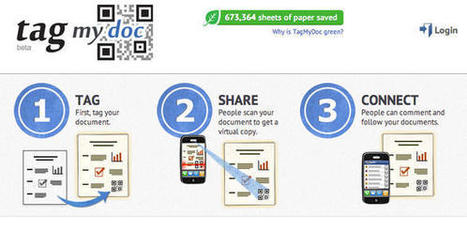
TagMyDoc propose de télécharger un document de travail en scandant simplement un code avec son mobile.
La startup canadienne a mis au point une plateforme web qui stocke vos documents à télécharger et y appose un QR Code. Celui-ci permet à l’utilisateur de partager son fichier très simplement : il suffit de flasher le code avec son téléphone.
Commander ses courses à Lyon et se les faire livrer à Paris ? C'est possible ! Carrefour vient de lancer son nouveau magasin virtuel qui permet de scanner les produits à l'aide d'un smartphone, avant de choisir le lieu de livraison.
Après le Drive qui connait une croissance vertigineuse depuis quelques temps, cette technique de vente par smartphone marque la désolidarisation des flux physiques et d'informations avec une commande digitale et une livraison à domicile. Cette démarche des distributeurs pour venir au devant des consommateurs permet de compenser la relative désaffection pour les grands centres commerciaux préiurbains.
C'est le mouvement inverse des pure-players qui cherchent eux à s'établir avec des boutiques en centre ville pour se rapprocher de leurs clients, mieux les connaître et les fidéliser ...
Chacun avance dans le sens du cross-canal avec à la clef une complexité grandissante de la Supply Chain qui doit piloter des flux qui s'entecroisent chaque jour un peu plus !
Will 3D printing make global supply chains unnecessary? That’s a real possibility, states a recent report from Transport Intelligence.
3D printing (or “additive manufacturing,” as it’s called in industrial circles) takes offshore manufacturing and brings it back close to the consumer. It has enormous potential to shift the trade balance. Goods will be cheaper to reproduce within the domestic market, versus manufacturing and then shipping them from a distant low-wage country. The report, authored by John Manners-Bell of Transport Intelligence and Ken Lyon of Virtual-Partners Ltd., points to the growing role of automation in production resulting from 3D printing: “New technologies which are currently being developed could revolutionize production techniques, resulting in a significant proportion of manufacturing becoming automated and removing reliance on large and costly work forces. This in turn could lead to a reversal of the trend of globalization which has characterized industry and consumption over the last few decades, itself predicated on the trade-off between transportation and labor costs.”
DAVID is a software for 3D laser scanning. All you need to build a 3D scanner is a PC, a camera (e.g. a webcam), a background corner, and a laser which projects a line onto the object you want to scan.
Excellent documentary with the great Stephen Hawkings as Stephen Hawking and others such as Professor Richard Dawkins and Professor Jim Al-Khalili examine how science is striving for humankind's next leap forward. In Episode 1 the team showcase breakthroughs in technology and engineering that are creating a new generation of machines. Mark Evans fuses his brain with a computer in Switzerland to test a new breed of machine. Kathy Sykes hits the streets of San Francisco to have the ride of her life as she experiences the future of transport in a driverless car. In Italy Jim Alei-Khalili comes face to face with a remarkable, baby-like robot called iCub, which learns like a child. Joy Reidenberg discovers the extraordinary exoskeleton that can make the paralysed walk and give one man the strength of three. In the Canary Islands Maggie Aderin-Pocock visits one of the world's biggest telescopes, where they're searching for new planets in the furthest reaches of the universe - planets that we could one day colonise.
Looks at a Year 3 student using Augmented Reality to help solve a Mathematics Problem. Augmented reality in schools is growing and ICT visionary, Paul Hamilt...
Does Siri ever frustrate you? Like, does she ever call who you don’t want her to? Yea we’ve all cursed Siri’s name one time or another, but soon that’s going to change.
Les capteurs de Microsoft permettraient de mieux saisir les déplacements d'une personne en tenant compte de la profondeur de champ. Le but : rendre les espaces publics plus adaptés.
To get content containing either thought or leadership enter:
To get content containing both thought and leadership enter:
To get content containing the expression thought leadership enter:
You can enter several keywords and you can refine them whenever you want. Our suggestion engine uses more signals but entering a few keywords here will rapidly give you great content to curate.


 Your new post is loading...