 Your new post is loading...

|
Scooped by
Jeff Domansky
July 19, 2016 6:12 PM
|
Boris Johnson’s latest column for the Telegraph is a marvellous specimen of an emergent school of political thought: Bloody Brilliant Brexit Britishism. Here’s a snippet:
And that gives us a chance not just to do new trade deals, but to think of ourselves once again as a truly global Britain using our unique voice — humane, compassionate, principled — to do good around the world, and to exploit growth markets to the full. link
How splendid. Here’s another cracking example of the genre: Priti Patel‘s got some cracking news, just wait til you hear this, guys!
We are already seeing our friends in the Anglosphere sending us positive messages on future trade deals, and it is clear that the US wants us at the front of the queue rather than the back…As a beacon of global free trade and enterprise, we should go into our negotiations with the EU with confidence that we can achieve fair terms of withdrawal. link
Cool! What are you all worrying about, you idiots, we’re a beacon! We’ve got confidence! And, and and and, we’ve got some amazingly positive messages, and — holy shit! — have you seen how big these imaginary trade deals are?!...
|
|
Scooped by
Jeff Domansky
July 19, 2016 5:45 PM
|
Without ever getting into YouTube, you can do short videos on several social media sites. On Vine, they last six seconds, Instagram they are 15 seconds, and on Google+, LinkedIn, and Facebook the videos can be as long as 2–3 minutes. Once videos are created, they can also be pinned on Pinterest.
You don’t need expensive camera equipment, though it will add to the quality if you do use something different than you smartphone camera. It should do a decent job until you have the funds to invest in something better. Short videos are like a dessert or snack, just enough to satisfy and not so much that in the middle you’ve had enough and are trying to figure out how to end it sooner rather than later. And getting the story or information visually is almost always preferred to reading about it.
|
|
Scooped by
Jeff Domansky
July 19, 2016 5:13 PM
|
SEO is a marathon, not a sprint. And at some point, your businesses is likely to experience a lull in organic traffic performance that requires you to mix up your strategy to get back on track. One way to do this is through dynamite keyword discovery.
The search landscape is always changing. This includes what people search for, how they search, and what syntax – or combination of words and phrases – they use to search for things.
Efficient and resourceful keyword discovery, done on a regular basis, is key to a strong content strategy and rewarding SEO over the long term.
So whether you’re in an SEO slump, or just trying to start SEO, use these 2 keyword discovery techniques to quickly identify promising terms....
|
|
Scooped by
Jeff Domansky
July 19, 2016 10:13 AM
|
One of my biggest bugbears in the world of marketing are people that do not have Twitter. It’s a free platform that has over 310 million active users, and unlike the monster that is Facebook, doesn’t meddle with your timeline (too much). Whether it’s engaged with is a completely different matter but with these Twitter tips you should see a rise in your performance! Retweets and reply tweets broaden your network, your audience, and your profile – which in turn drives traffic to your blog and customers to your product or service. Ready to jump in?...
|
|
Scooped by
Jeff Domansky
July 19, 2016 9:55 AM
|
Parts of Melania Trump’s speech at the Republican National Convention are strikingly similar to Michelle Obama’s speech from eight years ago. How does this happen? Plagiarism at this level is typically the result of sloppiness, not outright theft. If you don’t want this to happen to you, then you need to change how you work. What Melania Trump said sounds awfully familiar. In 2008, here’s what Michelle Obama said, in part (most of the highlights in these passages, which show the similar parts, are from a Wall Street Journal article about the plagiarism). Like my family, they scrimped and saved so that he could have opportunities they never had themselves. And Barack and I were raised with so many of the same values: that you work hard for what you want in life; that your word is your bond and you do what you say you’re going to do; that you treat people with dignity and respect, even if you don’t know them, and even if you don’t agree with them. And Barack and I set out to build lives guided by these values, and pass them on to the next generation. Because we want our children—and all children in this nation—to know that the only limit to the height of your achievements is the reach of your dreams and your willingness to work for them....
|
|
Scooped by
Jeff Domansky
July 19, 2016 12:55 AM
|
From my perspective, digital marketing is all about the thinking involved rather than just the tools. But tools these days are making it increasingly easier toimplement those creative ideas, connect with more people, do research quickly and get your content out there. So without further ado, here are a list of some of our favorite digital marketing tools for 2016....
|
|
Scooped by
Jeff Domansky
July 18, 2016 11:59 PM
|
Last June, as dusk fell outside Tony Schwartz’s sprawling house, on a leafy back road in Riverdale, New York, he pulled out his laptop and caught up with the day’s big news: Donald J. Trump had declared his candidacy for President. As Schwartz watched a video of the speech, he began to feel personally implicated.
Trump, facing a crowd that had gathered in the lobby of Trump Tower, on Fifth Avenue, laid out his qualifications, saying, “We need a leader that wrote ‘The Art of the Deal.’ ” If that was so, Schwartz thought, then he, not Trump, should be running. Schwartz dashed off a tweet: “Many thanks Donald Trump for suggesting I run for President, based on the fact that I wrote ‘The Art of the Deal.’ ”
Schwartz had ghostwritten Trump’s 1987 breakthrough memoir, earning a joint byline on the cover, half of the book’s five-hundred-thousand-dollar advance, and half of the royalties. The book was a phenomenal success, spending forty-eight weeks on the Times best-seller list, thirteen of them at No. 1. More than a million copies have been bought, generating several million dollars in royalties. The book expanded Trump’s renown far beyond New York City, making him an emblem of the successful tycoon. Edward Kosner, the former editor and publisher of New York, where Schwartz worked as a writer at the time, says, “Tony created Trump. He’s Dr. Frankenstein.”
Starting in late 1985, Schwartz spent eighteen months with Trump—camping out in his office, joining him on his helicopter, tagging along at meetings, and spending weekends with him at his Manhattan apartment and his Florida estate. During that period, Schwartz felt, he had got to know him better than almost anyone else outside the Trump family. Until Schwartz posted the tweet, though, he had not spoken publicly about Trump for decades. It had never been his ambition to be a ghostwriter, and he had been glad to move on. But, as he watched a replay of the new candidate holding forth for forty-five minutes, he noticed something strange: over the decades, Trump appeared to have convinced himself that he had written the book. Schwartz recalls thinking, “If he could lie about that on Day One—when it was so easily refuted—he is likely to lie about anything.”
It seemed improbable that Trump’s campaign would succeed, so Schwartz told himself that he needn’t worry much. But, as Trump denounced Mexican immigrants as “rapists,” near the end of the speech, Schwartz felt anxious. He had spent hundreds of hours observing Trump firsthand, and felt that he had an unusually deep understanding of what he regarded as Trump’s beguiling strengths and disqualifying weaknesses. Many Americans, however, saw Trump as a charmingly brash entrepreneur with an unfailing knack for business—a mythical image that Schwartz had helped create. “It pays to trust your instincts,” Trump says in the book, adding that he was set to make hundreds of millions of dollars after buying a hotel that he hadn’t even walked through....
|
|
Scooped by
Jeff Domansky
July 18, 2016 4:27 PM
|
Facebook offers great opportunities to attract, engage and convert would-be customers, but building a high-converting Facebook page has been elusive for many organizations.
It's important to know the elements of a successful Facebook page; it's even more crucial to recognize the reasons your Facebook page is failing.
If you want your ideal customers to "like" your page and follow you, you have to continually reward them with great content and build an engaged community. This means employing a content strategy that works for your business both culturally and operationally.
You also have to incorporate Facebook ads to promote your content, increase clicks to your website and turn fans into customers.
Is achieving consistent engagement and conversions on Facebook a struggle for your company? Here's a list of 10 reasons why your Facebook page is failing, along with tips to make it work for you rather than against you:
|
|
Scooped by
Jeff Domansky
July 18, 2016 11:35 AM
|
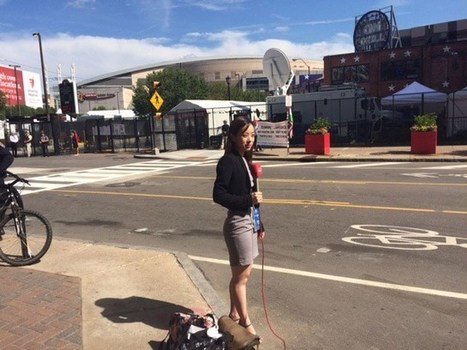
If their labor was similar to that of many other reporters in town covering the convention, their nationality wasn't. Reporter Jiwon Park and cameraman Bohyun Bang are with Arirang TV based in Seoul, South Korea. Why were they here? "It's the president of the United States," Park explained. "We have a lot of interest in the United States. It is the number-one country in the world." As NBC's Chuck Todd was hustling to a nearby outdoors studio not too far away and eliciting a news celebrity's typical response from passersby ("hey, that's the guy from CBS!" a Mississippi delegate said to his companion), the two journalists from Arirang were virtually unnoticed and blended into the bustle of conventioneers, media and massive security. The duo has been in the country for 10 days, starting in Washington, D.C. and finishing up in Cleveland.I asked if they had come to any clear understanding of Trump's appeal. They said a little bit but not completely. Perhaps join the crowd, I said....
|
|
Scooped by
Jeff Domansky
July 18, 2016 11:16 AM
|
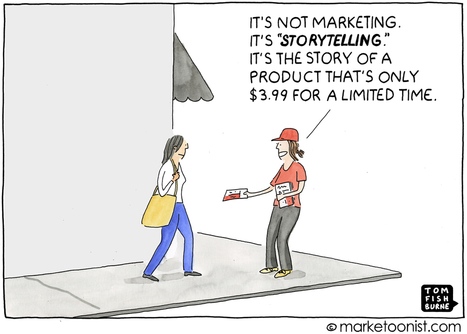
It’s in vogue for marketers to think of themselves as storytellers. But much of the marketing that gets passed off as “storytelling” really isn’t that much of a story. There is genuine power in stories and there are inspiring examples of brands that tell stories. But I think that often gets diluted by all of the content produced in the name of storytelling that is really just a thinly veiled marketing pitch. Not all marketing is storytelling. Not all content tells a story. Most case studies are just case studies. Most video testimonials are just video testimonials. Most long-form blog posts are just long-form blog posts. I enjoyed this 2-minute critique from Stefan Sagmeister about storytelling (from an interview ironically made while speaking at a marketing conference on storytelling).As he summarized, “Storytelling has taken on the mantle of bullshit.”...
|
|
Scooped by
Jeff Domansky
July 16, 2016 2:58 AM
|
What’s the difference between The New York Times, and, say, DNAInfo New York? Maybe about $20. The Times, along with outlets like ESPN, Hearst, Discovery Communications, Gannett, Slate, and ABC, all consider themselves “premium” media. That means they can charge advertisers “premium prices,” as compared to the great mass of news and entertainment sites out there, like a DNAInfo, a site covering local news across New York City’s five boroughs. That $20 or so difference is how much more the Times can charge for access to each thousand of its readers (a cost-per-thousand rate, or CPM) as compared to lesser-branded sites. It’s just an approximation but it holds true across major media: Big branded media companies believe that the “context” they provide and their “quality audiences” justifies higher-than-average rates. Their pitch to advertisers goes like this: We’ve got tons of readers, and they’re smart and affluent. They really trust us. And when they’re on our site, they’re paying attention. In a word, their argument is a single word: effectiveness. With the publication of a new comScore study this morning, they just got more justification for their justifying. Entitled “The Halo Effect: How Advertising on Premium Publishers Drives Higher Ad Effectiveness,” comScore puts a few numbers on that effectiveness.Its key word: lift....
|
|
Scooped by
Jeff Domansky
July 16, 2016 2:29 AM
|
It was hard not to get swept up in the sensation of Pokemon Go this week. You likely either saw people out playing it—holding up their cell phones as they walked or ran down the street—or you heard people talking about it on social media. Pokemon Go fever came on fast—the free app almost instantly became the most-downloaded free iPhone app and the top-grossing iPhone app in the U.S. It reminds me of the fervor that surrounded the early days of Twitter, when real-world tweet-ups happened regularly among the tech-savvy early adopters who “got” the social network long before it became mainstream. This is perhaps fitting, given that Pokemon Go has just surpassed Twitter’s 65 million active users. Naturally, many national media outlets covered the phenomenon. Anything that got typically reclusive gamers out walking, running and biking was sure to make national news. Soon, businesses and brands began to take notice, too. So what about brand managers—can they, or should they, join in the Pokemon Go craze? Yes, but only if you can do it well....
|
|
Scooped by
Jeff Domansky
July 16, 2016 1:11 AM
|
To social selling expert Jill Rowley, ABC doesn't mean "always be closing." It means "always be connecting." She believes that because a sales rep's network is their net worth, salespeople should live on LinkedIn, researching and requesting thought leaders, industry influencers, and potential prospects. The upshot of this mantra is that sales reps should be connecting with people they know online, but have never met in person. And the difference between being perceived as a valuable contact rather than a stalking stranger in these situations comes down to your LinkedIn request. "I'd like to add you to my professional network" just isn't going to cut it.LinkedIn allows you to write personalized invitations that contain up to 300 characters -- take advantage of this real estate to make a strong first impression. Confused about what to write? Let the following template be your guide....
|
|
|
Scooped by
Jeff Domansky
July 19, 2016 5:58 PM
|
Guy Kawasaki shares the layout for a perfect pitch.
Pitching your startup to investors just might be the most nerve-wracking aspect of starting your new business — well, besides the prospect of losing your shirt.
I get it. The last thing you want to do when you’re sleep-deprived and edgy and suffering startup angst is pitch it over… and over… and over again. It’s actually a pretty helpless feeling, asking strangers to decide on the fate of your new venture. If it’s your first or second venture, there can be a real learning curve, too. It takes time and feedback to get it right.
Presentation guru Guy Kawasaki has put together an infographic that can help make your pitch both more effective and less painful....
|
|
Scooped by
Jeff Domansky
July 19, 2016 5:39 PM
|
This is how the Internet looks to the advertising business today:
This is how they approach it:
And this is the result:
Fred Wilson calls that result “data pollution.” (See here, starting at about 23 minutes in.)
What’s wrong with this view, and this approach, is the architectural assumption that:
We are consumers and nothing more. Fish in a bowl.
The Net — and the Web especially — is a container.
Advertisers have a right to target us in that container. And to track us so we can be targeted.
Negative externalities, such as the miseries we suffer as a consequence, hardly matter.
This can all be rationalized as an economic necessity.
|
|
Scooped by
Jeff Domansky
July 19, 2016 10:59 AM
|
You won't believe the amazing amount of stuff people have done online in the past 10 seconds. Take a look and see for yourself. It's pretty amazing! In the time it has taken you to read this first sentence, a shit load has happened around the world via mobile devices. Let’s take a quick look… Now, granted, this is a marketing infographic based loosely on various sources of recent stats. However… in the past 10 seconds: – 48,000 tweets have been posted – 280,000 Facebook Likes given, and – 87,000 new Snapchat pictures shared...
|
|
Scooped by
Jeff Domansky
July 19, 2016 10:03 AM
|
It was a case study in the difficulty of covering national political conventions, hurry-up-and-wait affairs that feature a tricky combination of canned speeches and bouts of breaking news at nearby protests. Even in an epicenter of media scrutiny, it's impossible for news organizations to have someone at every street corner. That's why, when the Republican National Convention kicks off in Cleveland Monday, BuzzFeed will have a reporter in everyone's pocket. On Sunday, BuzzFeed launched BuzzBot, an automated chatbot for Facebook's Messenger app. The bot, developed by BuzzFeed's Open Lab (an R&D skunkworks based in San Francisco), is capable of having a limited back-and-forth with users to gather news about the convention throughout the week.It works like this: Users can open up the Facebook Messenger app and search for BuzzFeed News (or follow this link) to open up the dialogue. Then, BuzzBot will begin asking users a series of multiple-choice questions related to the convention: Are they following the news? If they live in Cleveland, are they attending, protesting or living there?...
|
|
Scooped by
Jeff Domansky
July 19, 2016 1:04 AM
|
Why have they done this to us?! Simply put, there are just too many users and too much content on Instagram now — so Instagram is doing its best to help us out. If you’re a brand that advertises on Instagram, you can expect the organic reach of your posts to shrink. Instagram has always been a for-profit company and now with a user base surpassing 400 million people, Instagram will require you to pay for ads if you wish to reach the amount of people you once did. The ethical nature of this move is a discussion for another time; this article’s goal is to help you prepare for these changes and continue to use Instagram as a tool to grow your business. If Instagram is an important part of your business strategy, here are 7 strategies your business needs to employ right now....
|
|
Scooped by
Jeff Domansky
July 19, 2016 12:46 AM
|
Content marketing is a powerful way for organisations across all sectors to attract and retain an audience – and ultimately drive profitable customer action. Through the strategic and targeted distribution of regular high quality content, businesses can connect and build long term relationships with potential clients and customers online. Onsite blogs, email campaigns, white papers, ebooks and free downloads can all be used at to attract, engage and convert people along various key stages of the buyer process. But this content marketing approach relies on the production of a large volume of interesting content. How do you come up enough content ideas to keep momentum going? Here I share some of my content creation tips, along with advice from a number of other content marketers to whom I’ve reached out exclusively for this article. At the end of this article, there are a couple of links to surprise gifts that content creators can use to make the quest for regular quality content a little easier....
|
|
Scooped by
Jeff Domansky
July 18, 2016 11:53 PM
|
Once considered a social platform solely for networking, LinkedIn has proved itself invaluable for a wide range of other uses: sales prospecting, recruiting, marketing, hiring, and research, among others. There's a lot you can do with LinkedIn, so getting up to speed on and nailing the basic functions is a worthwhile exercise in itself.
For example, you can leverage your LinkedIn summary section to outline exactly how you've been helpful to prospects, allowing them to see what value you'll bring to a sales process.
But little did you know the social media platform also contains a variety of secret capabilities that can make you that much more efficient and effective. In this SlideShare, we've collected 21 of the most useful -- and hidden -- hacks in LinkedIn...
|
|
Scooped by
Jeff Domansky
July 18, 2016 11:41 AM
|
It was early evening in Politico’s newsroom, four days before the Iowa caucuses. Reporters were working sources and checking TV screens as a presidential debate was about to get under way. But tonight, January 28, Politico’s biggest story was about itself. Outside news organizations were reporting a massive, unexpected overhaul of the company’s leadership. Now executives were scrambling to respond. In a glass-enclosed office at the far end of the newsroom, CEO Jim VandeHei was hunkered down alongside chief operating officer Kim Kingsley and chief revenue officer Roy Schwartz, hurriedly crafting a statement announcing that they—along with marquee reporter Mike Allen—were leaving the company. After months of behind-the-scenes drama, Washington’s most successful media partnership in a generation was busting apart. And all the players had to get their stories straight....
|
|
Scooped by
Jeff Domansky
July 18, 2016 11:23 AM
|
Mere hours after the putsch in Turkey has failed, it is still too early to understand exactly what went on. Given those constraints, I still want to discuss something which has altered “the game” so much that the existing guidebook needs to be significantly revised. I am not a military strategist, but I have lived through a couple coups in Thailand, so I have some first hand experience of what they look like. The guide book to running a coup is still Luttwak’s Coup d’État, but it needs to be revised to reflect the use of cyberpower. In the same vein, people who talk about cyberpower need to understand what it actually is (hint: it isn’t a stockpile of exploits, it’s the ability to create and maintain advantage.) The Good Coup Guide A coup is basically a sucker punch. The trick is to end the fight before it even begins. The members of the coup are in the minority and a long drawn out fight, even if they win, will not have the trappings of legitimacy or stability. The goal is to have a rapid attack against the existing leadership and replace them before anyone knows what happened. At the same time, the general population needs to be kept out of the way, because large groups of civilians complicate things to no end....
|
|
Scooped by
Jeff Domansky
July 16, 2016 3:08 AM
|
For the 2008 presidential race, Barack Obama hired one of Facebook’s early employees, Chris Hughes, to drive the campaign’s technology strategy. Hughes created social tools that saved the campaign millions of dollars and months of grassroots community building, some of which are described in the book Barack, Inc. Back then however, Hughes’s contribution helped mobilize a relatively small portion of volunteers, those already familiar with social media — mainly young people and early adopters. It’s hard to remember this considering today’s widespread adoption, but the first iPhone only launched in 2007, a few months prior to the start of the campaign; and Facebook had only about 100 million users then, many of them university students. Today, three out of four American voters have both a smartphone and a Facebook account. How will technology impact the outcome of the 2016 presidential election? In this article, I review three critical aspects to watch: marketing, operations, and profiling....
|
|
Scooped by
Jeff Domansky
July 16, 2016 2:39 AM
|
As a content marketer for Bizzabo, a growing SaaS company, it’s often challenging to know if what I spend my day doing is working. I worry about generating more visits and more leads while serving the best interests of our readers. A year ago, the challenges were even steeper. I knew that inbound marketing was effective. I knew that blogging was a good thing and that it was generating some great leads for us. But I wasn’t sure if blogging more frequently would have a tangible positive impact on our key metrics. After talking with my team, we decided to give blogging more frequently a shot. We committed to publishing 3 posts a week for one year, and we got pretty darn close to that ambitious goal (averaging 2.5 posts per week). We were able to grow our readership by 190% in that time. We also increased the number of people who subscribed to our blog by 980%. By publishing quality content so frequently, we learned a thing or two about what makes a B2B blog successful, and what doesn’t. Here’s what I wish I knew when Bizzabo started this initiative a year ago....
|
|
Scooped by
Jeff Domansky
July 16, 2016 2:21 AM
|
Pokemon Go phenomenon has swept the nation at a record pace since its release on July 6. In just a matter of days the app has moved to the top of the iOS App Store's chart, and we've seen droves of people gathering in common places across the country, hunting virtual characters with their phones. While it's difficult to predict the virality and success of any content, we often find that the truly successful have many elements in common, and Pokemon Go has hit on all of them: Emotional connection: At the core of any brand or campaign is an emotional connection....
|


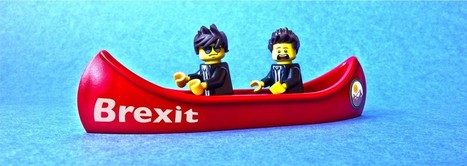











While post-Brexit Britain burns, Boris Johnson leads the British cheerleaders in their "Bloody Brilliant Brexit Britishism". If I was young and living in Britain might be getting ready to pack up and leave because cheerleading is not substance.