 Your new post is loading...

|
Scooped by
Jeff Domansky
September 12, 2016 12:35 PM
|
Most brands have some form of newsletter to connect with customers. But for many brands, more emphasis is placed on getting people to sign up than on giving them a reason to sign up.
Last week David Hieatt, founder of Hiut Denim and the Do Lectures gave a workshop in London on the power of the humble email newsletter. I didn’t go to the workshop, but how he described it got me thinking about this often overlooked communication tool:
“In terms of using social media to grow your business, we are all looking for the next new platform or app. We want to find that magic ‘Multiplier’ that gets our story out to the world…
“A great newsletter can do that. And yet most people ignore it, dismiss it, or if they use it, use it poorly. Yet, this tool, in the right hands, is as powerful as they come…
“I am fascinated by the power of a simple newsletter to grow a business. I am also fascinated that most businesses don’t pay much attention to theirs. It’s an afterthought. A poor cousin.
“But when done right, they become something else. With a strategy, with a simple methodology, they become one of the most effective tools in your digital toolbox. They build community. They build your brand. And they relentlessly build long-term growth. They are pure and utter gold.”...
|
|
Scooped by
Jeff Domansky
September 12, 2016 11:24 AM
|
Twilio, the developer-centric communications platform that successfully IPOed earlier this year, published a new study today about how consumers want to use tech to talk to businesses and brands. The study, which the market research firm Vanson Bourne performed for Twilio by surveying 6,000 consumers in Europe, Asia and North America, shows that nine out of ten consumers would like to be able to use messaging to talk to businesses. The majority of businesses, however, don’t yet have the infrastructure in place to do so right now. Given that it’s Twilio’s bread and butter to provide this kind of infrastructure to businesses, it’s worth taking the results with a grain of salt, of course. What they do highlight, though, is that while consumers overall prefer messaging over face-to-face interactions with businesses (and millennials even more so), businesses haven’t quite caught up to this new world yet....
|
|
Scooped by
Jeff Domansky
September 12, 2016 10:46 AM
|
It’s no secret that our digital communication tools are overwhelming us. A Deloitte study found that U.S. workers (in aggregate) look at their phones almost 8 billion times a day, and research shows that U.S. productivity has waned since the introduction of the smartphone. But the world of business needs a way to bring people together to share information and explain ideas, and to get them to reach for the same goals. So what’s the happy medium we’re looking for? I’m going to suggest a classic, underappreciated solution: presentations. They often get a bad rap because they’re often badly made. A good one takes many hours to build: It requires research and clarity of thinking, and great care must be given to word choice, image selection, and flow. Yet when we do that important work, presentations can help us do something more effectively than almost any other communication tool at our disposal (which is saying a lot, because there are many). They enable us to make a compelling, persuasive argument — without overwhelming people with disjointed messages or a fire hose of information. When I was on the high school debate team in the 1970s, we studied the psychological concept of cognitive dissonance, and I’ve since used it to create thousands of speeches and inspirational talks. The idea behind it is very simple: If you want a group of people to adopt your point of view, start by describing some difficult or painful issue they’re faced with. ...
|
|
Scooped by
Jeff Domansky
September 12, 2016 10:01 AM
|
Portent Title Maker is a free web tool which helps you identify the best type of structure and wording style to title your articles and blog posts. No registration required.100% free. My comment: Handy tool for anyone who has little experience with titling owith titling online. It provides alternative title structures and wording examples for any topic you suggest. Recommended.online. It provides alternative title structures and wording examples for any topic you suggest. Recommended.
|
|
Scooped by
Jeff Domansky
September 11, 2016 10:42 AM
|
If you want some light reading for eternity, Google the question “is the media biased.” The question is a staple of both the political right and the socialist left. Either The Media is partisan against Republicans as part of our obvious liberal agenda, or the Corporate Media insidiously perpetuates the status quo by shutting out dissenting voices and uncomfortable narratives in favor of crony capitalism and entrenched privilege. Choose your favorite. They’re both idiotic....
|
|
Scooped by
Jeff Domansky
September 9, 2016 10:57 AM
|
The study -- which is part of an ongoing series of research commissioned by the Council for Research Excellence to understand the nature of watching TV in the current viewing environment -- was conducted by Nielsen Consumer Neuro, which utilizes a variety of biometric measurement techniques to understand people’s conscious and unconscious interaction with media. The findings of the study, dubbed “The Mind of the Viewer,” were described as preliminary, especially the part testing response to people-meter prompts, but it suggested that the kinds of media distractions impacting the way people consume media may also be impacting the way the industry measures how people consume media. “We live in the age of distraction,” Carl Marci, chief neuroscientist at Nielsen, remarked, adding: “People make interesting choices with technology.” When it comes to interacting with people meters -- the technology that is the basis for producing national TV’s advertising currency, Nielsen national TV ratings -- 25% of Nielsen people-meter panelists participating in the study did not respond to their prompts because they were looking at a second screen when the meter prompted them with a light....
|
|
Scooped by
Jeff Domansky
September 8, 2016 8:42 PM
|
Chatbots — AI-enabled messaging programs that respond to text-based requests — are the latest innovation that startups and corporations are using to serve existing customers and bring in new ones. Companies across a wide variety of industries are building these tools on popular messaging apps like Facebook Messenger, Slack, Kik, and Hipchat, as well as on their own websites and apps. Some are even available by text, to help users do things like fight parking tickets, respond to customer service inquiries, and order tacos.
This is by no means an exhaustive list, so if you see we’re missing a chatbot that’s currently up and running, please share the link with us in the comments section. We’ll add new, significant chatbots to the list over time.
|
|
Scooped by
Jeff Domansky
September 8, 2016 4:47 PM
|
While making a robot sounds complicated for most people, creating a chatbot is way, way easier. The term chatbot stands for an Artifical Intelligence (AI) that automatically chats with internet users, and answers the questions they ask.
A chatbot can function in many different ways. Depending on its type, a chatbot can talk to you or provide customer service, tell you what the current weather, and even contest parking tickets (successfully). For businesses, chatbots could respond to a customer’s question and help you do your job.
The question now is where do you get or how do you create a chatbot? Well, these are the chatbot creator apps out there you can try. Most of them don’t require programming knowledge to use....
|
|
Scooped by
Jeff Domansky
September 8, 2016 12:08 PM
|
As we’ve already outlined, your digital strategy is the series of actions you take to help you achieve your overarching marketing goal. Your digital marketing campaigns are the building blocks or actions within your strategy that move you towards meeting that goal. For example, you might decide to run a campaign sharing some of your best performing gated content on Twitter to generate more leads through that channel. That campaign is part of your strategy to generate more leads.It’s important to note that even if a campaign runs over the course of a couple of years, it doesn’t make it a strategy -- it’s still a tactic that sits alongside other campaigns to form your strategy. Now we’ve got to grips with the basics of digital strategy and digital marketing campaigns, let’s dig into how to build your strategy....
|
|
Scooped by
Jeff Domansky
September 8, 2016 11:35 AM
|
The Interactive Advertising Bureau estimates malicious advertising ”malvertising” costs the U.S. digital marketing, advertising, and media industry $8.2 billion annually. A few years ago malvertising was merely scamming the system: fake ads, fake traffic, fake analytics. Ad tech is a hacker's heaven, an unregulated labyrinth of circumlocution systems for bidding, placing and tracking ads. "All the code is awful and you aren't allowed to change it anyway," says Salon developer Aram Zucker-Scharff. "Usually ad servers claim they run some sort of checks, but considering just how many malicious or badly formed ads get through, it is pretty apparent they don't do much." The hacker's goal is to bill, aka bilk, advertisers for ads no human ever saw. Their fraud takes several forms: Ad stacking piles multiple ads on top of each other. Ad stuffing shrinks ads to invisible 1-pixel squares. Click farms send fraud users to real sites. Clickjacking sends real users to fraud sites....
|
|
Scooped by
Jeff Domansky
September 8, 2016 10:27 AM
|
Organ designers, chief drone experience designers, cybernetic director. Those are some of the fanciful new roles that could be created by the global design industry in the next few years. But what about current design roles? How will they favor over the next 15 years? Will every company by 2030 have a chief design officer, or will they all go extinct? Should a generation of creatives who grew up worshipping Apple's Jonathan Ive put all their eggs in the industrial design basket? We talked to a dozen design leaders and thinkers from companies such as Frog, Artefact, and Ideo to find out which design jobs could die out in the next 15 years, and which could grow. There's no empirical evidence behind these picks, so they shouldn't be taken too seriously. Still, they represent the informed opinions of people who get paid to think about the future....
|
|
Scooped by
Jeff Domansky
September 7, 2016 9:41 PM
|
Marketers and public relations professionals can find plenty of advice on how to write a press release, but rarely is that advice directly from the journalists that press releases attempt to engage.
It turns out, journalists have a lot to say about press releases. It also turns out that marketers have a lot to learn.
Although I recently joined an inbound marketing agency, I'm a 25-year veteran the Chicago Sun-Times and the Contra Costa Times, among other. For decades I started my mornings weeding through the press releases in my inbox, one finger hovering over the "delete" key and ready to strike.
Wondering whether things have gotten better lately, I reached out to several journalist friends.
"Most of what I get is garbage," said Mary Pols, a longtime Portland Press-Herald/Sunday Telegram reporter who has also worked at the Los Angeles Times.
Ouch.
Follow these top 9 recommendations to stand out....
|
|
Scooped by
Jeff Domansky
September 7, 2016 9:28 PM
|
If you’re one of the 300 million people using Instagram on a daily basis, you’ve probably noticed that Instagram Stories are a thing now.
It’s one thing if you don’t care about this as a user, but if you use Instagram for your marketing, Stories should definitely be on your radar – because the feature is already a hit.
(But first, for the uninitiated – what’s “Instagram Stories” mean, again? In three sentences or less, please.)
Instagram Stories is a way of sharing images and videos outside of your main Instagram feed. When you share something using this feature, it gets added to your “Story,” which is kind of like a little album that people can quickly flip through. The images and videos you add to your Story will stay there for 24 hours, and after that, they disappear....
|
|
|
Scooped by
Jeff Domansky
September 12, 2016 11:36 AM
|
Combining some apps and content driven by social can be a powerful tactic that minimizes your time and resources once they are set up. Below are the 5 easy steps that show how I used Twitter to increase my leads by over 10,000 on “autopilot” in less than 12 months. That’s the old term for marketing automation. Even though this is only 10% of my annual email growth, this little tweak has been vital in continuing to optimize my list building. The majority of my email acquisition is via the SumoMe “Welcome Mat”. Which I outlined in this post “How to Double Your Traffic Without Paying Google or Facebook a Cent“....
|
|
Scooped by
Jeff Domansky
September 12, 2016 10:59 AM
|
It might be easy to assume that the shorter the video ad, the better the completion rate. But maybe things change when it’s on a social platform. According to Q2 data, video ads that were between 30 and 60 seconds long fared better than those of less than 30 seconds on Facebook. During Q2 2016, Kinetic Social tracked data based on 2 billion social ad impressions, including ad spending for all ad types on Facebook, across both desktop and mobile channels. Kinetic Social is a programmatic social media platform that delivers paid social ads, and more than 90% of its clients are US-based. According to the data, almost half (or 44%) of 30- to 60-second video ads on Facebook were viewed to completion. Meanwhile, those that ran 30 seconds or less saw a 26% completion rate. Interestingly, 2-minute or longer video ads had the second-best completion rate of 31%....
|
|
Scooped by
Jeff Domansky
September 12, 2016 10:24 AM
|
Headline Analyzer is a free web app which allows you to test the quality of any headline based on its emotional qualities and on its overall structure, grammar, readability, use of words, sentiment and length. 100% free. My comment: Useful tool to benchmark and test the quality of any title, helps you see with more perspective and objectivity the strengths and weaknesses of your online subject lines....
|
|
Scooped by
Jeff Domansky
September 12, 2016 9:53 AM
|
DocumentCyborg is a free web app that allows to convert any web page into a PDF, Word Doc, ePub, ODT, RTF or TXT file document. It works on most every kind of web page while also removing all the ads from the page itself.
|
|
Scooped by
Jeff Domansky
September 10, 2016 3:11 PM
|
This is the ultimate guide to how Facebook chooses what to show in your News Feed, and how you can get your content seen by more people.
Understanding how the News Feed works is tough because the algorithm is always changing. So TechCrunch launched this research project for today’s 10th anniversary of News Feed, interviewing Facebook’s team members, compiling the company’s announcements, and reviewing a decade of our coverage. The result is this helpful explainer, which we’ll keep updated as new changes roll out so it’s always accurate.
|
|
Scooped by
Jeff Domansky
September 9, 2016 10:37 AM
|
They’re not flattered by your unauthorized republishing of their content, or by how you’re amplifying their ideas by presenting them as your own. Because I try to assume positive intent on behalf of the curator, it looks like many content creators simply are not aware of the fine line that exists between content curation and plagiarizing, or even stealing someone else’s content. With that in mind, I’d like to share a few examples of what not to do for your content curation, unless your goal is to piss off your favorite influencers and ensure they’re unlikely to want to work with you....
|
|
Scooped by
Jeff Domansky
September 8, 2016 8:09 PM
|
The thing is: We'd never know it anyway.
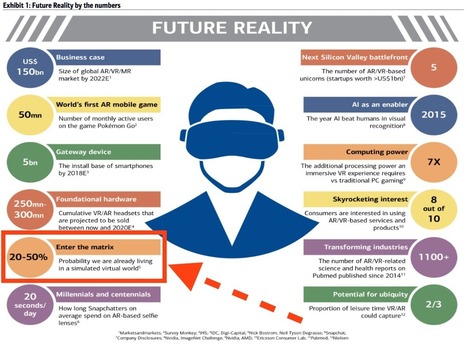
In a note to clients out Tuesday, Bank of America Merrill Lynch said there's a 20%-50% chance that we're living in the matrix — meaning that the world we experience as "real" is actually just a simulation.
The firm cites comments from Elon Musk, Neil deGrasse Tyson, and Nick Bostrom's seminal paper on the issue as the basis for its 20%-50% view.
Here's BAML (emphasis added):
"Many scientists, philosophers, and business leaders believe that there is a 20-50% probability that humans are already living in a computer-simulated virtual world. In April 2016, researchers gathered at the American Museum of Natural History to debate this notion. The argument is that we are already approaching photorealistic 3D simulations that millions of people can simultaneously participate in. It is conceivable that with advancements in artificial intelligence, virtual reality, and computing power, members of future civilizations could have decided to run a simulation of their ancestors."
|
|
Scooped by
Jeff Domansky
September 8, 2016 12:29 PM
|
Consider a survey from eMarketer earlier this year that claims that over three-quarters of European marketers are using website visits as their primary measure of branded content effectiveness, yet less than half are measuring ROI (whether that be brand return or actual sales return, presumably). Visits are important, of course they are: Every brand manager wants people to actually see their content, right? But to use a simple behavioral measure as a metric of impact on your brand is arguably doing more injustice to the rich immersive nature of branded content (when it’s done well!) than clicks do to display ads. So why do we do this then? Simple: Because it's often too hard to do anything else. The measurement of branded content shouldn’t even stop at measuring brand impact. Quality of content is the very measure by which our readers judge us, and media owners need to acknowledge that what they produce has an impact on both their own and their commercial partners' brands… and this impact needs to be measured, too. So what might a simple hierarchy of branded content metrics look like if you want to measure impact in its entirety then....
|
|
Scooped by
Jeff Domansky
September 8, 2016 11:59 AM
|
Your blog goes dormant, and you curse yourself every day for it. Sound familiar? It happens to a lot of people. For all the craze over content marketing, there sure are a lot of people who fell off the wagon a long time ago. I get that. I understand. It’s tough work. It’s grueling at times. It’s thankless. It’s challenging. And to write an article every single day, day in and day out, year after year? Sounds impossible. It’s not. And I’m going to tell you how and why. Here’s what you need to know about what it takes to write a blog post every day....
|
|
Scooped by
Jeff Domansky
September 8, 2016 10:58 AM
|
The Washington Post is enjoying a “remarkable” revenue picture, the paper said in a leaked memo. The Post’s financial picture has been shrouded in secrecy since Amazon founder Jeff Bezos took it private three years ago. So when figures do slip out, they often don’t tell the whole story. Still, they’re interesting because the Post is a rare legacy media outlet that, with Bezos’ deep pockets and patience, would seem to have the best shot at creating a sustainable online news model. Now an internal memo got out that sheds a little more light on that financial picture. Yesterday’s memo, from Post chief revenue officer Jed Hartman, painted a rosy picture, saying, “We are a growing business.” The Post wouldn’t elaborate on the memo. Hartman wrote that the Post’s annual digital ad revenue is a “nine-figure” business, which stands in contrast to the $60 million that New York magazine estimated in a recent profile. He wrote that total ad revenue is up year over year, led by a 48 percent increase in digital sales through August. Within digital, Hartman wrote that the biggest increase is in native advertising, up 275 percent; followed by programmatic, up 92 percent; and video, up 82 percent....
|
|
Scooped by
Jeff Domansky
September 8, 2016 12:00 AM
|
It was late morning on Friday, October 16, when Elizabeth Holmes realized that she had no other choice. She finally had to address her employees at Theranos, the blood-testing start-up that she had founded as a 19-year-old Stanford dropout, which was now valued at some $9 billion. Two days earlier, a damning report published in The Wall Street Journal had alleged that the company was, in effect, a sham—that its vaunted core technology was actually faulty and that Theranos administered almost all of its blood tests using competitors’ equipment.
The article created tremors throughout Silicon Valley, where Holmes, the world’s youngest self-made female billionaire, had become a near universally praised figure. Curiosity about the veracity of the Journal story was also bubbling throughout the company’s mustard-and-green Palo Alto headquarters, which was nearing the end of a $6.7 million renovation. Everyone at Theranos, from its scientists to its marketers, wondered what to make of it all....
|
|
Scooped by
Jeff Domansky
September 7, 2016 9:36 PM
|
Which of these sums up your view on content production?
“Content is about quality, not quantity. We should be producing high value, authoritative content regularly, not publishing lots of short posts. Less is more.”
“Winning in digital media now boils down to a simple equation: figure out a way to produce the most content at as low a cost as possible.” (Digiday 2013)
Do you agree with first statement? Me too, until recently. But now I think we could be wrong.
The Washington Post now publishes around 1,200 posts a day. That is an incredible amount of content. My initial reaction when I read the statistic was ‘surely that is too much, the quality will suffer, why produce so much content?’ The answer seems to be that it works. The Post’s web visitors have grown 28% over the last year and they passed the New York Times for a few months at the end of 2015....
|


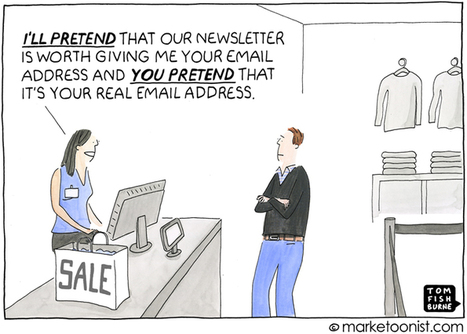
























Tom Fishburne offers a thoughtful commentary on brand newsletters, their impact and lack of effectiveness.