 Your new post is loading...

|
Scooped by
Jeff Domansky
October 6, 2016 12:36 PM
|
There’s a Word for Using Truthful Facts to Deceive: Paltering Virtually everyone lies when we interact or communicate with others. Hard to believe? Well, here is what the evidence tells us: people (you and me included!) tell, on average, one or two lies per day. Many of these lies are harmless: e.g., giving a spouse or friend a compliment we really don’t mean. Others, however, when mixed in with actual facts, have important consequences. Take politics, where candidates all too frequently employ such distortions to influence voters.For example, in the U.S. vice-presidential debate between Democrat Tim Kaine and Republican Mike Pence, Kaine pushed Donald Trump, the Republican presidential nominee, to release his tax returns. (Trump has said he’d do it once the Internal Revenue Service completed an ongoing audit.) Kaine asserted that “Richard Nixon released tax returns when he was under audit,” leaving the impression that Nixon, a Republican, did so while running for re-election, creating a precedent for Trump. But as the New York Times pointed out, “Mr. Nixon released his taxes while under audit — but it was not until a year after his 1972 re-election.” Another recent example is Trump’s response in the September 26 presidential debate to a question about a federal lawsuit that charged his family’s company with housing discrimination. His answer was: “When I was really young, I went into my father’s company. We, along with many, many, many other companies, throughout the country — it was a federal lawsuit — were sued. We settled the suit with zero — no admission of guilt. It was very easy to do. But they sued many people.”...
|
|
Scooped by
Jeff Domansky
October 6, 2016 12:11 PM
|
More than two years ago, Amazon Chief Executive Officer Jeff Bezos spoke on 60 Minutes about delivering goods to homes with unmanned aircraft, or drones. But a little startup near Reno, Nev., beat Amazon to the punch. The company, called Flirtey, in July made its first household delivery via drone, from a 7-Eleven. Flirtey likes to say its partnership with the convenience-store chain will save parents with sick children a late-night run to the store for medicine. But the drone deliveries are conveniently made with insulated boxes, so a chili dog and Slurpee dropping from the sky to your home is within reach. Flirtey Co-founder and CEO Matt Sweeny says his company was able to jump ahead of Amazon by working with government regulators to get early approval to run tests. And those test runs have paid off: Sweeny boldly predicts delivery by drone will be a regular sight within a year. In this video, Bloomberg visited Flirtey’s undisclosed testing site for a closer look at what the company is doing and how it aims to change the nature of product delivery while keeping its lead in the race with Amazon....
|
|
Scooped by
Jeff Domansky
October 6, 2016 11:03 AM
|
Social media is an extremely valuable tool for promoting your marketing content. But with so many social networks providing their own individual content sharing and follow buttons, it's often difficult to know which social media button to use for what purpose. To address this, we've put together a comprehensive guide to help you understand the differences between the share and follow buttons for six of the biggest social networks (Twitter, Facebook, LinkedIn, YouTube, Instagram, and Pinterest), as well as how to implement them on your website, blog, and other content....
|
|
Rescooped by
Jeff Domansky
from digital marketing strategy
October 6, 2016 10:38 AM
|
Marketing on social media can be a daunting task for a small business or a startup. With so much conflicting advice and competition, it can seem impossible to even get started. An infographic from Social Media Marketo outlines 12 crucial steps your business can take to set up for success. More than 90 percent of marketers indicated that they use social for marketing and that social media marketing is important for their business. Sales teams said using social helps them reach their sales goals, consumers use social to research products and more than 30 percent of all web traffic is driven by the top eight social sites. Indeed, social is an important part of doing business on the Internet....
Via malek
|
|
Scooped by
Jeff Domansky
October 6, 2016 3:58 AM
|
Social media has taken the world by storm. Currently, there are over 1.96 billion social media users in the world, and that number is expected to grow to 2.5 billion by 2018. The trends that shape the future of social media drastically affect other elements of the digital world, specifically in terms of marketing. Today we’re going to look at ten predictions for the future of social media and how they offer exciting new tactics and strategies for today’s digital marketers. 10 Future Social Media Trends Affecting Marketing Today Whether it’s a new technology or a growing need, social media is setting the precedent for how people will consume content and make purchasing decisions online. In fact, social media is already influences 78% of consumer purchase decisions, and that number is only set to grow. Let’s take a look at ten predictions for the future of social media, and how they are affecting today’s marketing best practices:....
|
|
Scooped by
Jeff Domansky
October 6, 2016 3:38 AM
|
Measured by shopping channel experience, here’s the breakdown of where smartphone owners are very satisfied: :60% -- Store56% -- Desktop47% -- Mobile24% -- Social. This matters, since almost three quarters (73%) of smartphone owners spend five or more hours a week using their phone to research products, find stores or make a purchase, and more than half (51%) spend 10 hours or more. As yet another indicator that mobile influences sales well in advance of a store visit, more than half (55%) of smartphone owners said they researched products via mobile prior to visiting a store. When they get to the store, that doesn’t mean a sale there is inevitable. More than four in 10 (42%) researched products and alternatives on their smartphone during a store visit....
|
|
Scooped by
Jeff Domansky
October 6, 2016 3:09 AM
|
Last week, we looked at how content on Instagram has seen tremendous growth and engagement for publishers in the past year. We’ve looked at the top tactics for Instagram video as well, but how do the top media publishers on Instagram divvy up their photo and video game? As video is an increasingly essential medium across social media platforms, how are these publishers using it on Instagram? We put 31 Instagram accounts from news publishers under the microscope. The data around engagement for the month of September comes from NewsWhip Spike. Let’s start with a look at the top 10 media publishers of September....
|
|
Scooped by
Jeff Domansky
October 5, 2016 2:20 AM
|
Corporate communications teams around the world are working hard at the moment to build and present a “corporate narrative” to the world. There are two factors that are the main cause of all this interest and investment. First, companies have become a lot more complex in recent years as they globalize and update their organizational structures; this makes it harder to communicate a single, clear company story. Second, the amount of information available to people, and the ease with which people can tap into niche sources of information based on their interests – personal or professional – make it increasingly difficult to cut through the noise and engage people with a company story. Two Trends But without a cohesive company story, communicators — and their CEOs — fear that messages about the company’s identity and direction will be inconsistent, making the company appear disorganized, or even disingenuous. Early findings from a CEB survey on the topic show two interesting findings about the way firms build a corporate narrative....
|
|
Scooped by
Jeff Domansky
October 5, 2016 12:53 AM
|
When The New York Times announced that they had lost half the traffic to the nytimes.com homepage in just two years (80 million visitors), the Internet collectively mourned the “death of the homepage.” Other publishers like GQ, and brands alike, have seen their homepage traffic steadily decline as more users visit their site via article/content pages, bypassing the homepage altogether. Some even say that Snapchat killed the homepage. Well, it’s true. The homepage is no longer the primary point of discovering brands, their content and products on the Web, as social sites have replaced them as the new entry point.The homepage is not dead, however, it just needs a revamp for social Web. Here are four ways to make the homepage a destination again....
|
|
Scooped by
Jeff Domansky
October 4, 2016 5:34 PM
|
The online retail ecosystem is fast evolving, and increasingly, shoppers no longer simply go to the nearest store. Rather, they grab the nearest digital device. And with the world at our fingertips, why only shop domestically? In fact, digital analytics firm eMarketer projects that online retail sales will more than double between 2015 and 2019 and account for more than 12% of global sales by 2019. Retail therapy is giving way to e-tail therapy.
To gain a better understanding of how consumers are navigating the connected commerce landscape, the Nielsen Global Connected Commerce Survey polled respondents in 26 countries. We looked at how consumers are using the Internet to make shopping decisions both in stores and online, and we examined what they’re buying, where they’re purchasing and how they’re paying for goods and services.
While connected commerce is still largely a domestic affair, with consumers primarily ordering from retailers in their own country, cross-border ecommerce is a growing phenomenon. Shoppers are increasingly looking outside their country’s borders, as more than half of online respondents in the study who made an online purchase in the past six months say they bought from an overseas retailer (57%).
Nearly three-quarters of Indian respondents* who purchased online in the past six months say they bought items from an overseas retailer (74%). But this isn’t just a developing-market trend. Roughly two-thirds of respondents in the Western European countries in the survey say they purchased from an overseas retailer, including 79% in Italy—the highest percentage in the online study—and 73% in Germany....
|
|
Scooped by
Jeff Domansky
October 4, 2016 5:11 PM
|
For consumers, having content options is no longer a luxury, but an imperative. And so, too, are the multitude of devices that they use to engage with that content—be it a TV, tablet or soon-to-be emerging technologies.
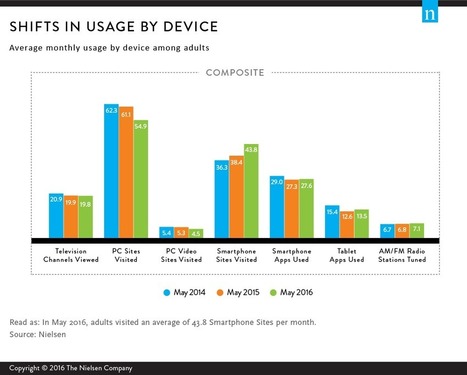
But having a plethora of content options at our collective fingertips doesn’t necessarily mean consumers are connecting with ALL choices ALL of the time. In fact, according to the second quarter Nielsen Total Audience Report, which focuses on what options consumers have in addition to how they use them, behaviors and usage are unique to the device being used. Consumers still spend most of their time on traditional platforms, but they also look to explore the wide range of content channels made available by new media.
Adults still spend the most time watching TV, as the average adult spends more than four hours each day watching live TV. The average monthly channels available on TV (206) is only a fraction of what’s available on digital apps or websites, so consumers are using more of them. In the second quarter of 2016, consumers visited 55 PC sites and used 28 smartphone apps, compared to 20 TV channels viewed. Even though Americans have fewer channels to choose from than they did last year, the percentage of channels they actually view has remained consistent at 9.6% year over year from 2015-2016....
|
|
Scooped by
Jeff Domansky
October 4, 2016 2:25 AM
|
It might be easy to assume that the shorter the video ad, the better the completion rate. But maybe things change when it’s on a social platform. According to Q2 data, video ads that were between 30 and 60 seconds long fared better than those of less than 30 seconds on Facebook. During Q2 2016, Kinetic Social tracked data based on 2 billion social ad impressions, including ad spending for all ad types on Facebook, across both desktop and mobile channels. Kinetic Social is a programmatic social media platform that delivers paid social ads, and more than 90% of its clients are US-based. According to the data, almost half (or 44%) of 30- to 60-second video ads on Facebook were viewed to completion. Meanwhile, those that ran 30 seconds or less saw a 26% completion rate. Interestingly, 2-minute or longer video ads had the second-best completion rate of 31%....
|
|
Scooped by
Jeff Domansky
October 4, 2016 2:02 AM
|
So what can you do to ensure that you make a positive impression and get the maximum percentage of visitors to hang around and check out your content? It starts by answering some basic questions and satiating the curiosity of your average visitor. At the end of the day, you want to make sure that you cover all of the bases and that you don’t make your visitors work too hard. With that being said, here are eight specific questions every visitor wants answered in 10 seconds....
|
|
|
Scooped by
Jeff Domansky
October 6, 2016 12:21 PM
|
I was curious what colors were being used by large, popular sites, so I decided to find out.Alexa.com maintains a list of the most visited sites on the internet. I wrote aPHP script to scrape the ten most popular sites and record all the colors used in the sites' home pages and style sheets. I plan to rescrape the data on a regular basis. Because of this, I'll keep analysis to a minimum, since it could become outdated when the data changes. Once I have data over a larger time period I'll be able to examine and graph trends in web development. I also plan to examine the difference in color usage between popular websites from different parts of the world....
|
|
Scooped by
Jeff Domansky
October 6, 2016 11:18 AM
|
Cats are everywhere in our culture. Since ancient times, they have been regarded as special, and have been afforded a cherished place in our lives because of their characteristic independence, intelligence, quickness and elegance… it’s no wonder people have been using cats in artwork and design for millennia. Today you’ll find cats not only all over social media, but also in branding. Cat logos are all the rage because people are eager to associate themselves with the many of (p)awesome kitty qualities....
|
|
Rescooped by
Jeff Domansky
from World's Best Infographics
October 6, 2016 10:56 AM
|
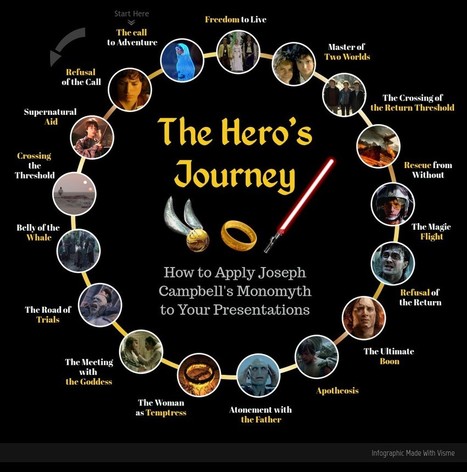
Have you ever gotten a sense of déjà vu while reading a book or watching a movie that’s otherwise totally new to you? Obviously you have— so many stories are built on the same foundations of archetypes and tropes. Stripped of complexities, all stories are basically the same: an individual ventures into the unknown to acquire something they desire.
That’s not a new idea— Joseph Campbell broke the door down in 1949 with his book, The Hero With a Thousand Faces. Odysseus, Christ, Captain Ahab, Gautama Buddha, Jane Eyre, Luke Skywalker… different names and faces, different times and places, but all the same story. Not only that, the same effective story. What Campbell called “The Hero’s Journey” has resonated with humanity for millennia, and is the root for so many stories that we cherish.
So why wouldn’t this apply to public speaking? Any muttonhead can tell you that good speeches tell a story. This infographic will show you exactly how Campbell’s 17 Steps can lead to storytelling success. It doesn’t matter if you want to discuss Martin Luther King’s march to Selma, why you deserve a raise, or Walking Dead plot summaries. The Hero’s Journey can apply to almost any presentation.
Via David Hain, Jeff Domansky
|
|
Scooped by
Jeff Domansky
October 6, 2016 10:25 AM
|
For the last five years, Google and the font giant Monotype have been working together to fill in all those tofu squares—hundreds of thousands of them. With the help of hundreds of designers, researchers, linguists, and cultural consultants, the two companies created Google Noto (the name derives from "NoTofu"). It’s a typeface family of the world’s languages—many in the minority, or even extinct—which can be rendered in serif or sans serif across eight weights, totaling more than 300,000 unique glyphs in all. As a point of comparison, Helvetica supports 97 different languages. Google Noto supports more than 800. According to Google, Noto is nearly 10 times larger than the nearest universal typeface, Arial Unicode. "For everyone in the typographical field, this is a scale of language and script support that’s never been attempted before," says Kamal Mansour, linguistic typographer at Monotype. "And it would be hard to imagine anyone sponsoring this other than Google. It’s a very big investment."...
|
|
Scooped by
Jeff Domansky
October 6, 2016 3:49 AM
|
For almost a year after launching in 2015, only Twitter employees and an exclusive list of publishing partners were able to create Moments. Now, though, anyone can do it – including you! How does creating a Twitter Moment work? Why is it such a big deal that you can do it now? And what are Twitter’s tips for creating the most eye-catching, share-worthy Moments you possibly can? Let’s take a closer look!...
|
|
Scooped by
Jeff Domansky
October 6, 2016 3:19 AM
|
According to the recently released "Benchmarks, Budgets, and Trends" report from Content Marketing Institute and MarketingProfs, 28 percent of B2B marketers don't measure the ROI of their content marketing. Failing to do so is a mistake, because tracking metrics — the right ones — enables you to concentrate on the content marketing activities that most benefit your bottom line. To prove your content marketing effectiveness and see which content initiatives are worth your time and money, focus on these metrics....
|
|
Scooped by
Jeff Domansky
October 5, 2016 10:53 AM
|
There was a point four years ago when marketing agencies—that sprouted up thanks to the explosion of social media—didn't want to be identified any longer as purely "social" practitioners. They contended: We have grown to be so much more. In recent weeks, it's become clear that a similar mindset has fully taken hold among the social media platforms themselves. Snapchat is now a "camera company,"accented by its recent announcement of its video-recording sunglasses calledSpectacles. The Venice, Calif.-based company, now known as Snap Inc., has been trying to shed the "social" tag in recent months when meeting with the press. Twitter COO Adam Bain last week mentioned at Advertising Week that his company recently moved its mobile app listing in Apple's App Store from the social section to news—and his team saw downloads of the app accelerate. The idea that Facebook is a social network? Pfft. ...
|
|
Scooped by
Jeff Domansky
October 5, 2016 1:58 AM
|
Instagram is the go-to place for over 300 million people to share their photos, videos, and stories every single day. And as Instagram has grown over recent years, that’s left many business owners and marketers with one very clear and important question: How can we use Instagram for business? Well today, we’d love to dive head first into that topic and share: - How to set up a killer Instagram profile - The importance of goal setting and how to create a clear Instagram strategy - How to post great content on a consistent basis - Growth tips to help you build an engaged follower base. Continue reading for our best tips on how to use Instagram for business....
|
|
Scooped by
Jeff Domansky
October 5, 2016 12:48 AM
|
Even with Penguin 4.0 running in real-time, links continue to be one of the most important ranking factors going into 2017. While there are literally tons of over-complicated link building strategies (IFTTT Networks) sticking to these three simple types of links in 2017 will help you rank higher, attract more traffic, and increase leads. While we are not diving into the specifics of each type of link building, this will give you a checklist of link building strategies to brush up on....
|
|
Scooped by
Jeff Domansky
October 4, 2016 5:23 PM
|
The current state of the media universe presents a bounty of boundless choice to today’s consumer. Like the cosmos, which is contemplated much in current times, the proliferation of devices and the abundance of media choices is presenting endless options for the consumer and endless challenges and opportunities for the marketer. Nielsen is reaching new frontiers by totaling up audiences across devices and burgeoning viewing platforms. Consumer engagement is reaching new heights.
The data used in this graphic is inclusive of multicultural audiences. Hispanic consumer audiences are composed of both English and Spanish speaking representative populations....
|
|
Scooped by
Jeff Domansky
October 4, 2016 2:36 AM
|
This is the time of year people post their prognostications for the next year. The predictions will be … predictable: More video! More Snapchat! More podcasts! Well, OK. It’s pretty easy to make a prediction based on what’s already happening. But there are less obvious tectonic forces rumbling through our marketplace. Here’s a view of some of the underlying shifts, the marketing mega trends, you need be considering in 2017: 1. Content Marketing Re-constructed If you are operating under the idea that what worked in content marketing last year will work this year, it’s time to update the perspective. The world of 2017 will look nothing like the marketing world of 2015. These trends will be forcing dramatic change....
|
|
Scooped by
Jeff Domansky
October 4, 2016 2:13 AM
|
Retail ecommerce sales—which include products and services (barring travel, restaurant and event ticket sales) ordered via the internet over any device—will reach $1.915 trillion in 2016, accounting for 8.7% of total retail spending worldwide. While the pace of growth for overall retail sales is subdued, the digital portion of sales continues to expand rapidly, with a 23.7% growth rate forecast for 2016. eMarketer expects retail ecommerce sales will increase to $4.058 trillion in 2020, making up 14.6% of total retail spending that year.Asia-Pacific will remain the world’s largest retail ecommerce market throughout the forecast period, with sales expected to top $1 trillion in 2016 and more than double to $2.725 trillion by 2020. The region will also see the fastest rise in retail ecommerce sales, climbing 31.5% this year. Expanding middle classes, greater mobile and internet penetration, growing competition of ecommerce players and improving logistics and infrastructure will all fuel ecommerce growth in the region. The bulk of retail ecommerce will come from China, where sales are expected to reach $899.09 billion this year, representing almost half (47.0%) of all such sales worldwide. While there is plenty of opportunity for growth, parts of Asia-Pacific are still faced with challenges. In Southeast Asia in particular, ecommerce still represents only a fraction of total retail sales. An underdeveloped digital payments infrastructure and a weak logistics framework have made these markets unprepared to handle high volumes of ecommerce orders and have kept ecommerce at a nascent stage....
|





















It might feel like it’s not really lying…but it is. Take note you paltering politicians!