 Your new post is loading...

|
Scooped by
Jeff Domansky
March 24, 2017 10:00 AM
|
Do you want to increase your traffic from Pinterest or are you a newbie who just wants to learn more about Pinterest? No matter what you aim for, you are in the right place as this article will help you transform into a Pinterest ninja. What is Pinterest? Pinterest is not just a platform where people seek inspiration, it is a great medium that’s contributing to the success of online purchases as well. Well the numbers hold the proof. Around 93% of overall pinners (Pinterest Users) use Pinterest to plan or make a purchase, which is undeniably a very high number compared to purchases that come from Facebook and Twitter. Without understanding these numbers and without exactly knowing how many people you are engaging with via Pinterest- you’ll definitely get the chance to enjoy the kind of success you’re hoping for....
|
|
Scooped by
Jeff Domansky
March 24, 2017 9:40 AM
|
As Hubspot explains, “implementing a marketing automation system won’t make your job irrelevant, it will just make you more effective. It will free up some of your time, while not compromising the authenticity of the content you’re producing. And it will help you reach your goals faster.” From helping you nurture leads to managing your emails, when used correctly, marketing automation tools can completely transform your marketing results. Here are four of the best marketing automation tools on the market today.
|
|
Scooped by
Jeff Domansky
March 23, 2017 10:19 AM
|
Anyone who follows the cultural industries — art, music, publishing, theater, cinema — knows of the tussles between artists and those who feed off of their talents. The traditional food chain in movie-making, for example, is a long one: Between those who create a film and those who pay for it — movie goers, cable subscribers, pay-per-viewers, advertisers, rights licensees, and institutional sponsors such as the National Endowment for the Arts — is a multitude of middlemen: online retailers (Amazon, Walmart), streaming video services (Netflix, YouTube, Hulu), theatre venues (Wanda’s AMC, Regal, Cinemark), product placement and media agencies (Propaganda GEM, Omicom’s OMD), film producers (Columbia Pictures, Marvel Studios, Disney-Pixar), movie distributors (Sony Pictures, Universal, Warner Bros.), home marketers (Fox, HBO), cable and satellite services (Comcast, DirectTV), video syndicators (PMI, TVS), film libraries and archives (Eastman House, Getty Images), and talent agencies (WME, CAA, ICM), each with its own contracts and accounting systems. That’s a staggeringly long list. Each of these middlemen takes a cut of the revenues and passes along the rest, with the leftovers typically reaching the artists themselves months later, per the terms of their contracts. How technology is transforming transactions. So concentrated is the power in this feeding frenzy that many actors have taken themselves off the menu by launching their own companies within the existing industry model. The same is true in music, too. For example, Grammy-award winning singer-songwriter Imogen Heap has been a pioneer in the field with the launch of Mycelia, a think-and-do-tank whose goal is “to empower a fair, sustainable and vibrant music industry ecosystem involving all online music interaction services,” using blockchain. Artlery, a company founded by technologists and artists, is attempting the same thing for physical art such as sculptures and paintings. But for most artists and creators, that’s not an option....
|
|
Scooped by
Jeff Domansky
March 22, 2017 2:28 PM
|
Missinglettr creates strategic, automatic social media campaigns that drive traffic for an entire year. Leaving you to focus on writing your next blog post.
We turn each of your blog posts into a year's worth of social media updates.
Pre-filled with quotes, hashtags, images and more!
All you have to do is review our suggestions, click approve and then sit back and relax.
Missinglettr will send the content out to your social accounts increasing engagement and clickbacks to your site....
|
|
Scooped by
Jeff Domansky
March 22, 2017 11:08 AM
|
Science has explained that the Earth rotates at 1,000 miles an hour at its equator, but flat-earthers are not buying it. Wouldn't people feel the rush of the rotation if the planet were spinning at that speed, you could ask. Well, no, you wouldn't -- think about when you're an airplane or train ride that's moving at a constant speed, as astrophysicist Sabrina Stierwalt explained for Cornell University's "Ask An Astronomer." As long as it's a smooth, constant speed, you wouldn't feel any movements at all. When you're on a flight, do you feel like you are personally blasting at 570 miles an hour through the air? You feel a change in speed, not a constant. If the Earth suddenly stopped moving, the atmosphere would continue to blast forward at 1,000 miles an hour, destroying everybody, according to NASA. Web comic XKCD's creator Randall Munroe explains the morbid aftermath in his book "What If?"...
|
|
Scooped by
Jeff Domansky
March 22, 2017 10:39 AM
|
In an effort to get to the bottom of what makes videos successful on social media, we set out to answer two not-so-simple questions: Where does video perform best? In what format does video perform best? RWhat we found is that there are so many ways to go about it! Video format, length, content, captions, and graphics (to name a few) all play a big part in the success of your video content. But one stat really stood out to us: Square video (1:1) takes up 78% more real estate in a person’smobile newsfeed than does landscape video (16:9). That’s a lot of space! And with mobile content consumption on a dramatic rise, this felt like something we had to get to the bottom of....
|
|
Scooped by
Jeff Domansky
March 22, 2017 9:54 AM
|
When Americans encounter news on social media, how much they trust the content is determined less by who creates the news than by who shares it, according to a new experimental study from the Media Insight Project, a collaboration between the American Press Institute and The Associated Press-NORC Center for Public Affairs Research. Whether readers trust the sharer, indeed, matters more than who produces the article —or even whether the article is produced by a real news organization or a fictional one, the study finds. Who shares an article on social media influences whether people trust it, research shows As social platforms such as Facebook or Twitter become major thoroughfares for news, the news organization that does the original reporting still matters. But the study demonstrates that who shares an article on a social media site like Facebook has an even bigger influence on whether people trust what they see....
|
|
Scooped by
Jeff Domansky
March 22, 2017 9:34 AM
|
In a time of Trump, how should journalists serve the public? Should they join the protests? Become a partisan, opposition press? Or stick to neutrally reporting the facts? In this three-part series, media ethicist Stephen J. A. Ward, author of “Radical Media Ethics,” rejects these options. A proper response requires a radical rethink of journalism ethics. He urges journalists to practice democratically engaged journalism, which views journalists as social advocates of a special kind. They follow a method of objective engagement which Ward calls pragmatic objectivity. Journalists of this ilk are neither partisans nor neutral reporters of fact. In the first article in the series, Ward defines democratically engaged journalism. In this, the second article, he explains and applies pragmatic objectivity. In the final article, Ward will show how democratically engaged journalism opposes Trump’s tribalism of Us versus Them..”...
|
|
Scooped by
Jeff Domansky
March 22, 2017 2:53 AM
|
It’s not enough for marketers to collect petabytes of data; it takes a sharp mind to make sense of it all. Actually it takes a nonhuman one. That’s why artificial intelligence has invaded the marketing world, with Facebook, Google, Salesforce, IBM, Amazon, and others building machine learning into their platforms. Now marketers must understand the lingo if they’re going to survive the machines. To help, here’s a guide to the terminology around A.I....
|
|
Scooped by
Jeff Domansky
March 22, 2017 2:40 AM
|
Content marketing and search now involve a combination of media (blogs, video, social platforms, podcasts, etc.), and they must adapt to the ways human can now engage with this content in virtual and augmented reality. What must content marketing and search do to remain competitive? How must they redefine themselves? How to respect the lessons that intertwined them, on these new frontiers? Technologies which can tap into the full spectrum of our senses, are the adaptations that will eventually be required by content marketing and search. For the sake of this article, we will focus only on vision. Until recently, most content marketing and search were accessed via a highly compressed and forcefully artificial medium of 2D screens. In VR and AR, there are typically two screens, close to one’s eyes, permitting users to view content in a three-dimensional way. The simplest way to begin adapting content marketing and search, is to remake it for 3D viewing and interaction. Take the following history as an analogy: Google actively ranks results lower for sites not optimized for responsively mobile layouts. Why? More than half of all people accessing the web do so via mobile. As developing countries come online with another billion+ users and even more devices (nearly all mobile), they will be skipping the desktop era and joining us right alongside the mobile one....
|
|
Scooped by
Jeff Domansky
March 21, 2017 1:45 PM
|
John Oliver may have called it "repurposed bovine waste," but it appears as though native advertising isn't going away anytime soon. In fact, a new eMarketer study says that native digital display ad spending in the U.S. will grow 36.2% this year to reach $22.09 billion.
And why not? As marketing opportunities continue to splinter across a myriad of platforms and channels, at the same time as traditional interruptive ad intervals are ever avoided like a consumerist plague, brands need to find a way to get their messages across in ways we might actually want to see it. Back in 2014, The New York Times' executive vice president of advertising Meredith Levien said readers were spending roughly the same amount of time on advertiser-sponsored posts as on news stories, and the company sold upwards of $18 million worth of native ads that year. It's T Brand Studio continues to roll out some of the best examples of the ad genre, most notably still is the 2014 interactive piece "Women Inmates," a detailed look at incarceration of women sponsored by...you guessed it... Netflix for Orange is the New Black....
|
|
Scooped by
Jeff Domansky
March 21, 2017 10:45 AM
|
What if goals aren’t even sales-oriented? For example, perhaps the need is to demonstrate thought leadership in the industry, to create brand favorability. Then there are all those “content marketing” how-tos that are channel-, rather than strategy-oriented. Lately, these have been Snapchat-heavy, due to the company’s recent IPO. But just because Snapchat is attracting attention this week doesn’t mean it’s for everyone. (Moreover, Snapchat is more of a channel and a tactic than a strategy.) These types of prescriptive, formulaic, devoid-of-strategic-oversight articles are what give content marketing a bad name. We’ve entered the eye-rolling phase of content, when noise overwhelms signal. And we’ve seen it all before. Ten years ago, this happened to social media. The carpetbaggers moved in, and suddenly marketers branding themselves as social media experts were crawling out of the woodwork....
|
|
Scooped by
Jeff Domansky
March 21, 2017 9:55 AM
|
In summary, here are the key takeaways from the infographic below that tells us the latest shifts in digital advertising this 2017: - Increased usage of mobile ad blockers
- Increased monetization of Google AMP and Facebook
- Instant Articles
- Revenue on desktop advertising will continue to level down; Mobile advertising will experience massive growth
- Google and Facebook continues to be the most utilized platform in digital advertising
- Programmatic advertising will gain more popularity
- Outstream videos will gain more popularity
- Increased utilization of Chatbots....
|
|
|
Scooped by
Jeff Domansky
March 24, 2017 9:50 AM
|
“A minute of video is worth 1.8 million words” says James McQuiey, a principal analyst at Forrester Research. It’s easy to understand the potential of video as a medium and in 2017 this format will definitely dominate. Here are some stats that will additionally fortify video as an absolute must in marketing: A video in an email increases click-through rates by 280%; 90% of users say that watching product videos help them in a decision-making process; 59% of senior executives would rather watch a video than read a text on the same topic; Here are some of the hottest video marketing trends for 2017....
|
|
Scooped by
Jeff Domansky
March 23, 2017 10:29 AM
|
What makes marketing creative? Is it more imagination or innovation? Is a creative marketer more artist or entrepreneur? Historically, the term “marketing creative” has been associated with the words and pictures that go into ad campaigns. But marketing, like other corporate functions, has become more complex and rigorous. Marketers need to master data analytics, customer experience, and product design. Do these changing roles require a new way of thinking about creativity in marketing? To explore this question, we interviewed senior marketing executives across dozens of top brands. We asked them for examples of creativity in marketing that go beyond ad campaigns and deliver tangible value to the business. Their stories — and the five wider trends they reflect — help illustrate what it means to be a creative marketer today....
|
|
Scooped by
Jeff Domansky
March 22, 2017 2:37 PM
|
Clicktotweet is the best, easiest and simplest way to promote and advertise your blog, website, business and stuff on Twitter. Create fast tweet about this links to use on your website, blog or even Twitter and help deliver your message, the right way....
|
|
Scooped by
Jeff Domansky
March 22, 2017 2:23 PM
|
Want more people to share your blog posts on Twitter?
Looking for proven promotion tactics that deliver blog traffic?
Twitter is a great place to share your blog posts but you’ll have to go beyond tweeting the basics to generate substantial traffic and visibility.
In this article, you’ll discover seven ways to effectively promote your blog posts on Twitter without any ad spend.
|
|
Scooped by
Jeff Domansky
March 22, 2017 10:48 AM
|
The series that once defined A&E Network will be revived starting in the spring as a recurring program tied to current headlines, milestone anniversaries and newly unearthed material about famous names. The new-model “Biography” will air in various formats, from multi-part series to two-hour specials. The installments will primarily air on A&E Network but some will run on History and Lifetime as warranted by the subject matter. As part of the revival, A+E’s existing Bio.com digital content hub will receive a major overhaul, adding more video content and resources to coincide with new installments. Among the docu productions ordered for the relaunch is a six-hour series examing the life and death of Tupac Shakur, a two-hour take on the murder of rapper Notorious B.I.G. (aka Christopher Wallace), and a four-hour look at the complicated relationship between mob boss John Gotti and scion John Gotti Jr....
|
|
Scooped by
Jeff Domansky
March 22, 2017 10:02 AM
|
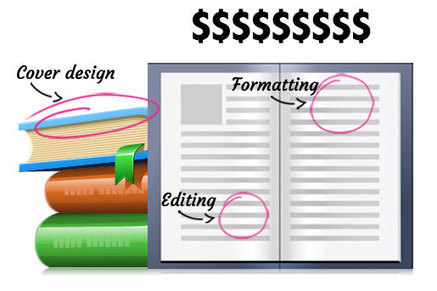
At every writers conference or self-publishing panel the question that almost always inevitably comes up is: “How much will self-publishing really cost me?” Because the book publishing industry is one of the last industries to go digital, it’s going through a quick transition. As a result of this shift, authors no longer need to go through the traditional gatekeepers to publish high-quality books and are instead moving toward self-publishing. Launching a book is like launching a startup. Putting together a quality book involves not just writing it, but getting it edited, then formatted, designing a cover, and having a marketing strategy around it. Below, I break down the costs of how much professional services will cost you for a high-quality book....
|
|
Scooped by
Jeff Domansky
March 22, 2017 9:44 AM
|
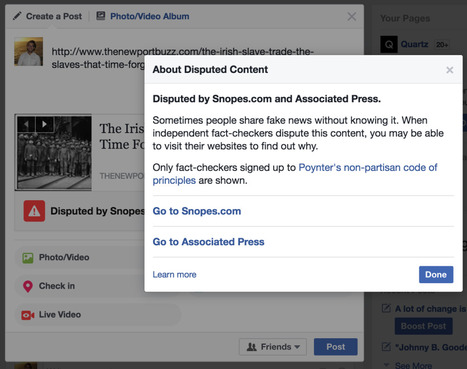
Facebook has started deploying new weapons in its battle against fake news. The election of Donald Trump to the presidency of the United States has led to a lot of soul-searching, not least of which by the world’s largest social network. Facebook has been repeatedly accused of facilitating and magnifying an ecosystem of websites that spread false information and conspiracy theories across the platform. That criticism led Facebook to announce late last year that it would be collaborating with “third-party fact checking organizations” to identify stories that don’t hold up to scrutiny, and warn users when they try to post these stories. The new feature appears to be picking up steam. The Facebook fact-checker has begun flagging a story that was shared widely on the lead-up to St. Patrick’s Day (March 17) that falsely claims thousands of Irish people were brought to the United States as slaves. This is what happens when you try to share the story on Facebook...
|
|
Scooped by
Jeff Domansky
March 22, 2017 3:00 AM
|
If content lives on the Internet but no one sees it, does it really exist? Aside from philosophical musings, the truth is that without a content distribution strategy, even the most creative, innovative, and groundbreaking content may never be discovered. An effective content distribution strategy will not only put your content in front of your target audience. It’ll also help you build a relationship with them, and eventually lead them to take a desired action – watching your video, signing up for your newsletter, reading an article, or downloading a whitepaper. Your strategy can include both paid and unpaid distribution channels. Each can work in conjunction with others, so pick and choose the channels that help you meet your business goals....
|
|
Scooped by
Jeff Domansky
March 22, 2017 2:47 AM
|
It might be early days, but marketers are seeing little return when advertising on Snapchat. They also seem more interested in spending ad dollars on the company’s newfound rival: Instagram. That’s according to a series of studies published by RBC Capital Markets in partnership with Ad Age, where some 1,600 marketers were surveyed in an attempt to gauge the pulse of the digital advertising industry. The sobering news underscores the uphill battle Snapchat faces as other platforms like Facebook-owned Instagram and Messenger mimic its features. It also shows Snapchat is a far cry from being in similar company to Google or Facebook, which both received significantly higher marks from marketers. Between Twitter, Facebook, LinkedIn, Google, Yahoo, AOL, and YouTube, Snapchat only outperformed AOL in terms of ROI, scoring a 3.43 out of a possible 8 points, according to the survey (AOL scored a 2.88). Google (6.98) and Facebook (6.72) led the pack, performing nearly twice as better than Snapchat, RBC said....
|
|
Scooped by
Jeff Domansky
March 22, 2017 2:30 AM
|
Let's start with a story. To analyze the effectiveness of its TV commercial storyboard, Makro, an international digital and in-store retailer, asked neuroscience research firm Neurensics to conduct an f-MRI study to determine people's reactions. The experiments showed that the storyboard scored lower than average in effectiveness: "It activated more negative than positive emotions. In particular, the storyboard did not activate decent levels of trust and expectation. The overall result was a negative score on influencing buying behavior." The experts' advice to Makro was to eliminate the scenes that provoked anger and rejection, to mention the company's end-value, resolve some elements of the plot, and add music with a climax. The TV commercial based on the optimized storyboard provoked more positive feelings in the audience, according to the Neuromarketing Science and Business Association (NMSBA). The result of Makro's trusting in neuroscience to enhance its advertising activities was a 12% increase in sales compared with the same period in the previous year....
|
|
Scooped by
Jeff Domansky
March 21, 2017 11:00 AM
|
Consumer packaged goods brands like Campbell’s Soup are the epitome of content and commerce. The company ladles up recipes and cooking tips through an online community, app and email newsletter called Campbell’s Kitchen. But socially distributed content increasingly is its main ingredient for success. To boost content engagement across its owned-and-operated site and social channels, Campbell’s is beta testing a new tool called Muse developed by Pinterest marketing platform Ahalogy. Muse taps Facebook topic data through a partnership with DataSift and combines it with Ahalogy’s bank of category-level Pinterest data. “Campbell’s Kitchen’s biggest audience is on Facebook right now, but Pinterest users tend to be younger and early adopters of new cooking methods,” said Sheila Miller, a senior manager for Campbell’s Kitchen.
|
|
Scooped by
Jeff Domansky
March 21, 2017 10:35 AM
|
Imagine a world without search engines. It’s easy if you try. No more surprise Google updates. No more worrying about XML sitemaps, robots.txt, and content analysis and optimization. And perhaps most importantly, no more keyword research. That last one means you’re going to have to go old-school to figure out the language of your audience to reflect it back to them. It’s going to take a lot more work....
|



















Pinterest tips you can put into action from Startafire.