 Your new post is loading...

|
Rescooped by
Jeff Domansky
from Simply Social Media
May 31, 2017 10:57 AM
|
|
|
Scooped by
Jeff Domansky
May 31, 2017 10:24 AM
|
When I was just a wee lass and HubSpot was first starting to make a name for itself, inbound marketing was a brand new idea. Marketers were learning that they couldn't just publish a high volume of content -- it also had to be high-quality and optimized in ways that made it as discoverable as possible through search engines. And once upon a time, that content was largely limited to the written word. Eleven years later, that's no longer the case -- a comprehensive content strategy includes written work like blogs and ebooks, as well as media like podcasts, visual assets, and videos. That last part -- video -- continues to be on the rise. According to the 2017 State of Inbound, marketers named video as a huge disruptor. "I mostly write content right now," one respondent said, "but I'm afraid it may begin to diminish more and more with video." And with the rise of other content formats comes the need to optimize them for search. One increasingly important place to do that is on YouTube, which is a video distribution website used by the masses (HubSpot included). But how does that work? What are the steps you need to take to optimize your YouTube channel for search? We've outlined some major tips below. And if you're short on time, no problem -- check out the video summary here....
|
|
Scooped by
Jeff Domansky
May 31, 2017 9:54 AM
|
Long before the Internet and direct-to-consumer advertising, the medical profession tried to reassure people about their health concerns. Remember “take two aspirins and call me in the morning?” Flash forward to today’s online “symptom checkers.” They are quizzes to see if someone has a certain disease and exhortations to see their doctor even if they feel fine. Once drug makers discovered that health fears and even hypochondria sell drugs, there seems to be no end to the new diseases, symptoms and risks people need to worry about. In fact, since drug ads began on TV, Americans take so many drugs it inspires satirical T-shirts like the one that says: “I take aspirin for the headache caused by the Zyrtec I take for the hay fever I got from Relenza for the uneasy stomach from the Ritalin I take for the short attention span caused by the Scopoderm I take for the motion sickness I got from the Lomotil I take for the diarrhea caused by the Xenical for the uncontrolled weight gain from the Paxil I take for the anxiety from Zocor I take for my high cholesterol because exercise, a good diet and regular chiropractic care are just too much trouble.” Here are some of the ways ads use fear to keep the public buying drugs....
|
|
Scooped by
Jeff Domansky
May 31, 2017 9:30 AM
|
Donald Trump says a lot of things that aren’t true, often shamelessly so, and it’s tempting to call him a liar. But that’s not quite right. As the Princeton University philosophy professor Harry Frankfurt put it in a famous essay, to lie presumes a kind of awareness of and interest in the truth — and the goal is to convince the audience that the false thing you are saying is in fact true. Trump, more often than not, isn’t interested in convincing anyone of anything. He’s a bullshitter who simply doesn’t care. In Trump's own book, Crippled America: How to Make America Great Again, our now-president describes himself in a way that Frankfurt could hold up as the quintessential example of a bullshitter. Trump writes that he’s an "I say what’s on my mind" kind of guy. Pages later, he explains that doesn’t mean he’s necessarily an honest guy." If you do things a little differently," he writes of the media, "if you say outrageous things and fight back, they love you." The free publicity that results from deliberately provoking controversy is invaluable. And if a bit of exaggeration is what it takes, Trump doesn’t have a problem with that. "When," he asks "was the last time you saw a sign hanging outside a pizzeria claiming ‘The fourth best pizza in the world’?!"...
What if tattoos weren’t just decorative, but could convey real-time data about your body? That’s the vision of the MIT Media Lab researcher Katia Vega, whose project DermalAbyss explores the possibilities of tattoos inked with biosensors instead of traditional ink. In collaboration with Harvard Medical School, Vega created three different types of biosensor inks that measure the shifts in interstitial fluid in your skin, changing color based on the levels of glucose, sodium, or pH in your body. Vega, who is a computer scientist by training and is currently opening a computer science department at Peru’s University of Engineering and Technology, believes the skin can act as a new kind of interface. She’s been researching what she calls “beauty technology” for seven years, combining cosmetics and electronics to create things like smart fake eyelashes, conductive makeup, and RFID-enabled nail polish. But while these former projects enable wearers to interact with the outside world through different types of cosmetic interfaces, injecting biosensors below the skin allows Vega to connect internal biological processes with external interfaces. “I wanted to go deeper, not just on the top of your epidermis,” she says....
|
|
Scooped by
Jeff Domansky
May 30, 2017 9:42 AM
|
A friend and fellow writer I hadn’t heard from for a while sent me an email the other day. She wanted some advice, and I readily offered it. Then she wrote me a nice response–the sort of casually witty, stupidly impressive little thing that no one I know could have written but her. And at the bottom of her thoughtful email, Google offered me three quick responses in the iOS Gmail app: Thanks! You’re welcome! Sounds good to me! With a tap, I could auto-fill my response to her. Just like on Google’s Allo Messenger or Apple’s iMessage, I could let the software respond to an email or text not with a unique response, but a quick tap to say something like “haha,” “lol,” or “talk later.” Sometimes, it’s tempting! Sometimes–especially dealing with work emails in the off hours–I have hit those quick response buttons. But I also know that it’s very bad for me, and it’s bad for us, as a collective, creative species. Today, we face one of the promises of Silicon Valley: to quantify us. To average our individuality out. To train a model on all of those collective averages, creating the ultimate average response. To provide the convenience of never speaking uniquely again....
|
|
Scooped by
Jeff Domansky
May 30, 2017 9:23 AM
|
In fact, using display ads, paid search or paid social as a way to generate instant results for brands or organizations is increasingly popular. Don’t believe me? Wrap your head around these figures:In its Q4 2016 fiscal year results, Google’s parent company Alphabet reported a whopping 17% increase in advertising revenue compared with the same period the year before. When Facebook published its fourth quarter and end of year results, it also reported an increase in revenue from advertising, up 12% year on year. Statista estimates we’ll all be spending more this year – with paid advertising expenditure soaring to $92.4 billion worldwide in 2017. Marketers are now branching out to new ad formats, with the IAB calculating that mobile advertising grew massively in the first six months of 2016, with a total spend increase of 89% or $15.5 billion. Big numbers, for sure, but are we missing a trick here? While there may be plenty of plus points to paid advertising and paid social – and it most definitely plays a role in a well-executed marketing strategy – it might be time to take back ownership of your marketing....
|
|
Scooped by
Jeff Domansky
May 30, 2017 8:48 AM
|
Effie Worldwide named the most effective marketers in the world, based on the global results of the 2017 Effie Effectiveness Index. Unilever, Vodafone, WPP, BBDO Worldwide, Sancho BBDO and ACG Advertising Agency held the top rankings in the categories of Most Effective Marketer, Brand, Agency Holding Group, Agency Network, Agency Office and Independent Agency, respectively. Now in its seventh year, the Effie Index recognizes the companies that create the most effective marketing communications ideas from around the world, determined by their cumulative success in more than 40 national, regional and global Effie Awards competitions. The 2017 Effie Index is compiled from 3,601 finalists and winning entries from worldwide Effie Awards competitions held between January 1, 2016 and December 31, 2016. Global food and beverage companies continue to dominate the most effective marketer ranking. Unilever jumped one spot to regain the title of Most Effective Marketer, globally, in this year’s rankings. It previously held the top spot from 2012-2014. Nestlé moved up two spots as the second most effective marketer, while Procter & Gamble retained its third place ranking....
|
|
Scooped by
Jeff Domansky
May 25, 2017 9:57 AM
|
Do you want to target a segment of your Facebook audience? Have you considered dark Facebook posts? Dark (unpublished) posts are a great way to tailor different messages to various audiences without posting multiple messages to your page timeline. In this article you’ll discover four ways to use dark Facebook posts for your business....
|
|
Scooped by
Jeff Domansky
May 25, 2017 9:41 AM
|
I can’t get Facebook Ads to work for my business.” Matthew Ganzak, Facebook Ads expert and disruptive innovator, hears this statement multiple times each day from prospective clients. How can something so simple to set up be so difficult to “get working” for your business? Facebook’s organic reach has been trending down over the past few years, due in part to the fact that more than 60 million business pages are now competing for consumer eyeballs. Facebook now requires brands to spend more money to get the same reach as in the past. To optimize their spend, brands need to stay in touch with the latest trends. This means learning to work the evolving Facebook system to get more activity on posts. According to Ganzak, the first 500 impressions a Facebook Ad gets are the most important. Below, he lays out his five best tips to maximize engagement for those early viewer...
|
|
Scooped by
Jeff Domansky
May 25, 2017 9:26 AM
|
It's no secret that e-commerce has become an integral part of our economy - consumers spent over $51.5 billion in clothes, shoes, and handbags online in 2015. Clothing sales rose by 19%, largely because of the increase in mobile usage and free shipping options. But with access to billions of products, it's becoming increasingly difficult for online shoppers to keep it all straight. When asked what e-commerce trend to expect in 2017, Tracey Wallace, editor of BigCommerce, said: "We know consumers are shopping in micro-moments. They see an item they like (on Instagram or Facebook), they research it, they find other brands selling something similar, they compare prices, they read reviews and then they finally make a decision." Because the shopping experience is prompted through a number of mediums (email, social media, search, etc.,) many consumers are turning to apps that simplify and organize the shopping process. Jonathan Friedman, CEO of Shoptagr, believes that "the A.I. Shopping Assistant will become the future of e-commerce and online retail as we know it. While retailers have been leveraging A.I. for years, it is now the consumer who will capitalize on machine learning and automation tools for efficiency."...
|
|
Scooped by
Jeff Domansky
May 24, 2017 2:38 AM
|
Pinterest has slowly been building itself up as an advertising alternative to Google and Facebook over the past 12 months. The company’s focus has historically been on building an engaged user base through its intuitive, visual interface. As a social network, it has always offered something a little different. However, advertisers have been skeptical about whether Pinterest could ‘monetize’ this model, due to the nature of engagements users have and also the demographics that typically spend time on the site. Those concerns have not been allayed altogether, but Pinterest has made some fascinating moves of late. They have launched a paid search partnership with Kenshoo, completely upgraded their visual search capabilities, and expanded their reach by adding a new Google Chrome extension.
|
|
Scooped by
Jeff Domansky
May 24, 2017 2:13 AM
|
In an era where more than 2 million blog posts are published per day, promotion is the crucial piece to the marketing puzzle that’s so important but also so easy to screw up. If you aren’t taking the time to squeeze the most out of your content in terms of promotion, you’re shooting yourself in the foot.If you want to see actual results from your content, from more shares and comments to “likes” and leads, perhaps it’s time to rethink how you spend your time creating content....
|
|
|
Scooped by
Jeff Domansky
May 31, 2017 10:34 AM
|
When was the last time you created something online that went viral?Whether you're new to content marketing or are a viral content maven, you probably know that it can be nearly impossible to predict which tweet or video or meme might go viral. Often, it feels like virality is just completely random. We asked three content marketing experts to weigh in on what they think makes some content super-popular while other content goes straight to the internet graveyard.Drawing from their own knowledge and experience, they share their perspectives below. Learn what they think sets viral content apart....
|
|
Scooped by
Jeff Domansky
May 31, 2017 10:08 AM
|
Traditional advertising went after “share of mind”–the idea was to get you to associate a brand with a single idea, a single emotion. Volvo: safety. Jaguar: speed. Coke: happiness. The Economist: success. Bang, bang, bang, went the ads, hammering the same idea into your mind every time you saw one. Advertising briefs evolved to focus the creatives on a single USP and a single message. Tell them we’re the Ultimate Driving Machine. Tell them in a thrilling way. It worked when you saw ads infrequently on television, in a Sunday magazine, or on a billboard on your morning commute. It hasn’t worked online. Audiences have stopped engaging with advertising. Big brands like Pepsi and P&G have slashed investment in Facebook spending. The agencies’ response has been to create new formats of ads that take over a page, dominate our mobiles’ screens, and generally scream at us. And when somebody screams at you for long enough, you put in earplugs and ignore them. Or, in the case of the online world, you install an ad blocker, as much of the U.K. population has now done. Yet there are many brands online that people don’t want to block. We asked over 5,000 people around the world to tell us about the brands whose content they actively sought out, then analyzed what those brands did. The results were surprisingly consistent. Popular brands had multifaceted personalities. They could make you laugh, or cheer, or lean forward and take notes. They’d stopped hammering away at a share of mind, and were expanding to achieve a share of emotion....
|
|
Scooped by
Jeff Domansky
May 31, 2017 9:43 AM
|
Keyword intent represents the user’s purpose for the search. It’s what the user is likely to do when searching for a particular phrase. Or, to be more precise, it’s what we think the user is likely to do, since we cannot always be sure. Intent is undoubtedly the most important concept when it comes to keyword research. It helps you meet the users’ needs better and match your content and landing pages to their intentions. Analyzing keywords by intent is thus your first step when diagnosing conversion issues when it comes to search referrals....
|
|
Scooped by
Jeff Domansky
May 30, 2017 10:25 AM
|
“When you tell people you work at National Geographic, you get incredible reactions. It’s revered, trusted, and stands for quality. And, they’ve been at the content game for close to 130 years,” she says. On the other hand, Cress says her role feels more like being at the helm of a one-year old company. “National Geographic Partners is a joint venture between 21st Century Fox and the National Geographic Society. We’re like a well funded startup, working on reinventing and reinvigorating the brand,” she says. But with so much history to rely upon, however, the brand is hardly resting on its laurels. Instead, it’s continuing to push the boundaries of innovation and technology, just like it did back when Alexander Graham Bell was the president of the National Geographic Society. He was the one to make the then-controversial decision to start including photography in the magazine, something that was considered to be a lowbrow, tabloid way to sell magazines....
|
|
Scooped by
Jeff Domansky
May 30, 2017 9:47 AM
|
Ahead of us, there are two roads: A future based on artificial intelligence, building toward a real understanding of what a person is saying, then generating the right response. This is hard to do with a high degree of accuracy, and leads to all sorts of potentially creepy sci-fi futures. A future of controllable, scripted responses to a fixed set of commands. These bots may be full of personality and generate complex scripts, but their understanding is basic, and they can’t guarantee a nuanced response. Choosing the right road means choosing the right way to understand the other side of the conversation. To what degree should a bot anticipate what’s happening on the other side of the wall?...
|
|
Scooped by
Jeff Domansky
May 30, 2017 9:30 AM
|
Whitelists have become of interest for brands looking to make sure their ads only appear in pre-approved places. Instead of blacklists, which can end up being a game of whack-a-mole, whitelists, while less scaleable and more expensive, can actually provide a better guarantee of not having an ad next to porn content — or worse. Now, a growing number of companies are testing influencer whitelists: Creating pre-approved lists of influencers that brands can work with, and in some cases, get unfettered, open access to their handles. Against the backdrop of brand safety, the issue becomes more prevalent. One marketing executive, who spoke to Digiday under condition of anonymity, said that he’s been “burned” by influencers who have taken his product, then posted content in “unsavory” ways that he said were “disgusting.” There have been flubs in the space. Perhaps the biggest one was when YouTube star PewDiePie posted videos with anti-Semitic jokes, costing him the business of brands including Disney and YouTube. Shortly after, in February, influencer and CoverGirl ambassador James Charles tweeted a joke about going to Africa and catching Ebola alongside a CoverGirl-sponsored tweet. And for influencers, it’s not just about so-called “brand safety” issues. Companies are also looking for influencers who haven’t worked with similar brands, or sometimes, haven’t worked with brands at all....
|
|
Scooped by
Jeff Domansky
May 30, 2017 9:02 AM
|
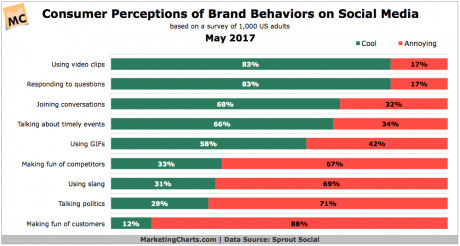
Consumers seem to have fairly clear ideas about brand personalities on social media, and the use of slang isn’t… woke. In a new study from Sprout Social, roughly 1,000 US social media users weighed in on brand personalities, with most feeling that it’s “cool” if brands talk about timely events, but not politics. (In related news, consumers aren’t that interested in brands taking public stances in on social issues.) Meanwhile, respondents are most accepting of the use of video clips (83% seeing this as “cool” rather than “annoying”), though the exploding use of GIFs – which brands starting incorporating in their emails back in 2013 – isn’t met with quite as much fervor (58% approving as “cool”). It stands to reason that most would be happy with brands responding to questions, although separate data from the report suggests that only about one-third of consumer messages on social media in Q1 that needed a response actually got one… Behaviors that more social media users see as “annoying” than “cool” include: Making fun of competitors (67% annoying) and customers (88%); Using slang (69%); and Talking politics (71%).
|
|
Scooped by
Jeff Domansky
May 28, 2017 2:32 PM
|
Advertising spending should increase by 10% or more this year, but a study released Wednesday by the Association of National Advertisers (ANA) and White Ops estimates the economic losses due to bot fraud at $6.5 billion globally in 2017 -- down 10% from the $7.2 billion reported in 2016.
The Bot Baseline Report analyzes the digital advertising activity of 49 ANA members between October 2016 and January 2017.
"Extrapolating the results of the participants to the overall global market would result in 2017 fraud losses of just $3.3 billion — about half of the $6.5 billion general market projection," per the study.
ANA CEO Bob Liodice called the results of the study "a powerful indicator that the war on digital ad fraud is winnable for those who establish proper controls and protocols."...
|
|
Scooped by
Jeff Domansky
May 25, 2017 9:47 AM
|
The term “dark social” is kicked around every so often by marketers. But what is it, how does it affect your brand, and how you can measure it? Messaging apps continue to be on the rise with no end in sight, and they come with a bunch of new opportunities for marketers. The prize: billions of active monthly users, including coveted millennial and Generation Z consumers. The four most popular messaging apps already have more monthly active users than the four major social networks. According to a recent estimate, 16 percent of the world’s population is using Whatsapp. The marketing potential is endless. AI-based technologies are bridging the gap between users and brands on a one-to-one basis, offering bots for ordering pizza and settling customer service questions in private. There are great examples on how brands are leveraging this, but the age of messenger communication also comes with a new set of challenges that already have an impact on your brand. The question is: How big is that impact, and how are brands supposed to measure it?...
|
|
Scooped by
Jeff Domansky
May 25, 2017 9:32 AM
|
Fast forward almost ten years and blogging is so ubiquitous that not only are blogs supplanting traditional media channels as sources for breaking news, practically every single company I can think of has one. A good public relations professional will counsel their client to have a blog or content hub as a way to showcase thought leadership, earned media placements, company news, and announcements, and engage with fans and followers. Yet, we are often the shoemakers with no shoes.If you’re a PR pro, and you’re thinking of starting a new blog or rejuvenating a dormant one, here are a few tips to boost your digital presence....
|
|
Scooped by
Jeff Domansky
May 25, 2017 9:21 AM
|
Retail management consulting firm BRP released its 2017 Customer Experience/Unified Commerce Benchmark Survey and found 55% of retailers are focused on optimizing the customer experience to increase customer loyalty with tactics including improving the mobile shopping experience and creating a unified experience across all channels per a press release. The survey also found that 45% of retailer intend to begin using artificial intelligence within three years to enhance the customer experience. In the press release, Perry Kramer, vice president and practice lead at BRP, described the customer experience in unified commerce as more complex than in pure e-commerce or brick-and-mortar retail environments adding the complexity “expands exponentially” as technologies including social media, the Internet of Things, (IoT), artificial intelligence and machine learning impact the retail sector and its customer journey.
|
|
Scooped by
Jeff Domansky
May 24, 2017 2:23 AM
|
The inbound movement has always been about one thing: being relevant and truly helpful to your audience. This approach shouldn't change, but as technology and internal company relationships change, marketers and salespeople must learn how to adapt to better serve their customers. To better understand how our relationships with consumers and coworkers are changing, we collected data from more than 6,300 marketers and salespeople from around the globe, which we've compiled in the 2017 State of Inbound report. It examines the relationship between company leadership and employees, details on collaboration between marketing and sales teams, and a look at what the industry’s foremost marketers are adding to their strategy in the coming year....
|















Useful Facebook marketing tips.