 Your new post is loading...

|
Scooped by
Jeff Domansky
March 23, 2016 2:45 AM
|
Most online publishers use some form of native advertising — ads that look like news stories — to grow revenue. It is accepted practice to declare that this content is sponsored by a company, so that readers can differentiate between what is and is not news. However, the way in which many publishers declare these ads could be "complicit with deception," according to a new study by Bart Wojdynski, director of the digital media, attention, and cognition lab at the University of Georgia.Wojdynski and Nathaniel J. Evans, assistant professor in advertising at the same university, led the study, which found that 60% of readers did not notice the sponsor disclosure label placed at the top of sponsored articles. It also showed that readers are seven times more likely to recognize the labels that use some form of the words "advertising" or “sponsored,” than those which use more vague phrases like “brand voice” or “presented by.” Overall, only 20% of people in the study were aware that they were reading advertising, rather than objective, editorial content....
|
|
Scooped by
Jeff Domansky
March 23, 2016 2:27 AM
|
You’ve probably heard the idea that controversy sells, but at the same time, controversy is scary. Branching out with a new idea or polarizing opinion makes your brand vulnerable, and runs you the risk of alienating a major section of your audience. However, there’s a distinct advantage and an enormous value to producing controversial content, especially when compared to the alternative—without controversy, you’re either sitting on the fence, or telling audiences what they already know. The fact is, most brands could stand to offer more controversial content. Let’s take a look at the why and how....
|
|
Scooped by
Jeff Domansky
March 23, 2016 1:47 AM
|
Despite the well-documented power of storytelling, far too many leaders and organizations are nothing short of awful at telling stories that make authentic connections to what people care about the most. Leaders commonly prep for change by creating catchy tag lines, slogans and rallying cries to communicate their ideas. These sound bites might be rich with data, numbers, statistics, and analytic driven acronyms, but they’re devoid of authentic meaning. The end result? Seventy percent of the workforce is left phoning it in because their leaders haven’t told a compelling story that makes them feel connected to their jobs or the company as a whole. Consider this: if engagement scores haven’t changed in 30 years and we still have the vast majority of people sleep-walking through their work-a-day-life, something is not working....
|
|
Scooped by
Jeff Domansky
March 22, 2016 11:37 AM
|
We’re at a critical time for the digital economy. Digital is no longer the shiny front end of the organization – it’s integrated into every aspect of today’s companies. As digital technologies continue to transform the economy, many leaders are struggling to set a digital strategy, shift organizational structures, and remove the barriers that are keeping them from maximizing the potential impact of new digital technologies. Every year, Russell Reynolds Associates surveys more than 2,000 C-level executives on the impact, structure, barriers, and enablers of digital technologies across 15 industries. The barometer below shows the percentage of executives surveyed who responded that their business would be moderately or massively disrupted by digital in the next 12 months, broken down by industry....
|
|
Scooped by
Jeff Domansky
March 22, 2016 11:18 AM
|
For the first time since Facebook unseated MySpace in the hearts and minds of teens, ladies and gentlemen, we have a new social media champion — Snapchat, at least if you’re a young American (cue David Bowie). While Facebook continues to dominate overall social media usage, in a new report from Edison Research, Snapchat has eclipsed Facebook with social media users aged 12-24. In fact, 72 percent of them now use Snapchat and 26 percent cited this as the channel they use most often, up from 15 percent just a year ago, a mind-blowing statistic. At the same time, Facebook dropped from 43 percent to 32 percent as the most-used network for that age group.This new report prompted a fascinating discussion with Tom Webster...
|
|
Scooped by
Jeff Domansky
March 22, 2016 10:49 AM
|
If converting traffic to subscribers is high on your list of priorities, you won’t want to miss today’s episode of the ProBlogger podcast, where I chat with “Conversion Educator” Tim Paige of LeadPages. Getting better conversions on our websites is something I think bloggers really need to know, and Tim certainly doesn’t hold back! Even if you don’t use LeadPages as a landing site for your blog, you can really get something out of this conversation. Tim discusses what he calls his “Reverse Value Bomb” and strategies to get more opt-ins on your site (including a section about content upgrades – one of the best-converting strategies you can have). From emerging trends in online marketing we need to be paying attention to, to creating an optimised landing page in five minutes, there is a ton of value in this episode, including a special offer for ProBlogger readers....
|
|
Scooped by
Jeff Domansky
March 21, 2016 3:11 PM
|
eMarketer released its Media Usage Around the World report this month. If you love data and stats, this is one for you. Also check it out if you're in charge of figuring out where to place your next bet for connecting with where your consumers already are.
Here are five data points:
-- By the end of this year, 3.3 billion people globally will use the Internet at least once a month. That is almost half the global population.
-- The vast majority will do so via a mobile device.
-- This year will be the first year more than half of the USA will stream at least some TV online at least once a month.
-- Android remains the largest mobile platform worldwide.
-- Germany still loves its desktops and laptops more than any other platform — including mobile devices. For a country that calls a mobile phone a “Handy,” this is surprising!
It is clear that the mobile Internet is now the world’s most important mass delivery platform. But a marketing platform it is still not. Marketers are mightily struggling to figure out what to do with mobile within the marketing mix....
|
|
Scooped by
Jeff Domansky
March 21, 2016 11:24 AM
|
If you have a targeted lead list and your response rate is less than 10% with personalized emails, your emails could use some work. Earlier this year a B2B company came to me for help with their emails. They offered an incredible service for the SaaS space, but weren’t very successful with their sales emails. Their response rates were below 2%. In about a month of working together I created a single email template that got them more than 16 new customers. But before I reveal the template, let's dig into what was wrong with their previous approach....
|
|
Scooped by
Jeff Domansky
March 21, 2016 2:26 AM
|
Pinterest has released a new set of advertising tools for small and medium sized businesses. These tools give businesses new ways to promote their content and advertise on Pinterest. Around three-fourths of the content on Pinterest comes from businesses already and opening up their ads product to all SMBs feels like a great way to enable businesses to get the right content in front of the right people. Pinterest users regularly save their favorite Pins (including adverts!) to their own boards, and as such, Promoted Pins generate lots of impressions and engagements as they get resurfaced time and time again. The data shows advertisers who use the Pinterest Ads Manager received an average of 20% more (free) clicks in the month after the start of a Promoted Pins campaign. So, how does it all work? In this post, we’ll take a look at what’s new with Pinterest Ads Manager and give you a quick guide on how to get started with your first Promoted Pin....
|
|
Scooped by
Jeff Domansky
March 21, 2016 2:01 AM
|
“How can we get more visitors to our website?”… You’re certainly not alone, as increasing traffic is often the number one problem faced by marketers today. The bad news? Saying “get more traffic” is easier said than done. You could write guest posts (Leo wrote 150 articles in 9 months when Buffer first launched), optimize for SEO traffic, or drive visitors through social media. The options are endless. This article focuses on the latter, though. In this post, I’ll share the seven most powerful lessons we learned at Hubspot from running social media experiments to increase our social media referral traffic by 241%....
|
|
Scooped by
Jeff Domansky
March 21, 2016 1:27 AM
|
For many of its 400 million monthly active users, Instagram is used just for recreational purposes. But, did you know that Instagram can be used as a powerful business tool, too? The problem, however, is that many people simply don’t know how to use Instagram for their business. In this article, we’re going to take a look at how you can begin to use Instagram in order to generate sales. We’ll analyze three tactics that you can put into action, right now, in order to turn Instagram into a profitable sales channel....
|
|
Scooped by
Jeff Domansky
March 20, 2016 11:41 AM
|
One of the most important tools in any salesperson’s tool kit consist of success stories that demonstrate capabilities, build credibility, and move the prospect closer to signing on the bottom line. Here’s a template used to describe the three parts of the commonly told success story:
|
|
Scooped by
Jeff Domansky
March 20, 2016 11:25 AM
|
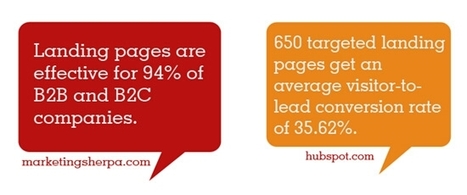
When you’re building a landing page for the purpose of converting leads into customers, you must take bold steps to eliminate all potential credibility killers. Landing pages, in general, are effective tools for building your business. According to MarketingSherpa, “landing pages are effective for 94% of B2B and B2C companies.” In this in-depth article, I want to show you 4 landing page credibility killers that you should eliminate right now....
|
|
|
Scooped by
Jeff Domansky
March 23, 2016 2:37 AM
|
I quite like this provocative sausage dog picture because it forces marketers to think differently about responsive web design (RWD). More often than not, marketers scale content down to fit a smaller screen; because they then claim that they use RWD and have some mobile apps, they think they have checked the mobile box. In fact, RWD was by far the most common tactic that marketers were using or planning to use in 2015: Only 9% of marketers we surveyed are not planning to use it. When fully implemented, RWD can improve the user experience, but more often than not, it’s implemented as a quick fix to the problem of multiple screen sizes. It often prevents marketers from thinking about the need to contextualize offerings for different devices. Customers do not necessarily want the same content across all their screens. However, a scarily high percentage of marketers we surveyed — 47% — admit their mobile services are primarily a scaled-down version of their PC services....
|
|
Scooped by
Jeff Domansky
March 23, 2016 2:14 AM
|
What’s your opinion on the current trends? Digital design trends are fickle creatures. Like a fashion trend, they come, they go, they come back again with a riff on the original. Some stick around, and flat design seems to have stuck, for now that is…I am not sure we could even call flat design a trend anymore, but either way it was one of the most drastic recent visual shifts in digital design which makes it pretty interesting. Whenever a digital trend appears there are both tradeoffs and benefits. Flat design grew from designers’ realization that skeumorphism, with its bevels and shadows, did not scale well across smaller devices. As a reaction to this, and perhaps with the realization that these interfaces were pretty darn garish, the design trend swung from overly styled to barely styled. The minimal elements of flat design scale much more effectively on all devices....
|
|
Scooped by
Jeff Domansky
March 22, 2016 9:53 PM
|
The Republican frontrunner met with the editorial board on Monday morning. The full transcript follows at the link above: FREDERICK RYAN JR., WASHINGTON POST PUBLISHER: Mr. Trump, welcome to the Washington Post. Thank you for making time to meet with our editorial board. DONALD TRUMP: New building. Yes this is very nice. Good luck with it. RYAN: Thank you… We’ve heard you’re going to be announcing your foreign policy team shortly… Any you can share with us? TRUMP: Well, I hadn’t thought of doing it, but if you want I can give you some of the names… Walid Phares, who you probably know, PhD, adviser to the House of Representatives caucus, and counter-terrorism expert; Carter Page, PhD; George Papadopoulos, he’s an energy and oil consultant, excellent guy; the Honorable Joe Schmitz, [former] inspector general at the Department of Defense; [retired] Lt. Gen. Keith Kellogg; and I have quite a few more. But that’s a group of some of the people that we are dealing with. We have many other people in different aspects of what we do, but that’s a representative group....
|
|
Scooped by
Jeff Domansky
March 22, 2016 11:25 AM
|
Facebook and Twitter are increasingly becoming news sources for its users, but news is not necessarily the reason why people are logging onto these social networking sites. It just so happens that news ends up being part of the social media experience. That’s according to a new report from the Pew Research Center. "One of the things we saw early on is the degree to which people describe this as 'incidental news...And that's something that's being reinforced." -- Amy Mitchell, director of journalism research for the Pew Research Center The findings cement the fact that both users and news organizations must continue to wrestle with social media, its different features and their implications. “Social media is certainly a part of Americans’ news streams, and it’s going to continue to be a part of that,” said Amy Mitchell, director of journalism research for the Pew Research Center. “And the different ways people connect with these platforms will influence how they learn about their communities and the world.”...
|
|
Scooped by
Jeff Domansky
March 22, 2016 11:02 AM
|
Domain names have always had an impact in the branding and SEO of online businesses. In the past, online marketers used “Exact Match Domains” or EMDs, which are domain names that are the same as a key phrase they are targeting. Although this is no longer as effective after Google’s EMD update in 2012, coming up with a domain name that’s relevant and conveys a meaningful message to your would-be visitors. Adding a keyword or two in the domain name has also shown to increase a website’s performance in ads and SERP listings. Given that domain names cannot be changed when registered, it is essential for businesses and bloggers to plan very carefully ahead.This is one of the most important decisions you should make for your site to take off. To help you determine the perfect domain name for your site, here are five of the best tools out there you should consider using....
|
|
Scooped by
Jeff Domansky
March 22, 2016 10:38 AM
|
Want to earn money for your business? Want to generate leads for your sales team? Want to accelerate sales for your online store? Want to do anything for your business that actually matters? Well then you need calls-to-action. Without them, we wouldn't be converting our website visitors or social media fans into actual leads for our sales team. Without them, we wouldn't be calling on our audience to take any action in their lifecycle that actually benefits them or the growth of your business. But just because they're important doesn't mean we all have a professional designer at our disposal -- whether due to budget limitations, resource restrictions, or just lack of design skills. That's why we created 50 free call-to-action (CTA) templates in PowerPoint for you to customize and use. The template will teach you how to customize your new CTAs effectively, so don't let fear of DIY design stop you. This post will give you a sneak peek into a large set of designs available in the template. Download it now and follow along.
|
|
Scooped by
Jeff Domansky
March 21, 2016 2:28 PM
|
Every day, Snapchat gets 100 million visitors. That means more people will use the app today than the total populations of California, New York, and Texas combined. One hundred million users is the kind of number that can seduce any marketer. But jumping onto the platform without a strategy or some boundaries is a sure-fire way to lose the respect of both your audience and your marketing team. In order to connect with viewers, drive ROI, and—let’s be honest—have some fun, your first step should be to understand the platform’s best practices. Here are four examples of brands that have mastered Snapchat....
|
|
Scooped by
Jeff Domansky
March 21, 2016 11:13 AM
|
Ten years ago today, Jack Dorsey sent out the first tweet. Twitter was nearly an afterthought in those early days, an outcropping from a video service Dorsey had a hand in starting. Despite protests from investors, the company launched officially July 15, 2006. Still, I like to think of this day as the “real” birth of the service.It is no overstatement or social media hyperbole to say that Twitter has changed my life. Although I am known (somewhat?) for writing the best-selling book on Twitter the platform has altered my path in profound ways.I could spend days recounting the real personal and business benefits of Twitter, but allow me today to tell you one story, one of my favorites....
|
|
Scooped by
Jeff Domansky
March 21, 2016 2:11 AM
|
Most inbound marketers spend a lot of time creating content, and it can be a struggle to constantly come up with fresh content ideas. However, the key to creating effective inbound content is to know what you have already in your content inventory. Creating an inventory of effective content means mapping your content to the appropriate stage in The Buyer’s Journey. Once you know what content you already have, you can analyze the entire library to identify opportunities and holes, and then create a new content offer that fills out the gaps in your content library. For those of you up to the task of doing a content mapping yourself, read on! This blog post will cover a three-step process to help you create the content you need to align with The Buyer’s Journey. Let’s get started!...
|
|
Scooped by
Jeff Domansky
March 21, 2016 1:44 AM
|
Wow, how time flies! It’s been just over a year since we shared a behind-the-scenes look at Buffer’s social media strategy and stats. The feedback from the community on that post was amazing, and we learned so much from the comments, many of which ended up shaping future Buffer articles like “How to Create a Social Media Report and Explain It to Your Boss or Client” and “What $5 Per Day Will Buy You on Facebook Ads.” Since then, we’ve tried our best to learn about what’s working well for us on social media and what’s not. Some of these discoveries led us to change directions on particular social platforms, drop others entirely, and experiment with new ideas and strategies along the way. Now that we’re nearing the end of Q1 of 2016, we thought it would be a great time to share our latest social media stats, what we’ve learned, and what our strategies look like for the future....
|
|
Scooped by
Jeff Domansky
March 20, 2016 11:52 AM
|
Unlike business storytelling, storybranding isn’t used to help audiences identify with events the way storytelling identifies events. Rather, storybranding is used to help brands associate with a strong and enduring value or belief system.. In brand briefs, this is sometimes mistaken for a description of the brand’s personality or how it should be portrayed i.e. bold, unique, caring, or responsive. But directing a brand to exhibit a personality trait is like directing a stage actor to show passion or be courageous. It becomes more natural for the actor to show passion, courage, or any other personality trait by helping him get in touch with his character’s belief system. Storybranding ratchets brands up to something more powerful than a display of certain personality traits. It does this by defining the brand’s authentic motivational thrust underlying its personality. This thrust could be the strongly adhered to the value placed upon scooping competitive rivals with technological advancements, the belief that being friendly is not the same as “doing” friendly, or the importance that is placed on being obsessive about quality control. In effect, storybrands internalize beliefs that more naturally manifest themselves in their outward appearances. The most important purpose behind storybranding is to help companies become identified with certain ideals. And it’s a purpose that comes with a very big reward....
|
|
Rescooped by
Jeff Domansky
from SEO and Social Media Marketing
March 20, 2016 11:35 AM
|
Pinterest is a lifestyle searching tool for millions of people. People go on there with excited eyes to look for amazing recipes to cook for dinner that weekend, find ways to dress to the tens for a special date, or find creative educational materials to teach children with. Millions of users turn to Pinterest to enhance their lifestyle. And they are doing so by using the search function on Pinterest. Here’s a fun fact. Did you know that Google has a search engine just for recipes? It’s been around for years, but almost nobody I know uses it. Instead, most people I know automatically go to Pinterest if they want to find recipes to try out. That’s not the only reason Pinterest is better than Google. Here are 5 reasons why Pinterest’s search engine is better than Google....
Via Antonino Militello
|



















Publishers that use unclear positioning or language in sponsored news articles may be "complicit with deception," study author suggests.