 Your new post is loading...

|
Scooped by
Jeff Domansky
July 21, 2017 2:16 AM
|
Video marketers know we lack patience. So they're starting to tailor content for our dwindling attention spans. In fact, 56% of all videos published in the last year are less than 2 minutes long. But marketers must innovate further because users expect different video lengths on different platforms. Odds are, they're more willing to watch a 2 minute long video on YouTube than on Twitter. If you don't customize video length for each platform, then you're not fully catering to your audience. Sooner or later, the attention they give to your brand will wither away. That's why we decided to create this handy, bookmarkable infographic about the optimal video length for the most popular video channels. To help you better engage your audience on Instagram, Twitter, Facebook, and YouTube, we extracted insights from HubSpot's own social and YouTube data, and combined it with existing research in the area. ...
|
|
Scooped by
Jeff Domansky
July 21, 2017 1:56 AM
|
When it comes to innovation, being first isn’t a prerequisite for being the best. This seems to be the guiding principle behind the recent introduction of LinkedIn video, the business-oriented social media giant’s first attempt at incorporating native video content into its extensive range of benefits and features. As practically the last among the largest and most popular social media platforms to add a native video feature, all eyes are on LinkedIn, as users eagerly anticipate how this new feature will change the way they maximize their presence on the site. Initially tested among select users in the United States, LinkedIn video is scheduled to be launched to all LinkedIn users within the next few months. LinkedIn video offers all sorts of new possibilities to its tremendous user base of professionals, social sellers and marketers. Now, LinkedIn users can upload and share videos directly from their mobile phones, allowing their network to enjoy unique and original video content that’s relevant to their industry and more importantly, is of interest to their target market....
|
|
Scooped by
Jeff Domansky
July 19, 2017 11:45 PM
|
Content curation can be a socially valuable as well as an economically sustainable, if not altogether profitable, activity.
When making a choice, choosing a solution, a product or a tool, if there are too many available choices, we find it hard to select.
On the other hand, when there are few, selected options, and there’s someone expert who we trust that explains their value to us, we are instead much more inclined to pick one.
In a system where there are huge quantities of apparently alternative options, there is always the opportunity to organize, pick and select groups of items based on specific needs, requirements, objectives, costs as well as on many other variables.
|
|
Scooped by
Jeff Domansky
July 19, 2017 11:15 PM
|
Most people believe content curation is a relatively recent, Internet-born trend, generated by the constantly increasing amount of unverified information available online.
The general belief is that “content curation” is a content marketing tactic, designed to provide value to the reader and to save time and writing effort to the author/publisher. Such curation, according to most articles you find online, consists of searching and gathering already published content on a specific topic and to organize it together into a reading list, an anthology or a compilation.
In reality, the key elements of an editorial curation practice (finding, gathering, organizing/arranging, value adding, sharing) have a long history and have been utilized by man since thousands of years, to preserve, organize, uncover and highlight valuable poetry, philosophical ideas as well as historical and artistic works.
Historically, the need for curating content, appears to have arisen as a solution to two key needs:
1) to preserve valuable work before it would disappear
2) to facilitate the discovery and appreciation of valuable literary works, for future generations....
|
|
Scooped by
Jeff Domansky
July 19, 2017 9:28 PM
|
The question isn’t whether you should invest in SEO, but more about which activities you should invest in to get the best results.
This article will take a closer look at what it takes to rank on page one of Google and where you should be investing your money.
|
|
Scooped by
Jeff Domansky
July 19, 2017 4:56 PM
|
There are millions of people on Pinterest, searching, pinning, and sharing – so it’s important to recognize its potential for building awareness and filling the top of the funnel, particularly for ecommerce companies.
This blog will discuss a couple of recommended targeting types within Pinterest to help fill the top of the funnel and essentially build up your audience. From there, once your audience is built out, we’ll run through how to actually capitalize on these new users to drive sales.
|
|
Scooped by
Jeff Domansky
July 19, 2017 1:12 PM
|
Consumers find video engaging, compelling and convincing — so much so that they’re anywhere from 64% to 85% more likely to buy after watching a product video.
In fact, video on a landing page can boost conversions by an astonishing 80%. Already, companies that use video on their website get 41% more traffic from search results than those that don’t, and by next year, you can expect 74% of all web traffic to be video.
There’s a lot to think about, from actually shooting the video to post production, finding copyright free music and more. Equipment quality, lighting expertise, editing skill and audio optimization still matter a great deal (more than ever, in fact).
So while the barriers to entry for video creation have been reduced, the barriers to creating exceptional video have actually skyrocketed.
In this column, we’re going to explore some really useful places to find one element that can make your marketing and product videos way more professional and polished: background music.
|
|
Scooped by
Jeff Domansky
July 19, 2017 2:51 AM
|
Going viral is the elusive, holy grail of content creation. You put hard work into a story, video, or epic meme, and hope that the internet masses will appreciate your work for the masterpiece it is.As we all know, it’s not as easy as it sounds. Is there a way to simply just, go viral? We wanted to figure it out. First, where do we have the biggest chances of going viral? Facebook is a live wire for your content to reach levels of virality. Of course, there are ways to go viral on Twitter, Youtube, Instagram and the like as well. But Facebook offers an enormous audience and with its friends and family algorithm, you’re more likely to reach more and more people as your audience starts sharing. Consider the Dodo, LittleThings, NowThis, and of course, Chewbacca Mom. Their success is rooted in Facebook’s snowball effect....
|
|
Scooped by
Jeff Domansky
July 19, 2017 2:31 AM
|
Today’s audience has trouble focusing because of their hyperactive, commotion-ridden environment. Everyday, people are exposed to more webpages, TV shows, social media posts, instant gratification technologies and data. The Attention Economy records how one Sunday New York Times edition presents more factual data than 15th century readers could access in their entire lifetimes! According to new research, social media marketers are turning to visual content to get the job done. The power of visual content marketing isn’t a new concept. Graphic designers have always had a role to play in marketing and advertising, even on traditional media like TV and newspapers....
|
|
Scooped by
Jeff Domansky
July 18, 2017 10:47 AM
|
“If you use a poor headline, it does not matter how hard you labor over your copy because your copy will not be read.” John Caples A good headline is one that resonates with your audience not one that resonates with someone else’s audience. This is why copying a viral headline format that worked on BuzzFeed or Facebook is a bad idea, particularly if you write for a B2B audience. Our latest research reveals the headlines that resonate with B2B audiences including: The top phrases that start B2B headlines The most engaging phrases in B2B headlines The most shared numbers in business headlines The top words and topics that resonate with B2B audiences The optimum length of B2B headlines Key lessons for business content writers The research is based on an analysis of 10 million articles shared on LinkedIn. See our methodology note at the end of this post.
|
|
Scooped by
Jeff Domansky
July 18, 2017 9:59 AM
|
Facebook focuses on idea sharing, Twitter is all about broadcasting your thoughts, Instagram prioritizes the visually interesting, and Pinterest provides storage for the content and products you love. Each social media site is designed to serve a different purpose, so we use it differently. It’s no surprise, then, that we’ll watch—and expect—different types of video on each platform. In this post, we’re going to go over how to use video marketing on each individual social media site for best results, including ideal length, file size, and best practices....
|
|
Scooped by
Jeff Domansky
July 18, 2017 9:41 AM
|
Contrary to your Instagram feeds, longer video tends to drive higher engagement. A new report from TwentyThree, a video marketing automation platform, studied over 1.5 million videos to better inform marketing and content creation teams about preconceived video myths. The “State of Online Video in 2017” report found that videos can, and should, last longer that 90 seconds if publishers want to see higher engagement rates. While 80 percent of videos are under five minutes, they drive less than a third of overall video engagement. Mid-form and long-form videos, which are at least 15 minutes long, drive over half of all video engagement despite encompassing just 8 percent of all video....
|
|
Scooped by
Jeff Domansky
July 18, 2017 9:25 AM
|
Arguably the biggest digital media story of 2017 has been the case of brands pulling spend from Google properties following an investigation by The Times of London which contained evidence of branded adverts appearing next to controversial content on its video-sharing site YouTube. This has prompted a torrent of chest-thumping vitriol from ‘legacy publishers’, namely from The Times' owner itself News Corp, which itself harbors ambitions of launching its own ad network. The publishers strike back However, others from the ‘legacy publisher set’ have added volume to this cry, with this week’s appeal from members of The News Media Alliance which lobbied the US Congress to repeal laws that prevent them from collectively negotiating with Google (and Facebook) as they constitute “a de facto duopoly that is vacuuming up all but an ever-decreasing segment of advertising revenue”....
|
|
|
Scooped by
Jeff Domansky
July 21, 2017 2:02 AM
|
Have you ever wondered if you’re missing some of the functions within LinkedIn that may help you with your business? It’s hard to keep up with all of the changes and functionality on social media sites. It’s something that my team and I do daily to make sure we stay up-to-date on all of the LinkedIn tips, tricks and changes. In this article, I’m going to share some of the best kept secrets (old and new) that include extremely advanced LinkedIn ninja tricks and much more. Each of these 17 LinkedIn tips are simple and easy to implement immediately....
|
|
Scooped by
Jeff Domansky
July 21, 2017 1:38 AM
|
This is the last WordPress website creation checklist you’ll ever need. Today, we’re going to give you the Ultimate WordPress checklist. All of the things you need to do get a website fully up and running and ready for launch. This WordPress checklist is divided into multiple sections, providing a complete list of tasks you need to do for each and every step when planning, building and launching a new WordPress website....
|
|
Scooped by
Jeff Domansky
July 19, 2017 11:21 PM
|
To gain readers’ attention and trust it is evidently not enough to create a top 10 tools list by searching on Google and then picking the best items from existing lists, or to pull together a few interesting article titles on a topic with their introductory paragraphs.
Unless your readers are not very interested themselves into the topic you cover, why would they take recommendations from someone who has not even had the time to fully vet and verify his own suggested resources?
Picking what superficially appears to be interesting content just by reading titles or curating and suggesting content to your readers by leveraging tools that do this automatically is like recommending movies or music records based on how much you like their trailers or their cover layouts.
By using this approach how many times are you going to recommend truly valuable resources versus how many times is your recommendation going to lower your credibility and authority just because the content you have recommended is actually quite shallow, provides no new insight, or it is even copied from somewhere else?
|
|
Scooped by
Jeff Domansky
July 19, 2017 11:08 PM
|
Imagine if an art museum contained every single painting created over a hundred-year period. It wouldn’t be much fun to visit, right? Hundreds of thousands of images, of wildly varying quality, without organization or context? It would be like a Google image search crossed with a garage sale.
Content curation is what turns a warehouse full of art and artifacts into a museum. A good curator sifts through the content to find pieces that are valuable for an intended audience. Their job is to direct attention to worthy content—and in doing so, make the museum a worthwhile place to visit.
Your blog readers and social media followers are drowning in content. You can be the content curator that helps direct their attention to what is most helpful, educational, or entertaining. Content curation, as part of your editorial strategy, can help make your blog a more valuable destination for your readers.
But the benefits go both ways; as you help your readers find great content, you’re helping your organization, too. Here are just a few ways curated content can help advance your marketing goals, and some of our favorite curating tools.
|
|
Scooped by
Jeff Domansky
July 19, 2017 5:38 PM
|
Fei-Fei Li, chief scientist of artificial intelligence and machine learning at Google Cloud, came on stage at Google’s Next Cloud conference today to talk about the current and next-generation applications of AI that Google’s working on. These technologies will make a difference in self-driving cars and healthcare, sure, but also Snapchat’s filters and Google Photos’ search capabilities. But the big highlight came when she announced a new way to allow software to parse video.
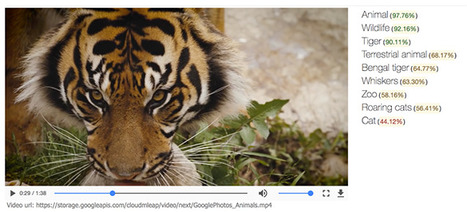
This new “Video Intelligence API” was demoed onstage, and it offered the kind of “whoa” moment you expect from a Google keynote. By playing a short commercial, the API was able to identify the dachshund in the video, when it appeared in the video, and then understand that the whole thing was a commercial. In another demo, we saw a simple search for “beach” and was able to find videos which had scenes from beaches in them, complete with timestamps. That’s similar to how Google Photos lets you search for “sunset” and pull up your best late-day snapshots.
Before now, computers couldn’t really understand the content of a video directly without manual tagging. “We are beginning to shine light on the dark matter of the digital universe,” Li said. At least in Google’s demo, it was genuinely impressive. And Google is making the API available to developers, just as it has with its other machine learning APIs.
|
|
Scooped by
Jeff Domansky
July 19, 2017 4:42 PM
|
In January, I wrote a post called Content Shock which explained that we are entering a new phase in the evolution of content-based marketing. There are primarily two dynamics driving this change:
The amount of content on the web is literally exploding. By 2020, the amount of web-based information (most of it consumer-driven) is expected to increase by 600%. Think about that for a moment. If you can imagine the vastness of the Internet today, in six years we will have six of those.
Today an average American spends about 10 hours a day consuming content, a number that has risen steadily year by year. But there is a threshold to the amount of attention we will be able to devote to content, which will further challenge a marketer’s ability to get messages through to their audience and stakeholders.
I wrote about a third factor — the development of advanced content filters — as another emerging issue that will make it harder to get our content to emerge as the signal instead of the noise.
My conclusion was that these pressures are bound to thin the herd. Content marketing as we know it will not be a sustainable strategy for some businesses, and it will become more difficult and expensive for almost all of us.
How do we break through this information density and win in a hyper-competitive content market?...
Here are brief descriptions of 10 possible strategies to break through....
|
|
Scooped by
Jeff Domansky
July 19, 2017 3:00 AM
|
Last week, we saw that both video output and engagements have increased for publishers.Instagram videos now account for 85 percent of BBC News’ monthly interactions on the platform, and engagements have grown for top publishers’ videos by 53 percent between last year and 2017. In March 2016, Instagram made a change allowing video posts as long as 60 seconds long. Previously, the limit had been 15 seconds. We decided to look at whether this change has impacted how publishers are creating video for Instagram. When we looked at video for Facebook in January, we saw that many top publishers were creating videos between 60 and 90 seconds long. This time, we wanted to dive in a little more deeply and understand what makes for a successful video on Instagram. How long are the top most liked and commented videos from Instagram publishers? Using NewsWhip Analytics, we surveyed the top 20 engaging publishers and media brands of Instagram video in June 2017. We calculated the length of their top five videos to find what length had their audiences liking and commenting. NewsWhip Analytics allows us to dig into historical social data across any niche, keyword, or region, and see how users are reacting across Facebook, Twitter, Instagram, and more....
|
|
Scooped by
Jeff Domansky
July 19, 2017 2:44 AM
|
It’s hard to extract meaning from raw data only, so we enrich our data by adding story metadata such as authorship, publication sources, entities, topic classification; social data including influencers on a story’s distribution, audience size, social velocity, and performance against peer stories. With this information, you can unpack each story and see how it is spreading. You can quickly spot events of significance in any topic, and analyze by format to find what works. Meanwhile, our algorithms can already predict the eventual reach of newly published stories, and extract trending entities (recently, this power was used to pounce on and debunk “disinformation” spreading in the run up to the French Presidential election). Our metrics can be used to spot “white space” opportunities with an audience, by analyzing which angles on stories are over-performing with an audience but are underreported. We also plan to use algorithms to analyze whether a story is likely to be true, false, or biased based on source and other characteristics, and are working on making our recommendations much more powerful, such as: “Here’s what your audience will like today.”...
|
|
Scooped by
Jeff Domansky
July 18, 2017 10:42 PM
|
The idea pops into my mind almost immediately. For weeks, amid my dad’s barrage of doctor’s appointments, medical tests, and treatments, I keep the notion to myself.
I dream of creating a Dadbot—a chatbot that emulates not a children’s toy but the very real man who is my father. And I have already begun gathering the raw material: those 91,970 words that are destined for my bookshelf....
|
|
Scooped by
Jeff Domansky
July 18, 2017 10:38 AM
|
Where does customer loyalty come from? When you successfully create a connection with your customers and employees, many of them might stay loyal for life -- and you'll have the chance to increase your overall profitability while building a solid foundation of brand promoters. But achieving that connection is no easy task. The companies that succeed are ones that stay true to their core values over the years and create a company that employees and customers are proud to associate with. That's where company vision and mission statements come in. A mission statement is intended to clarify the 'what' and 'who' of a company, while a vision statement adds the 'why' and 'how' as well. As a company grows, its objectives and goals may change. Therefore, vision statements should be revised as needed to reflect the changing business culture as goals are met. Check out some of the following company vision and mission statements for yourself -- and get inspired to write one for your brand.
|
|
Scooped by
Jeff Domansky
July 18, 2017 9:52 AM
|
If a 150-million-year-old Brachiosaurus could talk, what would it say?You can find out at Chicago’s Field Museum of Natural History, where many of the exhibits will soon tell their own stories using local voices, thanks to an initiative from local museum advertising specialist Leo Burnett. The agency wrote more than 100 short scripts, each a paragraph or two long, designed to capture the “voice” of various plants, animals and minerals in the museum’s permanent collection. The write-ups combine history and humor. For example, the Brachiosaurus bemoans its girth while also discussing the contributions of paleontologist Elmer Riggs. Everyday Chicagoans are invited to record the first-person monologues in a special pop-up audio booth that is traveling around the city this summer. (It visited Chinatown this weekend.) Ultimately, the best voiceovers will be accessible via smartphone for Field visitors to enjoy on audio tours....
|
|
Scooped by
Jeff Domansky
July 18, 2017 9:33 AM
|
MADRID — “Nos encanta la verdad.” We love the truth. Political fact-checking has existed in the United States for many years. FactCheck.org was established in 2003, and The Washington Post Fact Checker and PolitiFact were launched in 2007. In recent years, this movement representing a new form of accountability journalism has exploded around the globe. Now, there are 126 fact-checking organizations in 49 countries. Clearly, voters in many countries care about and want to know the truth. About 190 fact-checkers from 54 countries attended the fourth annual Global Fact-Checking Summit, July 5-7, 2017. The International Fact-Checking Network at Poynter Institute hosted the summit. The first meeting of fact-checkers from around the world took place in 2014, with 50 fact-checkers. Now the community has grown so much that we needed a “speed meeting” session for introductions....
|






















Check out the ideal video lengths for Facebook, Instagram, Twitter, and YouTube
I found this really interesting, but not all that surprising! Keep it short and simple! I need to do this with my blog posts -- I think they're too long!