 Your new post is loading...

|
Scooped by
Jeff Domansky
May 11, 2016 5:53 PM
|
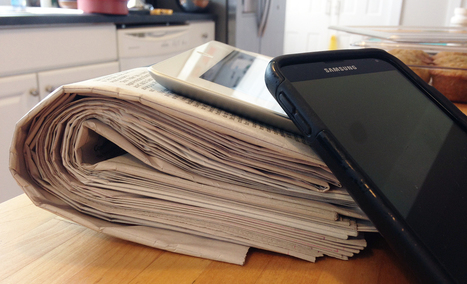
Pew Research Center, in association with the John S. and James L. Knight Foundation, wanted to explore how the rise in mobile devices impacted long-form content. Using anonymized data from Parse.ly’s database of hundreds of news and media sites, it was able to analyze this trend.
Report Findings: People Read Long-Form Content On Phones
It turns out that long-form journalism does have a place in today’s mobile-centric society.
“These findings suggest that on small, phone-sized screens the public does not automatically turn away from an article at a certain point in time – or reject digging into a longer-length news article. Instead, the average user tends to stay engaged past the point of where short-form reading would end, suggesting that readers may be willing to commit more time to a longer piece of work,” said Amy Mitchell, Pew Research Center’s director of journalism research.
Some highlights of the report include:
- Long-form stories attract visitors at nearly the same rate as short-form stories.
- Across all five distinct parts of the day, readers spend about twice the time with long-form news content on their cellphones as with short-form.
- No matter how readers arrive at specific content (through a link from an external website, social media, search, etc.), engaged time for long-form content regularly extends beyond that of short-form content.
These findings hold true even for individual digital publishers. For example, Lehigh University, a member of Parse.ly’s University Partnerships program, recently completed a study on reader engagement with long-form content. Editors at Lehigh’s student newspaper, The Brown & White, found that readers spend about the same amount of time on all pieces of content, relative to the length of an article.
|
|
Scooped by
Jeff Domansky
May 11, 2016 5:28 PM
|
Instagram unveiled a new logo Wednesday, and it may well go down as one of the biggest design fails of the year.
The brand's famous skeuomorphic icon, a virtual representation of a physical camera, was beloved almost universally, and is one of the most instantly recognizable logos in tech. For some reason, Instagram felt it was dated. It was "beginning to feel, well… not reflective of the community, and we thought we could make it better," Ian Spalter, head of design at Instagram, writes in a Medium post (which also goes into its new, broader visual identity).
The ellipsis in that sentence is telling. It seems to indicate a confusion of purpose. If only the ellipsis had turned into a real pause—and they'd put on hold this instinct to ditch the key symbol of the brand's personality.
As often happens with logo redesigns, Instagram goes into great detail about the creative decisions that went into this one. The brand says it started off trying to "modernize" the original mark. That produced a "brighter, flatter option" that wasn't working. So, they began an effort to work the rainbow and camera lens into a different mark entirely—hoping to produce "a more modern app icon that strikes a balance between recognition and versatility."...
|
|
Scooped by
Jeff Domansky
May 11, 2016 5:11 PM
|
This billboard, which went up this week next to the Gardiner Expressway in Toronto, is provocative in the extreme—blatantly urging drivers to text and drive as a way of drumming up business for the advertiser, Wathan Funeral Home.
But there's a method to the madness.
It's actually a PSA from the Montreal office of agency John St., in partnership with out-of-home company Cieslok Media. No, Wathan Funeral Home isn't real. But it does have a website, where angry motorists who've Googled the place are confronted with this message:
If you're here, you've probably seen our "Text and Drive" billboard. And if you have, you probably came to this website to tell us what horrible people we are for running an ad like that. And you'd be right. It is a horrible thing for a funeral home to do. But we're not a funeral home. We're just trying to get Canadians to stop texting and driving, which is projected to kill more people in Ontario this year than drinking and driving. That's right. More. And while most people wouldn't even think about drinking and driving, over half of Ontario drivers admit to reading texts while behind the wheel. That's more than half of the drivers on the road today risking their lives, their passengers' lives and the lives of their fellow motorists and pedestrians. Which should make you even madder than our billboard did....
|
|
Scooped by
Jeff Domansky
May 11, 2016 10:54 AM
|
Every now and again you write something that knocks it out of the park. The content is compelling, the title attracts eyeballs and everything falls in to place. You can sit back and pat yourself on the back. Good work team you!But what do you do with that successful content after it’s had it’s initial run? We wondered if there was a way to take that awesome content and repackage it. Would people consume it more thoroughly in a book format? As a bonus we thought it might help build our email list....
|
|
Scooped by
Jeff Domansky
May 10, 2016 9:20 PM
|
Gary Friedman has a pronounced distaste for discounts. The outspoken Restoration Hardware chairman and CEO blames the retail sector’s reliance on sales and pricing promotions for many of the problems facing the upscale home furnishings chain.
“Much of how we behave promotionally is left over from the Great Recession,” Friedman wrote in a February letter to shareholders published ahead of Restoration Hardware’s disappointing Q4 2015 earnings report. “The multiple sale events and email communications do not reflect the brand we are building, nor are these promotions aligned with how our customers shop with us.”
Restoration Hardware is eliminating traditional promotions altogether in favor of introducing a premium customer rewards program. Priced at $100 per year, its new RH Grey Card offers shoppers a flat 25% savings on all regularly priced merchandise across all of Restoration Hardware’s brands, along with 10% savings on clearance merchandise, complimentary interior design services and reduced interest rates on its RH credit card.
“Our lives are filled with complexity—and we long to break through the clutter to find simplicity,” Friedman said in a press release announcing the RH Grey Card program. “We want to shop for what we want, when we want and receive the greatest value. So rather than navigating countless promotions, we’re changing things… because time is the ultimate luxury.”...
|
|
Scooped by
Jeff Domansky
May 10, 2016 9:10 PM
|
At one point, my ideas didn’t do the trick in terms of producing new, engaging, and relevant content. I’m sure you can relate.
It dawned on me that I needed to change my strategy and fully embrace this sentiment from Kevin Roberts: “Ideas are the currency of the future.”
Great ideas are based on logic, data, and emotions. To hit those marks, I use different tools and surveys as well as logic-focused tricks. Here are some that will help you find great content ideas to which your audience will respond....
|
|
Scooped by
Jeff Domansky
May 10, 2016 9:01 PM
|
Are you struggling to remain visible in Facebook’s news feed?
Wondering how Facebook decides what to show in the news feed?
In this article you’ll discover how the Facebook news feed algorithm works, what’s been updated, and how marketers can respond to create more visibility on Facebook....
|
|
Scooped by
Jeff Domansky
May 6, 2016 5:52 PM
|
We still write as if people will read our work in print, but they don’t — they read on glass screens. As a result, you should include links in everything you write, from emails to reports. It will make your writing shorter and more powerful.
The versatility of links
As a blogger, I use links all the time. Once you realize how versatile they are, you become addicted. How many of these types of links do you use?
- Footnote-type links. A link to an article lets people check what you’re writing or go deeper — and they let you deliver traffic to somebody worth supporting.
- Calls to action. If you’re doing content marketing, you’ll want it to pay off in commerce, subscriptions, or some similar value.
- Internal links to showcase your value. My blog is a network of related content. My links reveal the value I’m trying to deliver.
- Easter eggs. Reward your readers with something fun if they click.
- Intranet links. In internal documents and emails, link to content on your intranet so you don’t have to include it.
- Opposing viewpoints. Links allow you to refer to an argument without getting into it.
- Canned searches. People forget that if you can type it in a browser window, you can put it in a link — including a link to a search.
I know links improve SEO. But I’m about meaning. Include links because they make your writing better — any SEO benefit just a nice plus....
|
|
Scooped by
Jeff Domansky
May 5, 2016 8:57 PM
|
Now that we have all of these digital touch-points and databases, marketers and their corporate information officers and finance officers are looking for models to organize and manage all of these marketing and advertising activities. And, quite naturally, they are looking for guidance to models that worked on other parts of their business. Not surprisingly, many have focused on what has worked for their supply chain and have tried to apply supply chain-oriented models to their “demand chain.”
I believe that treating marketing – and the creation of customers – with supply-chain models is short-sighted and will be damaging for businesses and their customers. Why? Because is likens acquiring customers to buying commodity raw materials. It assumes that marketing is only a cost, and that customers are commodities. It doesn’t assume that customers are organic assets that can grow. As Wenda Millard famously warned us almost a decade ago at an IAB meeting, trading advertising like “pork bellies” will be damaging to our industry.
Wenda is and was right. Media should not be bought and sold like pork bellies, and not just because much of what makes media special can’t be captured in a real-time-bidded world, but because customers are not commodities, and treating them as such can only hurt businesses that do.
|
|
Scooped by
Jeff Domansky
May 4, 2016 9:43 PM
|
So people don’t trust brands – but what does that MEAN?
That they think you’re overcharging them?
That they’re worried you’ll lose their credit card information to hackers?
That they wouldn’t ask you to watch their cocker spaniel for the afternoon?
Mistrust comes from a disconnect between what you say and what you do.
A whopping 78% of people think that in general, brands are NOT open and honest. In fact, only 1 in 4 people thinks that brands actually do what they say they’re going to do – a level of mistrust typically reserved for badly behaved toddlers and black market organ dealers.
This doesn’t mean you or your business have necessarily made people feel misled – but it means you still have to work a lot harder to make up for the damaged caused by brands in general....
|
|
Scooped by
Jeff Domansky
May 4, 2016 7:57 PM
|
In the infancy of the drone era, we’re still only certain about a handful of specific use cases. Choreographed drone dancing probably wasn’t one of them, unless you’re with MicroAd, the company that created this artful waltz of LED-laden drones in front of Mt. Fuji.
The production featured over 16,500 LED lights on over 20 drones that then launched into a choreographed performance at the foot of Mt. Fuji. The spectacle offered the perfect juxtaposition of old and new and an innovative way for MicroAd to show of its new Sky Magic Drone.
As the drones move through the night sky in conjunction with a band playing the Samisen (traditional Japanese guitar), it imparts a feeling of futuristic wonder that, for just a second, reminds you of the awe-inspiring power conceived at the intersection of tech and creativity....
|
|
Scooped by
Jeff Domansky
May 4, 2016 7:15 PM
|
Fundamentally, advertising researchers retrieve brand memories from the mind of a consumer through two different ways—recall and recognition. It’s the difference between recalling a person’s name or recognizing the face of someone you met before. Of the two, recognition goes deeper, into the non-verbal, more primitive parts of the brain. As it relates to spokescharacters, a recognizable one works to personify the brand, providing meaning and a stronger relationship with the brand in the mind of the consumer. For example, Tony the Tiger can evoke many more positive associations than simply reading, “Frosted Flakes.” Or, when trying to remember which cake mix to buy, visions of the cute little Dough Boy may be more quickly retrieved than the name, Pillsbury.
The question then becomes how can a brand effectively use a spokescharacter in advertising?
Spokescharacter as the brand personified:
Spokescharacters used to personify the brand embody the most important attributes for their brands. Their job is to primarily reinforce these attributes and give the brand a face to go along with the name.
|
|
Scooped by
Jeff Domansky
May 4, 2016 6:52 PM
|
A powerful picture is an incredibly efficient tool: The human brain can process an image in just a few milliseconds, so the right picture can spark someone's interest and convince a viewer it's worth exploring a new show in a single glance. Which is why, in 2014, Netflix began gathering consumer research specifically about the images on its service.
The research indicated that looking at images not only prompted users to watch content, but accounted for a whopping 82% of their time spent browsing (as opposed to, say, reading movie titles or descriptions). In other words, the images mattered almost four times more than the text describing the storyline. Members also spent only 1.8 seconds considering each title. "We know that if you don't capture a member's attention within 90 seconds, he or she will likely lose interest and move on to another activity," says Nick Nelson, Netflix's global manager for creative services. "Images become the most efficient and compelling way to help them discover the perfect title as quickly as possible."
Recently, Netflix—which is famously tight-lipped about its own data—has been doing experiments to better understand which images capture our attention and why, and shared some of its findings with Fast Company as well as in a post on its blog. The effort was both science and art: Data scientists analyzed user statistics, while creative teams considered the colors, emotions, and words that appear on pictures. The company tests several images for a single show or movie to try to discover what makes members click. Its first lesson was that images had to be high quality in order to draw viewers in. "We saw one clear thing," Nelson says. "Using better images to represent content significantly increased overall streaming hours and engagement."...
|
|
|
Scooped by
Jeff Domansky
May 11, 2016 5:35 PM
|
Looking for some fresh content to curate and share on social media?
It’s out there — in spades!
Almost too many spades, right? With so many blogs to choose from, the challenge can sometimes flip from finding content to share to choosing which content to share.
We’d love to help.
At Buffer, we’re lucky to have some data on the most popular blogs that are read, loved, and shared by social media power users. In the Buffer product, you can connect RSS feeds to your profile so that all the latest posts from your favorite blogs are pulled directly into your dashboard where you can pick and choose which to add to your queue.
Keen to hear which blogs are subscribed to most?
Here’s the complete list of the top 100 RSS feeds that have been connected in Buffer. Hope you find some fresh inspiration and ideas here!...
|
|
Scooped by
Jeff Domansky
May 11, 2016 5:21 PM
|
Netflix's refusal to show ads is a core part of its identity.
The company has always maintained that killing ads provides a better experience for its subscribers, and shows no signs of changing that position. And that stance has had an effect.
"We know one of the benefits of an ecosystem like Netflix is its lack of advertising," Howard Shimmel, a chief research officer at Time Warner, told Bloomberg last year. "Consumers are being trained there are places they can go to avoid ads."...
|
|
Scooped by
Jeff Domansky
May 11, 2016 5:04 PM
|
While assessing the coverage of the launch of Amazon Video Direct—Jeff “Mr. Everything Store” Bezos’ gutsy challenge to YouTube—the figure $3 billion jumped out at me. That’s how much industry analysts estimate Amazon spends on video each year in its relentless drive to dominate on a playing field where YouTube, Facebook, Hulu and myriad others have plenty of pixels in the game.
Amazon’s multibillion-dollar appetite for video supremacy also includes cable companies as rivals. The product delivery giant recently began to offer its Amazon Prime streaming service, initially available only to those paying $99 a year for a Prime membership, as a standalone, for a $9 monthly fee, a buck less than Netflix. It’s also been cutting deals with myriad players and is eventually expected to offer a tailored bundle of programming services in a so-called “skinny bundle” package to lure the cord-shavers and cutters.
Yesterday’s Amazon Direct launch is a typically straight shot from the Bezos playbook. It puts a laser focus both on those who create the content, and on the customer experience. In contrast to YouTube, Amazon Direct is allowing those who make the videos to distribute and profit in a variety of ways, including: making their content available to Prime Video subscribers and receiving a per-hour royalty fee; offering them as rentals or sold as subscription through its Streaming Partners Program; and putting the videos up for digital rental or purchase. Producers can also opt to offer videos free in an ad-supported model with a 55% share of revenues—same as YouTube.
|
|
Scooped by
Jeff Domansky
May 10, 2016 9:32 PM
|
Name one brand that isn’t in social media.
Give up?
That’s because today, when something is not in social media, it probably doesn’t exist. People, events, brands, even government institutions are engaging their followers through social media.
Brands invest in social media marketing because it doesn’t just guarantee awareness or increase profit. Social media gives you a platform to be closer to your followers and ultimately earn their loyalty.
As a blogger, you may not have thought about it, but you need to see what you do as a business. You have to build your brand – if you want to succeed, that is.
A survey by The Social Habit showed that 53% of Americans who follow brands in social media channels are more loyal to those brands.
|
|
Scooped by
Jeff Domansky
May 10, 2016 9:14 PM
|
Back in 2011, Snapchat was synonymous with risqué teen behavior. News coverage repeatedly warned parents of the damaging effects the platform might have, and as a result, the success trajectory wasn't looking good.
Since then, Snapchat has evolved into something so much more. And while it's certainly not the cornerstone of every marketing strategy just yet, the channel has earned a reputation for fast growth and innovation.
Snapchat is now known as a platform for individuals and brands -- one that allows users to create quick, lighthearted, and even educational video content without using valuable production resources. For brands, this means a new opportunity to show off their culture, share knowledge, and connect with their audience in a new and exciting way.
After reporting more than 100 million daily active users, and over 8 billion video views a day, we decided to give it a go: The official HubSpot Snapchat account launched in March 2016. And while we're still getting our feet wet, we've already learned a lot about executing and iterating a successful Snapchat business strategy....
|
|
Scooped by
Jeff Domansky
May 10, 2016 9:06 PM
|
Quick confession: I am addicted to taking BuzzFeed-style online quizzes.
Yes, I know they are designed to artificially inflate the site’s page views and engagement metrics; and I fully realize that the results will likely be vague and unsatisfying. But somehow, I don’t care. In fact, any time a company offers me an opportunity to see a bit of myself reflected in its content, I find myself more drawn to that company, and more willing to explore what else they have to offer.
Isn’t that the exact result all marketers hope for when they create content?
The increased potential for engagement is a compelling reason why marketers should consider adding interactive content – quizzes, assessments, customization tools, games, and other participative features – to their marketing arsenal. But that’s certainly not the only advantage these tech-enhanced content formats can offer.
Let’s take a deeper look at interactive content, how it works, and how it can be used to help you achieve your marketing goals....
|
|
Scooped by
Jeff Domansky
May 10, 2016 8:56 PM
|
As a Customer Training Specialist at HubSpot, I’ve had the pleasure of meeting hundreds of our customers in person. One thing that makes my job so interesting is that I’m always learning about new and exciting tools HubSpot customers are using when it comes to inbound marketing. Some of my favorites have come from our discussions around keyword research.
There are many tools out there to do keyword research. At times it can seem overwhelming to decide which one is right for your business. Most of the tools customers have shared with me fall into two categories: keyword generators and keyword analytics tools. Here are some of my favorites....
|
|
Scooped by
Jeff Domansky
May 5, 2016 9:05 PM
|
What's a little e coli among friends? That's the question US fast-casual dining chain Chipotle will soon be asking its best customers. After publicly eschewing the idea of launching a customer loyalty programme last year, Chipotle executives said on an earnings call last week that they aim to stem the flood of frequent diners abandoning the chain with - wait for it - a loyalty programme. Though the programme is likely to be temporary, Chipotle hopes it will reignite customer passion for bowls and burritos. The problem: Chipotle executives still seem to display a fundamental misunderstanding of the purpose of loyalty programmes.
The announcement was one of the only positives in an earnings call that can only be described as apocalyptic: same store sales fell nearly 30% in the first quarter of 2016 and the company posted a net loss of $26.4 million. The company has tried everything to pull out of the free fall: giving away millions of free burritos, BOGO offers, national advertising campaigns; nothing has worked. Money quote from reporter Virginia Chamlee over at eater.com:
"The aim is to target the most loyal Chipotle consumer — i.e. the one who visits 25 or more times per year. The company saw the largest declines among its top loyal (25+ visits a year) and its 'light' consumers (those that visit two to five times per year). Noting the decline in visits amongst its once most-loyal customers, [Chief Marketing and Development Officer Mark] Crumpacker said the company would love to get that 'habit' back up. "We do believe it's beneficial to us to get people back in the habit of visiting Chipotle [as often as they used to]."...
|
|
Scooped by
Jeff Domansky
May 5, 2016 8:43 PM
|
The cost of e-commerce is weighing heavily on brick-and-mortar retailers, who have successfully increased digital sales but thinned their margins in the process, according to a new study from retail strategy firm HRC Advisory released Tuesday.
That shift has led operating earnings as a percentage of sales to decline by up to 25%, in part due to the major investments retailers are making in e-commerce and omnichannel plus the higher cost of e-commerce fulfillment, the study found. Returns of online orders are particularly expensive and returned merchandise is difficult to resell at full value, HRC added.
Although brick-and-mortar retailers have successfully increased their digital efforts, momentum is slowing. Online sales growth for 11 public department store chains fell from 39.3% in 2012 to 18.6% in 2015, HRC said, while the online sales growth rate for 22 specialty stores declined from 17.5% in 2012 to 9% last year....
|
|
Scooped by
Jeff Domansky
May 4, 2016 8:25 PM
|
How is it going with getting your posts seen by your fans on Facebook these days?
Let me guess. You have great stuff that think your fans are going to love.
You post it and wait anxiously for all of the Reactions (used to be Likes), Comments and Shares you are bound to get (WOW! what a Facebook community-building genius your are!) and then…
…CRICKETS! and a big UUUGGGHHH, what happened, right?
Low Facebook Reach is NOT Your Fault
I will say it again…it’s NOT your fault. The truth is that Facebook has stacked the cards against you.
|
|
Scooped by
Jeff Domansky
May 4, 2016 7:43 PM
|
Do you want more people to share your content on Facebook?
Are you taking advantage of Facebook’s sharing features?
Facebook offers a variety of new buttons and plugins that make it easier than ever for readers to share and engage with your content on Facebook.
In this article you’ll discover how the new social sharing buttons and plugins from Facebook can help increase shares of your content....
|
|
Scooped by
Jeff Domansky
May 4, 2016 7:06 PM
|
Gupta sees the market evolving in a bifurcated way: premium native vs. programmatic native. He sees premium native as branded content and maintains that programmatic native is much closer to display advertising. While there’s a lot of excitement around programmatic native from the ad tech community, Gupta takes the contrarian view that native is premium content created by publishers -- and publishers alone. That’s in contrast to programmatic native, which is created by advertisers.
Gupta’s purist view is that premium native is focused on quality content and engagement, while programmatic native is focused on getting an audience at the lowest possible price. Further, “Publishers are starting to see that programmatic native is different than programmatic display,” Gupta says. “They’ve seen how programmatic display has eroded the value of their premium display business.”
Gupta says that while some premium publishers work with Outbrain and Taboola, they’re rethinking working with these partners because of a poor user experience and click bait. In addition, he says that programmatic native doesn’t offer a way to optimize for engagement. Gupta argues that if you’re a marketer and you buy ads on Outbrain and Sharethrough, you don’t know where those ads are going to run....
|


























Pew Research Center found that longform content can work on mobile.