Globally, organic farming and bradyrhizobia inoculation are gaining popularity as agronomically and environmentally sound soil management strategies with great potential to alleviate declining soil fertility, maintain environmental quality and enhance soybean production. However, the role of bradyrhizobia in organic farming system is poorly understood. Field experiment was conducted to evaluate the effects of bradyrhizobia inoculation and organic farming on growth parameters and yield quality of soybean varieties: SC squire, SB19 and Gazelle. The experimental treatments included native bradyrhizobia, commercial Bradyrhizobium japonicum, mixture of native + commercial bradyrhizobia and uninoculated control. The experimental design was a split-split plot, with three replications. The results demonstrated significant improvement in soybean nodule dry weight (NDW), shoot dry weight (SDW) and seed dry weight (SEDW) following bradyrhizobia inoculation. Remarkably, organic farming significantly out-performed conventional systems in nodulation, SDW and SEDW. Moreover, seed nutrient content differed depending on farming system; where nitrogen, phosphorus, potassium and organic carbon were higher in organic farming. Soybean varieties differed significantly on SDW, NDW and SEDW; where SC squire performed better than SB19 and Gazelle. The results demonstrate the importance of organic farming and bradyrhizobia inoculation in enhancing soil fertility, yield production and quality, a key step towards sustainable food production.
The integral role of microbial communities in plant growth and health is now widely recognized, and, increasingly, the constituents of the microbiome are being defined. While phylogenetic surveys have revealed the taxa present in a microbiome and show that this composition can depend on, and respond to, environmental perturbations, the challenge shifts to determining why particular microbes are selected and how they collectively function in concert with their host. In this study, we targeted the isolation of representative bacterial strains from environmental samples of Populus roots using a direct plating approach and compared them to amplicon-based sequencing analysis of root samples. The resulting culture collection contains 3,211 unique isolates representing 10 classes, 18 orders, 45 families, and 120 genera from 6 phyla, based on 16S rRNA gene sequence analysis. The collection accounts for ∼50% of the natural community of plant-associated bacteria as determined by phylogenetic analysis. Additionally, a representative set of 553 had their genomes sequenced to facilitate functional analyses. The top sequence variants in the amplicon data, identified as Pseudomonas, had multiple representatives within the culture collection. We then explore a simplified microbiome, comprised of 10 strains representing abundant taxa from environmental samples, and tested for their ability to reproducibly colonize Populus root tissue. The 10-member simplified community was able to reproducibly colonize on Populus roots after 21 days, with some taxa found in surface-sterilized aboveground tissue. This study presents a comprehensive collection of bacteria isolated from Populus for use in exploring microbial function and community inoculation experiments to understand basic concepts of plant and environmental selection.
Aims Soil microbiomes and their interactions with crop plants are important drivers of agricultural health and productivity. Our objective was to examine short-term responses of soil microbiota to agricultural management (i.e. cover cropping and nitrogen fertilization).
Methods Following three years of cropping, soil samples were collected from replicated field plots at two southern Minnesota field sites (Lamberton and Waseca). We used amplicon-based gene sequencing (ITS2 and 16S rRNA V4) to investigate short-term soil fungal and bacterial community responses to cover crops and urea-nitrogen (N) fertilization (0, 80, 100, and 120% of recommended rates) in a corn (Zea mays)-soybean (Glycine max) cropping system planted with and without cover crops.
Results We found that rates of N-fertilizer applied, more than cover crops, significantly impacted soil chemical properties at both sites. Different cropping or N fertilization treatments did not lead to strong differences in fungal or bacterial alpha (local) diversity. At both sites, cover crop was a significant predictor of fungal community compositions and specific fungal and bacterial taxa were significantly impacted by cover crops. While, N fertilization was not a strong predictor of community compositions, urea-N additions, at any rate, resulted in changes in the relative abundances of the fungal phyla Glomeromycota in addition to a number of bacterial phyla.
Conclusions Our findings suggest that after three years of cropping, fungal communities respond to cover crops, while bacterial community responses may depend on soil chemical conditions.
Arbuscular mycorrhizal (AM) fungi are root symbiont found in association with plants under various geoclimatic and edaphic conditions. Biodiversity of AM fungi is reported from (but not limited to) tropical zones, temperate zones, alpine zones, agricultural soils, mangroves, heavy metal (HM)-polluted soils, acidic soils, saline soils, and alkaline soils. This chapter summarizes the diversity of AM fungi in at least 77 families and 347 genera of land plants. Diversity of AM fungi is most studied in Fabaceae, followed by Asteraceae, Poaceae, Euphorbiaceae, Lamiaceae, and Rubiaceae. Biodiversity of AM fungi is also reported in the families of gymnosperm (i.e., Pinaceae and Taxaceae) and pteridophyte (Ophioglossaceae). AM fungi is also reported from Brassicaceae and Amaranthaceae. With the help of artworks, this chapter elaborates the mechanism of interaction between AM fungi and roots of plants. Various transporters invovled in the symbiotic interaction are well-illustrated in the chapter. In the end, functional aspects including bioprospection of AM fungi is discussed in details.
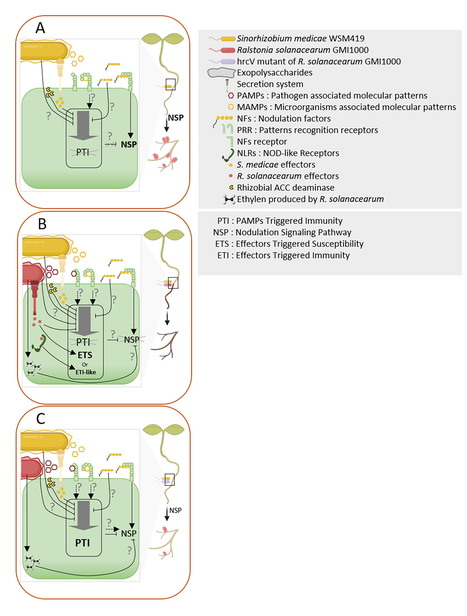
How plants deal with beneficial and pathogenic microorganisms and how they can tolerate beneficial ones and face pathogens at the same time are questions that remain puzzling to plant biologists. Legume plants are good models to explore those issues, as their interactions with nitrogen-fixing bacteria called rhizobia results in a drastic and easy-to-follow phenotype of nodulation. Intriguingly, despite massive and chronic infection, legume defense reactions are essentially suppressed during the whole symbiotic process, raising a question about a potential negative effect of plant immune responses on the establishment of nodulation. In the present study, we used the model legume, Medicago truncatula, coinoculated with mutualistic and phytopathogenic bacteria, Sinorhizobium medicae and Ralstonia solanacearum, respectively. We show that the presence of R. solanacearum drastically inhibits the nodulation process. The type III secretion system of R. solanacearum, which is important for the inhibition of pathogen-associated molecular pattern–triggered immunity (PTI), strongly contributes to inhibit nodulation. Thus, our results question the negative effect of PTI on nodulation. By including a pathogenic bacterium in the interaction system, our study provides a new angle to address the influence of the biotic environment on the nodulation process.
The energetic requirements for biological nitrogen fixation necessitate stringent regulation of this process in response to diverse environmental constraints. To ensure that the nitrogen fixation machinery is expressed only under appropriate physiological conditions, the dedicated NifL-NifA regulatory system, prevalent in Proteobacteria, plays a crucial role in integrating signals of the oxygen, carbon and nitrogen status to control transcription of nitrogen fixation (nif) genes. Greater understanding of the intricate molecular mechanisms driving transcriptional control of nif genes may provide a blueprint for engineering diazotrophs that associate with cereals. In this study, we investigated the properties of a single amino acid substitution in NifA, (NifA-E356K) which disrupts the hierarchy of nif regulation in response to carbon and nitrogen status in Azotobacter vinelandii. The NifA-E356K substitution enabled overexpression of nitrogenase in the presence of excess fixed nitrogen and release of ammonia outside the cell. However, both of these properties were conditional upon the nature of the carbon source. Our studies reveal that the uncoupling of nitrogen fixation from its assimilation is likely to result from feedback regulation of glutamine synthetase, allowing surplus fixed nitrogen to be excreted. Reciprocal substitutions in NifA from other Proteobacteria yielded similar properties to the A. vinelandii counterpart, suggesting that this variant protein may facilitate engineering of carbon source-dependent ammonia excretion amongst diverse members of this family.
Endophytic bacteria have been explored for their role in plant growth promotion, however, not much has been explored in cucumber. The metabolomic response of plants to application of such microbes also remains largely unknown. Thus, we investigated the application of endophytic bacteria to cucumber to infer their role in plant growth promotion and document metabolome response. The lowest healthy leaf-stalks were sampled from four differently sourced cucumber plants, and endophytic bacteria were isolated after surface disinfection. Initial plant growth-promoting (PGP) screening was performed to identify PGP strains out of numerous isolates, and five strains (Strains 4=Curtobacterium spp., 72=Brevibacillus spp., 167=Paenibacillus spp., 193=Bacillus spp., and 227=Microbacterium spp.) were selected based on their contribution to root growth compared with the control. The selected strains were further evaluated in pot experiments, axenic PGP trait assays, and metabolomic analysis. Results revealed that the selected isolates possessed different qualitative characteristics among indole acetic acid, siderophore production, phosphate solubilization, and 1-aminocyclopropane-1-carboxylate (ACC)-deaminase and nifH genes, and all isolates significantly enhanced plant growth in both pot experiments compared with the uninoculated control and fertilizer control. Metabolomic profiling revealed that both strains affected the plant metabolomes compared with the uninoculated control. Around 50 % of the metabolites explored had higher concentrations in either or both bacteria-applied plants compared with the uninoculated control. Differences were observed in both strains’ regulation of metabolites, although both enhanced root growth near equally. Overall, endophytic bacteria significantly enhanced plant growth and tended to produce or induce release of certain metabolites within the plant endosphere.
The critical role of cytokinin in early nodulation in legumes is well known. In our study, exogenous cytokinin application to roots of the important crop legume, chickpea (Cicer arietinum L.) led to the formation of pseudo nodules even in the absence of rhizobia. Hence a genome-wide analysis of the cytokinin signaling, Two-Component System (TCS) genes was conducted in chickpea, Medicago and Cajanus cajan. The integrated phylogenetic, evolutionary and expression analysis of the TCS genes was carried out which revealed that Histidine Kinases (HKs) were highly conserved, whereas, there was diversification leading to neofunctionalization at the level of Response Regulators (RRs) especially the TypeB RRs. Further, the functional role of the CaHKs in nodulation was established by complementation of the sln1Δ mutant of yeast and cre1 mutants of (Medicago) which led to restoration of the nodule deficient phenotype. Additionally, the highest expressing TypeB RR of chickpea, CaRR13 was functionally characterized. Its localization in the nucleus and its Y1H assay-based interaction with the promoter of the early nodulation gene CaNSP2 indicated its role as a transcription factor regulating early nodulation. Overexpression, RNAi lines and complementation of cre1 mutants with CaRR13 revealed its critical involvement as an important signaling molecule regulating early events of nodule organogenesis in chickpea.
Legume plants are able to establish nitrogen-fixing symbiotic relations with Rhizobium bacteria. This symbiosis is, however, affected by a number of abiotic constraints, particularly drought. One of the consequences of drought stress is the overproduction of reactive oxygen (ROS) and nitrogen species (RNS), leading to cellular damage and, ultimately, cell death. Ascorbic acid (AsA), also known as vitamin C, is one of the antioxidant compounds that plants synthesize to counteract this oxidative damage. One promising strategy for the improvement of plant growth and symbiotic performance under drought stress is the overproduction of AsA via the overexpression of enzymes in the Smirnoff-Wheeler biosynthesis pathway. In the current work, we generated Medicago truncatula plants with increased AsA biosynthesis by overexpressing MtVTC2, a gene coding for GDP-L-galactose phosphorylase. We characterized the growth and physiological responses of symbiotic plants both under well-watered conditions and during a progressive water deficit. Results show that increased AsA availability did not provide an advantage in terms of plant growth or symbiotic performance either under well-watered conditions or in response to drought.
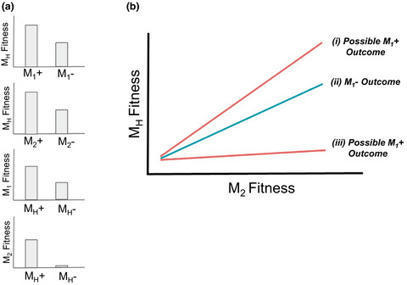
Nearly all organisms participate in multiple mutualisms, and complementarity within these complex interactions can result in synergistic fitness effects. However, it remains largely untested how multiple mutualisms impact eco-evolutionary dynamics in interacting species. We tested how multiple microbial mutualists—N-fixing bacteria and mycorrrhizal fungi—affected selection and heritability of traits in their shared host plant (Medicago truncatula), as well as fitness alignment between partners. Our results demonstrate for the first time that multiple mutualisms synergistically affect the selection and heritability of host traits and enhance fitness alignment between mutualists. Specifically, we found interaction with multiple microbial symbionts doubled the strength of natural selection on a plant architectural trait, resulted in 2- to 3-fold higher heritability of plant reproductive success, and more than doubled fitness alignment between N-fixing bacteria and plants. These findings show synergism generated by multiple mutualisms extends to key components of microevolutionary change, emphasising the importance of multiple mutualism effects on evolutionary trajectories.
The roots of most plants host diverse assemblages of arbuscular mycorrhizal fungi (AMF), which benefit the plant hosts in diverse ways. Even though we understand that such AMF assemblages are non-random, we do not fully appreciate whether and how environmental settings can make them more or less predictable in time and space. Here we present results from three controlled experiments, where we manipulated two environmental parameters, habitat connectance and habitat quality, to address the degree to which plant roots in archipelagos of high connectance and invariable habitats are colonized with (i) less diverse and (ii) easier to predict AMF assemblages. We observed no differences in diversity across our manipulations. We show, however, that mixing habitats and varying connectance render AMF assemblages less predictable, which we could only detect within and not between our experimental units. We also demonstrate that none of our manipulations favoured any specific AMF taxa. We present here evidence that the community structure of AMF is less responsive to spatio-temporal manipulations than root colonization rates which is a facet of the symbiosis which we currently poorly understand. View Full-Text
Transcriptomics studies have been facilitated by the development of microarray and RNA-Seq technologies, with thousands of expression datasets available for many species. However, the quality of data can be highly variable, making the combined analysis of different datasets difficult and unreliable. Most of the microarray data for Medicago truncatula, the barrel medic, have been stored and made publicly accessible on the web database Medicago truncatula Gene Expression atlas (MtGEA). The aim of this work is to ameliorate the quality of the MtGEA database through a general method based on logical and statistical relationships among parameters and conditions. The initial 716 columns available in the dataset were reduced to 607 by evaluating the quality of data through the sum of the expression levels over the entire transcriptome probes and Pearson correlation among hybridizations. The reduced dataset shows great improvements in the consistency of the data, with a reduction in both false positives and false negatives resulting from Pearson correlation and GO enrichment analysis among genes. The approach we used is of general validity and our intent is to extend the analysis to other plant microarray databases.
The use of microbial tools to sustainably increase agricultural production has received significant attention from researchers, industries and policymakers. Over the past decade, the market access and development of microbial products have been accelerated by (i) the recent advances in plant-associated microbiome science, (ii) the pressure from consumers and policymakers for increasing crop productivity and reducing the use of agrochemicals, (iii) the rising threats of biotic and abiotic stresses, (iv) the loss of efficacy of some agrochemicals and plant breeding programs and (v) the calls for agriculture to contribute towards mitigating climate change. Although the sector is still in its infancy, the path towards effective microbial products is taking shape and the global market of these products has increased faster than that of agrochemicals. Promising results from using microbes either as biofertilizers or biopesticides have been continually reported, fuelling optimism and high expectations for the sector. However, some limitations, often related to low efficacy and inconsistent performance in field conditions, urgently need to be addressed to promote a wider use of microbial tools. We propose that advances in in situ microbiome manipulation approaches, such as the use of products containing synthetic microbial communities and novel prebiotics, have great potential to overcome some of these current constraints. Much more progress is expected in the development of microbial inoculants as areas such as synthetic biology and nano-biotechnology advance. If key technical, translational and regulatory issues are addressed, microbial tools will not only play an important role in sustainably boosting agricultural production over the next few decades but also contribute towards other sustainable development goals, including job creation and mitigation of the impacts of climate change.
Mycorrhizal fungi are key components of whole-plant adaptive strategies to cope with different abiotic and biotic constraints. Although they are particularly sensitive to different global change drivers, there are still many gaps on the mechanisms underpinning shifts in mycorrhizal associations under different climatic and management scenarios.
We carried out a field manipulative experiment of rainfall exclusion and increased temperature aimed to evaluate the impact of forecasted warming and drying on mycorrhizal associations of savanna plant communities subjected to different grazing history. Additionally, we compiled detailed information on the abiotic and biotic environment with the final aim of disentangling the direct and indirect effects of climate change on this widespread mycorrhizal symbiosis.
Our results suggest that climate change could induce relevant changes in mycorrhizal associations, primarily promoted by warming, which decreased the abundance of mycorrhizae but induced higher activity of nutrient exchange between the host–plant and the mycosymbiont. Temperature did not only affect this symbiosis in a direct way, but also exerted relevant indirect effects via changes in soil functioning and other root-colonizing microorganisms such as dark septate endophytes. Grazing history influenced the allocation of fungal structures inside the host-root, but its effect differed as a function of the climatic treatment.
Results from this study suggest that mycorrhizal fungi might become less prevalent in plant communities inhabiting savanna ecosystems under future scenarios of increasing aridity. In agreement with this finding, higher temperatures also promoted the predominance of plants with root traits that favour efficient resource acquisition by themselves without the help of a mycorrhizal partner. Our results provide new insights into the interactive effects of the two main threats facing Mediterranean savanna ecosystems, as well as potentially useful information to be applied in ecologically-based management strategies aimed at attenuating the potential impact of global change on mycorrhizal fungi.
I'm wondering how microbe-specific is this cry for helpAn open question in environmental ecology regards the mechanisms triggered by root chemistry to drive the assembly and functionality of a beneficial microbiome to rapidly adapt to stress conditions. This phenomenon, originally described in plant defense against pathogens and predators, is encompassed in the ‘cry-for-help’ hypothesis. Evidence suggests that this mechanisms may be part of the adaptation strategy to ensure the holobiont fitness in polluted environments. Polychlorinated biphenyls (PCBs) were considered as model pollutants due to their toxicity, recalcitrance and poor phyto-extraction potential which lead to a plethora of phytotoxic effects and rise environmental safety concerns. Plants have inefficient detoxification processes to catabolize PCBs, even leading to by-products with a higher toxicity. We propose that the “cry-for-help” mechanism could drive the exudation-mediated recruitment and sustainment of the microbial services for PCBs removal, exerted by an array of anaerobic and aerobic microbial degrading populations working in a complex metabolic network. Through this synergistic interaction, the holobiont copes with the soil contamination, releasing the plant from the pollutant stress by the ecological services provided by the boosted metabolism of PCBs microbial degraders. Improving knowledge of root chemistry under PCBs stress is therefore advocated to design rhizoremediation strategies based on plant microbiome engineering.
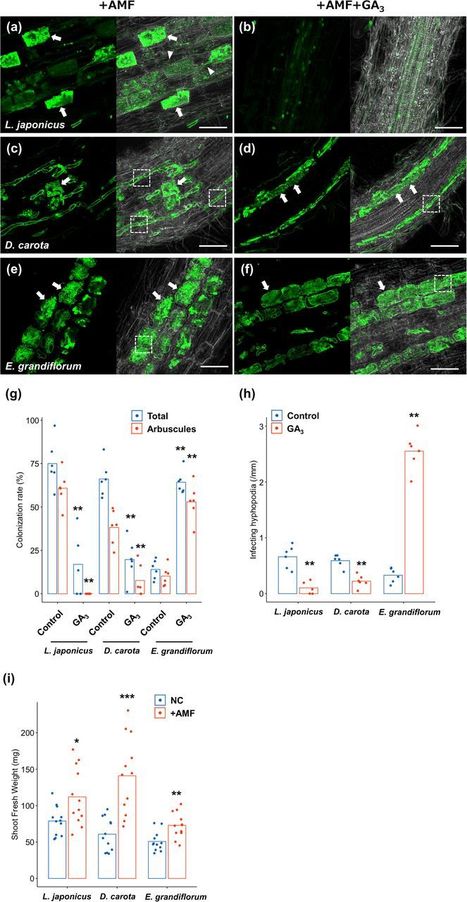
The morphotype of arbuscular mycorrhizal (AM) roots is distinct mostly depending on AM host species: Arum, Paris, and Intermediate types. We previously reported that gibberellin (GA) promotes the establishment of Paris-type AM symbiosis in Eustoma grandiflorum despite its negative effects on Arum-type AM symbiosis in model plants. However, the molecular mechanisms underlying the differential effects of GA on different morphotypes, including Intermediate-type AM symbiosis, remain elusive.
Comparative transcriptomics revealed that several symbiosis-related genes were transcriptionally promoted upon AM fungal colonization in Lotus japonicus (Arum-type), Daucus carota (Intermediate-type), and E. grandiflorum (Paris-type). Interestingly, upon GA treatment, the fungal colonization levels and expression of symbiosis-related genes were suppressed in L. japonicus and D. carota but were promoted in E. grandiflorum.
Exogenous GA transcriptionally inhibited the biosynthetic process of a host-derived signal molecule involved in AM symbiosis, strigolactone, in L. japonicus and E. grandiflorum. Additionally, disaccharides mainly metabolized in AM roots would be different between L. japonicus and D. carota/E. grandiflorum.
This study uncovered the conserved transcriptional responses during mycorrhization and diverse responses to GA in AM roots with distinct morphotypes among phylogenetically distant host plants.
The major forces driving farm-level production for the ever-growing global population have relied upon mechanized farming techniques, synthetic inputs, and developing high-yielding crop varieties. Recently, however, there has been a gradual shift toward developing sustainable approaches addressing the potential use of beneficial traits of the soil-plant microbiome to establish a sustainable food supply as well as to maintain soil and plant health. The intricate relationship of the soil-plant microbiome complex often faces difficulty in the efficient translation for the broad spectrum of audiences across society. In recent years, there has been a growing need to formulate strategies and streamline the global sharing of the generated information on plant microbiome interactions. In this review, we discuss novel and emerging strategies to use indigenous microbial consortia and engineered exogenous microbial inoculants for rhizosphere engineering. In addition, this review also details the use of these microbial consortia to improve crop yields and environmental protection that are currently in practice.
Most land plants live in close contact with beneficial soil microbes: the majority of land plant species establish symbiosis with arbuscular mycorrhizal fungi, while most legumes, the third largest plant family, can form a symbiosis with nitrogen-fixing rhizobia. These microbes contribute to plant nutrition via endosymbiotic processes that require modulating the expression and function of plant transporter systems. The efficient contribution of these symbionts involves precisely controlled integration of transport, which is enabled by the adaptability and plasticity of their transporters. Advances in our understanding of these systems, driven by functional genomics research, are rapidly filling the gap in knowledge about plant membrane transport involved in these plant-microbe interactions. In this review, we synthesize recent findings associated with different stages of these symbioses, from the pre-symbiotic stage to nutrient exchange, and describe the role of host transport systems in both mycorrhizal and legume-rhizobia symbioses.
The resilience of forests is compromised by human-induced environmental influences pushing them towards tipping points resulting in major shifts in ecosystem state that might be difficult to reverse, are difficult to predict and manage, and can have vast ecological, economic and social consequences. The literature on tipping points has grown rapidly, but almost exclusively based on aquatic and aboveground systems. So far little effort has been made to make links to soil systems, where change is not as drastically apparent, timescales may differ, and recovery may be slower. Predicting belowground ecosystem state transitions and recovery, and their impacts on aboveground systems, remains a major scientific, practical and policy challenge. Recently observed major changes in aboveground tree condition across European forests are likely causally-linked with ectomycorrhizal (EM) fungal changes belowground. Based on recent breakthroughs in data collection and analysis, we 1) apply tipping point theory to forests, including their belowground component, focusing on EM fungi, 2) link environmental thresholds for EM fungi with nutrient imbalances in forest trees, 3) explore the role of phenotypic plasticity in EM fungal adaptation to, and recovery from, environmental change, and 4) propose major positive feedback mechanisms to understand, address and predict forest ecosystem tipping points.
The effects of biochar on soil–plant–microorganisms systems are currently being extensively investigated. Considering that arbuscular mycorrhizal fungi (AMF) play an essential role in nutrient dynamics, the present study aims at understanding vine shoot-derived biochar effects on AMF activity and the impact of their multiplication in soils on water-stress resistance of plants. Three agronomic tests were performed in greenhouse pots. The first experiment evaluated the effects of three factors: final pyrolysis temperature for biochar production (400 °C and 600 °C), application rate (0 weight-wt.- % as a control, 1.5 wt. %, and 3.0 wt. %) and texture of the growing media (sandy-loam and clay-loam origin) on AMF, microbial communities and phosphatase activity. In the second experiment, an indigenous consortium of AMF was multiplied through the solid substrate method and sorghum as a trap plant with biochar addition. This process was compared to a control treatment without biochar. Obtained inocula were tested in a third experiment with lettuce plants under different water irrigation conditions. Results from the first experiment showed a general increase in AMF activity with the addition of the biochar produced at 400 °C in the sandy-loam texture substrate. Results of the second experiment showed that the biochar addition increased AMF root colonization, the number of AMF spores and AMF infective potential. Results of the third experiment showed that biochar-derived AMF inoculum increased AMF root colonization, AMF spores, dry biomass and the SPAD index in a lettuce crop under low-water irrigation conditions.
Aims The relationships between nitrogen (N) and phosphorus (P) acquisition strategies among herbaceous legume species remain poorly understood, particularly in relation to how they are altered by N availability. This study aimed to investigate the relationships between N2 fixation, plant N concentration and P acquisition through two main strategies in temperate herbaceous legumes, and to demonstrate the influences of soil N availability on these relationships.
Methods In a field pot experiment, eight temperate herbaceous legumes were grown with or without N addition. Plant growth, plant N and P concentrations, N2 fixation, arbuscular mycorrhizal (AM) fungal colonization and root phosphatase activity (RPA) were measured, and the relationships between N2 fixation, plant N concentration and each P acquisition strategy were assessed under contrasting N availability.
Results N addition increased RPA. However, AM fungal colonization showed species-specific responses to N addition, and the ratio of AM fungal colonization to root phosphatase activity was decreased by N addition. Among eight legume species, AM fungal colonization increased with N2 fixation rate in the absence of N addition, but no relationship was observed with N addition. RPA increased with plant N concentration among legume species, regardless of N addition.
Conclusions As two key P acquisition strategies, neither RPA nor AM fungal colonization of temperate herbaceous legumes were species-specific traits, since both were positively correlated with N2 fixation rate and plant N concentration. In addition, the correlation between N2 fixation and AM fungal colonization was regulated by N availability. While N enrichment intensifies the legume reliance on RPA for acquiring more P, it weakens the association of N2 fixation in driving across species AM colonization.
Disclosed herein are methods of increasing nitrogen fixation in a non-leguminous plant. The methods can comprise exposing the plant to a plurality of bacteria. Each member of the plurality comprises one or more genetic variations introduced into one or more genes or non- coding polynucleotides of the bacteria's nitrogen fixation or assimilation genetic regulatory network, such that the bacteria are capable of fixing atmospheric nitrogen in the presence of exogenous nitrogen. The bacteria are not intergeneric microorganisms. Additionally, the bacteria, in planta, produce 1% or more of the fixed nitrogen in the plant.
To get content containing either thought or leadership enter:
To get content containing both thought and leadership enter:
To get content containing the expression thought leadership enter:
You can enter several keywords and you can refine them whenever you want. Our suggestion engine uses more signals but entering a few keywords here will rapidly give you great content to curate.


 Your new post is loading...