Your new post is loading...

|
Scooped by
Jean-Michel Ané
August 3, 2021 11:08 PM
|
Decades of ill-agricultural practices associated with emerging risks of climatic changes have been degrading the ecosystem with immense stress on the soil health, crop productivity. Arbuscular mycorrhiza (AM) form advantageous symbiosis between plant roots and specialized soil fungi that is rampant in natural habitats. Studies show that the elevated AMF indicated good soil health, high crop turnouts benefiting the Agriculture and other industries. AMF dependent on plants for sugars, while offering benefits like intact binding of soil particles, biomass increase, improvement of water-holding capacity, replacement of harmful chemicals, increased intake of phosphorous, zinc and other nutrients, drought and salinity tolerance, carbon sequestering in soil and protection from nematodes and other predatory insects. AMF are best candidates as bio-fertilizers and this review will explore their beneficial interconnections.
|
|
Scooped by
Jean-Michel Ané
August 3, 2021 10:59 PM
|
The metabolic impacts of endophytes on grape cells have been addressed in many studies. However, to date, no reports have investigated these phenomena in vine leaves, which also permit examination under well-controlled whereas more represent the situation of endophytes within grapevines. In the current work, we first established a method to test the symbiotic efficiency of fungal endophytes in vitro using aseptic grapevine (Vitis vinifera L.) leaves. Next, we compared the symbioses of varied fungal strains as well as physio-chemical changes triggered by these symbioses, in grapevine leaves from two different cultivars ‘Rose honey’ (RH) and ‘Cabernet sauvignon’ (CS). Our results demonstrated that all the tested fungal strains were able to achieve successful infection and symbiosis in leaves from both cultivars. The symbiotic efficiencies of the tested fungi in grapevine leaves varied considerably from one fungal strain to another, perhaps due to host-selectivity. Concerning the cultivars, most of the fungal strains that were tested appeared similarly detrimental and similar symbiotic rates between leaves of the two cultivars. Meanwhile, the symbioses of most fungal strains clearly promoted the detected physio-chemical traits compared to the control. Most of these fungal strains, such as RH7, RH12, RH32, and others, conferred greater physio-chemical effects in RH leaves than in CS leaves. Several fungal strains (RH34, RH49 and MDR36) exhibiting high symbiotic efficiency and lower host damage, while initiating greater physio-chemical responses in grape leaves of both cultivars, may potentially be developed for further applications. The results of this study demonstrate that, in addition to grape cells, grape leaves are also able to respond metabolically to endophytes, and also provide a more efficient approach to select candidate endophytes for grape quality management in viticulture.
|
|
Scooped by
Jean-Michel Ané
August 3, 2021 10:54 PM
|
• Growth promotion and P uptake differed by length of the soil bridge and AMF species.
• Hyphae of C. etunicatum spread at a rate of 4.1 mm d−1 across a 12 cm soil bridge.
• AMF species differed in their ability to facilitate nitrogen transport across a soil bridge.
|
|
Scooped by
Jean-Michel Ané
August 3, 2021 10:49 PM
|
Sand dunes of the Mediterranean region constitute drought-stressed, low-fertility ecosystems. Arbuscular mycorrhizal fungi (AMF) are regarded as key components of their biota, that contribute to plant host adaptation and fitness. However, AMF community assembly rules in the roots of the psammophilous plants of coastal sand dunes have not been investigated. We studied the root colonizing AMF communities of four characteristic native plants of eastern Mediterranean coastal foredunes, in nine locations in Greece. Host specificity (plant identity) was the major driver of AMF community assembly in the plant roots, while geographical distance between locations was not related to differences in the AMF communities. Additionally, colonizer AMF communities were characterized by overdominance of a single OTU which was remarkably host-specific among locations. Wider dissimilarity in AMF communities was observed in small and disturbed (SD) sites compared to large and undisturbed (LU) sites, a trait that may be attributed to relaxed environmental filtering and facilitated AMF dispersal/immigration in SD sites from surrounding habitats. Overall, our results indicate that the assembly of root-colonizing AMF communities in the eastern Mediterranean sand dunes is characterized by strong biotic filtering (host identity), suggesting that co-adaptation processes may be more pronounced than previously proposed, under extreme environmental conditions.
|
|
Scooped by
Jean-Michel Ané
August 3, 2021 4:37 PM
|
Long-distance signaling between the shoot and roots of land plants plays a crucial role in ensuring their growth and development in a fluctuating environment, such as with soil nutrient deficiencies. MicroRNAs (miRNAs) are considered to contribute to such environmental adaptation via long-distance signaling since several miRNAs are transported between the shoot and roots in response to various soil nutrient changes. Leguminous plants adopt a shoot-mediated long-distance signaling system to maintain their mutualism with symbiotic nitrogen-fixing rhizobia by optimizing the number of symbiotic organs and root nodules. Recently, the involvement and importance of shoot-derived miR2111 in regulating nodule numbers have become evident. Shoot-derived miR2111 can systemically enhance rhizobial infection, and its accumulation is quickly suppressed in response to rhizobial inoculation and high-concentration nitrate application. In this mini-review, we briefly summarize the recent progress on the systemic optimization of nodulation in response to external environments, with a focus on systemic regulation via miR2111.
|
|
Scooped by
Jean-Michel Ané
August 3, 2021 9:37 AM
|
Background and Aims
Forage production constitutes a great challenge for the Salado River Basin (Argentina), the major area devoted to livestock in the country. The successful naturalization of the European legume Lotus tenuis has been a productive and environmental relevance for the region. This study aims to evaluate its strategic contribution, reporting for the first time the B value for this species in these marginal environments for agriculture.
Methods
The 15N natural abundance method was used to evaluate the BNF of L. tenuis at soil plots and non-leguminous weed species in the same plots were utilized as reference plants. The assays included determinations of the 13C isotope, as well. Simultaneously, evaluations were carried out in the greenhouse for the determination of the B value of L. tenuis and the relative reproducibility of the field experiments.
Results
The results obtained demonstrated that the L. tenuis promotion is accompanied by an increase in forage quality, due to the predominance of this C3 legume species, over C4 species. Moreover, its contribution to N inputs to the system, through the BNF with native rhizobia demonstrated to be about 80%, a highly relevant percentage for these constrained agroecosystems.
Conclusions
This work supports the hypothesis that L. tenuis promotion plays a strategic role in the sustainability of the ecosystem, especially in soil constrained areas. Joined with data previously published, the results obtained contribute to support the criteria that define the naturalized legume playing a strategic role in the sustainability of agriculture marginal soils.
|
|
Scooped by
Jean-Michel Ané
August 1, 2021 12:45 PM
|
Coffee crop in Brazil is typically grown as a monoculture. However, we hypothesized that agroforestry system is favorable association for arbuscular mycorrhizal fungi (AMF), affecting its community structure and potentially impacting crop productivity and agroecosystem health. This study evaluated how the microclimate, soil depth, macauba field spacing and distance between coffee plants and palms affect the structure of the AMF community. The structure of the AMF community was influenced by the soil depth, microclimate features, soil moisture, maximum air temperature, and photosynthetically active radiation (PAR). The distance at which coffee-macauba influences ecological diversity indices of AMF, and higher diversity are related to the proximity between plants. AMF diversity (Richness and Shannon) in the agroforestry system exceeded that observed in the full-sun coffee in the 0-20 soil depth layer. Our results showed that the microclimate, soil depth, plant density, and distance between coffee from macauba affected the AMF community structure.
|
|
Scooped by
Jean-Michel Ané
August 1, 2021 12:41 PM
|
Drought stress is a major environmental concern that limits crop growth on a large scale around the world. Significant efforts are required to overcome this issue in order to improve crop production. Therefore, the exciting role of beneficial microorganisms under stress conditions needs to be deeply explored. In this study, the role of two biotic entities, i.e., Arbuscular mycorrhizal fungi (AMF, Glomus versiforme) and plant growth-promoting rhizobacteria (PGPR, Bacillus methylotrophicus) inoculation in drought tolerance of tobacco (Nicotiana tabacum L.), was investigated. The present results showed that drought stress considerably reduced tobacco plant’s growth and their physiological attributes. However, the plants co-inoculated with AMF and PGPR showed higher drought tolerance by bringing up significant improvement in the growth and biomass of tobacco plants. Moreover, the co-inoculation of AMF and PGPR considerably increased chlorophyll a, b, total chlorophylls, carotenoids, photosynthesis, and PSII efficiency by 96.99%, 76.90%, and 67.96% and 56.88%, 53.22%, and 33.43% under drought stress conditions, respectively. Furthermore, it was observed that drought stress enhanced lipid peroxidation and electrolyte leakage. However, the co-inoculation of AMF and PGPR reduced the electrolyte leakage and lipid peroxidation and significantly enhanced the accumulation of phenols and flavonoids by 57.85% and 71.74%. Similarly, the antioxidant enzymatic activity and the plant nutrition status were also considerably improved in co-inoculated plants under drought stress. Additionally, the AMF and PGPR inoculation also enhanced abscisic acid (ABA) and indole-3-acetic acid (IAA) concentrations by 67.71% and 54.41% in the shoots of tobacco plants. The current findings depicted that inoculation of AMF and PGPR (alone or in combination) enhanced the growth and mitigated the photosynthetic alteration with the consequent up-regulation of secondary metabolism, osmolyte accumulation, and antioxidant system.
|
|
Scooped by
Jean-Michel Ané
August 1, 2021 12:06 PM
|
Several species of soil free-living saprotrophs can sometimes establish biotrophic symbiosis with plants, but the basic biology of this association remains largely unknown. Here, we investigate the symbiotic interaction between a common soil saprotroph, Clitopilus hobsonii (Agaricomycetes), and the American sweetgum (Liquidambar styraciflua). The colonized root cortical cells were found to contain numerous microsclerotia-like structures. Fungal colonization led to increased plant growth and facilitated potassium uptake, particularly under potassium limitation (0.05 mM K+). The expression of plant genes related to potassium uptake was not altered by the symbiosis, but colonized roots contained the transcripts of three fungal genes with homology to K+ transporters (ACU and HAK) and channel (SKC). Heterologously expressed ChACU and ChSKC restored the growth of a yeast K+-uptake-defective mutant. Upregulation of ChACU transcript under low K+ conditions (0 and 0.05 mM K+) compared to control (5 mM K+) was demonstrated in planta and in vitro. Colonized plants displayed a larger accumulation of soluble sugars under 0.05 mM K+ than non-colonized plants. The present study suggests reciprocal benefits of this novel tree-fungus symbiosis under potassium limitation mainly through an exchange of additional carbon and potassium between both partners.
|
|
Scooped by
Jean-Michel Ané
August 1, 2021 11:49 AM
|
Rhizobia are ecologically important, facultative plant-symbiotic microbes. In nature, there is a large variability in the association of rhizobial strains and host plants of the same species. Here, we evaluated whether plant and rhizobial genotypes influence the initial transcriptional response of rhizobium following perception of a host plant. RNA sequencing of the model rhizobium Sinorhizobium meliloti exposed to root exudates or luteolin (an inducer of nod genes, involved in the early steps of symbiotic interaction) was performed on a combination of three S. meliloti strains and three alfalfa varieties as host plants. The response to root exudates involved hundreds of changes in the rhizobium transcriptome. Of the differentially expressed genes, 35% were influenced by the strain genotype, 16% were influenced by the plant genotype, and 29% were influenced by strain-by-host plant genotype interactions. We also examined the response of a hybrid S. meliloti strain in which the symbiotic megaplasmid (∼20% of the genome) was mobilized between two of the above-mentioned strains. Dozens of genes were upregulated in the hybrid strain, indicative of nonadditive variation in the transcriptome. In conclusion, this study demonstrated that transcriptional responses of rhizobia upon perception of legumes are influenced by the genotypes of both symbiotic partners and their interaction, suggesting a wide spectrum of genetic determinants involved in the phenotypic variation of plant-rhizobium symbiosis.
|
|
Scooped by
Jean-Michel Ané
July 30, 2021 9:47 AM
|
Biological nitrogen fixation in rhizobium-legume symbioses is of major importance for sustainable agricultural practices. To establish a mutualistic relationship with their plant host, rhizobia transition from free-living bacteria in soil to growth down infection threads inside plant roots and finally differentiate into nitrogen-fixing bacteroids. We reconstructed a genome-scale metabolic model for Rhizobium leguminosarum and integrated the model with transcriptome, proteome, metabolome and gene essentiality data to investigate nutrient uptake and metabolic fluxes characteristic of these different lifestyles. Synthesis of leucine, polyphosphate and AICAR is predicted to be important in the rhizosphere, while myo-inositol catabolism is active in undifferentiated nodule bacteria in agreement with experimental evidence. The model indicates that bacteroids utilize xylose and glycolate in addition to dicarboxylates, which could explain previously described gene expression patterns. Histidine is predicted to be actively synthesized in bacteroids, consistent with transcriptome and proteome data for several rhizobial species. These results provide the basis for targeted experimental investigation of metabolic processes specific to the different stages of the rhizobium-legume symbioses.
|
|
Scooped by
Jean-Michel Ané
July 29, 2021 10:16 PM
|
Nitrogen is an essential nutrient in plant growth. The main constituent of chlorophyll, it is the most central pigment required for photosynthesis process in the plants, in addition to amino acids, the fundamental building blocks of proteins. Even though it comprises 78% of atmospheric gases, molecular nitrogen (N2) is metabolically not useful directly to plants. To be so, N2 should be initially reduced to ammonium or nitrate through the chemical fixation of nitrogen. Alternatively, atmospheric N2 is reduced to ammonium by microbial nitrogenase enzyme through a process known as biological nitrogen fixation (BNF). In this chapter we focus on: (i) the importance of biological nitrogen fixation; (ii) symbiotic nitrogen fixation in cereals; (iii) the association of diazotrophs with non-leguminous plants; and (iv) engineering symbiotic nitrogen fixation in cereals.
|
|
Scooped by
Jean-Michel Ané
July 28, 2021 5:38 PM
|
Carbonic anhydrase (CA) plays a vital role in photosynthetic tissues of higher plants, whereas its non-photosynthetic role in the symbiotic root nodule was rarely characterized. In this study, 13 CA genes were identified in the model legume Lotus japonicus by comparison with Arabidopsis CA genes. Using qPCR and promoter-reporter fusion methods, three previously identified nodule-enhanced CA genes (LjαCA2, LjαCA6, and LjβCA1) have been further characterized, which exhibit different spatiotemporal expression patterns during nodule development. LjαCA2 was expressed in the central infection zone of the mature nodule, including both infected and uninfected cells. LjαCA6 was restricted to the vascular bundle of the root and nodule. As for LjβCA1, it was expressed in most cell types of nodule primordia but only in peripheral cortical cells and uninfected cells of the mature nodule. Using CRISPR/Cas9 technology, the knockout of LjβCA1 or both LjαCA2 and its homolog, LjαCA1, did not result in abnormal symbiotic phenotype compared with the wild-type plants, suggesting that LjβCA1 or LjαCA1/2 are not essential for the nitrogen fixation under normal symbiotic conditions. Nevertheless, the nodule-enhanced expression patterns and the diverse distributions in different types of cells imply their potential functions during root nodule symbiosis, such as CO2 fixation, N assimilation, and pH regulation, which await further investigations.
|
|
|
Scooped by
Jean-Michel Ané
August 3, 2021 11:08 PM
|
An increasing need for a more sustainable agriculturally-productive system is required in order to preserve soil fertility and reduce soil biodiversity loss. Microbial biostimulants are innovative technologies able to ensure agricultural yield with high nutritional values, overcoming the negative effects derived from environmental changes. The aim of this review was to provide an overview on the research related to plant growth promoting microorganisms (PGPMs) used alone, in consortium, or in combination with organic matrices such as plant biostimulants (PBs). Moreover, the effectiveness and the role of microbial biostimulants as a biological tool to improve fruit quality and limit soil degradation is discussed. Finally, the increased use of these products requires the achievement of an accurate selection of beneficial microorganisms and consortia, and the ability to prepare for future agriculture challenges. Hence, the implementation of the microorganism positive list provided by EU (2019/1009), is desirable
|
|
Scooped by
Jean-Michel Ané
August 3, 2021 10:59 PM
|
In nature, some plant species produce seedpods with spines, which is an adaptive biological trait for protecting the seed and helping seed dispersal. However, the molecular mechanism of spine formation is still unclear. While conducting routine tissue culture and transformation in the model legume Medicago truncatula, we identified a smooth seedpod (ssp1) mutant with a suite of other phenotypic changes. Preliminary analysis showed that the mutation was derived from the tissue culture process. Genetic segregation analysis suggested that ssp1 is a recessive mutant. By combining whole-genome sequencing and bioinformatics analysis, we found that the mutant phenotype was caused by a SNP and a 30bp deletion in the gene locus Medtr4g039430, named SSP1. Complementation of the M. truncatula ssp1 and Arabidopsis twd1 mutants showed complete restoration, indicating that SSP1 is an ortholog of Arabidopsis TWD1 which encodes an immunophilin-like FK506-binding protein 42. The formation of spines on seedpod is associated with auxin transport. The method used in this study offers an effective way for detecting genes responsible for somaclonal variations. The results demonstrate, for the first time, that SSP1 plays a crucial role in the determination of spine formation on seedpods.
|
|
Scooped by
Jean-Michel Ané
August 3, 2021 10:52 PM
|
Crop diversity affects the processes of soil physical structuring and most likely provokes changes in the frequencies of soil microbial communities. The study was conducted for soil prokaryotic diversity sequencing 16S rDNA genes from a 25-year no-tillage experiment comprised of two crop systems: crop succession (Triticum aestivum-Glycine max) and rotation (Vicia sativa-Zea mays-Avena sativa-Glycine max-Triticum aestivum-Glycine max). The hypothesis was that a crop system with higher crop diversification (rotation) would affect the frequencies of prokaryotic taxa against a less diverse crop system (succession) altering the major soil functions guided by bacterial diversity. Soils in both crop systems were dominated by Proteobacteria (31%), Acidobacteria (23%), Actinobacteria (10%), and Gemmatimonadetes (7.2%), among other common copiotrophic soil bacteria. Crop systems did not affect the richness and diversity indexes of soil bacteria and soil archaea. However, the crop rotation system reduced only the frequencies of anaerobic metabolism bacteria Chloroacidobacteria, Holophagae, Spirochaetes, Euryarchaeota, and Crenarchaeota. It can be concluded that crop succession, a system that is poorer in root diversity over time, may have conditioned the soil to lower oxygen diffusion and built up ecological niches that suitable for anaerobic bacteria tolerating lower levels of oxygen. On the other hand, it appeared that crop rotation has restructured the soil over the years while enabling copiotrophic aerobic bacteria to dominate the soil ecosystem. The changes prompted by crop succession have implications for efficient soil organic matter decomposition, reduced greenhouse gas emissions, higher root activity, and overall soil productivity, which compromise to agriculture sustainability.
|
|
Scooped by
Jean-Michel Ané
August 3, 2021 10:49 PM
|
Almost all land plants form symbiotic associations with arbuscular mycorrhizal fungi (AMF). Individual plants usually are colonized by a wide range of phylogenetically diverse AMF species. The impact that different AMF taxa have on plant growth is only partly understood. We screened 44 AMF isolates for their effect on growth promotion and nutrient uptake of leek plants (Allium porrum), including isolates that have not been tested previously. In particular, we aimed to test weather AMF lineages with an ancient evolutionary age differ from relatively recent lineages in their effects on leek plants. The AMF isolates that were tested covered 18 species from all five AMF orders, eight families, and 13 genera. The experiment was conducted in a greenhouse. A soil–sand mixture was used as substrate for the leek plants. Plant growth response to inoculation with AMF varied from − 19 to 232% and depended on isolate, species, and family identity. Species from the ancient families Archaeosporaceae and Paraglomeraceae tended to be less beneficial, in terms of stimulation plant growth and nutrient uptake, than species of Glomeraceae, Entrophosporaceae, and Diversisporaceae, which are considered phylogenetically more recent than those ancient families. Root colonization levels also depended on AMF family. This study indicates that plant benefit in the symbiosis between plants and AMF is linked to fungal identity and phylogeny and it shows that there are large differences in effectiveness of different AMF.
|
|
Scooped by
Jean-Michel Ané
August 3, 2021 9:38 AM
|
New research published in Science Advances from the University of Oxford’s Departments of Plant Sciences and Engineering, as well as collaborators at VU Amsterdam, uses both mathematical modelling and experimental validation to study the metabolic processes controlling how bacteria provide ammonia to legumes, which is vastly important for sustainable agriculture.
Ammonia-based fertiliser is commonly used in industrial agriculture, and since the early 20th C. this has been provided by industrially produced ammonia. Whilst this does increase crop yields, it has had a catastrophic impact on the environment. This is partly because of the energy it takes to both make the ammonia, and partly because half of the ammonia in these fertilisers goes into the soil and rivers, causing massive harm to our oceans, as well as leading to release of huge amounts of the potent greenhouse gas nitrous oxide.
|
|
Scooped by
Jean-Michel Ané
August 3, 2021 9:35 AM
|
Both chemical fertilizers and cover crops can help build the nitrogen content in soil. But cover crops come with many other benefits, like improving soil structure and boosting beneficial microbes.
Researchers at Cornell University are looking at ways to help breed better cover crops, also known as green manures, that could help farmers in their quest to grow crops in the most sustainable way. Their results were published in Crop Science, a publication of the Crop Science Society of America.
|
|
Scooped by
Jean-Michel Ané
August 1, 2021 12:42 PM
|
BACKGROUND: Garden pea (Pisum sativum L.) possesses the ability to form beneficial symbioses with various soil microorganisms. However, different pea cultivars, genotypes, and lines gain more or less benefit from these interactions, so the trait named “efficiency of interaction with soil microorganisms” (EIBSM) was suggested to describe this phenomenon. The molecular mechanisms underlying the manifestation of the EIBSM trait are not properly studied, and only few works focusing on plant responses to combined microbial preparations have been published to date.
METHODS: Eight pea lines previously described as contrasting in manifestation of the EIBSM trait were grown in pots with soil under combined inoculation with nodule bacteria and arbuscular mycorrhizal fungi, and the transcriptome profiles of the whole root systems of the plants were investigated using 3'MACE RNA sequencing.
RESULTS: The relatedness of the lines inferred from the analysis of transcripts’ SNVs (Single Nucleotide Variants) corresponded to the manifestation of the EIBSM trait: three high-EIBSM lines and three low-EIBSM lines formed two distinct clusters. Thus, the gene expression profiles were compared between these two clusters, which enabled identification of transcriptome signatures characteristic for each group. The lines previously described as high-EIBSM have lower symbiotic activity, and the expression levels of pathogen response genes were elevated compared to the lines with low EIBSM.
CONCLUSION: This result suggests that the mechanism of high interaction efficiency may be connected to stricter host control of symbionts, allowing such plants to expend less on the symbioses.
|
|
Scooped by
Jean-Michel Ané
August 1, 2021 12:22 PM
|
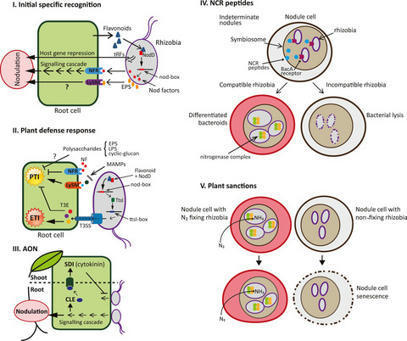
The specific interaction between rhizobia and legume roots leads to the development of a highly regulated process called nodulation, by which the atmospheric nitrogen is converted into an assimilable plant nutrient. This capacity is the basis for the use of bacterial inoculants for field crop cultivation. Legume plants have acquired tools that allow the entry of compatible bacteria. Likewise, plants can impose sanctions against the maintenance of nodules occupied by rhizobia with low nitrogen-fixing capacity. At the same time, bacteria must overcome different obstacles posed first by the environment and then by the legume. The present review describes the mechanisms involved in the regulation of the entire legume–rhizobium symbiotic process and the strategies and tools of bacteria for reaching the nitrogen-fixing state inside the nodule. Also, we revised different approaches to improve the nodulation process for a better crop yield.
|
|
Scooped by
Jean-Michel Ané
August 1, 2021 12:05 PM
|
There is a troubling new expansion of antiscience aggression in the United States. It’s arising from far-right extremism, including some elected members of the US Congress and conservative news outlets that target prominent biological scientists fighting the COVID-19 pandemic.
|
|
Scooped by
Jean-Michel Ané
July 30, 2021 11:50 AM
|
Hybrids account for nearly all commercially planted varieties of maize and many other crop plants because crosses between inbred lines of these species produce first-generation [F1] offspring that greatly outperform their parents. The mechanisms underlying this phenomenon, called heterosis or hybrid vigor, are not well understood despite over a century of intensive research. The leading hypotheses—which focus on quantitative genetic mechanisms (dominance, overdominance, and epistasis) and molecular mechanisms (gene dosage and transcriptional regulation)—have been able to explain some but not all of the observed patterns of heterosis. Abiotic stressors are known to impact the expression of heterosis; however, the potential role of microbes in heterosis has largely been ignored. Here, we show that heterosis of root biomass and other traits in maize is strongly dependent on the belowground microbial environment. We found that, in some cases, inbred lines perform as well by these criteria as their F1 offspring under sterile conditions but that heterosis can be restored by inoculation with a simple community of seven bacterial strains. We observed the same pattern for seedlings inoculated with autoclaved versus live soil slurries in a growth chamber and for plants grown in steamed or fumigated versus untreated soil in the field. In a different field site, however, soil steaming increased rather than decreased heterosis, indicating that the direction of the effect depends on community composition, environment, or both. Together, our results demonstrate an ecological phenomenon whereby soil microbes differentially impact the early growth of inbred and hybrid maize.
|
|
Scooped by
Jean-Michel Ané
July 30, 2021 9:45 AM
|
Drought can have a lasting impact on the community of microbes that live in and around roots of rice plants, a team led by UC Davis researchers has found. Root-associated microbes help plants take up nutrients from the soil, so the finding could help in understanding how rice responds to dry spells and how it can be made more resilient to drought. The work was published July 22 in Nature Plants.
|
|
Scooped by
Jean-Michel Ané
July 28, 2021 5:42 PM
|
•P. indica colonization improves growth, yield and drought tolerance in different crops.
•Under drought stress, P. indica regulates genes/proteins related to phytohormones signaling, photosynthesis, wax and suberin biosynthesis, cytoskeleton and autophagy.
•P. indica stimulates the antioxidant system of the host plant to detoxify ROS.
|


 Scoop.it!