Your new post is loading...

|
Scooped by
Jean-Michel Ané
September 26, 2021 9:36 PM
|
In an attempt to attain sustainability in agriculture, microbiome-based approaches have been investigated as “next-generation biologicals”. The top-down strategy of plant-mediated indirect selection of rhizospheric microbiome holds potential in generating a robust and efficient microbiome for enhancement of desired plant phenotype and its overall fitness. It involves multiple rounds of plant growth experiments under selection pressure such that the plant recruits a microbiome optimal for its fitness over the course of selection. In the review, we have critically discussed various aspects related to the approach, viz. methodological details, the current challenges faced by the technique, and the concerns related to the adoption of the plant-mediated indirect selection of microbiome at a larger scale. Besides, based on recent methodological developments and knowledge gained, we have proposed solutions for some of the issues, which will aid in popularizing the strategy.
|
|
Scooped by
Jean-Michel Ané
September 26, 2021 3:19 PM
|
•Rhizobium-inoculated faba bean/maize intercropping had advantages.
•The recovery of fertilizer N was increased by intercropping and rhizobium inoculation.
•Intercropping lowered accumulation of Nmin in the soil profile at maize harvest.
•Intercropping with rhizobium inoculation enhances productivity and reduces the risk of environment.
|
|
Scooped by
Jean-Michel Ané
September 26, 2021 1:45 PM
|
Ectomycorrhizal plants trade plant-assimilated carbon for soil nutrients with their fungal partners. The underlying mechanisms, however, are not fully understood. Here we investigate the exchange of carbon for nitrogen in the ectomycorrhizal symbiosis of Fagus sylvatica across different spatial scales from the root system to the cellular level.
We provided 15N-labelled nitrogen to mycorrhizal hyphae associated with one half of the root system of young beech trees, while exposing plants to a 13CO2 atmosphere. We analysed the short-term distribution of 13C and 15N in the root system with isotope-ratio mass spectrometry, and at the cellular scale within a mycorrhizal root tip with nanoscale secondary ion mass spectrometry (NanoSIMS).
At the root system scale, plants did not allocate more 13C to root parts that received more 15N. Nanoscale secondary ion mass spectrometry imaging, however, revealed a highly heterogenous, and spatially significantly correlated distribution of 13C and 15N at the cellular scale.
Our results indicate that, on a coarse scale, plants do not allocate a larger proportion of photoassimilated C to root parts associated with N-delivering ectomycorrhizal fungi. Within the ectomycorrhizal tissue, however, recently plant-assimilated C and fungus-delivered N were spatially strongly coupled. Here, NanoSIMS visualisation provides an initial insight into the regulation of ectomycorrhizal C and N exchange at the microscale.
|
|
Scooped by
Jean-Michel Ané
September 25, 2021 6:50 PM
|
•Application of different next generation postemergence herbicides and their impact on AM fungal association were studied by both unsupervised and supervised deep learning techniques in rice plants.
•Individual application of bispyribac sodium, ethoxysulfuron and fenoxaprop-p ethyl found safe for AMF application in rice.
•Individual application of penoxsulam and flucetosulfuron showed negative effect on AMF association and associated microbial properties in rice rhizosphere,.
•The negative effect of penoxsulam on AMF trade-offs was drastically reduced when combined with cyhalofop‑butyl.
|
|
Scooped by
Jean-Michel Ané
September 25, 2021 6:31 PM
|
The formation of legume-rhizobial symbiosis goes through a series of coordinated stages, the main of which is the distant interaction of symbionts, which is carried out through the exchange of molecular signals between macro- and microsymbionts. There is clear regulation in the interaction between symbiosis partners: rhizobia with their associated molecular patterns (MAMPs) and the plant, which forms two types of immune response (MTI/ETI) to infection, leading to the activation of symbiotic processes in host plants and suppression of their functional systems. The development of protective reactions of legume plants to the invasion of rhizobia is very similar to the processes of pathogenesis. However, the result of symbiotic interaction is not the inactivation of the microorganism but rather the regulation of its reproduction and metabolic activity, primarily regulated by macrosymbionts. Clear regulation of precontact intermolecular events between both partners of symbiosis leads to the activation of the main pathways of symbiotic signals’ transduction and the successful development of organogenesis programs of the nodule–epidermal and cortical. The important participation of the reactive oxygen species in the regulation of symbiotic processes that occur on the early stages of interaction of macro- and microsymbionts (preinfection, infection, formation of infectious threads), as well as the prospects for further studies of these signaling molecules in integration with other transduction pathways of legume-rhizobial symbiosis formation, were highlighted. The review summarizes the current scientific information on the main molecular genetic mechanisms that underlie the regulation of symbiotic interaction of legumes with nodule bacteria as well as the participation of reactive oxygen species in the formation of legume-rhizobial symbiosis.
|
|
Scooped by
Jean-Michel Ané
September 23, 2021 10:30 PM
|
In the last decades, many studies were addressed focusing on soil protection that helps sequestration and stabilization of organic carbon in soil aggregates. Soil aggregates are an association of primary soil particles, bacteria, fungi, plant root and soil organic matter. Plant root provides a carbon source for arbuscular mycorrhizal fungi (AMF) present in soil aggregates. AMF produces a glycoprotein glomalin which is hydrophobic, insoluble, and recalcitrant in nature. Glomalin plays a vital role in the stabilization of soil aggregates. Greater stability of soil aggregates leads to a larger amount of protected organic carbon in the soil. Thus, glomalin-related soil protein can be considered as a potential contributor in the stabilization of soil organic carbon. In the present chapter, the different aspects of glomalin composition, production, role in soil, recalcitrant nature, potential role in soil carbon locking up and stabilization are summarized and discussed.
|
|
Scooped by
Jean-Michel Ané
September 23, 2021 7:43 PM
|
Background and aims
Endophytic bacteria from legume roots and nodules play important roles in regulating plant growth and health. Therefore, the aim is to focus on the community structure and network of pea root endophytes throughout the plant life cycle.
Methods
We collected five edible pea cultivars to study the endophytic bacterial community during the whole developmental period using Illumina sequencing of 16S rRNA gene.
Results
The structure and complexity of root endophytes was significantly affected by the development period and different root endophytes were recruited by peas at different developmental stages. Pea cultivars gave no significant influence on the patterns of root endophytic bacterial community during plant growth. Here, the complexity of root-endophytic bacterial community was the highest at seedling stage and became more and more simple after that. Rhizobium was a dominant root bacteria during the whole developmental stage. The amount of Rhizobium began to accumulate in pea seedling roots, and reached the highest at flowering stage and decreased at the mature stage. The relative abundance of Pseudomonas increased overtime throughout the pea entire life cycle, whereas the amount of Bacteroides decreased overtime.
Conclusions
The pea root and nodule endophytes were dominated by Rhizobium, Pseudomonas and Bacteroides. These findings provide an endophyte-based characterization of the reference stock bacteria detail for the establishment of root endophytic bacteria throughout the plant life cycle. Specially, a proper synthetic microbial community to improve pea yields.
|
|
Scooped by
Jean-Michel Ané
September 23, 2021 7:34 PM
|
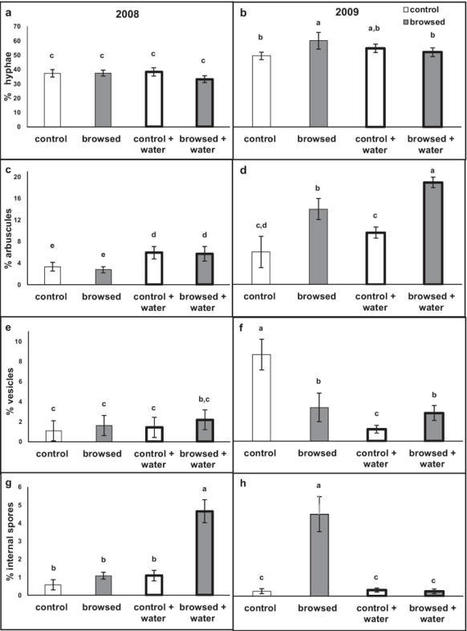
We tested the prediction that abundance and composition of arbuscular mycorrhizal fungi (AMF) in Ipomopsis aggregata roots and soils are influenced by ungulate herbivory and drought conditions by examining the effects in a field setting over two years. We used a multi-metric approach to quantify AMF root colonization, AMF reproduction, and AMF community composition in roots and soils. We incorporated complimentary community characterization assays by morphologically identifying spores from trap cultures and the use of terminal restriction fragment length polymorphism (T-RFLP) fingerprinting. Herbivory caused a twofold increase in spore production, an increase in AMF taxa diversity in roots, and a shift in AMF species composition in rhizosphere soils. The impact of herbivory was dependent on water availability, which differed in the two contrasting years. This study demonstrates that both soil water availability and herbivory shape arbuscular mycorrhizal fungi communities. The changes to mycorrhizal communities may help in understanding mycorrhizal function in changing climates.
|
|
Scooped by
Jean-Michel Ané
September 23, 2021 6:57 PM
|
Major crops such as rice and maize can benefit from associations with different plant growth-promoting bacteria (PGPB). Studies have shown that these PGPB (e.g., Azospirillum, Herbaspirillum, Burkholderia) promote plant growth primarily via nitrogen fixation and phytohormone secretion. However, our current understanding of the underlying molecular mechanisms involved in these associations is limited. During my master’s thesis research projects, I used multiple approaches to better understand the interactions between two different plant growth-promoting bacteria (B. unamae and A. brasilense) and rice. In the first project, my research focused on investigating the interactions between rice and B. unamae at a molecular level. Earlier, we set up an experimental system where PGPB such as A. brasilense could colonize rice roots and promote plant growth. In this study, we used the same experimental system and showed that B. unamae could promote growth and colonize the roots of rice plants. Next, using RNA sequencing, we identified the transcriptomic responses in rice roots, one day post-inoculation. We identified 1128 differentially expressed genes (DEGs) in rice roots and validated the expression pattern of few genes via RT-PCR. We identified genes involved in the flavonoid biosynthesis pathway, defense, hormone signaling, and photosynthesis to be differentially expressed. We also identified several genes encoding for transcription factors, protein kinases, and transporters in our dataset. Comparison of our dataset to existing RNA-seq datasets in rice roots during interactions with other plant-beneficial Burkholderia species (Burkholderia vietnamiensis, Paraburkholderia kururiensis, Paraburkholderia phytofirmans) indicated downregulation of defense genes during these interactions. We also identified 398 differentially expressed genes in rice roots during interactions with B. unamae and A. brasilense. Some of these genes are likely to play important roles during these interactions. Overall, our study has identified several promising targets for future genetic studies. In the second project, I identified the transcriptomic responses in rice shoots during interactions with A. brasilense. I showed that A. brasilense could promote growth in rice plants, including shoots, under our experimental conditions. Next, we identified gene expression changes in rice shoots during associations with A. brasilense via RNA sequencing. We identified 1245 differentially expressed genes (DEGs) in rice shoots and validated the expression of a few genes via RT-PCR. Several of the DEGs identified encode proteins involved in defense, hormone signaling, and photosynthesis. We also identified several genes encoding protein kinases, transcription factors, and transporters. Next, we compared these DEGs to those identified in rice shoots during interactions with Sinorhizobium meliloti and identified some genes that might play critical roles during these interactions. Overall, my findings provide a holistic understanding of gene expression changes in rice plants during interactions with two important PGPB, B. unamae and A. brasilense.
|
|
Scooped by
Jean-Michel Ané
September 23, 2021 6:55 PM
|
Soybean has the potential to bring significant benefits in diversified cropping systems, which could help restructuring soil fertility and allow smallholders to increase grain yield. Rhizobium inoculation improves the biological nitrogen fixation (BNF) in legume crops and assists resource-poor farmers to increase grain yield at lower financial costs. The efficacy of symbiotic bacteria on legumes can also be improved through supplementation of phosphorus fertilizer. In this work, a meta-analysis of 29 peer-reviewed studies was performed to understand the effects of various Rhizobium strains and phosphate fertilizer application on soybean nodules. Results showed that Rhizobium inoculation was highly effective in increasing the number of soybean nodules, nodule dry weight, and shoot dry weight. Application of phosphorus fertilizer increased the overall nodule number due to improved BNF processes by Rhizobia. The main effects of both Rhizobium inoculation and phosphate fertilizer resulted in moving grain yields to 1.67 t ha-1 and 1.95 t ha-1, respectively. Furthermore, the interaction of Rhizobium inoculants and phosphorus led to relatively higher grain yield (2.51 t ha-1). Therefore, African smallholders were advised to adopt Rhizobium inoculation in soybean fields concomitantly to phosphate fertilizer application, to improve soybean productivity at lower costs.
|
|
Scooped by
Jean-Michel Ané
September 23, 2021 3:52 PM
|
Mycorrhizal symbiosis represents a valuable tool for increasing plant nutrient uptake, affecting system biodiversity, ecosystem services and productivity. Introduction of agroecological service crops (ASCs) in cropping systems may determine changes in weed community, that can affect the development of the mycorrhizal mycelial network in the rhizosphere, favoring or depressing the cash crop mycorrhization. Two no-till Mediterranean organic horticultural systems were considered: one located in central Italy, where organic melon was transplanted on four winter-cereals mulches (rye, spelt, barley, wheat), one located in southern Italy (Sicily), where barley (as catch crop) was intercropped in an organic young orange orchard, with the no tilled, unweeded systems taken as controls. Weed “Supporting Arbuscular Mycorrhiza” (SAM) trait, weed density and biodiversity indexes, mycorrhization of coexistent plants in the field, the external mycelial network on roots were analyzed by scanning electron microscopy, crop P uptake, yield and quality were evaluated. We verified that cereals, used as green mulches or intercropped, may drive the weed selection in favor of the SAM species, and promote the mycelial network, thus significantly increasing the mycorrhization, the P uptake, the yield and quality traits of the cash crop. This is a relevant economic factor when introducing sustainable cropping practices and assessing the overall functionality of the agroecosystem. View Full-Text
|
|
Scooped by
Jean-Michel Ané
September 22, 2021 5:35 PM
|
Background
Bacterial abortive infection (Abi) systems are type IV toxin–antitoxin (TA) system, which could elicit programmed cell death and constitute a native survival strategy of pathogenic bacteria under various stress conditions. However, no rhizobial AbiE family TA system has been reported so far. Here, a M. huakuii AbiE TA system was identified and characterized.
Results
A mutation in M. huakuii abiEi gene, encoding an adjacent GntR-type transcriptional regulator, was generated by homologous recombination. The abiEi mutant strain grew less well in rich TY medium, and displayed increased antioxidative capacity and enhanced gentamicin resistance, indicating the abiEi operon was negatively regulated by the antitoxin AbiEi in response to the oxidative stress and a particular antibiotic. The mRNA expression of abiEi gene was significantly up-regulated during Astragalus sinicus nodule development. The abiEi mutant was severely impaired in its competitive ability in rhizosphere colonization, and was defective in nodulation with 97% reduction in nitrogen-fixing capacity. The mutant infected nodule cells contained vacuolation and a small number of abnormal bacteroids with senescence character. RNA-seq experiment revealed it had 5 up-regulated and 111 down-regulated genes relative to wild type. Of these down-regulated genes, 21 are related to symbiosis nitrogen fixation and nitrogen mechanism, 16 are involved in the electron transport chain and antioxidant responses, and 12 belong to type VI secretion system (T6SS).
Conclusions
M. huakuii AbiEi behaves as a key transcriptional regulator mediating root nodule symbiosis.
|
|
Scooped by
Jean-Michel Ané
September 22, 2021 3:57 PM
|
Henan Province is a major area of peanut production in China but the rhizobia nodulating the crop in this region have not been described. A collection of 217 strains of peanut rhizobia was obtained from six field sites across four soil types in Henan Province, North China, by using peanut as a trap host under glasshouse conditions. The 217 strains separated into 8 distinct types on PCR–RFLP analysis of their IGS sequences. Phylogenetic analysis of the 16S rRNA, recA, atpD, and glnII genes of 11 representative strains of the 8 IGS types identified Bradyrhizobium guangdongense, B. ottawaense and three novel Bradyrhizobium genospecies. Bradyrhizobium guangdongense was dominant, accounting for 75.0% of the total isolates across the field sites while B. ottawaense covered 5.1% and the three novel Bradyrhizobium genospecies 4.1 to 8.8% of the total. The symbiosis-related nodA and nifH gene sequences were not congruent with the core genes on phylogenetic analysis and separated into three groups, two of which were similar to sequences of Bradyrhizobium spp. isolated from peanut in south-east China and the third identical to that of B. yuanmingense isolated from Lespedeza cuneata in northern China. A canonical correlation analysis between the distribution of IGS genotypes and soil physicochemical characteristics and climatic factors indicated that the occurrence of IGS types/species was mainly associated with soil pH and available phosphorus.
|
|
|
Scooped by
Jean-Michel Ané
September 26, 2021 9:35 PM
|
•The plant microbiota is associated with all plant organs, influencing many functions.
•The composition of the plant microbiota depends on abiotic and biotic factors.
•Local and global censuses reveal the dominance of few key taxa.
•Bacterial and fungal communities modulate plant immunity, nutrition and development.
•Engineering the plant microbiota may help in sustainable agriculture.
|
|
Scooped by
Jean-Michel Ané
September 26, 2021 3:12 PM
|
Host-specific legume-rhizobium symbiosis is strictly controlled by rhizobial type III effectors (T3Es) in some cases. Here, we demonstrated that the symbiosis of Vigna radiata (mung bean) with Bradyrhizobium diazoefficiens USDA110 is determined by NopE, and this symbiosis is highly dependent on host genotype. NopE specifically triggered incompatibility with V. radiata cv. KPS2, but it promoted nodulation in other varieties of V. radiata, including KPS1. Interestingly, NopE1 and its paralogue NopE2, which exhibits calcium-dependent autocleavage, yield similar results in modulating KPS1 nodulation. Furthermore, NopE is required for early infection and nodule organogenesis in compatible plants. Evolutionary analysis revealed that NopE is highly conserved among bradyrhizobia and plant-associated endophytic and pathogenic bacteria. Our findings suggest that V. radiata and B. diazoefficiens USDA110 may use NopE to optimize their symbiotic interactions by reducing phytohormone-mediated ETI-type (PmETI) responses via salicylic acid (SA) biosynthesis suppression.
|
|
Scooped by
Jean-Michel Ané
September 26, 2021 1:38 PM
|
Using tandem mass spectrometry (MS/MS), we analyzed the proteome of Sinorhizobium medicae WSM419 growing as free-living cells and in symbiosis with Medicago truncatula. 3215 proteins were identified, over half of the ORFs predicted from the genomic sequence. The abundance of 1361 proteins displayed strong lifestyle bias. 1131 proteins had similar levels in bacteroids and free-living cells, and the low levels of 723 proteins prevented statistically significant assignments. Nitrogenase subunits comprised ~12% of quantified bacteroid proteins. Other major bacteroid proteins included symbiosis-specific cytochromes and FixABCX, which transfer electrons to nitrogenase. Bacteroids had normal levels of proteins involved in amino acid biosynthesis, glycolysis/gluconeogenesis and the pentose phosphate pathway, but several amino acid degradation pathways were repressed. This suggests bacteroids maintain a relatively independent anabolic metabolism. TCA cycle proteins were highly expressed in bacteroids and no other catabolic pathway emerged as an obvious candidate to supply energy and reductant to nitrogen fixation. Bacterial stress response proteins were induced in bacteroids. Many WSM419 proteins that are not encoded in Sinorhizobium meliloti Rm1021 were detected and understanding the functions of these proteins might clarify why S. medicae WSM419 forms a more effective symbiosis with M. truncatula than S. meliloti Rm1021.
|
|
Scooped by
Jean-Michel Ané
September 25, 2021 6:44 PM
|
Arbuscular mycorrhizal (AM) fungi lack efficient exoenzymes to access organic nutrients directly. Nevertheless, the fungi often obtain and further channel to their host plants a significant share of nitrogen (N) and/or phosphorus from such resources, presumably via cooperation with other soil microorganisms. Because it is challenging to disentangle individual microbial players and processes in complex soil, we took a synthetic approach here to study 15N-labelled chitin (an organic N source) recycling via microbial loop in AM fungal hyphosphere. To this end, we employed a compartmented in vitro cultivation system and monoxenic culture of Rhizophagus irregularis associated with Cichorium intybus roots, various soil bacteria, and the protist Polysphondylium pallidum. We showed that upon presence of Paenibacillus sp. in its hyphosphere, the AM fungus (and associated plant roots) obtained several-fold larger quantities of N from the chitin than it did with any other bacteria, whether chitinolytic or not. Moreover, we demonstrated that adding P. pallidum to the hyphosphere with Paenibacillus sp. further increased by at least 65% the gain of N from the chitin by the AM fungus compared to the hyphosphere without protists. We thus directly demonstrate microbial interplay possibly involved in efficient organic N utilisation by AM fungal hyphae.
|
|
Scooped by
Jean-Michel Ané
September 23, 2021 10:47 PM
|
Arbuscular mycorrhizal fungi (AMF) are obligate plant symbionts that have the potential to improve crop yield. These multinucleate organisms are either “homokaryotic” or “dikaryotic”. In AMF dikaryons, thousands of nuclei originating from two parental strains coexist in the same cytoplasm. In other fungi, homokaryotic and dikaryotic strains show distinct life history traits (LHTs), such as variation in growth rates and fitness. However, how such traits compare between dikaryons and homokaryons of AMF is unknown. To address this, we measured 20 LHT of four dikaryons and five homokaryons of the model fungus Rhizophagus irregularis across root organ cultures of three host plants (carrot, chicory, and tobacco). Our analyses show that dikaryons have clearly distinct life history strategies (LHSs) compared to homokaryons. In particular, spores of homokaryons germinate faster and to a higher proportion than dikaryons, whereas dikaryons grow significantly faster and create a more complex hyphal network irrespective of host plant species. Our study links AMF nuclear status with key LHT with possible implications for mycorrhizal symbiotic functioning.
|
|
Scooped by
Jean-Michel Ané
September 23, 2021 10:24 PM
|
Soybean crop production in Serbia involves seed inoculation by N-fixing bacteria just before sowing time. The main objective of the current work was to assess the impact of the genotype and inoculation on range of morphological and yield traits of soybean (Glycine max L. Merrill), as well as the total protein content. The experiment was conducted on chernozem soil, where soybean was previously grown. The six local varieties were used, where each variety was sown, in three replicates for both inoculated and non-inoculated treatment. The following morphological traits were analysed: the plant height, number of lateral branches, distance to the first pod, number of pods per plant, pods (containing seeds) weight per plant, seed weight per plant, and the total grain yield. The total protein content in seeds was determined by standard analytical method, while subtle differences in qualitative protein composition were assessed using Raman spectroscopy. The total protein content varied from 39.6 to 42.15 %. Performance of inoculation resulted in an increase of the plant height and the distance to the first pod, although not in all tested varieties. The highest and the lowest plant height values were observed for non-inoculated variety Dana (59.23cm) and Sava (80.03cm), respectively. The effect of genotype was much more expressed causing differences in almost all tested characters, except for the total protein content. However, Raman spectroscopy analyses revealed distinct discrimination among surveyed varieties, and differences between inoculated and non-inoculated plants in qualitative composition of seed proteins.
|
|
Scooped by
Jean-Michel Ané
September 23, 2021 7:41 PM
|
Ectomycorrhizal fungi contribute to the nutrition of many woody plants, including those in the Pinaceae family. Loblolly pine (Pinus taeda L.), a native species of the Southeastern USA, can be colonized by multiple species of ectomycorrhizal fungi. The role of these symbionts in P. taeda potassium (K+) nutrition has not been previously investigated. Here, we assessed the contribution of four ectomycorrhizal fungi, Hebeloma cylindrosporum, Paxillus ammoniavirescens, Laccaria bicolor, and Suillus cothurnatus, in P. taeda K+ acquisition under different external K+ availabilities. Using a custom-made two-compartment system, P. taeda seedlings were inoculated with one of the four fungi, or kept non-colonized, and grown under K+-limited or -sufficient conditions for 8 weeks. Only the fungi had access to separate compartments in which rubidium, an analog tracer for K+, was supplied before harvest. Resulting effects of the fungi were recorded, including root colonization, biomass, and nutrient concentrations. We also analyzed the fungal performance in axenic conditions under varying supply of K+ and sodium. Our study revealed that these four ectomycorrhizal fungi are differentially affected by external K+ and sodium variations, that they are not able to provide similar benefits to the host P. taeda in our growing conditions, and that rubidium may be used with some limitations to estimate K+ transport from ectomycorrhizal fungi to colonized plants.
|
|
Scooped by
Jean-Michel Ané
September 23, 2021 7:16 PM
|
The legume Cytisus scoparius has a mutualism with the bacteria Bradyrhizobium. Symbiosis-related genes cluster on the chromosome of Bradyrhizobium on a Symbiosis Island (SI) that can be transferred via horizontal gene transfer (HGT). We compared SI and housekeeping (HK) genes of Bradyrhizobium strains from European legumes, NA legumes, invasive NA Cytisus, and Cytisus exposed to soil from NA where Cytisus had never grown. All NA Cytisus strains sampled had an SI of European origin but HK genes like those of NA legume strains. Strains from Cytisus exposed to NA soil had genes like NA legume strains. Cytisus grew better when inoculated with NA Cytisus strains than with strains from Cytisus exposed to NA soil. This suggests Bradyrhizobium adapted to invading Cytisus populations across NA by convergently acquiring a SI variant via HGT that confers higher benefit to Cytisus plants than SIs of NA legume symbionts.
|
|
Scooped by
Jean-Michel Ané
September 23, 2021 6:55 PM
|
Protein kinases regulate virtually all cellular processes, but it remains challenging to determine the functions of all protein kinases, collectively called the kinome, in any species. We developed an approach called EXPLICIT-Kinase to predict the functions of the Arabidopsis kinome. Because the activities of many kinases can be regulated transcriptionally, their gene expression patterns provide clues to their functions. A universal gene expression predictor for Arabidopsis was constructed to predict the expression of 30,172 non-kinase genes based on the expression of 994 protein kinase genes. The model reconstituted highly accurate transcriptomes for diverse Arabidopsis samples. It identified the significant kinases as predictor kinases for predicting the expression of Arabidopsis genes and pathways. Strikingly, these predictor kinases were often known regulators of the related pathways, as exemplified by those involved in cytokinesis, tissue development, and stress responses. Comparative analyses have revealed that portions of these predictor kinases, including the novel ones, are shared and conserved between Arabidopsis and maize. The conservation between species provide additional evidence to support the novel predictor kinases as bona fide regulators of the pathways involved. Thus our approach enables the systematic dissection of the functions of the Arabidopsis kinome.
|
|
Scooped by
Jean-Michel Ané
September 23, 2021 6:53 PM
|
Leaves are primarily responsible for the plant’s photosynthetic activity. Thus, changes in the phyllosphere microbiota, which includes deleterious and beneficial microbes, can have far reaching effects on plant fitness and productivity. In this context, identifying the processes and microorganisms that drive the changes in the leaf microbiota over a plant’s lifetime is crucial. In this study we analyzed the temporal dynamics in the leaf microbiota of Arabidopsis thaliana, integrating both compositional changes and changes in microbe-microbe interactions via the study of microbial networks. Field-grown Arabidopsis were used to follow leaf bacterial, fungal and oomycete communities, throughout the plant’s growing season (extending from November to March), over three consecutive years. Our results revealed the existence of conserved time patterns, with microbial communities and networks going through a stabilization phase (decreasing diversity and variability) at the beginning of the plant’s growing season. Despite a high turnover in these communities, we identified 19 ‘core’ taxa persisting in Arabidopsis leaves across time and plant generations. With the hypothesis these microbes could be playing key roles in the structuring of leaf microbial communities, we conducted a time-informed microbial network analysis which showed core taxa are not necessarily highly connected network ‘hubs’ and ‘hubs’ alternate with time. Our study shows that leaf microbial communities exhibit reproducible dynamics and patterns, suggesting it could be possible to predict and drive these microbial communities to desired states.
|
|
Scooped by
Jean-Michel Ané
September 23, 2021 12:33 PM
|
To acquire sufficient mineral nutrients such as phosphate (Pi) from the soil, most plants engage in symbiosis with arbuscular mycorrhizal (AM) fungi. Attracted by plant-secreted strigolactones (SLs), the fungi colonize the roots and form highly branched hyphal structures called arbuscules inside inner cortex cells. The host plant must control the different steps of this interaction to maintain its symbiotic nature. However, how plants sense the amount of Pi obtained from the fungus, and how this determines the arbuscule lifespan, are far from understood. Here, we show that Medicago truncatula SPX-domain containing proteins SPX1 and SPX3 regulate root Pi starvation responses, in part by interacting with PHOSPHATE RESPONSE REGULATOR2, as well as fungal colonization and arbuscule degradation. SPX1 and SPX3 are induced upon Pi starvation but become more restricted to arbuscule-containing cells upon the establishment of symbiosis. This induction in arbuscule-containing cells is associated with the presence of cis-regulatory AW-boxes and transcriptional regulation by the WRINKLED1-like transcription factor WRI5a. Under Pi-limiting conditions, SPX1 and SPX3 facilitate the expression of the SL biosynthesis gene DWARF27, which could help explain the increased fungal branching in response to root exudates. Later, in arbuscule-containing cells, SPX1 and SPX3 redundantly control arbuscule degradation. Thus, SPX proteins play important roles as phosphate sensors to maintain a beneficial AM symbiosis.
|
|
Scooped by
Jean-Michel Ané
September 22, 2021 4:01 PM
|
The sex-specific physical and biochemical responses in dioecious plants to abiotic stresses could result in gender imbalance, and how to ease the current situation by microorganisms is still unclear. Using native soil where poplars were grown, growth parameters, soil physicochemical properties in the rhizosphere soil of different sexes of Populus cathayana exposed to salt stress and exogenous arbuscular mycorrhizal (AM) inoculation were tested. Besides, the sex-specific microbial community structures in the rhizosphere soil of different sexes of Populus cathayana were compared under salt stress. To identify the sex-specific microbial community characteristics related to salinity and AM symbiosis, a combined qPCR and DGGE method was used to monitor microbial community diversity. Seedlings suffered severe pressure by salt stress, reflected in limited growth, biomass, and nutrient element accumulation, especially on females. Exogenous AM inoculation treatment alleviated these negative effects, especially under salt treatment of 75 mM. Compared with salt effect, exogenous AM inoculation treatment showed a greater effect on soil physical–chemical properties of both sexes. Based on DGGE results, salt stress negatively affected fungal richness but positively affected fungal Simpson diversity index, while exogenous AM inoculation treatment showed the opposite effect. Structural equation modeling (SEM) was performed to show the causal relationships between salt and exogenous AM inoculation treatments with biomass accumulation and microbial community: salt and exogenous AM inoculation treatment showed complicated effects on elementary concentrations, soil properties, which resulted in different relationship with biomass accumulation and microbial community. Salt stress had a negative effect on soil properties and microbial community structure in the rhizosphere soil of P. cathayana, whereas exogenous AM inoculation showed positive impacts on most of the soil physical–chemical properties and microbial community status.
|


 Scoop.it!