Your new post is loading...

|
Scooped by
Jean-Michel Ané
October 14, 2021 5:00 PM
|
The alphaproteobacterium Sinorhizobium meliloti secretes two acidic exopolysaccharides (EPS), succinoglycan (EPSI) and galactoglucan (EPSII), which differentially enable it to adapt to a changing environment. Succinoglycan is essential for invasion of plant hosts, and thus for formation of nitrogen-fixing root nodules. Galactoglucan is critical for population-based behaviors such as swarming and biofilm formation, and can facilitate invasion in the absence of succinoglycan on some host plants. Biosynthesis of galactoglucan is not as completely understood as that of succinoglycan. We devised a pipeline to: identify putative pyruvyltransferase and acetyltransferase genes; construct genomic deletions in strains engineered to produce either succinoglycan or galactoglucan; and analyze EPS from mutant bacterial strains. EPS samples were examined by 13C cross-polarization magic-angle spinning (CPMAS) solid-state nuclear magnetic resonance (NMR). CPMAS NMR is uniquely suited to defining chemical composition in complex samples and enable detection and quantification of distinct EPS functional groups. Galactoglucan was isolated from mutant strains, with deletions in five candidate acyl/acetyltransferase genes (exoZ, exoH, SMb20810, SMb21188, SMa1016) and a putative pyruvyltransferase (wgaE or SMb21322). Most samples were similar in composition to wild-type EPSII by CPMAS NMR analysis. However, galactoglucan produced from a strain lacking wgaE exhibited a significant reduction in pyruvylation. Pyruvylation was restored through ectopic expression of plasmid-encoded wgaE. Our work has thus identified WgaE as a galactoglucan pyruvyltransferase. This exemplifies how the systematic combination of genetic analyses and solid-state NMR detection is a rapid means to identify genes responsible for modification of rhizobial exopolysaccharides.
|
|
Scooped by
Jean-Michel Ané
October 14, 2021 4:54 PM
|
Exploring the symbiosis between plants and plant growth-promoting bacteria (PGPB) is a new challenge for sustainable agriculture. Even though many works have reported the beneficial effects of PGPB in increasing plant resilience for several stresses, its potential is not yet widely explored. One of the many reasons is the differential symbiosis performance depending on the host genotype. This opens doors to plant breeding programs to explore the genetic variability and develop new cultivars with higher responses to PGPB interaction and, therefore, have higher resilience to stress. Hence, we aimed to study the genetic architecture of the symbiosis between PGPB and tropical maize germplasm, using a public association panel and its impact on plant resilience. Our findings reveal that the synthetic PGPB population can modulate and impact root architecture traits and improve resilience to nitrogen stress, and 37 regions were significant for controlling the symbiosis between PGPB and tropical maize. In addition, we found two overlapping SNPs in the GWAS analysis indicating strong candidates for further investigations. Furthermore, genomic prediction analysis with genomic relationship matrix computed using only significant SNPs obtained from GWAS analysis substantially increased the predictive ability for several traits endorsing the importance of these genomic regions for the response of PGPB. Finally, the public tropical panel reveals a significant genetic variability to the symbiosis with the PGPB and can be a source of alleles to improve plant resilience.
|
|
Scooped by
Jean-Michel Ané
October 14, 2021 4:18 PM
|
Azotobacter vinelandii, the model microbe in nitrogen fixation studies, uses the ferredoxin:NAD+-oxidoreductase Rnf to regenerate ferredoxin (flavodoxin) acting as an electron donor for nitrogenase. However, the relative contribution of Rnf into nitrogenase functioning is unknown because this bacterium contains another ferredoxin reductase, FixABCX. Furthermore, Rnf is flavinylated in the cell, but the importance and pathway of this modification reaction also remain largely unknown. We have constructed A. vinelandii cells with impaired activities of FixABCX and/or putative flavin transferase ApbE. The ApbE-deficient mutant could not produce covalently flavinylated membrane proteins and demonstrated a markedly decreased flavodoxin:NAD+ oxidoreductase activity and significant growth defect under diazotrophic conditions. The double ΔFix/ΔApbE mutation abolished the flavodoxin:NAD+ oxidoreductase activity and the ability of A. vinelandii to grow in the absence of fixed nitrogen source. ApbE flavinylated a truncated RnfG subunit of Rnf1 by forming a phosphoester bond between FMN and a threonine residue. These findings indicate that Rnf (presumably its Rnf1 form) is the major ferredoxin-reducing enzyme in the nitrogen fixation system and that the activity of Rnf depends on its covalent flavinylation by the flavin transferase ApbE.
|
|
Scooped by
Jean-Michel Ané
October 14, 2021 4:16 PM
|
Rice polluted by metal(loid)s, especially arsenic (As) and cadmium (Cd), imposes serious health risks. Numerous studies have demonstrated that the obligate plant symbionts arbuscular mycorrhizal fungi (AMF) can reduce As and Cd concentrations in rice. The behaviours of metal(loid)s in the soil-rice-AMF system are of significant interest for scientists in the fields of plant biology, microbiology, agriculture, and environmental science. This paper reviews the mechanisms of As and Cd accumulation in rice with and without the involvement of AMF. In the context of the rice-soil-AMF system, we review and discuss the role of AMF in affecting soil ion mobility, chemical form, transport pathways (including symplast and apoplast), and genotype variation. A potential strategy for AMF application in rice fields is considered, followed by future research directions to improve theoretical understanding and encourage field application.
|
|
Scooped by
Jean-Michel Ané
October 13, 2021 10:52 PM
|
The circadian rhythm of plants is associated with stress responses; however, it is not clear whether increased host plant drought tolerance by arbuscular mycorrhizal fungi (AMF) is associated with changes in the circadian clock. The present study aimed to analyze the effect of Funneliformis mosseae (Nicol. & Gerd.) Schüßler & Walker on the circadian clock gene expression patterns in trifoliate orange (Poncirus trifoliata L. Raf.), along with gas exchange, abscisic acid (ABA) levels, and antioxidant enzyme gene expression under well-watered (WW) and drought stress (DS) conditions. Plant growth, net photosynthetic rate, stomatal conductance, and ABA levels were significantly higher in AMF- than in non-AMF-inoculated plants, regardless of soil water regimes. Six circadian clock genes, including PtPRR7, PtLHY, PtCCA1, PtGI, PtPIF3, and PtSRR1, were identified and showed rhythmic expression patterns over the course of the day. AMF inoculation reduced the expression of most circadian clock genes in different time periods. However, AMF treatment significantly increased PtPRR7 and PtGI expression at 17:00 p.m. under WW and DS conditions, PtLHY expression at 1:00 a.m., and PtSRR1 expression at 21:00 p.m. At 1:00 a.m., AMF inoculation up-regulated the expression of the circadian clock genes PtPRR7, PtCCA1, PtLHY, and PtPIF3 and the antioxidant enzyme genes PtFe-SOD, PtMn-SOD, PtCu/Zn-SOD, PtPOD, and PtCAT1. Correlation analysis revealed that these changes in circadian clock gene expression were associated with antioxidant enzyme gene expression, root ABA and gas exchange. We concluded that mycorrhizal fungi have the ability to regulate the daily rhythm of the circadian clock in trifoliate orange plants in response to drought.
|
|
Scooped by
Jean-Michel Ané
October 13, 2021 10:48 PM
|
Mycorrhizal fungi constitute a considerable sink for plant photo-assimilates, yet poor knowledge about mycorrhizal respiration (RMyc) hinders the quantification of its role in belowground carbon cycling. We synthesized available field data of RMyc, and found that RMyc contributed 15% of soil respiration and 38% of autotrophic respiration (including RMyc and root respiration, RRoot). We observed no significant differences of RMyc between ectomycorrhiza and arbuscular mycorrhiza dominated ecosystems. Both RMyc/RRoot and RMyc/(RRoot + RMyc) significantly decreased with increasing RRoot, and correlated with absolute latitude, mean annual temperature and precipitation. Collectively, RMyc is a substantial component of soil respiration and exhibits divergent geographical pattern with that of RRoot, and should be considered separately in terrestrial carbon cycling models.
|
|
Scooped by
Jean-Michel Ané
October 13, 2021 10:29 PM
|
• A new map of the rice mycorrhizal symbiosis transcriptional regulatory network
• PHR-centered network controls arbuscular mycorrhizal symbiosis
• Phosphate regulates mycorrhizal symbiosis via the SPX-PHR-centered network
• Co-option of the conserved P-sensing pathway for mycorrhizal symbiosis
|
|
Scooped by
Jean-Michel Ané
October 13, 2021 12:42 PM
|
Nodule Inception (NIN) is one of the most important root nodule symbiotic genes as it is required for both infection and nodule organogenesis in legumes. Unlike most legumes with a sole NIN gene, there are four putative orthologous NIN genes in soybean (Glycine max). Whether and how these NIN genes contribute to soybean-rhizobia symbiotic interaction remain unknown. In this study, we found that all four GmNIN genes are induced by rhizobia and that conserved CE and CYC binding motifs in their promoter regions are required for their expression in the nodule formation process. By generation of multiplex Gmnin mutants, we found that the Gmnin1a nin2a nin2b triple mutant and Gmnin1a nin1b nin2a nin2b quadruple mutant displayed similar defects in rhizobia infection and root nodule formation, Gmnin2a nin2b produced fewer nodules but displayed a hyper infection phenotype compared to wild type, while the Gmnin1a nin1b double mutant nodulated similar to wild type. Overexpression of GmNIN1a, GmNIN1b, GmNIN2a, and GmNIN2b reduced nodule numbers after rhizobia inoculation, with GmNIN1b overexpression having the weakest effect. In addition, overexpression of GmNIN1a, GmNIN2a, or GmNIN2b, but not GmNIN1b, produced malformed pseudo-nodule-like structures without rhizobia inoculation. In conclusion, GmNIN1a, GmNIN2a, and GmNIN2b play functionally redundant yet complicated roles in soybean nodulation. GmNIN1b, although expressed at a comparable level with the other homologs, plays a minor role in root nodule symbiosis. Our work provides insight into the understanding of the asymmetrically redundant function of GmNIN genes in soybean.
|
|
Scooped by
Jean-Michel Ané
October 3, 2021 9:40 PM
|
•Cold stress decreased Medicago truncatula biomass, mineral nutrients, and photosynthetic pigments.
•Rhizobium inoculation (RI) and melatonin (MT) pretreatment increased cold-stress tolerance capacity.
•Combined application of RI and MT was most effective in reducing oxidative damage.
•MT pretreatment increased the endogenous melatonin concentration and enhanced photosynthetic pigments.
•RI and MT applications maintained better root activity and nutrients uptake under stress.
|
|
Scooped by
Jean-Michel Ané
October 3, 2021 9:06 PM
|
Modern agricultural practices rely extensively on use of chemicals—including synthetic fertilizers, pesticides, and herbicides—as well as techniques such as the genetic modification of plant germplasm, to produce characteristically high crop yields. Concerns about the environmental and health risks involved in heavy use of synthetic chemicals have forced a reexamination of the costs and benefits of such practices (Olivares et al., 2013; Pii et al., 2015). There is an environmentally sound and cost-efficient alternative, involving the application of beneficial bacteria known as plant probiotics (Spence et al., 2012; Martínez-Hidalgo et al., 2014). These bacteria are also known as plant-growth promoting microbes (PGPM), which may refer to a wide variety of soil microbes that colonize the rhizosphere and directly or indirectly stimulate growth in their host (Abbasi et al., 2011; Vessey, 2003). They do so by a number of mechanisms including fixing nitrogen, secreting plant hormones or antibiotics, lowering ethylene levels in plants, freeing phosphate and micronutrients from insoluble sources (Schwartz et al., 2011; Spence et al., 2012), and stimulation of disease-resistance mechanisms (Martinez-Hidalgo et al. 2015). In addition, some PGPM can directly fight off phytopathogens by the production and secretion of secondary metabolites.
|
|
Scooped by
Jean-Michel Ané
October 3, 2021 8:52 PM
|
Brazil has a long history of research with rhizobia and plant growth–promoting rhizobacteria (PGPR). Currently, the use of bio-based products in Brazil, containing microorganisms that are effective in promoting plant growth through various mechanisms, is already a consolidated reality for the cultivation of several crops of agricultural interest. This is due to the excellent results obtained over many years of research, which contributed to reinforce the use of rhizobia and PGPR by farmers. The high quality of the products offered, containing elite strains, allows the reduction and prevention in the use of mineral fertilization, contributing to low-cost and sustainable agriculture. Currently, research has turned its efforts in the search for new products that further increase the efficiency of those already available on the market and for new formulations or inoculation strategies that contribute to greater productivity and efficiency of these products. In this review, the history of biological products for main crops of agricultural interest and the new biotechnologies and research available in the agricultural market are discussed.
|
|
Scooped by
Jean-Michel Ané
October 2, 2021 11:04 PM
|
Symbiotic nitrogen fixation is an energy-expensive process, and the light available to plants has been proposed to be a primary influencer. We demonstrate that the light-induced soybean TGACG-motif binding factor 3/4 (GmSTF3/4) and FLOWERING LOCUS T (GmFTs), which move from shoots to roots, interdependently induce nodule organogenesis. Rhizobium-activated calcium- and calmodulin-dependent protein kinase (CCaMK) phosphorylates GmSTF3, triggering GmSTF3–GmFT2a complex formation, which directly activates expression of nodule inception (NIN) and nuclear factor Y (NF-YA1 and NF-YB1). Accordingly, the CCaMK–STF–FT module integrates aboveground light signals with underground symbiotic signaling, ensuring that the host plant informs its roots that the aboveground environment is prepared to sustainably supply the carbohydrate necessary for symbiosis. These results suggest approaches that could enhance the balance of carbon and nitrogen in the biosphere.
|
|
Scooped by
Jean-Michel Ané
October 1, 2021 12:14 PM
|
Describes rhizospheric diversity of microbes and their significance to tropical ecosystems
Covers methods of assessments of microbial diversity as well as their role in soil fertility and crop productivity
Sheds light on the development of microbial consortia and biofertilizers for crops in varied environments, and discusses future prospects and challenges of using soil microbes for sustainable agriculture
|
|
|
Scooped by
Jean-Michel Ané
October 14, 2021 4:58 PM
|
Lipids have diverse functions across the different stages in the formation of plant root–microbe interactions, commencing from the shaping of the rhizomicrobiome to the establishment of symbiosis.
Plant rhizodeposition and microbe-generated signals involve lipid substances, which act as chemical signals that are exchanged for successful microbe recruitment or phytopathogen defense.
The plasma membrane, as the interface for plant roots and microbes, is where lipids’ intrinsic functions modulate and facilitate interactions.
|
|
Scooped by
Jean-Michel Ané
October 14, 2021 4:18 PM
|
Legume root nodules harbor rhizobia and other non-nodulating endophytes known as nodule-associated bacteria (NAB) whose role in the legume symbiosis is still unknown. We analyzed the genetic diversity of thirty-four NAB isolates obtained from the root nodules of faba bean grown under various soil conditions in Egypt using 16S rRNA and concatenated sequences of three housekeeping genes. All isolates were identified as members of the family Enterobacteriaceae belonging to the genera Klebsiella, Enterobacter, and Raoultella. We identified nine enterobacterial genospecies, most of which have not been previously reported as NAB. All isolated strains harbored nifH gene sequences and most of them possessed plant growth-promoting (PGP) traits. Upon co-inoculation with an N2 fixing rhizobium (Rlv NGB-FR128), two strains (E. sichanensis NGB-FR97 and K. variicola NGB-FR116) significantly increased nodulation, growth, and N-uptake of faba bean plants over the single treatments or the uninoculated control. The presence of these enterobacteria in nodules was significantly affected by the host plant genotype, symbiotic rhizobium genotype, and endophyte genotype, indicating that the nodule colonization process is regulated by plant-microbe-microbe interactions. This study emphasizes the importance of nodule-associated enterobacteria and suggests their potential role in improving the effectiveness of rhizobial inoculants.
|
|
Scooped by
Jean-Michel Ané
October 14, 2021 4:17 PM
|
Researchers from across the four U.S. Department of Energy Bioenergy Research Centers engaged in a microbiome workshop that focused on identifying challenges and collaboration opportunities to better understand bioenergy-relevant plant–microbe interactions. The virtual workshop included hands-on educational sessions and a keynote address on current best practices in microbiome science and community microbiome standards, as well as breakout sessions aimed at identifying microbiome-related data and measurements that should be prioritized, opportunities for and barriers to integrating plant metabolites to microbiome research, and strategies for more effectively integrating microbiome data and processes into existing models. Based on participant discussion, key findings of the workshop were the need to prioritize scaling data sharing across BRCs and the broader research community and securing collaborative infrastructure in the areas of microbiome-ecosystem modeling and molecular plant-microbe interactions. This workshop review highlights additional main findings from this event, to encourage cross-site and more holistic meta-analyses while promoting wide scientific community engagement across plant microbiome sciences.
|
|
Scooped by
Jean-Michel Ané
October 14, 2021 4:11 PM
|
Includes cutting-edge methods and protocols
Provides step-by-step detail essential for reproducible result
Contains key notes and implementation advice from the experts
|
|
Scooped by
Jean-Michel Ané
October 13, 2021 10:50 PM
|
•The effect of AMF inoculum on soil N and P loss was investigated by meta-analysis.
•AMF decreased soil NO3−-N and TP losses by 32% and 21%, respectively.
•AMF caused a 10% decrease in soil N2O fluxes.
•The mitigation effects of AMF increased with increasing AMF root colonization rate.
•The mitigation effects of AMF decreased with increasing soil N and P availability.
|
|
Scooped by
Jean-Michel Ané
October 13, 2021 10:44 PM
|
Moderate soil drying (MSD) is a promising agricultural technique that can reduce water consumption and enhance rhizosheath formation promoting drought resistance in plants. The endophytic fungus Piriformospora indica (P. indica) with high auxin production may be beneficial for rhizosheath formation. However, the integrated role of P. indica with native soil microbiome in rhizosheath formation is unclear. Here, we investigated the roles of P. indica and native bacteria on rice rhizosheath formation under MSD using high-throughput sequencing and rice mutants. Under MSD, rice rhizosheath formation was significantly increased by around 30% with P. indica inoculation. Auxins in rice roots and P. indica were responsible for the rhizosheath formation under MSD. Next, the abundance of the genus Bacillus, known as plant growth-promoting rhizobacteria, was enriched in the rice rhizosheath and root endosphere with P. indica inoculation under MSD. Moreover, the abundance of Bacillus cereus (B. cereus) with high auxin production was further increased by P. indica inoculation. After inoculation with both P. indica and B. cereus, rhizosheath formation in wild-type or auxin efflux carrier OsPIN2 complemented line rice was higher than that of the ospin2 mutant. Together, our results suggest that the interaction of the endophytic fungus P. indica with the native soil bacterium B. cereus favors rice rhizosheath formation by auxins modulation in rice and microbes under MSD. This finding reveals a cooperative contribution of P. indica and native microbiota in rice rhizosheath formation under moderate soil drying, which is important for improving water use in agriculture.
|
|
Scooped by
Jean-Michel Ané
October 13, 2021 10:25 PM
|
Chitin is a structural polymer in many eukaryotes. Many organisms can degrade chitin to defend against chitinous pathogens or use chitin oligomers as food. Beneficial microorganisms like nitrogen-fixing symbiotic rhizobia and mycorrhizal fungi produce chitin-based signal molecules called lipo-chitooligosaccharides (LCOs) and short chitin oligomers to initiate a symbiotic relationship with their compatible hosts and exchange nutrients. A recent study revealed that a broad range of fungi produce LCOs and chitooligosaccharides (COs), suggesting that these signaling molecules are not limited to beneficial microbes. The fungal LCOs also affect fungal growth and development, indicating that the roles of LCOs beyond symbiosis and LCO production may predate mycorrhizal symbiosis. This review describes the diverse structures of chitin; their perception by eukaryotes and prokaryotes; and their roles in symbiotic interactions, defense, and microbe-microbe interactions. We also discuss potential strategies of fungi to synthesize LCOs and their roles in fungi with different lifestyles.
|
|
Scooped by
Jean-Michel Ané
October 12, 2021 4:08 PM
|
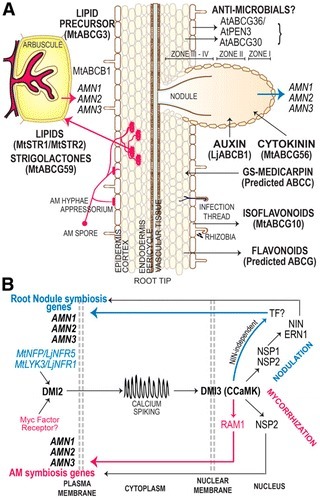
Several ATP-binding cassette (ABC) transporters involved in the arbuscular mycorrhizal symbiosis and nodulation have been identified. We describe three previously unreported ABC subfamily B transporters, named AMN1, AMN2, and AMN3 (ABCB for mycorrhization and nodulation), that are expressed early during infection by rhizobia and arbuscular mycorrhizal fungi. These ABCB transporters are strongly expressed in symbiotically infected tissues, including in root-hair cells with rhizobial infection threads and arbusculated cells. During nodulation, the expression of these genes is highly induced by rhizobia and purified Nod factors and is dependent on DMI3 but is not dependent on other known major regulators of infection, such as NIN, NSP1, or NSP2. During mycorrhization their expression is dependent on DMI3 and RAM1 but not on NSP1 and NSP2. Therefore, they may be commonly regulated through a distinct branch of the common symbiotic pathway. Mutants with exonic Tnt1-transposon insertions were isolated for all three genes. None of the single or double mutants showed any differences in colonization by either rhizobia or mycorrhizal fungi, but the triple amn1 amn2 amn3 mutant showed an increase in nodule number. Further studies are needed to identify potential substrates of these transporters and understand their roles in these beneficial symbioses.
|
|
Scooped by
Jean-Michel Ané
October 3, 2021 9:08 PM
|
Annexins as Ca2+/phospholipid-binding proteins are involved in the control of many biological processes essential for plant growth and development. In a previous study, we had shown, using a proteomic approach, that the synthesis of two annexins is induced in pea roots in response to rhizobial inoculation. In this study, phylogenetic analysis identif ied these annexins as PsAnn4 and PsAnn8 based on their homology with annexins from other legumes. The modeling approach allowed us to estimate the structural features of these annexins that might inf luence their functional activity. To verify the functions of these annexins, we performed comparative proteomic analysis, experiments with calcium inf lux inhibitors, and localization of labeled proteins. Essential down-regulation of PsAnn4 synthesis in a non-nodulating pea mutant P56 (sym10) suggests an involvement of this annexin in the rhizobial symbiosis. Quantitative RT-PCR analysis showed that PsAnn4 was upregulated at the early stages of symbiosis development, starting from 1–3 days after inoculation to up to 5 days after inoculation, while experiments with the Ca2+ channel blocker LaCl3 revealed its negative inf luence on this expression. To follow the PsAnn4 protein localization in plant cells, it was fused to the f luorophores such as red f luorescent protein (RFP) and yellow f luorescent protein (YFP) and expressed under the transcriptional regulation of the 35S promoter in Nicotiana benthamiana leaves by inf iltration with Agrobacterium tumefaciens. The localization of PsAnn4 in the cell wall or plasma membrane of plant cells may indicate its participation in membrane modif ication or ion transport. Our results suggest that PsAnn4 may play an important role during the early stages of pea-rhizobial symbiosis development.
|
|
Scooped by
Jean-Michel Ané
October 3, 2021 8:56 PM
|
In legumes interacting with rhizobia, the formation of symbiotic organs involved in the acquisition of atmospheric nitrogen gas (N2) is dependent on the plant nitrogen (N) demand. We used Medicago truncatula plants cultivated in split-root systems to discriminate between responses to local and systemic N signaling. We evidenced a strong control of nodule formation by systemic N signaling but obtained no clear evidence of a local control by mineral nitrogen. Systemic signaling of the plant N demand controls numerous transcripts involved in root transcriptome reprogramming associated with early rhizobia interaction and nodule formation. SUPER NUMERIC NODULES (SUNN) has an important role in this control, but we found that major systemic N signaling responses remained active in the sunn mutant. Genes involved in the activation of nitrogen fixation are regulated by systemic N signaling in the mutant, explaining why its hypernodulation phenotype is not associated with higher nitrogen fixation of the whole plant. We show that the control of transcriptome reprogramming of nodule formation by systemic N signaling requires other pathway(s) that parallel the SUNN/CLE (CLAVATA3/EMBRYO SURROUNDING REGION-LIKE PEPTIDES) pathway.
|
|
Scooped by
Jean-Michel Ané
October 3, 2021 3:16 PM
|
Bradyrhizobium sp. DOA9 can nodulate a wide spectrum of legumes; however, unlike other bradyrhizobia, DOA9 carries a symbiotic plasmid harboring type III secretion system (T3SS) and several effector (T3E) genes, one of which encodes a new putative type III effector—SkP48. Here, we demonstrated the pivotal roles of SkP48 from Bradyrhizobium sp. DOA9 in inhibiting nodulation of various Vigna species and Crotalaria juncea and suppressing nodulation efficiency of Arachis hypogea. By contrast, the nodulation efficiency of a SkP48 mutant did not differ significantly with the DOA9 wild-type strain on Macroptilium atropurpureum and Stylosanthes hamata. An evolutionary analysis revealed that the SkP48 effector which contains a shikimate kinase and a SUMO protease (C48 cysteine peptidase) domain is distinct from the others effectors previously identified in others bradyrhizobia and pathogenic bacteria. Our findings suggest that the new putative T3E SkP48 is a key factor suppressing nodulation and nodule organogenesis in several legumes by activation of effector-triggered immunity through salicylic acid biosynthesis induction, which is deleterious to rhizobial infection. In addition, nodulation may be modulated by the function of defensins involved in jasmonic acid signalling in V. radiata SUT1.
|
|
Scooped by
Jean-Michel Ané
October 1, 2021 2:47 PM
|
BACKGROUND
A decrease in rainfall is one of the main constraints on wheat production, although the association of wheat with arbuscular mycorrhizal fungi (AMF) may be an alternative for crop production under drought conditions. In the present study, we used three wheat cultivars (Purple, Ilustre and Maxi Baer) inoculated with two AMF strains, one obtained from the hyperarid Atacama Desert (northern Chile; Fm) and the other obtained from southern Chile (Cc). Plants were maintained under two irrigation conditions (normal irrigation and drought) and the physiological behaviour and enzymatic and nonenzymatic antioxidant activities in the shoots were determined. In addition, the phenolic compounds were identified by high-performance liquid chromatography-dioide array detection-electrospray ionization-tandem mass spectrometry and quantified.
RESULTS
AMF colonization produced higher levels of efficiency of photosystem II and photosynthetic pigments. High values of catalase in Purple-Cc, ascorbate peroxidase in Purple-Cc, glutathione reductase in Maxi-Cc and superoxide dismutase in Purple-Cc, all under stress, were registered. Of the inoculated cultivars, Purple-Cc showed the highest flavonoid levels, whereas hydroxycinnamic acids were higher in Maxi-Fm without drought, with apigenin and luteolin being the most abundant. High levels of phenols were present in the Ilustre-Fm plants without drought. Under normal irrigation, high levels of antioxidant activity were registered in the AMF treatments, whereas, under stress conditions, in general, high values were observed under the Fm inoculation.
CONCLUSION
Our results showed that the greatest antioxidant activity and phenolic content occurred in wheat plants inoculated with AMF, indicating their influence on coping with water stress, which is of importance in vast areas where global climate change is resulting in diminished rainfall.
|