 Your new post is loading...

|
Scooped by
Jean-Michel Ané
October 6, 2022 11:01 AM
|
Exploring natural diversity for biological nitrogen fixation in maize and its progenitors is a promising approach to reducing our dependence on synthetic fertilizer and enhancing the sustainability of our cropping systems. We have shown previously that maize accessions from the Sierra Mixe can support a nitrogen-fixing community in the mucilage produced by their abundant aerial roots and obtain a significant fraction of their nitrogen from the air through these associations. In this study, we demonstrate that mucilage production depends on root cap and border cells sensing water, as observed in underground roots. The diameter of aerial roots correlates with the volume of mucilage produced and the nitrogenase activity supported by each root. Young aerial roots produce more mucilage than older ones, probably due to their root cap’s integrity and their ability to produce border cells. Transcriptome analysis on aerial roots at two different growth stages before and after mucilage production confirmed the expression of genes involved in polysaccharide synthesis and degradation. Genes related to nitrogen uptake and assimilation were up-regulated upon water exposure. Altogether, our findings suggest that in addition to the number of nodes with aerial roots reported previously, the diameter of aerial roots and abundance of border cells, polysaccharide synthesis and degradation, and nitrogen uptake are critical factors to ensure efficient nitrogen fixation in maize aerial roots.
|
|
Scooped by
Jean-Michel Ané
October 4, 2022 3:35 PM
|
The arbuscular mycorrhizal (AM) symbiosis is characterized by the reciprocal exchange of nutrients. AM fungi are oleaginous microorganisms that obtain essential fatty acids from host plants. A lipid biosynthesis and delivery pathway has been proposed to operate in inner root cortex cells hosting arbuscules, a cell type challenging to access microscopically. Despite the central role lipids play in the association, lipid distribution patterns during arbuscule development are currently unknown. We developed a simple co-staining method employing fluorophore-conjugated Wheat Germ Agglutinin (WGA) and a lipophilic blue fluorochrome, Ac-201, for the simultaneous imaging of arbuscules and lipids distributed within arbuscule-containing cells in high resolution. We observed lipid distribution patterns in wild-type root infection zones in a variety of plant species. In addition, we applied this methodology to mutants of the Lotus japonicus GRAS transcription factor RAM1 and the Oryza sativa half-size ABC transporter STR1, both proposed to be impaired in the symbiotic lipid biosynthesis-delivery pathway. We found that lipids accumulated in cortical cells hosting stunted arbuscules in Ljram1 and Osstr1, and observed lipids in the arbuscule body of Osstr1, suggesting that in the corresponding plant species, RAM1 and STR1 may not be essential for symbiotic lipid biosynthesis and transfer from arbuscule-containing cells, respectively. The versatility of this methodology has the potential to help elucidate key questions on the complex lipid dynamics fostering AM symbioses.
|
|
Scooped by
Jean-Michel Ané
October 4, 2022 3:26 PM
|
The actinorhizal plant Datisca glomerata (Datiscaceae, Cucurbitales) establishes a root nodule symbiosis with actinobacteria from the earliest branching symbiotic Frankia clade. A subfamily of a gene family encoding nodule-specific defensin-like cysteine-rich peptides is highly expressed in D. glomerata nodules. Phylogenetic analysis of the defensin domain showed that these defensin-like peptides share a common evolutionary origin with nodule-specific defensins from actinorhizal Fagales and with nodule-specific cysteine-rich peptides (NCRs) from legumes. In this study, the family member with the highest expression levels, DgDef1, was characterized. Promoter-GUS studies on transgenic hairy roots showed expression in the early stage of differentiation of infected cells, and transient expression in the nodule apex. DgDef1 contains an N-terminal signal peptide and a C-terminal acidic domain which are likely involved in subcellular targeting and do not affect peptide activity. In vitro studies with E. coli and Sinorhizobium meliloti 1021 showed that the defensin domain of DgDef1 has a cytotoxic effect, leading to membrane disruption with 50% lethality for S. meliloti 1021 at 20.8 μM. Analysis of the S. meliloti 1021 transcriptome showed that, at sublethal concentrations, DgDef1 induced the expression of terminal quinol oxidases, which are associated with the oxidative stress response and are also expressed during symbiosis. Overall, the changes induced by DgDef1 are reminiscent of those of some legume NCRs, suggesting that nodule-specific defensin-like peptides were part of the original root nodule toolkit and were subsequently lost in most symbiotic legumes, while being maintained in the actinorhizal lineages.
|
|
Scooped by
Jean-Michel Ané
October 4, 2022 3:15 PM
|
The ability of leguminous crops to fix nitrogen (N) has been essential to the planting decisions of many farmers, but grass crops have generally not been considered to have the same capacity. Nevertheless, studies have revealed many species of bacterium that fix N in association with a wide variety of grass crops. In particular, a landrace of corn from Mexico has been studied that hosts an association with these bacteria in mucilage that is produced from aerial roots along the stem. This association creates a habitat for the bacteria while allowing the crop to receive the benefits from N fixed from the air. In this study we assessed the effect of inoculating two landrace varieties and a conventional variety of maize with N fixing and non-fixing strains of Azospirillum brasilense. Differences were observed for growth and aerial root traits in response to accession, but these characteristics did not respond to inoculation. Wider aerial roots correlated with higher mucilage production. Finally, we found N fixation occurring in the mucilage of those plants inoculated with the N fixing strain of A. brasilense. Mucilage samples responded to N gas analysis to imply nitrogen fixation is occurring in the mucilage. The implications of these findings could lead to research into further associations between maize cultivars and N fixing bacteria. There are cultivars other than the landrace of Sierra Mixe that can support nitrogen fixation, and mucilage is the key to this understanding.
|
|
Scooped by
Jean-Michel Ané
October 4, 2022 3:01 PM
|
To feed the continuously expanding world’s population, new crop varieties have been generated, which significantly contribute to the world’s food security. However, the growth of these improved plant varieties relies primarily on synthetic fertilizers, which negatively affect the environment and human health; therefore, continuous improvement is needed for sustainable agriculture. Several plants, including cereal crops, have the adaptive capability to combat adverse environmental changes by altering physiological and molecular mechanisms and modifying their root system to improve nutrient uptake efficiency. These plants operate distinct pathways at various developmental stages to optimally establish their root system. These processes include changes in the expression profile of genes, changes in phytohormone level, and microbiome-induced root system architecture (RSA) modification. Several studies have been performed to understand microbial colonization and their involvement in RSA improvement through changes in phytohormone and transcriptomic levels. This review highlights the impact of genes, phytohormones, and particularly root microbiota in influencing RSA and provides new insights resulting from recent studies on rice root as a model system and summarizes the current knowledge about biochemical and central molecular mechanisms.
|
|
Scooped by
Jean-Michel Ané
October 4, 2022 2:54 PM
|
Biological nitrogen fixation requires large amounts of energy in the form of ATP and low potential electrons to overcome the high activation barrier for cleavage of the dinitrogen triple bond. The model aerobic nitrogen-fixing bacteria, Azotobacter vinelandii, generates low potential electrons in the form of reduced ferredoxin (Fd) and flavodoxin (Fld) using two distinct mechanisms via the enzyme complexes Rnf and Fix. Both Rnf and Fix are expressed during nitrogen fixation, but deleting either rnf1 or fix genes has little effect on diazotrophic growth. However, deleting both rnf1 and fix eliminates the ability to grow diazotrophically. Rnf and Fix both use NADH as a source of electrons, but overcoming the energetics of NADH's endergonic reduction of Fd/Fld is accomplished through different mechanisms. Rnf harnesses free energy from the chemiosmotic potential, whereas Fix uses electron bifurcation to effectively couple the endergonic reduction of Fd/Fld to the exergonic reduction of quinone. Different reaction stoichiometries and condition-specific differential gene expression indicate specific roles for the two reactions. This work's complementary physiological studies and thermodynamic modeling reveal how Rnf and Fix balance redox homeostasis in various conditions. Specifically, the Fix complex is required for efficient growth under low oxygen concentrations, while Rnf is presumed to maintain reduced Fd/Fld production for nitrogenase under standard conditions. This work provides a framework for understanding how the production of low potential electrons sustains robust nitrogen fixation in various conditions.
|
|
Scooped by
Jean-Michel Ané
October 4, 2022 2:41 PM
|
•For the first time, we qualified AMF respiration (RAMF) and its drivers under N addition in the field.
•RAMF contributed 12 % of total soil respiration and 25 % of autotrophic respiration.
•RAMF is controlled by soil moisture rather than soil temperature.
•Short-term N addition does not affect the soil respiration and its components.
|
|
Scooped by
Jean-Michel Ané
October 3, 2022 8:50 PM
|
Many plant roots associate with fungi to form mycorrhizae; tree roots especially associate with ectomycorrhizal fungi, such as Tricholoma species. Tricholoma matsutake is an economically important fungus in Asian countries and usually inhabits forests primarily composed of Pinus densiflora (Japanese red pine). In this study, to understand the mycorrhizal association between T. matsutake and P. densiflora, genes specifically expressed in mycorrhiza compared with those expressed in mycelia and fruiting bodies were identified by RNA-seq. This revealed that genes for chromatin, proteasomes, signal transduction, pheromones, cell surface receptors, cytoskeleton, RNA processing and transporters from T. matsutake were highly expressed in mycorrhiza. It also identified 35 mycorrhiza-induced small secreted proteins (MiSSPs) that were highly expressed in mycorrhiza. Meanwhile, genes for proteases, defence-related proteins, cell-wall degradation, signal transduction, pinene synthesis, plant hormones and transporters from P. densiflora were highly expressed in mycorrhiza. These genes may be involved in mycorrhizal formation and maintenance. A MiSSP, 1460819, was highly expressed in mycorrhiza, and this expression was maintained for 24 months. These results provide insight into the mycorrhizal association between T. matsutake and P. densiflora.
|
|
Scooped by
Jean-Michel Ané
October 3, 2022 8:43 PM
|
Aims
This study investigated the influence of climate and soil on the exudation rate and polysaccharide composition of aerial nodal root mucilage from drought-resistant and drought-susceptible maize varieties.
Methods
Two maize varieties were grown in two different soils (sandy-clay loam Acrisol and loam Luvisol) under simulated climatic conditions of their agroecological zones of origin in Kenya and Germany. The exudation rate of mucilage from the aerial nodal roots was quantified as dry weight per root tip per day and the mucilage was characterized for its polysaccharide composition.
Results
On average, the mucilage exudation rate was 35.8% higher under the Kenyan semi-arid tropical than under the German humid temperate climatic conditions. However, cultivation in the loam Luvisol soil from Germany led to 73.7% higher mucilage exudation rate than cultivation in the sandy-clay loam Acrisol soil from Kenya, plausibly due to its higher microbial biomass and nutrient availability. The drought-resistant Kenyan maize variety exuded 58.2% more mucilage than the drought-susceptible German variety. On average, mucilage polysaccharides were composed of 40.6% galactose, 26.2% fucose, 13.1% mannose, 11% arabinose, 3.5% glucose, 3.2% xylose, 1.3% glucuronic acid, and 1% an unknown uronic acid. Overall, significantly higher proportions of the uronic acids were found in the mucilage of the plants grown in the Kenyan sandy-clay loam soil and under the Kenyan semi-arid tropical climatic conditions.
Conclusions
Maize is able to enhance its mucilage exudation rate under warm climatic conditions and in soils of high microbial activity to mitigate water stress and support the rhizosphere microbiome, respectively.
|
|
Scooped by
Jean-Michel Ané
October 3, 2022 8:39 PM
|
•Synthetic biology has transformed various aspects of agriculture.
•Synthetic biology promote the sustainable development of modern agriculture.
|
|
Scooped by
Jean-Michel Ané
October 3, 2022 5:37 PM
|
NodD1-NolA synergistically regulated CCBAU51778 symbioses with mung bean and peanut.
NodD2 but not NodD1 could activate type 3 secretion system (T3SS)-related genes.
NolA functions as a dominated transcriptional activator to activate T3SS-related genes and EPS-related genes.
Efficient symbiosis of CCBAU51778 with mung bean rather than peanut relies on fucosylated NFs and intact T3SS.
|
|
Scooped by
Jean-Michel Ané
October 3, 2022 5:26 PM
|
Legumes can host nitrogen-fixing rhizobia inside root nodules. In model legumes, rhizobia enter via infection threads (ITs) and develop nodules in which the infection zone contains a mixture of infected and uninfected cells. Peanut (Arachis hypogaea) diversified from model legumes c. 50–55 million years ago. Rhizobia enter through ‘cracks’ to form nodules in peanut roots where cells of the infection zone are uniformly infected. Phylogenomic studies have indicated symbiosis as a labile trait in peanut. These atypical features prompted us to investigate the molecular mechanism of peanut nodule development.
Combining cell biology, genetics and genomic tools, we visualized the status of hormonal signaling in peanut nodule primordia. Moreover, we dissected the signaling modules of Nodule INception (NIN), a master regulator of both epidermal infection and cortical organogenesis.
Cytokinin signaling operates in a broad zone, from the epidermis to the pericycle inside nodule primordia, while auxin signaling is narrower and focused. Nodule INception is involved in nodule organogenesis, but not in crack entry. Nodulation Pectate Lyase, which remodels cell walls during IT formation, is not required. By contrast, Nodule enhanced Glycosyl Hydrolases (AhNGHs) are recruited for cell wall modification during crack entry.
While hormonal regulation is conserved, the function of the NIN signaling modules is diversified in peanut.
|
|
Scooped by
Jean-Michel Ané
October 3, 2022 5:02 PM
|
Mycorrhizal symbiosis is an ancient association of plants and mycorrhizal fungi central to woody plant evolution and expansion. This symbiosis has established a complex exchange of services between plants and mycorrhizal fungi that ultimately helps plants thrive in extreme abiotic conditions and build resistance against lack of nutrients and water, pathogens, herbivores, or pollutants. Here, we briefly comment on the roles of mycorrhizal symbiosis as modulators of the responses of woody plants to multiple abiotic stress factors typical to ongoing global change. We comment on the most studied factors, i.e. drought, extreme temperatures, nutrient and light deficiency. There is a general lack of understanding of the interaction among stress factors and their combined effects on woody plants, their symbiotic interaction with mycorrhizal fungi and their impact on ecosystem processes. As a first step, identifying and ranking the severity of stress factors and situations/locations where multiple stress factors co-occur could guide initial expectations and hypotheses to comprehend the mycorrhizal benefits to woody species tolerance under multifactorial stress combinations. We finally highlight topical areas that require more information and research.
|
|
|
Scooped by
Jean-Michel Ané
October 5, 2022 9:17 PM
|
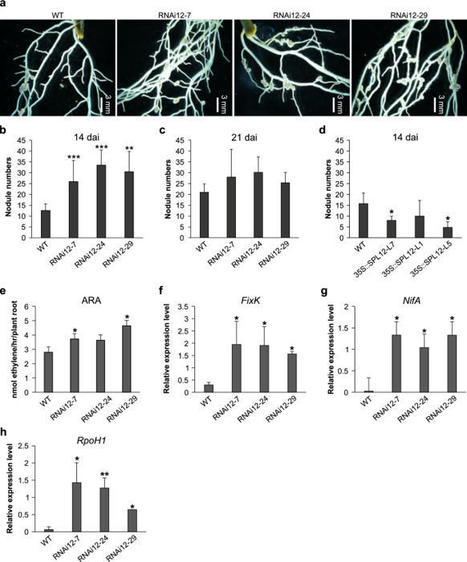
Root architecture in plants is critical because of its role in controlling nutrient cycling, water use efficiency and response to biotic and abiotic stress factors. The small RNA, microRNA156 (miR156), is highly conserved in plants, where it functions by silencing a group of SQUAMOSA-PROMOTER BINDING PROTEIN-LIKE (SPL) transcription factors. We previously showed that transgenic Medicago sativa (alfalfa) plants overexpressing miR156 display increased nodulation, improved nitrogen fixation and enhanced root regenerative capacity during vegetative propagation. In alfalfa, transcripts of eleven SPLs, including SPL12, are targeted for cleavage by miR156. In this study, we characterized the role of SPL12 in root architecture and nodulation by investigating the transcriptomic and phenotypic changes associated with altered transcript levels of SPL12, and by determining SPL12 regulatory targets using SPL12-silencing and –overexpressing alfalfa plants. Phenotypic analyses showed that silencing of SPL12 in alfalfa caused an increase in root regeneration, nodulation, and nitrogen fixation. In addition, AGL6 which encodes AGAMOUS-like MADS box transcription factor, was identified as being directly targeted for silencing by SPL12, based on Next Generation Sequencing-mediated transcriptome analysis and chromatin immunoprecipitation assays. Taken together, our results suggest that SPL12 and AGL6 form a genetic module that regulates root development and nodulation in alfalfa.
|
|
Scooped by
Jean-Michel Ané
October 4, 2022 3:30 PM
|
Arbuscular mycorrhizal (AM) symbiosis modulates plant-herbivore interactions. Still, how it shapes the overall plant defence strategy and the mechanisms involved remain unclear. We investigated how AM symbiosis simultaneously modulates plant resistance and tolerance to a shoot herbivore, and explored the underlying mechanisms. Bioassays with Medicago truncatula plants were used to study the effect of the AM fungus Rhizophagus irregularis on plant resistance and tolerance to Spodoptera exigua herbivory. By performing molecular and chemical analyses, we assessed the impact of AM symbiosis on herbivore-triggered phosphate (Pi)- and jasmonate (JA)-related responses. Upon herbivory, AM symbiosis led to an increased leaf Pi content by boosting the mycorrhizal Pi-uptake pathway. This enhanced both plant tolerance and herbivore performance. AM symbiosis counteracted the herbivore-triggered JA burst, reducing plant resistance. To disentangle the role of the mycorrhizal Pi-uptake pathway in the plant's response to herbivory, we used the mutant line ha1-2, impaired in the H+-ATPase gene HA1, which is essential for Pi-uptake via the mycorrhizal pathway. We found that mycorrhiza-triggered enhancement of herbivore performance was compromised in ha1-2 plants. AM symbiosis thus affects the defence pattern of M. truncatula by altering resistance and tolerance simultaneously. We propose that the mycorrhizal Pi-uptake pathway is involved in the modulation of the plant defence strategy.
|
|
Scooped by
Jean-Michel Ané
October 4, 2022 3:21 PM
|
•Water deficiency decreases stomatal conductance and plant O3 sensitivity.
•AM symbiosis increases stomatal conductance and plant O3 sensitivity.
•AM fungi and water condition affect stomatal conductance through different pathways.
•AM inoculation combined with water management could mitigate negative effects of O3 on plants.
|
|
Scooped by
Jean-Michel Ané
October 4, 2022 3:07 PM
|
In the symbiotic associations between rhizobia and legumes, the NodD regulators orchestrate the transcription of the specific nodulation genes. This set of genes is involved in the synthesis of nodulation factors, which are responsible for initiating the nodulation process. Rhizobium tropici CIAT 899 is the most successful symbiont of Phaseolus vulgaris and can nodulate a variety of legumes. Among the five NodD regulators present in this rhizobium, only NodD1 and NodD2 seem to have a role in the symbiotic process. However, the individual role of each NodD in the absence of the other proteins has remained elusive. In this work, we show that the CIAT 899 NodD2 does not require activation by inducers to promote the synthesis of nodulation factors. A CIAT 899 strain overexpressing nodD2, but lacking all additional nodD genes, can nodulate three different legumes as efficiently as the wild type. Interestingly, CIAT 899 NodD2-mediated gain of nodulation can be extended to another rhizobial species, since its overproduction in Sinorhizobium fredii HH103 not only increases the number of nitrogen-fixing nodules in two host legumes but also results in nodule development in incompatible legumes. These findings potentially open exciting opportunities to develop rhizobial inoculants and increase legume crop production.
|
|
Scooped by
Jean-Michel Ané
October 4, 2022 3:01 PM
|
The engineering of nitrogen fixation in plants requires assembly of an active prokaryotic nitrogenase complex, which is yet to be achieved. Nitrogenase biogenesis relies on NifB, which catalyzes the formation of the [8Fe–9S–C] metal cluster NifB-co. This is the first committed step in the biosynthesis of the iron–molybdenum cofactor (FeMo-co) found at the nitrogenase active site. The production of NifB in plants is challenging because this protein is often insoluble in eukaryotic cells, and its [Fe–S] clusters are extremely unstable and sensitive to O2. As a first step to address this challenge, we generated transgenic rice plants expressing NifB from the Archaea Methanocaldococcus infernus and Methanothermobacter thermautotrophicus. The recombinant proteins were targeted to the mitochondria to limit exposure to O2 and to have access to essential [4Fe–4S] clusters required for NifB-co biosynthesis. M. infernus and M. thermautotrophicus NifB accumulated as soluble proteins in planta, and the purified proteins were functional in the in vitro FeMo-co synthesis assay. We thus report NifB protein expression and purification from an engineered staple crop, representing a first step in the biosynthesis of a functional NifDK complex, as required for independent biological nitrogen fixation in cereals.
|
|
Scooped by
Jean-Michel Ané
October 4, 2022 2:44 PM
|
Arbuscular mycorrhizal fungi (AMF) symbiosis could mitigate the adverse effects of abiotic stresses in various plants. The aim of this study was to investigate the effect of AMF-inoculation on expression of several stress-responsive genes in two rice cultivars under different water conditions. The seedlings of Tarom-Hashemi and Nemat rice cultivars were transplanted in soil with or without G. mosseae spores. At the tilling stage, the AMF-inoculated (+AMF) and AMF-uninoculated (−AMF) plants were subjected to flooded and water deficit conditions (70% field capacity (FC) and 50%FC). The genes expression was evaluated by qRT-PCR and reported relative to control (flooded, -AMF) plants. The results showed lower expression of osDREB2A in +AMF plants in comparison with –AMF plants under water deficient conditions. The expression of OsPIP1;2 was significantly increased in roots of +AMF to –AMF plants. But, the expression of this gene was decreased in shoots of +AMF and –AMF plants in comparison with control plants. The stress-responsive gene transcripts, OsPIP2;3, OsGH3-8, OsLTP, OsAOS2 and OsADC1 in +AMF rice cultivars was higher than -AMF plants at both water deficit conditions. Expression of OsP5CS in +AMF and –AMF plants was increased in comparison with control plants, though, their differences was not significant. In 70%FC, OsEXP15 gene expression of +AMF and –AMF root plants was increased in comparison with control plants. However, under 50%FC the gene expression was decreased and not changed in -AMF and +AMF plants, respectively. It seems AMF induced changes in rice genes expression may enhance tolerance to water deficit conditions.
|
|
Scooped by
Jean-Michel Ané
October 4, 2022 2:08 PM
|
The maintenance of intracellular nitrogen-fixing bacteria causes changes in proteins’ location and in gene expression that may be detrimental to the host cell fitness. We hypothesized that the nodule’s high vulnerability toward salt stress might be due to alterations in mechanisms involved in the exclusion of Na+ from the host cytoplasm. Confocal and electron microscopy immunolocalization analyses of Na+/K+ exchangers in the root nodule showed the plasma membrane (MtNHX7) and endosome/tonoplast (MtNHX6) signal in non-infected cells; however, in mature infected cells the proteins were depleted from their target membranes and expelled to vacuoles. This mistargeting suggests partial loss of the exchanger’s functionality in these cells. In the mature part of the nodule 7 of the 20 genes encoding ion transporters, channels, and Na+/K+ exchangers were either not expressed or substantially downregulated. In nodules from plants subjected to salt treatments, low temperature-scanning electron microscopy and X-ray microanalysis revealed the accumulation of 5–6 times more Na+ per infected cell versus non-infected one. Hence, the infected cells’ inability to withstand the salt may be the integral result of preexisting defects in the localization of proteins involved in Na+ exclusion and the reduced expression of key genes of ion homeostasis, resulting in premature senescence and termination of symbiosis.
|
|
Scooped by
Jean-Michel Ané
October 3, 2022 8:46 PM
|
•The wheat varieties Iride and Ramirez show high and low mycorrhizal affinity, respectively.
•Untargeted metabolomics approach used to study the role of AMF in mitigating water deficit.
•AMF was found to cause up- and down-regulation of various primary and specialized metabolites.
•More remarkable alteration of metabolomic pathways were observed in Iride variety.
•No visible mycorrhizal effect occurred in well-watered conditions.
|
|
Scooped by
Jean-Michel Ané
October 3, 2022 8:42 PM
|
Molecular communication is a new paradigm of information relay, which uses chemical signals or molecules as dialogues for communication and has been witnessed in prokaryotes, plants as well as in animal kingdom. Understanding this fascinating relay of signals between plants and rhizobia during the establishment of a synergistic relationship for biological nitrogen fixation represents one of the hotspots in plant biology research. Predominantly, their interaction is initiated by flavonoids exuding from plant roots, which provokes changes in the expression profile of rhizobial genes. Compatible interactions promote the secretion of Nod factors (NFs) from rhizobia, which are recognised by cognate host receptors. Perception of NFs by host receptors initiates the symbiosis and ultimately leads to the accommodation of rhizobia within root nodules via a series of mutual exchange of signals. This review elucidates the bacterial and plant perspectives during the early stages of symbiosis, explicitly emphasizing the significance of NFs and their cognate NF receptors.
|
|
Scooped by
Jean-Michel Ané
October 3, 2022 5:39 PM
|
What if farmers could tend to their crops using microbes that naturally occur in the soil rather than expensive and polluting chemicals? Like humans, plants rely on complex microbiomes that contain thousands of different bacterial and fungal species. Many of these microorganisms are highly beneficial to their host: for example, some can break down toxic substances, neutralize disease-causing organisms, increase the availability of water and nutrients, or even boost growth by modifying the balance of hormones in the plant (Busby et al., 2016; Glick, 2012).
|
|
Scooped by
Jean-Michel Ané
October 3, 2022 5:30 PM
|
Aims
This study investigated the mycorrhizal responsiveness of modern hexaploid wheat and its ancestors under different soil fertility and inferred which ancestor contributed primarily to the mycorrhizal responsiveness of modern wheat.
Methods
Three or four accessions of each of five species, including hexaploid bread wheat (Triticum aestivum; AABBDD genome), Triticum urartu (AA), Aegilops speltoides (BB), Aegilops tauschii (DD), and Triticum turgidum (AABB), were used to conduct the greenhouse experiment. An artificially synthesized hexaploid wheat accession and its AABB and DD parents were also analyzed. Plants were inoculated or not with arbuscular mycorrhizal fungi and grown under individual or combined nitrogen (N) and phosphorus (P) additions. Plant and fungal performance and plant’s mycorrhizal growth response (MGR) were measured.
Results
Mycorrhizal colonization and plant’s MGRs were affected strongly by host species or accession, N or P additions, and their interactions. Mycorrhizal colonization was relatively lower in hexaploid wheat and responded negatively to N addition. The MGRs of plants, ranging from positive to negative across accessions or nutrient treatments, were statistically positive for B genome donor A. speltoides but neutral for the other species. The MGR pattern of the synthetic hexaploid wheat was similar to that of its AABB parent but differed considerably from the D genome donor A. tauschii.
Conclusions
This study demonstrates complex interactive effects of host identity and soil N and P availability on the mycorrhizal phenotypes of wheat, and speculates that the mycorrhizal responsiveness of modern hexaploid wheat may be controlled by both A and B genomes.
|
|
Scooped by
Jean-Michel Ané
October 3, 2022 5:15 PM
|
Lysin-motif receptor-like kinases (LysM-RLKs) are involved in the recognition of microbe-associated molecular patterns to initiate pattern-triggered immunity (PTI). LysM-RLKs are also required for recognition of microbe-derived symbiotic signal molecules upon establishing mutualistic interactions between plants and microsymbionts. A LysM-RLK CHITIN ELICITOR RECEPTOR KINASE1 (CERK1) plays central roles both in chitin-mediated PTI and in arbuscular mycorrhizal symbiosis, suggesting the overlap between immunity and symbiosis, at least in the signal perception and the activation of downstream signal cascades. In this study, we screened for the interacting proteins of Nod factor Receptor1 (NFR1), a CERK1 homolog in the model legume Lotus japonicus, and obtained a protein orthologous to NONRACE-SPECIFIC DISEASE RESISTANCE1/HARPIN-INDUCED1-LIKE13 (NHL13), a protein involved in the activation of innate immunity in Arabidopsis thaliana, which we named LjNHL13a. LjNHL13a interacted with NFR1 and with the symbiosis receptor kinase SymRK. LjNHL13a also displayed positive effects in nodulation. Our results suggest that NHL13 plays a role both in plant immunity and symbiosis, possibly where they overlap.
|









Latest paper from our lab with @PierreMarcDelau on nitrogen fixation on corn aerial roots and the role of root border cells in mucilage production.