The establishment of the symbiotic interaction between plants and arbuscular mycorrhizal (AM) fungi requires a very tight molecular dialogue. Most of the known plant genes necessary for this process are also required for nodulation in legume plants and only very recently genes specifically required for AM symbiosis have been described. Among them we identified RAM (Reduced Arbuscular Mycorrhization)1 and RAM2, a GRAS transcription factor and a GPAT respectively, which are critical for the induction of hyphopodia formation in AM fungi. RAM2 function is also required for appressoria formation by the pathogenPhytophtora palmivora. Here we investigated the activity ofRAM1 and RAM2 promoters during mycorrhization and the role of RAM1 and RAM2 during infection by the root pathogen Aphanomyces euteiches. pRAM1 is activated without cell type specificity before hyphopodia formation, whilepRAM2 is specifically active in arbusculated cells providing evidence for a potential function of cutin momomers in the regulation of arbuscule formation. Furthermore, consistent with what we observed with Phytophtora, RAM2 but notRAM1 is required during Aphanomyces euteiches infection.
The acidic polysaccharide succinoglycan produced by the nitrogen-fixing rhizobial symbiont Sinorhizobium meliloti 1021 is required for this bacterium to invade the host plant Medicago truncatula and to efficiently invade the host plant M. sativa (alfalfa). The β-glucanase enzyme encoded by exoK has previously been demonstrated to cleave succinoglycan and participate in producing the low molecular weight form of this polysaccharide. Here, we show that exoK is required for efficient S. meliloti invasion of both M. truncatula and alfalfa. Deletion mutants of exoK have a substantial reduction in symbiotic productivity on both of these plant hosts. Insertion mutants of exoK have an even less productive symbiosis than the deletion mutants with the host M. truncatula that is caused by a secondary effect of the insertion itself, and may be due to a polar effect on the expression of the downstreamexoLAMON genes.
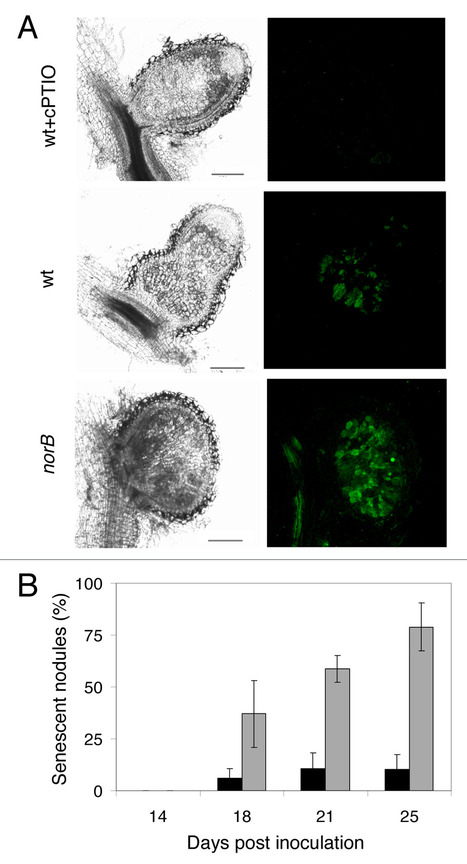
Nitric oxide (NO) is a gaseous signaling molecule which plays both regulatory and defense roles in animals and plants. In the symbiosis between legumes and rhizobia, NO has been shown to be involved in bacterial infection and nodule development steps as well as in mature nodule functioning. We recently showed that an increase in NO level inside Medicago truncatula root nodules also could trigger premature nodule senescence. Here we discuss the importance of the bacterial Sinorhizobium meliloti flavohemoglobin to finely tune the NO level inside nodules and further, we demonstrate that S. meliloti possesses at least two non redundant ways to control NO and that both systems are necessary to maintain efficient nitrogen fixing activity.
Meilhoc E, Blanquet P, Cam Y, Bruand C. (2013). Plant Signal Behav. Aug 14;8(10). pii: e25923. [Epub ahead of print]
Legumes play an important role as food and forage crops in international agriculture especially in developing countries. Legumes have a unique biological process called nitrogen fixation (NF) by which they convert atmospheric nitrogen to ammonia. Although legume genomes have undergone polyploidization, duplication and divergence, NF-related genes, because of their essential functional role for legumes, might have remained conserved. To understand the relationship of divergence and evolutionary processes in legumes, this study analyzes orthologs and paralogs for selected 20 NF-related genes by using comparative genomic approaches in six legumes i.e., Medicago truncatula (Mt), Cicer arietinum, Lotus japonicus, Cajanus cajan (Cc), Phaseolus vulgaris (Pv), and Glycine max(Gm). Subsequently, sequence distances, numbers of synonymous substitutions per synonymous site (Ks) and non-synonymous substitutions per non-synonymous site (Ka) between orthologs and paralogs were calculated and compared across legumes. These analyses suggest the closest relationship between Gm and Cc and the highest distance betweenMt and Pv in six legumes. Ks proportional plots clearly showed ancient genome duplication in all legumes, whole genome duplication event in Gmand also speciation pattern in different legumes. This study also reports some interesting observations e.g., no peak at Ks 0.4 in Gm-Gm, location of two independent genes next to each other in Mt and low Ks values for outparalogs for three genes as compared to other 12 genes. In summary, this study underlines the importance of NF-related genes and provides important insights in genome organization and evolutionary aspects of six legume species analyzed.
In the Internet era, communicating with friends and colleagues via social networks constitutes a significant proportion of our daily activities. Similarly animals and plants also interact with many organisms, some of which are pathogens and do no good for the plant, while others are beneficial symbionts. Almost all plants indulge in developing social networks with microbes, in particular with arbuscular mycorrhizal fungi, and emerging evidence indicates that most employ an ancient and widespread central ‘social media’ pathway made of signaling molecules within what is called the SYM pathway. Some plants, like legumes, are particularly active recruiters of friends, as they have established very sophisticated and beneficial interactions with nitrogen-fixing bacteria, also via the SYM pathway. Interestingly, many members of the Brassicaceae, including the model plant Arabidopsis thaliana, seem to have removed themselves from this ancestral social network and lost the ability to engage in mutually favorable interactions with arbuscular mycorrhizal fungi. Despite these generalizations, recent studies exploring the root microbiota of A. thaliana have found that in natural conditions, A. thaliana roots are colonized by many different bacterial species and therefore may be using different and probably more recent ‘social media’ for these interactions. In general, recent advances in the understanding of such molecular machinery required for plant–symbiont associations are being obtained using high throughput genomic profiling strategies including transcriptomics, proteomics and metabolomics. The crucial mechanistic understanding that such data reveal may provide the infrastructure for future efforts to genetically manipulate crop social networks for our own food and fiber needs.
Muthusubramanian Venkateshwaran, Jeremy D Volkening, Michael R Sussman, Jean-Michel Ané (2012). Current Opinion in Plant Biology 2012, 16:xx–yy
Crop rotation has been used since Roman times to improve plant nutrition and to control the spread of disease. A new study to be published in Nature’s ‘The ISME Journal’ reveals the profound effect it has on enriching soil with bacteria, fungi and protozoa...
Comparative metatranscriptomics reveals kingdom level changes in the rhizosphere microbiome of plants
Plant–microbe interactions in the rhizosphere have important roles in biogeochemical cycling, and maintenance of plant health and productivity, yet remain poorly understood. Using RNA-based metatranscriptomics, the global active microbiomes were analysed in soil and rhizospheres of wheat, oat, pea and an oat mutant (sad1) deficient in production of anti-fungal avenacins. Rhizosphere microbiomes differed from bulk soil and between plant species. Pea (a legume) had a much stronger effect on the rhizosphere than wheat and oat (cereals), resulting in a dramatically different rhizosphere community. The relative abundance of eukaryotes in the oat and pea rhizospheres was more than fivefold higher than in the wheat rhizosphere or bulk soil. Nematodes and bacterivorous protozoa were enriched in all rhizospheres, whereas the pea rhizosphere was highly enriched for fungi. Metabolic capabilities for rhizosphere colonisation were selected, including cellulose degradation (cereals), H2 oxidation (pea) and methylotrophy (all plants). Avenacins had little effect on the prokaryotic community of oat, but the eukaryotic community was strongly altered in the sad1 mutant, suggesting that avenacins have a broader role than protecting from fungal pathogens. Profiling microbial communities with metatranscriptomics allows comparison of relative abundance, from multiple samples, across all domains of life, without polymerase chain reaction bias. This revealed profound differences in the rhizosphere microbiome, particularly at the kingdom level between plants.
Turner TR, Ramakrishnan K, Walshaw J, Heavens D, Alston M, Swarbreck D, Osbourn A, Grant A, Poole PS. (2013). SME J. Jul 18. doi: 10.1038/ismej.2013.119. [Epub ahead of print]
Leguminous plants establish a symbiosis with rhizobia to enable nitrogen fixation in root nodules under the control of the presumed root-to-shoot-to-root negative feedback called autoregulation of nodulation. In Lotus japonicus, autoregulation is mediated by CLE-RS genes that are specifically expressed in the root, and the receptor kinase HAR1 that functions in the shoot. However, the mature functional structures of CLE-RS gene products and the molecular nature of CLE-RS/HAR1signalling governed by these spatially distant components remain elusive. Here we show that CLE-RS2 is a post-translationally arabinosylated glycopeptide derived from the CLE domain. Chemically synthesized CLE-RS glycopeptides cause significant suppression of nodulation and directly bind to HAR1 in an arabinose-chain and sequence-dependent manner. In addition, CLE-RS2 glycopeptide specifically produced in the root is found in xylem sap collected from the shoot. We propose that CLE-RS glycopeptides are the long sought mobile signals responsible for the initial step of autoregulation of nodulation.
In this real-life model of forest resilience and regeneration, Professor Suzanne Simard shows that all trees in a forest ecosystem are interconnected, with t...
Last week I attended a PhD student symposium. It was a very interesting day filled with student research talks and poster sessions and networking. One of the talks was given by Matt Cooper (Alison ...
Mutualisms are common in nature, though these symbioses can be quite permeable to cheaters in situations where one individual parasitizes the other by discontinuing cooperation yet still exploits the benefits of the partnership. In the Rhizobium-legume system, there are two separate contexts, namely nodulation and nitrogen fixation processes, by which residentRhizobium individuals can benefit by cheating. Here, we constructed reversible and irreversible mutations in key nodulation and nitrogen-fixation pathways of Rhizobium etli and compared their interaction with plant hosts Phaseolus vulgaris to that of wild type. We show that R. etli reversible mutants deficient in nodulation factor production are capable of intra-specific cheating, wherein mutants exploit other Rhizobium individuals capable of producing these factors. Similarly, we show that R. etli mutants are also capable of cheating inter-specifically, colonizing the host legume yet contributing nothing to the partnership in terms of nitrogen fixation. Our findings indicate that cheating is possible in both of these frameworks, seemingly without damaging the stability of the mutualism itself. These results may potentially help explain observations suggesting that legume plants are commonly infected by multiple bacterial lineages during the nodulation process.
ing J, Zheng H, Katzianer DS, Wang H, Zhong Z, et al. (2013) PLoS ONE 8(7): e70138.
Socrates Logos's insight: byXia Wang, Jian-Guo Yang, Li Chen, Ji-Long Wang, Qi Cheng, Ray Dixon Yi-Ping Wang "Biological nitrogen fixation is a complex process requiring multiple genes working in concert.
While chitooligosaccharides (COs) derived from fungal chitin are potent elicitors of defense reactions, structurally related signals produced by certain bacteria and fungi, called lipo-chitooligosaccharides (LCOs), play important roles in the establishment of symbioses with plants. Understanding how plants distinguish between friend and foe through the perception of these signals is a major challenge. We report the synthesis of a range of COs and LCOs, including photoactivatable probes, to characterize a membrane protein from the legumeMedicago truncatula. By coupling photoaffinity labeling experiments with proteomics and transcriptomics, we identified the likely LCO-binding protein as LYR3, a lysin motif receptor-like kinase (LysM-RLK). LYR3, expressed heterologously, exhibits high-affinity binding to LCOs but not COs. Homology modeling, based on the Arabidopsis CO-binding LysM-RLK AtCERK1, suggests that LYR3 could accommodate the LCO in a conserved binding site. The identification of LYR3 opens up ways for the molecular characterization of LCO/CO discrimination.
33rd New Phytologist Symposium.Networks of Power and Influence: A symposium on the ecology and evolution of symbiotic associations between plants and mycorrhizal fungi (33rd NewPhyt Symposium Networks of Power & Influence May'14
Leguminous plants establish symbiosis with nitrogen-fixing α- and β-Proteobacteria, collectively called rhizobia, which provide combined nitrogen to support plant growth. Members of the Inverted Repeat-Lacking Clade of legumes impose terminal differentiation on their endosymbiotic bacterium partners with the help of the nodule-specific cysteine-rich (NCR) peptide family composed of close to 600 members. Among the few tested NCR peptides, cationic ones had anti-rhizobial activity measured by reduction or elimination of the colony forming units and uptake of the membrane impermeable dye, propidium iodide. Here, the antimicrobial spectrum of two of these peptides, NCR247 and NCR335, were investigated as well as their effect on the transcriptome of the natural targetSinorhizobium meliloti was characterized. Both peptides were able to kill quickly a wide range of Gram-negative and Gram-positive bacteria, however their spectra were only partially overlapping and differencies were found also in their efficacy on given strains indicating that the action of NCR247 and NCR335 might be similar though not identical. Treatment of S. meliloti cultures with either peptide resulted in a quick down-regulation of genes involved in basic cellular functions such as transcription-translation and energy production as well as up-regulation of genes involved in stress and oxidative stress responses and membrane transport. Similar changes provoked mainly in Gram-positive bacteria by antimicrobial agents were coupled with the destruction of membrane potential indicating that it might also be a common step in bactericidal action of NCR247 and NCR335.
Micro-RNAs (miRNAs) play a pivotal role in the control of gene expression and regulate plant developmental processes. MicroRNA172 is a conserved miRNA in plants reported to control the expression of genes involved in developmental phase transition, floral organ identity and flowering time. However, the specific role of miR172 in legume nodulation is undefined. Ectopic expression of soybean miR172 resulted in an increase in nodule numbers in transgenic roots and an increase in the expression of both symbiotic leghemoglobin and non-symbiotic hemoglobin. These nodules showed higher levels of nitrogenase activity. Further analysis revealed a complex regulatory circuit in which miR156 regulates miR172 expression and controls the level of an AP2 transcription factor. The latter, either directly or indirectly, controls the expression of non-symbiotic hemoglobin, which is essential for regulating the levels of nodulation.
How Microbes can Help Feed the World" looks in depth at the intimate relationship between microbes and agriculture including why plants need microbes, what types of microbes they need, how they interact and the scientific challenges posed by the current state of knowledge. It then makes a series of recommendations, including greater investment in research, the taking on of one or more grand challenges such as characterization of the complete microbiome of one important crop plant, and the establishment of a formal process for moving scientific discoveries from the lab to the field.
Beneficial associations between plants and arbuscular mycorrhizal fungi play a major role in terrestrial environments and in the sustainability of agroecosystems. Proteins, microRNAs, and small molecules have been identified in model angiosperms as required for the establishment of arbuscular mycorrhizal associations and define a symbiotic ‘toolkit’ used for other interactions such as the rhizobia–legume symbiosis. Based on recent studies, we propose an evolutionary framework for this toolkit. Some components appeared recently in angiosperms, whereas others are highly conserved even in land plants unable to form arbuscular mycorrhizal associations. The exciting finding that some components pre-date the appearance of arbuscular mycorrhizal fungi suggests the existence of unknown roles for this toolkit and even the possibility of symbiotic associations in charophyte green algae.
Pierre-Marc Delaux, Nathalie Séjalon-Delmas, Guillaume Bécard, Jean-Michel Ané (2013). Trends in Plant Sciences, In press. Available online 22 February 2013.
Biological nitrogen fixation is widespread among the Eubacteria and Archae domains but completely absent in eukaryotes. The lack of lateral transfer of nitrogen-fixation genes from prokaryotes to eukaryotes has been partially attributed to the physiological requirements necessary for the function of the nitrogenase complex. However, symbiotic bacterial nitrogenase activity is protected by the nodule, a plant structure whose organogenesis can be trigged in the absence of bacteria. To explore the intrinsic potentiality of this plant organ, we generated rhizobium-independent nodules in alfalfa by overexpressing the MsDMI3 kinase lacking the autoinhibitory domain. These transgenic nodules showed similar levels of leghemoglobin, free oxygen, ATP, and NADPH to those of efficient Sinorhizobium meliloti B399-infected nodules, suggesting that the rhizobium-independent nodules can provide an optimal microenvironment for nitrogenase activity. Finally, we discuss the intrinsic evolutionary constraints on transfer of nitrogen-fixation genes between bacteria and eukaryotes.
Soto G, Fox AR, Ayub ND. (2013). J Mol Evol. Aug 11. [Epub ahead of print]
Alfalfa (Medicago sativa) devellops spontaneous (rhizobium-independent) nodules naturally.... No need to express the DMI3 kinase domain to get spontaneous nodules in alfalfa.
Most vascular plants interact with arbuscular mycorrhizal fungi (AMF) and are thereby provided significant advantages in nutrient acquisition, especially phosphate. The widespread retention of this symbiosis in vascular plants is testament to its importance and ancient origins. This highlight focuses on the reports of two of the first genes identified through forward genetic screens for AMF symbiotic mutants: Required for Abuscular Mycorrhization 1 (RAM1) and RAM2, which respectively encode a GRAS transcription factor and a glycerol-3-phosphate acyl-transferase (GPAT) that are required for the formation of fungal entry structures (hyphopodia) on the root surface. This provides the first insights into a mycorrhization specific signaling pathway and reveals cutin monomers as a critical component of signaling in the mycorrhizal symbiosis. We discuss the proposed links between these genes, and the role of cutin and its precursors in interactions with AMF, and oomycete and fungal pathogens.
Arbuscular mycorrhizal symbiosis (AMS) and root nodule symbiosis (RNS) are mutualistic plant-microbe interactions that confer nutritional benefits to both partners. Leguminous plants possess a common genetic system for ...
Nitrogenase, which catalyzes the ATP-dependent reduction of dinitrogen (N2) to ammonia (NH3), accounts for roughly half of the bioavailable nitrogen supporting extant life.
I totally agree... I am still waiting to see the scientific evidence supporting this press release. This kind of hoax really hurts our research field on nitrogen fixation and, more generally, discredits the scientific community.
Nitrogen fixation is essential for the synthesis of many important chemicals (e.g., fertilizers, explosives) and basic building blocks for all forms of life (e.g., nucleotides for DNA and RNA, amino acids for proteins). However, direct nitrogen fixation is challenging as nitrogen (N2) does not easily react with other chemicals. By dry ball-milling graphite with N2, we have discovered a simple, but versatile, scalable and eco-friendly, approach to direct fixation of N2 at the edges of graphene nanoplatelets (GnPs). The mechanochemical cracking of graphitic C−C bonds generated active carbon species that react directly with N2 to form five- and six-membered aromatic rings at the broken edges, leading to solution-processable edge-nitrogenated graphene nanoplatelets (NGnPs) with superb catalytic performance in both dye-sensitized solar cells and fuel cells to replace conventional Pt-based catalysts for energy conversion.
Homoserine represents a substantial component of pea root exudate that may be important for plant–microbe interactions in the rhizosphere. We identified a gene cluster on plasmid pRL8JI that is required for homoserine utilization by Rhizobium leguminosarum bv.viciae. The genes are arranged as two divergently expressed predicted operons that were induced by L-homoserine, pea root exudate, and were expressed on pea roots. A mutation in gene pRL80083 that prevented utilization of homoserine as a sole carbon and energy source affected the mutant's ability to nodulate peas and lentils competitively. The homoserine gene cluster was present in approximately 47% of natural R. leguminosarum isolates (n = 59) and was strongly correlated with homoserine utilization. Conjugation of pRL8JI to R. leguminosarum 4292 or Agrobacterium tumefaciens UBAPF2 was sufficient for homoserine utilization. The presence of L-homoserine increased conjugation efficiency of pRL8JI from R. leguminosarum to a pRL8JI-cured derivative of R. leguminosarum 1062 and to A. tumefaciens UBAPF2, and induced expression of the plasmid transfer gene trbB; however, there was no difference in conjugation efficiency or trbB expression with A. tumefaciens UBAPF2pRL8-Gm as the donor suggesting that other genes in R. leguminosarum may contribute to regulating conjugation of pRL8 in the presence of homoserine.
Vanderlinde EM, Hynes MF, Yost CK. (2013). Environ Microbiol. 2013Jun 21. . [Epub ahead of print]
Nice to see this work published! It has long been known that peas exude homoserine. To characterize the genes repsonsible for the catabolism and to show they affect competition for nodule occupancy strengthens the idea of a biased rhizosphere.
To get content containing either thought or leadership enter:
To get content containing both thought and leadership enter:
To get content containing the expression thought leadership enter:
You can enter several keywords and you can refine them whenever you want. Our suggestion engine uses more signals but entering a few keywords here will rapidly give you great content to curate.


 Your new post is loading...












Oomycete pathogens and AM Fungi commandeer similar symbiotic pathways during infection of legume host.