Your new post is loading...

|
Scooped by
Jean-Michel Ané
January 18, 2014 3:27 PM
|
Since the first truffle plantations were established in France, Italy and other parts in the world, many studies have been carried out to improve their productivity and sustainability. Success of plantations is clearly related to the mycorrhizal status of the host trees over the years, from inoculated seedlings to truffle-producing trees. The experience gained in monitoring the ectomycorrhizal fungus status in cultivated truffle grounds has allowed us to develop an extensive catalogue of the ectomycorrhizal fungi present in truffle plantations. Herein, we summarize fungal community data from 85 references that represent different truffle studies in natural habitats and plantations. Approximately 25 % of the ectomycorrhizae reported in the 85 references are common to most of the studies. In general, more fungal species are detected in productive plantations than in the non-productive ones. Truffle plantations display a diverse ectomycorrhizal fungal community, in which species of the genus Tuber are well represented. Tuber rufum and some members of Boletales are typically restricted to productive truffle plots. On the other hand, Hebeloma, Laccaria and Russulaspecies are mostly associated with unproductive plots. Ectomycorrhizae belonging to Thelephoraceae are frequently found in mature truffle orchards but do not seem to affect sporocarp production. Several biotic and abiotic factors affect the ectomycorrhizal fungus communities associated with truffle orchards. Among them are plantation age, host species and its growth, the surrounding environment (particularly the presence of other ectomycorrhizal hosts), and plantation management. Understanding the ectomycorrhizal fungal communities inhabiting different plantations may give us clues about the dynamics of the targeted truffles and the possibility of identifying mycorrhizal fungal species that are good indicators of successful truffle plantations.
|
|
Scooped by
Jean-Michel Ané
January 18, 2014 12:58 PM
|
Proficient performance in plants is strongly associated with distinct microbial communities that live in and on their organs. We comment here on the current knowledge of the composition of the foliar microbiome, highlight its importance for plants, ecosystemic functioning, and crop yields, and propose tools and experiments to overcome the current knowledge gap.
|
|
Scooped by
Jean-Michel Ané
January 18, 2014 12:50 PM
|
A common empirical observation in mutualistic interactions is the persistence of variation in partner quality and, in particular, the persistence of exploitative phenotypes. For mutualisms between hosts and symbionts, most mutualism theory assumes that exploiters always impose fitness costs on their host.We exposed legume hosts to mutualistic (nitrogen-fixing) and exploitative (non-nitrogen-fixing) symbiotic rhizobia in field conditions, and manipulated the presence or absence of insect herbivory to determine if the costly fitness effects of exploitative rhizobia are context-dependent.Exploitative rhizobia predictably reduced host fitness when herbivores were excluded. However, insects caused greater damage on hosts associating with mutualistic rhizobia, as a consequence of feeding preferences related to leaf nitrogen content, resulting in the elimination of fitness costs imposed on hosts by exploitative rhizobia.Our experiment shows that herbivory is potentially an important factor in influencing the evolutionary dynamic between legumes and rhizobia. Partner choice and host sanctioning are theoretically predicted to stabilize mutualisms by reducing the frequency of exploitative symbionts. We argue that herbivore pressure may actually weaken selection on choice and sanction mechanisms, thus providing one explanation of why host-based discrimination mechanisms may not be completely effective in eliminating nonbeneficial partners.
|
|
Scooped by
Jean-Michel Ané
January 16, 2014 12:08 PM
|
A C subunit of the heterotrimeric nuclear factor Y (NF-YC1) was shown to play a key role in nodule organogenesis and bacterial infection during the nitrogen fixing symbiosis established between Phaseolus vulgaris (common bean) and Rhizobium etli. In order to identify other proteins involved in this process, we used the yeast two hybrid system to screen for NF-YC1-interacting proteins. One of the positive clones encodes a member of the PAT1 subfamily of GRAS transcription factors. The protein, named SIN1, localizes both to the nucleus and the cytoplasm, but in transgenic Nicotiana benthamiana cells, bimolecular fluorescence complementarion suggested that the interaction with NF-YC1 takes place predominantly in the nucleus. SIN1 is expressed in aerial and root tissues, with higher levels in roots and nodules. Post-transcriptional gene silencing of SIN1 using RNA interference (RNAi) showed that the product of this gene is involved in lateral root elongation. However, root-cell organization, density of lateral roots and the length of root hairs were not affected by SIN1 RNAi. In addition, the expression of the RNAi of SIN1 led to a marked reduction in the number and size of nodules formed upon inoculation with R. etli and affected the progression of infection threads towards the nodule primordia. Expression of NF-YA1 and the G2/M transition cell cycle genes CycB and CDC2 was reduced in SIN1 RNAi roots. These data suggest that SIN1 plays a role in lateral root elongation and the establishment of root symbiosis in P. vulgaris.
|
|
Scooped by
Jean-Michel Ané
January 13, 2014 11:21 PM
|
Legumes (Fabaceae) establish a symbiotic relationship with nitrogen fixing soil bacteria (rhizobia) to overcome nitrogen source limitation. Single root hair epidermal cells serve as the entry point for bacteria to infect the host root leading to development of a new organ, the nodule, which the bacteria colonize. In the present study, the putative role of a soybean acyl carrier protein, GmACP (Glyma18g47950) was examined in nodulation. ACPs represent an essential cofactor protein in fatty acid biosynthesis. Phylogenetic analysis of plant ACP protein sequences showed that GmACP was classified in a legume-specific clade. Quantitative RT-PCR analysis demonstrated that GmACP was expressed in all soybean tissues but showed higher transcript accumulation in nodule tissue. RNAi-mediated gene silencing of GmACP resulted in a significant reduction in nodule numbers on soybean transgenic roots. Fluorescent protein labeled GmACP was localized to plastids in planta, the site of de novo fatty acid biosynthesis in plants. Analysis of the fatty acid content of root tissue silenced for GmACP expression, as determined by GC-MS, showed a ~22% reduction, specifically in palmitic and stearic acid. Taken together, our data provide evidence that GmACP plays an important role in nodulation.
|
|
Scooped by
Jean-Michel Ané
January 13, 2014 11:17 PM
|
Piriformospora indica, an endophytic fungus of Sebacinales, colonizes the roots of a wide range of host plants and establishes various benefits for the plants. In this work, we describe miRNAs which are upregulated in Oncidium orchid roots after colonization by the fungus. Growth promotion and vigorous root development were observed in Oncidium hybrid orchid, while seedlings were colonized by P. indica. We performed a genome-wide expression profiling of small RNAs in Oncidium orchid roots either colonized or not-colonized by P. indica. After sequencing, 24,570,250 and 24744,141 clean reads were obtained from two libraries. 13,736 from 17,036,953 unique sequences showed homology to either 86 miRNA families described in 41 plant species, or to 46 potential novel miRNAs, or to 51 corresponding miRNA precursors. The predicted target genes of these miRNAs are mainly involved in auxin signal perception and transduction, transcription, development and plant defense. The expression analysis of miRNAs and target genes demonstrated the regulatory functions they may participate in. This study revealed that growth stimulation of the Oncidium orchid after colonization by P. indica includes an intricate network of miRNAs and their targets. The symbiotic function of P. indica onOncidium orchid resembles previous findings on Chinese cabbage. This is the first study on growth regulation and development of Oncidium orchid by miRNAs induced by the symbiotic fungus P. indica.
|
|
Scooped by
Jean-Michel Ané
January 13, 2014 11:14 PM
|
Soil contamination with heavy metals is a widespread problem, especially prominent on grounds lying in the vicinity of mines, smelters, and other industrial facilities. Many such areas are located in Southern Poland; they are polluted mainly with Pb, Zn, Cd, or Cu, and locally also with Cr. As for now, little is known about most bacterial species thriving in such soils and even less about a core bacterial community—a set of taxa common to polluted soils. Therefore, we wanted to answer the question if such a set could be found in samples differing physicochemically and phytosociologically. To answer the question, we analyzed bacterial communities in three soil samples contaminated with Pb and Zn and two contaminated with Cr and lower levels of Pb and Zn. The communities were assessed with 16S rRNA gene fragments pyrosequencing. It was found that the samples differed significantly and Zn decreased both diversity and species richness at species and family levels, while plant species richness did not correlate with bacterial diversity. In spite of the differences between the samples, they shared many operational taxonomic units (OTUs) and it was possible to delineate the core microbiome of our sample set. The core set of OTUs comprised members of such taxa as Sphingomonas, Candidatus Solibacter, or Flexibacter showing that particular genera might be shared among sites ~40 km distant.
|
|
Scooped by
Jean-Michel Ané
January 12, 2014 9:30 PM
|
Quercus acutissima seedlings were cultivated in growth pouches, inoculated with Scleroderma verrucosum and supplied with inorganic phosphorus (Pi) to evaluate the change in P attributable to mycorrhization and to determine the anatomical localization of polyphosphate (phytate) and polysaccharide. Semithin sections were stained with metachromatic toluidine blue O (TBO) and fluoresced with acriflavine-HCl. The total P content was analyzed during the ectomycorrhizal (ECM) development stages and spherical electron-dense opaque granules were analyzed using TEM-EDS. The spherical polyphosphates (phytate) were precipitated and stained with TBO as dark variable sized granules in the vacuoles of the mantle hyphae, Hartig net and the epidermal and apical meristem cells of the ECM root. Higher levels of P and cations K, Mg, Ca, Na which indicated polyphosphate (phytate), were detected in the spherical electron-dense opaque granules in the mantle hyphae vacuoles, Hartig net and epidermal cells. The increase in phytate granules was correlated with the ECM development stages in the ECM root tip tissue. The total P content of the root tips also increased during each developmental stage, because of ECM development. The polysaccharide granules fluoresced in the apical meristem cells during the mature mantle stage. Wall ingrowth was observed in epidermal cells adjacent to Hartig net hyphae. Thus, the P acquired from the external Pi supply by the mantle hyphae was converted to polyphosphates, which were transferred initially to the epidermal cells in the host root tips that interfaced with mantle hyphae during the early mantle stage before Hartig net formation.
|
|
Scooped by
Jean-Michel Ané
January 12, 2014 12:08 AM
|
Soybean is nodulated by three distinct types of rhizobia bacteria; Rhizobium fredii, Bradyrhizobium japonicum, and Bradyrhizobium elkanii. These soil dwelling bacteria have the unique ability to penetrate and fix nitrogen in association or symbiosis with the soybean roots.
|
|
Scooped by
Jean-Michel Ané
January 11, 2014 11:49 PM
|
A plant protein called DELLA may lead to reducing phosphorus-fertilizer applications on farms and to better plant growth in poor soil.
|
|
Scooped by
Jean-Michel Ané
January 11, 2014 6:47 PM
|
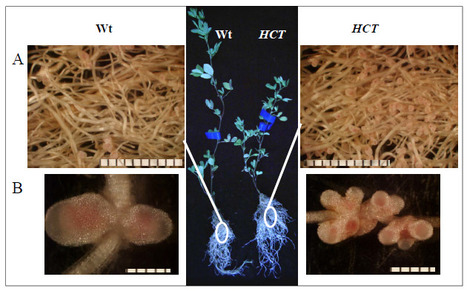
Reduction of lignin levels in the forage legume alfalfa by down-regulation of the monolignol biosynthetic enzyme hydroxycinnamoyl CoA: shikimate hydroxycinnamoyl transferase (HCT) results in strongly increased digestibility and processing ability of lignocellulose. However, these modifications are often also associated with dwarfing and other changes in plant growth. Given the importance of nitrogen fixation for legume growth, we evaluated the impact of constitutively targeted lignin modification on the below-ground organs (roots and nodules) of alfalfa plants. HCT down-regulated alfalfa plants exhibit a striking reduction in root growth accompanied by an unexpected increase in nodule numbers when grown in the greenhouse or in the field. This phenotype is associated with increased levels of gibberellins and certain flavonoid compounds in roots. Although HCT down-regulation reduces biomass yields in both the greenhouse and field experiments, the impact on the allocation of nitrogen to shoots or roots is minimal. It is therefore unlikely that the altered growth phenotype of reduced lignin alfalfa is a direct result of changes in nodulation or nitrogen-fixation efficiency. Furthermore, HCT down-regulation has no measurable effect on carbon allocation to roots in either greenhouse or three year field trials.
|
|
Scooped by
Jean-Michel Ané
January 10, 2014 3:17 PM
|
Strigolactones are recently defined plant hormones with roles in mycorrhizal symbiosis and shoot and root architecture. Their potential role in controlling nodulation, the related symbiosis between legumes and Rhizobium bacteria, was explored using the strigolactone-deficient rms1 mutant in pea (Pisum sativum L.). This work indicates that endogenous strigolactones are positive regulators of nodulation in pea, required for optimal nodule number but not for nodule formation per se. rms1mutant root exudates and root tissue are almost completely deficient in strigolactones, and rms1mutant plants have approximately 40% fewer nodules than wild-type plants. Treatment with the synthetic strigolactone GR24 elevated nodule number in wild-type pea plants and also elevated nodule number in rms1 mutant plants to a level similar to that seen in untreated wild-type plants. Grafting studies revealed that nodule number and strigolactone levels in root tissue of rms1 roots were unaffected by grafting to wild-type scions indicating that strigolactones in the root, but not shoot-derived factors, regulate nodule number and provide the first direct evidence that the shoot does not make a major contribution to root strigolactone levels.
|
|
Scooped by
Jean-Michel Ané
January 10, 2014 3:11 PM
|
Strigolactones have recently been suggested to be phytohormones that are present in all plants. Strigolactones are released by roots into the rhizosphere, stimulating the seed germination of parasitic plants such as Striga spp. and Orobanche spp. and play a crucial role in the interaction between plants and symbiotic arbuscular mycorrhizal fungi. By applying different concentrations of the synthetic strigolactone analogue GR24 to alfalfa (Medicago sativa) inoculated with Sinorhizobium meliloti we could show that in alfalfa nodulation is positively affected by the presence of the strigolactone analogue GR24. Moreover, we could show that this increased nodulation cannot be linked with a stimulatory effect of GR24 on the growth or the expression of nod genes ofS. meliloti. Putative mechanisms operating in the plant in response to the addition of GR24 and leading to increased nodule formation by rhizobia are discussed.
|
|
|
Scooped by
Jean-Michel Ané
January 18, 2014 3:26 PM
|
The effectiveness of ectomycorrhizal inoculation at the tree nursery seedling production stage on growth and survival was examined in jack pine (Pinus banksiana) and white spruce (Picea glauca) planted in oil sands reclamation sites. The seedlings were inoculated with Hebeloma crustuliniformestrain # UAMH 5247, Suillus tomentosus strain # UAMH 6252, and Laccaria bicolor strain # UAMH 8232, as individual pure cultures and in combinations. These treatments were demonstrated to improve salinity resistance and water uptake in conifer seedlings. The field responses of seedlings to ectomycorrhizal inoculation varied between plant species, inoculation treatments, and measured parameters. Seedling inoculation resulted in higher ectomycorrhizal colonization rates compared with non-inoculated control, which had also a relatively small proportion of roots colonized by the nursery contaminant fungi identified as Amphinema byssoides and Thelephora americana. Seedling inoculation had overall a greater effect on relative height growth rates, dry biomass, and stem volumes in jack pine compared with white spruce. However, when examined after two growing seasons, inoculated white spruce seedlings showed up to 75 % higher survival rates than non-inoculated controls. The persistence of inoculated fungi in roots of planted seedlings was examined at the end of the second growing season. Although the inoculation with H. crustuliniforme triggered growth responses, the fungus was not found in the roots of seedlings at the end of the second growing season suggesting a possibility that the observed growth-promoting effect of H. crustuliniforme may be transient. The results suggest that the inoculation of conifer seedlings with ectomycorrhizal fungi could potentially be carried out on a large scale in tree nurseries to benefit postplanting performance in oil sands reclamation sites. However, these practices should take into consideration the differences in responses between the different plant species and fungal strains.
|
|
Scooped by
Jean-Michel Ané
January 18, 2014 12:53 PM
|
To safely use bacteria in agriculture to help fertilize crops, it is vital to understand the difference between harmful and healthy strains. The bacterial genus Burkholderia, for example, includes dangerous disease-causing pathogens — one species has even been listed as a potential bioterrorist agent — but also many species that are safe and important for plant development. Can the microbial good and evil be told apart? Yes, UCLA life scientists and an international team of researchers report Jan. 8 in the online journal PLOS ONE.
Read more at http://scienceblog.com/69590/how-do-you-tell-good-microbes-from-bad/#06sCvSBdM4LVr7A2.99
|
|
Scooped by
Jean-Michel Ané
January 16, 2014 6:54 PM
|
Extracellular adenosine 5′-triphosphate (ATP) is an essential signaling molecule that is perceived in mammals by plasma membrane P2-type purinoceptors. Similar ATP receptors do not exist in plants, although extracellular ATP has been shown to play critical roles in plant growth, development, and stress responses. Here, we identify an ATP-insensitive Arabidopsis mutant, dorn1 (Does not Respond to Nucleotides 1), defective in lectin receptor kinase I.9 (Arabidopsis Information Resource accession code At5g60300). DORN1 binds ATP with high affinity (dissociation constant of 45.7 ± 3.1 nanomolar) and is required for ATP-induced calcium response, mitogen-activated protein kinase activation, and gene expression. Ectopic expression of DORN1increased the plant response to physical wounding. We propose that DORN1 is essential for perception of extracellular ATP and likely plays a variety of roles in plant stress resistance.
Auxin is a small molecule involved in most processes related to plant growth and development. Its effect usually depends on the distribution in tissues and the formation of concentration gradients. Until now there has been no tool for the direct tracking of auxin transport at the cellular and tissue level; therefore the majority of studies have been based on various indirect methods. However, due to their various restrictions, relatively little is known about the relationship between various pathways of auxin transport and specific developmental processes. We present a new research tool: fluorescently labelled auxin in the form of a conjugate with two different fluorescent tracers, FITC and RITC, which allows direct observation of auxin transport in plant tissues. Chemical analysis and biological tests have shown that our conjugates have auxin-like biological activity and transport; therefore they can be used in all experimental systems as an alternative to IAA. In addition, the conjugates are a universal tool that can be applied in studies of all plant groups and species. The conjugation procedure presented in this paper can be adapted to other fluorescent dyes, which are constantly being improved. In our opinion, the conjugates greatly expand the possibilities of research concerning the role of auxin and its transport in different developmental processes in plants.
Via Francis Martin
|
|
Scooped by
Jean-Michel Ané
January 13, 2014 11:20 PM
|
We determined the phosphate (P) uptake, substrate P concentration, phytase activity, acid phosphatase activity and expression of three predicted secreted purple acid phosphatase genes (PAPs) from trifoliate orange (Poncirus trifoliata L. Raf) through Glomus versiforme and phytin treatments to evaluate phytate-phosphorus utilization promoted by arbuscular mycorrhizal fungi (AMF, G. versiforme). The results showed that under inorganic phosphate (Pi) deficiency, trifoliate orange seedlings utilized phytin and G. versiforme colonization promoted trifoliate orange phytin utilization by increasing phytase activity and acid phosphatase activity in the roots and the substrate. Although the expression of the three secreted PtPAPs in the seedlings was significantly upregulated in the roots and the leaves after 2 months of −P solution application, the genes exhibited different expression patterns. In general, PtPAP1 was regulated more strongly in the roots than in the leaves, which was upregulated by G. versiforme colonization but downregulated by phytin treatment in the roots. PtPAP2 was activated by Pi deficiency in the leaves but was almost constitutive expressed in the roots. PtPAP3, which might encode a phytase, was also regulated more strongly in the roots than in the leaves and reduced by phytin treatment, but unaffected by G. versiforme colonization. The expression patterns of the PtPAP genes in response to the AMF and organic phosphate (Po) treatments suggested that the three PtPAPs had different functions in the Po utilization of trifoliate orange. Although the phytase activity and acid phosphatase activity in the roots and the substrate were not consistent with PtPAPs expression, AMF promoted the activities of the two enzymes in the substrate, which was at least partly ascribed to the regulation of PtPAPsexpression.
|
|
Scooped by
Jean-Michel Ané
January 13, 2014 11:16 PM
|
Soil microbiology is entering into a new golden age led by the development of cheap sequencing methods, improved metagenomic analyses and the renewed interest in studying an organism microbiome (East, 2013). Mirroring development in human and animal interactions with symbiotic microorganisms, new efforts are directed to identifying and studying the microorganisms associated with plants (Bulgarelli et al., 2012). Arguably, the most important components of a plant microbiome are mycorrhizal fungi. Mycorrhiza is the symbiosis with beneficial soil fungi established in the roots of > 90% of plants. Mycorrhizas have been a key element in plant colonization of terrestrial environments given the crucial role that they play in plant nutrition and stress resistance. In the case of ectomycorrhizas, the fungal partner ensheaths the finer roots of the host plant and takes over the supply of water and mineral nutrients to the host in exchange for photosynthates. It is estimated that over 90% of the phosphorus (P) requirements of the host plant are satisfied by the mycorrhizal fungus, c. 50% of the nitrogen (N) demand and similar amounts of other micronutrients. Interestingly, the mycorrhiza also protects against toxic concentrations of some of these elements, to the point that at least some mycorrhizal fungi act as living buffers, providing essential nutrients when available at low concentrations and detoxifying them when they are at higher levels. In spite of the wealth of knowledge available on P or N nutrition in mycorrhizal plants, very little is known about how potassium (K+) homeostasis is affected by the symbiosis (Smith & Read, 2008). This is despite the important role of K+ in different metabolic processes and physiological functions (such as osmorregulation, neutralization of negative charges and growth) and being the third critical component in most crop fertilizers (after N and P). In this issue of New Phytologist, Garcia et al. (pp. 951–960) present, for the first time, a study of the impact of an ectomycorrhizal fungus on the K+ nutrition of its host and the involvement of a fungal K+ transporter. It has been carried out using the basidiomycete Hebeloma cylindrosporum and Pinus pinaster as the two partners of the symbiotic association.
|
|
Scooped by
Jean-Michel Ané
January 13, 2014 11:09 PM
|
Legume plants secrete signalling molecules called flavonoids into the rhizosphere. These molecules activate the transcription of rhizobial nodgenes, which encode proteins involved in the synthesis of signalling compounds named Nod factors (NFs). NFs, in turn, trigger changes in plant gene expression, cortical cell dedifferentiation and mitosis, depolarization of the root hair cell membrane potential, and rearrangement of the actin cytoskeleton. Actin polymerization plays an important role in apical growth in hyphae and pollen tubes. Using sublethal concentrations of fluorescently labeled cytochalasin D (Cyt-Fl), we visualized the distribution of filamentous actin (F-actin) plus ends in living Phaseolus vulgaris and Arabidopsis root hairs during apical growth. We demonstrated that Cyt-Fl specifically labeled the newly available plus ends of actin microfilaments, which probably represent sites of polymerization. The addition of unlabeled competing cytochalasin reduced the signal, suggesting that the labeled and unlabeled forms of the drug bind to the same site on F-actin. Exposure to Rhizobium etli NFs resulted in a rapid increase in the number of F-actin plus ends in P. vulgaris root hairs and in the re-localization of F-actin plus ends to infection thread initiation sites. These data suggest that NFs promote the formation of F-actin plus ends, which results in actin cytoskeleton rearrangements that facilitate infection thread formation.
|
|
Scooped by
Jean-Michel Ané
January 12, 2014 9:27 PM
|
The Amazon rainforest is the Earth’s largest reservoir of plant and animal diversity, and it has been subjected to especially high rates of land use change, primarily to cattle pasture. This conversion has had a strongly negative effect on biological diversity, reducing the number of plant and animal species and homogenizing communities. We report here that microbial biodiversity also responds strongly to conversion of the Amazon rainforest, but in a manner different from plants and animals. Local taxonomic and phylogenetic diversity of soil bacteria increases after conversion, but communities become more similar across space. This homogenization is driven by the loss of forest soil bacteria with restricted ranges (endemics) and results in a net loss of diversity. This study shows homogenization of microbial communities in response to human activities. Given that soil microbes represent the majority of biodiversity in terrestrial ecosystems and are intimately involved in ecosystem functions, we argue that microbial biodiversity loss should be taken into account when assessing the impact of land use change in tropical forests.
|
|
Rescooped by
Jean-Michel Ané
from TAL effector science
January 12, 2014 12:01 AM
|
Curtin et al, 2014 (Poster) Advances in legume research have been frustrated by a lack of mutants and mutagenesis methodologies. This is especially relevant as scientists seek to explore the biological functions of gene candidates discovered through methods such as RNA-seq or genome-wide association studies (GWAS). Here we demonstrate a suite of mutagenesis platforms including; Tnt1 retro-transposons, hairpin constructs, zinc-finger (ZFNs), TAL-effector (TALENs) and CRISPRs (RNA-guided) nucleases to engineer Dicer-like and nodulation mutants in soybean and Medicago truncatula respectively. We have used the genetic transformation of Tnt1, hairpin, ZFNs, TALENs and CRISPR to knock-out/down single copy and duplicated legume genes, both in hairy root and whole plant systems. Some of the target genes were chosen in order to explore and optimize the features of knock-out/down systems (e.g., phytoene desaturase), while others were identified by soybean homology to Arabidopsis Dicer-like genes or by GWAS of nodulation in Medicago. These developments demonstrate the utility of these mutagenesis platfo
Via dromius
|
|
Scooped by
Jean-Michel Ané
January 11, 2014 11:40 PM
|
We report the draft genome sequence of the mycorrhizal helper bacteriumPseudomonas fluorescens strain BBc6R8. This is the first genome of a mycorrhizal helper bacterium. The draft genome contains 6,952,353 bp and is predicted to encode 6,317 open reading frames. Comparative genomic analyses will help to identify helper traits.
|
|
Scooped by
Jean-Michel Ané
January 11, 2014 6:44 PM
|
MicroRNAs are recognized as important post-transcriptional regulators in plants. Information about the roles of miRNAs in common bean (Phaseolus vulgaris L.), an agronomically important legume, is yet scant. The objective of this work was to functionally characterize the conserved miRNA: miR398b and its target Cu/Zn Superoxide Dismutase 1 (CSD1) in common bean. We experimentally validated a novel miR398 target: the stress up-regulated Nodulin 19(Nod19). Expression analysis of miR398b and target genes –CSD1 and Nod19- in bean roots, nodules and leaves, indicated their role in copper (Cu) homeostasis. In bean plants under Cu toxicity miR398b was decreased and Nod19 and CSD1, that participates in reactive oxygen species (ROS) detoxification, were up-regulated. The opposite regulation was observed in Cu deficient bean plants; lower levels of CSD1 would allow Cu delivery to essential Cu-containing proteins. Composite common bean plants with transgenic roots over-expressing miR398 showed ca. 20-fold higher mature miR398b and almost negligible target transcript levels as well as increased anthocyanin content and expression of Cu-stress responsive genes, when subjected to Cu deficiency. The down-regulation of miR398b with the consequent up-regulation of its targets was observed in common bean roots during the oxidative burst resulting from short-time exposure to high Cu. A similar response occurred at early stage of bean roots inoculated with Rhizobium tropici, where an increase in ROS was observed. In addition, the miR398b down-regulation and an increase in CSD1 and Nod19 were observed in bean leaves challenged with Sclerotinia scleortiorum fungal pathogen. Transient over-expression of miR398b in Nicotiana benthamiana leaves infected with S. sclerotiorum resulted in enhanced fungal lesions. We conclude that the miR398b-mediated up-regulation of CSD and Nod19 is relevant for common bean plants to cope with oxidative stress generated in abiotic and biotic stresses.
|
|
Scooped by
Jean-Michel Ané
January 10, 2014 3:16 PM
|
Legume–rhizobium symbiosis requires a complex dialogue based on the exchange of diffusible signals between the partners. Compatible rhizobia express key nodulation (nod) genes in response to plant signals – flavonoids – before infection. Host plants sense counterpart rhizobial signalling molecules – Nod factors – through transient changes in intracellular free-calcium. Here we investigate the potential involvement of Ca2+ in the symbiotic signalling pathway activated by flavonoids inRhizobium leguminosarum bv. viciae.•By using aequorin-expressing rhizobial strains, we monitored intracellular Ca2+ dynamics and the Ca2+ dependence of nodgene transcriptional activation.•Flavonoid inducers triggered, in R. leguminosarum, transient increases in the concentration of intracellular Ca2+ that were essential for the induction of nod genes. Signalling molecules not specifically related to rhizobia, such as strigolactones, were not perceived by rhizobia through Ca2+ variations. A Rhizobium strain cured of the symbiotic plasmid responded to inducers with an unchanged Ca2+ signature, showing that the transcriptional regulator NodD is not directly involved in this stage of flavonoid perception and plays its role downstream of the Ca2+ signalling event.•These findings demonstrate a key role played by Ca2+ in sensing and transducing plant-specific flavonoid signals in rhizobia and open up a new perspective in the flavonoid–NodD paradigm of nod gene regulation.
|