Janine Benyus, in an interview in Trim Tag Magazine (see previous BENTHOS post), talked about the Wood-Wide Web: “If you’ve been taught in forestry that every tree is out there for itself, eventually you realize that they are all connected underground by a mycorrhizal net called the “Wood Wide Web”. They are exchanging nutrients, water and chemical alarm signals about pests with one another. They are connected even though they are not genetically related. “This is something that we teach. We hear a lot of gasps and shocks when we discuss mutualisms because it basically goes against how economics is taught. It’s not a go-it-alone world out there as I was taught.” The Wood-Wide Web is the interconnected world of plant roots and fungal filaments call mycelium. As Janine points out, we used to think that each plant, each fungus, each organism was separate. We knew about mutualisms, but weren't aware of this degree of sharing--nutrients, water, [...]
Rhizobia and legumes are able to interact in a symbiotic way leading to the development of root nodules. Within nodules, rhizobia fix nitrogen for the benefit of the plant. These interactions are efficient because spectacularly high densities of nitrogen fixing rhizobia are maintained in the plant cells. DNF2, a Medicago truncatula gene has been described as required for nitrogen fixation, bacteroid’s persistence and to prevent defense-like reactions in the nodules. This manuscript shows that a Rhizobium mutant unable to differentiate is not sufficient to trigger defense-like reactions in this organ. Furthermore, we show that the requirement of DNF2 for effective symbiosis can be overcome by permissive growth conditions. The dnf2 knockout mutants grown in vitro on agarose or Phytagel as gelling agents are able to produce nodules fixing nitrogen with the same efficiency as the wild-type. However, when agarose medium is supplemented with the plant defense elicitor ulvan, the dnf2 mutant recovers the fix− phenotype. Together, our data show that plant growth conditions impact the gene requirement for symbiotic nitrogen fixation and suggest that they influence the symbiotic suppression of defense reactions in nodules.
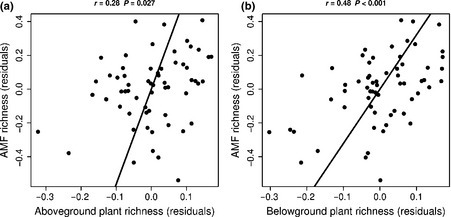
Although experiments show a positive association between vascular plant and arbuscular mycorrhizal fungal (AMF) species richness, evidence from natural ecosystems is scarce. Furthermore, there is little knowledge about how AMF richness varies with belowground plant richness and biomass.We examined relationships among AMF richness, above- and belowground plant richness, and plant root and shoot biomass in a native North American grassland. Root-colonizing AMF richness and belowground plant richness were detected from the same bulk root samples by 454-sequencing of the AMF SSU rRNA and plant trnL genes.In total we detected 63 AMF taxa. Plant richness was 1.5 times greater belowground than aboveground. AMF richness was significantly positively correlated with plant species richness, and more strongly with below- than aboveground plant richness. Belowground plant richness was positively correlated with belowground plant biomass and total plant biomass, whereas aboveground plant richness was positively correlated only with belowground plant biomass. By contrast, AMF richness was negatively correlated with belowground and total plant biomass.Our results indicate that AMF richness and plant belowground richness are more strongly related with each other and with plant community biomass than with the plant aboveground richness measures that have been almost exclusively considered to date.
This week’s paper is a Rapid Report by Gundale et al which appeared in New Phytologist in late January. It also happens to be the paper we discussed at the Hawkesbury Institute for the Environment’s student journal club this week.
This study was a really good example of a home-away growth experiment, and showed some really striking results. Seeds from Pinus contorta trees of known provenance were collected in Sweden, and then grown in soil from their native Canadian sites and their introduced
Transmembrane receptor-like kinases characterized by the presence of one or more LysM domains in the extracytoplasmic portion (LysM-containing receptor-like kinase, LYKs) mediate recognition of symbiotic and pathogenic microorganisms in plants. The Arabidopsis thaliana genome encodes five putative LYKs; among them, LYSM RLK1/CHITIN ELICITOR RECEPTOR KINASE 1 is required for response to chitin and peptidoglycan, and AtLYK4 contributes to chitin perception. More recently, AtLYK3 has been shown to be required for full repression, mediated by Nod factors, of Arabidopsis innate immune responses. In this work we show that AtLYK3 negatively regulates also basal expression of defence genes and resistance to Botrytis cinerea and Pectobacterium carotovorum infection. Enhanced resistance of atlyk3 mutants requires PHYTOALEXIN-DEFICIENT 3, which is crucial for camalexin biosynthesis. The expression of AtLYK3 is strongly repressed by elicitors and fungal infection, and is induced by the hormone abscisic acid (ABA), which has a negative impact on resistance against B. cinerea and P. carotovorum. Plants lacking a functional AtLYK3 also show reduced physiological responses to ABA, and are partially resistant to ABA-induced inhibition of PAD3 expression. These results indicate that AtLYK3 is important for the cross-talk between signaling pathways activated by ABA and pathogens.
Heavy metal pollution of soils is of great concern. The presence of the toxic metal species above critical concentration not only harmfully affects human health but also the environment. Among existing strategies to remediate metal contaminates in soils, phytoremediation approach using metal accumulating plants is much convincing in terms of metal removal efficiency, but it has many limitations because of slow plant growth and decreased biomass owing to metal-induced stress. In addition, constrain of metal bioavailability in soils is the prime factor to restrict its applicability. Phytoremediation of metals in association with phosphate-solubilizing bacteria (PSB) considerably overcomes the practical drawbacks imposed by metal stress on plants. This review is an effort to describe mechanism of PSB in supporting and intensifying phytoremediation of heavy metals in soils and to address the developmental status of the current trend in application of PSB in this context.
Legumes of the South African genus Lessertia, along with their microsymbionts, were introduced into the Western Australia wheatbelt. They achieved poor establishment followed by weak summer survival. This was caused in part by low levels of nodulation with the inoculant strains, and by ineffective nodulation with naturalized strains –an example of non-selective nodulation. The aims of this work were to assess Lessertia spp. symbiotic promiscuity, to study the effect of increased doses of an effective inoculant strain (WSM3565) with L. herbacea, and to study the competitive ability and symbiotic performance of different Mesorhizobium strains nodulating L. diffusa.
Methods
A glasshouse experiment was set up to evaluate the ability of L. diffusa, L. capitata, L. herbaceaand L. excisa to nodulate with inoculants under current use in Western Australia. To assess competitive ability two field experiments were set up at Karridale, Western Australia. L. herbaceawas inoculated with the strain WSM3565 at different doses and L. diffusa was inoculated with ten different Mesorhizobium strains. Rhizobia were re-isolated from nodules and their identity confirmed through PCR fingerprinting and sequencing of their partial dnaK.
Results
There were differences in promiscuity between different Lessertia spp., where L. herbacea proved to be highly promiscuous under controlled conditions. Increasing the inoculation dose of L. herbaceawith WSM3565 did not improve establishment and survival of the legume in the field. Although WSM3565 nodule occupancy improved from 28 to 54 % with higher doses of inoculation, none of the treatments increased L. herbacea yield over the inoculated control. The inoculation of L. diffusa with the strains WSM3598, 3636, 3626 and 3565 resulted in greater biomass production than the uninoculated control. These strains were able to outcompete resident rhizobia and to occupy a high (>60 %) proportion of lateral root nodules. The naturalised strains that achieved nodulation were identified as R. leguminosarum.
Conclusion
The high numbers of resident rhizobia and their ability to rapidly nodulate Lessertia spp. are likely to be the main reasons for the low nodule occupancy achieved by some effective inoculant strains withL. diffusa and L. herbacea. Strains WSM 3636 and 3598 were very competitive on nodule occupancy and together with WSM 3565, WSM 3612 and WSM3626, effective on nodule formation and plant growth of L. diffusa despite the high numbers of resident soil rhizobia. These strains and L. diffusa have potential to be introduced as exotic legumes species and rhizobia strains to Western Australia.
This book contains the most comprehensive reviews on the latest development of switchgrass research including the agronomy of the plant, the use of endophytes and mycorrhizae for biomass production, genetics and breeding of bioenergy related traits, molecular genetics and molecular breeding, genomics, transgenics, processing, bioconversion, biosystem and chemical engineering, biomass production modeling, economics of switchgrass feedstock production etc. The book will be of interest and great value to the switchgrass research communities in both academia and industry and a handbook for agronomists, geneticists, breeders, molecular biologists, physiologists, biosystems engineers and chemical engineers.
Gene-targeting vectors derived from mobile group II introns capable of forming a ribonucleoprotein (RNP) complex containing excised intron lariat RNA and an intron-encoded protein (IEP) with reverse transcriptase (RT), maturase, and endonuclease (En) activities have been described. RmInt1 is an efficient mobile group II intron with an IEP lacking the En domain. We performed a comprehensive study of the rules governing RmInt1 target site recognition based on selection experiments with donor and recipient plasmid libraries, with randomization of the elements of the intron RNA involved in target recognition and the wild-type target site. The data obtained were used to develop a computer algorithm for identifying potential RmInt1 targets in any DNA sequence. Using this algorithm, we modified RmInt1 for the efficient recognition of DNA target sites at different locations in the Sinorhizobium meliloti chromosome. The retargeted RmInt1 integrated efficiently into the chromosome, regardless of the location of the target gene. Our results suggest that RmInt1 could be efficiently adapted for gene targeting.
Arbuscular mycorrhizal (AM) fungus–plant symbiosis may induce morphological, physiological and/or biochemical changes in the host plants. This study was performed to investigate the effects of AM fungi on Phragmites australis (Cav.) Trin ex. Steudel.
Methods and Results
Funnelliformis mosseae and Rhizophagus irregularis were chosen as inocula, and detailed attributes related to seedling performance (from seed to five-leaf stage), rhizospheric conditions and micro-organisms were measured and compared. Both of the chosen AM fungal inocula accelerated seed germination and enhanced growth and development, especially in the underground tissues, of seedlings. Specifically, AM fungal colonization improved the photosynthetic efficiency, rhizospheric soil respiration and absorption of certain nutrients in Ph. australis seedlings as well as the rhizospheric microbial metabolic activity and richness in different extents. However, the decreased metabolic diversity suggested that the effects of AM fungi on rhizospheric microbial communities are specific and selective.
Conclusions
As a whole, F. mosseae showed greater improvements in the performance of Ph. australis seedlings than R. irregularis. In addition, the potential applications of AM fungi as a ‘bio-accelerator’, ‘biofortifier’, and ‘bio-enhancer’ in phyto-rhizoremediation have been discussed.
Within the framework of the JGI Mycorrhizal Genomics Initiative (MGI) and 1000 Fungal Genomes (1K FG) project, we are sequencing a phylogenetically and ecologically diverse suite of mycorrhizal fungi (Basidiomycota and Ascomycota), which include the major clades of symbiotic species associating with trees and woody shrubs. Analyses of these genomes will provide new insights into the diversity of mechanisms for the mycorrhizal symbiosis, including ericoid-, orchidoid- and ectomycorrhizal associations. A large collaborative effort led by PI’s of these projects, Francis Martin (INRA) and Joey Spatafora (OSU), aim for master publication(s) of the MGI and 1K FG data analyses. Researchers who wish to publish analyses using data from unpublished MGI genomes are respectfully required to contact the PI’s and JGI to avoid potential conflicts on data use and coordinate other publications with the MGI and 1K FG master paper(s).
he tropical nitrogen-fixing tree, Casuarina glauca Sieb. ex Spreng. was genetically transformed using Agrobacterium tumefaciens C58C1(pGV2260; pBIN19GUSINT). We report on the expression pattern conferred by the cauliflower mosaic virus (CaMV) 35S promoter in transgenic C. glauca plants grown in vitro, and for one year in a greenhouse. Histochemical assays in shoots from in vitro plants revealed β-glucuronidase (GUS) staining in apical and axillary buds, and in nearly all tissues near the base of the stem. In roots, the CaMV 35S drove strong GUS expression in the apex and vascular tissue. In 1-year old plants grown in a greenhouse, the CaMV 35S promoter was highly active, except in peripheral suberized tissues. Transgenic C. glauca plants were nodulated by the actinomycete Frankia. Histochemical assays on vibratome sections of transgenic nodules demonstrated intense GUS activity in the vascular bundle, the phellogen, and in strands of uninfected cells filled with polyphenols. GUS expression was undetectable in Frankia-infected cells.
Since the 3rd International Truffle Conference in Spoleto (2008), researchers have made considerable progress in advancing understanding of the biology and ecology of Tuber species and in improving the sustainable productivity of these valuable fungi. Publication of the black truffle, Tuber melanosporum Vittad., genome (Martin et al. 2010) has opened new possibilities to explore gene functions and population dynamics of black truffles. New molecular technologies provide valuable tools to monitor black truffle development (Parladé et al. 2013) and allow researchers and managers to monitor the success of new truffle plantations and the effects of cultivation treatments on truffle productivity.Given the significant impact of truffle plantations on local economies, the regional government of Aragón, together with other institutes and truffle grower groups (see “Acknowledgments”), organized the 1st International Congress of Trufficulture in Teruel on March 5–8, 2013. The province of Teruel (Aragón region, Spain) produces almost 20 % of the global truffle market and hosts 11 % of the world’s black truffle plantations. The main objective of the congress was to promote the sustainable productivity of truffles by highlighting and exchanging the latest scientific advances in truffle biology, ecology, and truffle plantation management among researchers, students, truffle hunters, truffle growers, forest managers, land-use planners, and rural entrepreneurs from around the world. The conference brought together 270 participants from 23 countries of Europe, North and South America, Australia, and New Zealand.More than 100 presentations, of which, 54 oral and the remaining posters, covered many aspects of truffle biology, genetics, taxonomy, ecology, cultivation, and commercialization. The congress also included market displays by regional truffle entrepreneurs and a local field trip to productive truffle plantations, seedling nurseries, and a truffle processing facility. Congress attendees thus experienced firsthand the many aspects of the region’s practicing truffle culture. The trip culminated with a delightful banquet where all enjoyed the essence of truffle cuisine.
The genus Bradyrhizobium has been considered to be a taxonomically difficult group. In this study, phylogenetics and evolutionary genetics analyses were used to investigate divergence levels among Bradyrhizobium strains nodulating soybeans in China. Eleven genospecies were identified by sequence analysis of three phylogenetic and taxonomic markers (SMc00019-thrA-truA). This was also supported by analyses of eight genes outside the symbiosis island (off_islandgenes: SMc00019, thrA, truA, fabB, glyA, phyR, exoN and hsfA). However, seven genes inside the symbiosis island (island genes: nifA, nifH, nodC, nodV, fixA,trpD and rhcC2) showed contrasting lower level of nucleotide diversity and recombination rate than off_island genes. Island genes had significantly incongruent gene phylogenies compared to the species tree. Four phylogenetic clusters were observed in island genes, and the epidemic cluster IV (harbored byBradyrhizobium japonicum, Bradyrhizobium diazoefficiens, Bradyrhizobium huanghuaihaiense, Bradyrhizobium liaoningense, Bradyrhizobium daqingense,Bradyrhizobium sp. I, Bradyrhizobium sp. III and Bradyrhizobium sp. IV) was not found in Bradyrhizobium yuanmingense, Bradyrhizobium sp. II or Bradyrhizobium elkanii. The gene flow level of island genes among genospecies is discussed in the context of the divergence level of off_island genes.
Managing nutrient run off for in the agriculture industry is a key issue for farmers. Learn how mycorrhizae increases plant efficiency and reduces nutrient run off.
The Bill and Melinda Gates Foundation has agreed to boost primary healthcare and agriculture in Borno State and other states in the North-east area of the country, it was revealed Monday.
A statement issued by the Special Adviser on Communications to the state Governor Kashim Shettima, Alhaji Isa Gusau, disclosed that the foundation established by the world's richest man, Mr. Bill Gates, on Sunday, after a special appeal made by the state, agreed to accord accelerated support to the state and other parts of North-east area on primary healthcare and agriculture.
The foundation remains the world's number one private body supporting global eradication of polio and other child killer diseases. It also supports the Nitrogen for Africa project which is designed to ensure high yields in agriculture through soil technology and fertilizer improvement.
Highlights• The number of experimental basidiomycete secretomes is still very low.• Secretome differences can be correlated with different fungal lifestyles.• Saprotrophs mainly secrete glycosyl-hydrolases and peptidases.• Symbionts and pathogens mainly secrete uncharacterized and small secreted proteins.• Non-conventional secretion pathways are frequent in basidiomycete secretomes.
There is a concerted understanding of the ability of root exudates to influence the structure of rhizosphere microbial communities. However, our knowledge of the connection between plant development, root exudation and microbiome assemblage is limited. Here, we analyzed the structure of the rhizospheric bacterial community associated with Arabidopsis at four time points corresponding to distinct stages of plant development: seedling, vegetative, bolting and flowering. Overall, there were no significant differences in bacterial community structure, but we observed that the microbial community at the seedling stage was distinct from the other developmental time points. At a closer level, phylum such as Acidobacteria, Actinobacteria, Bacteroidetes, Cyanobacteria and specific genera within those phyla followed distinct patterns associated with plant development and root exudation. These results suggested that the plant can select a subset of microbes at different stages of development, presumably for specific functions. Accordingly, metatranscriptomics analysis of the rhizosphere microbiome revealed that 81 unique transcripts were significantly (P<0.05) expressed at different stages of plant development. For instance, genes involved in streptomycin synthesis were significantly induced at bolting and flowering stages, presumably for disease suppression. We surmise that plants secrete blends of compounds and specific phytochemicals in the root exudates that are differentially produced at distinct stages of development to help orchestrate rhizosphere microbiome assemblage.
We used DNA-based pyrosequencing to characterize the bacterial community structure of apple rhizosphere soil with different manure ratios. Five percentages of manure (5%, 10%, 15%, 20% and 25%) were examined. More than 10,000 valid reads were obtained for each replicate, and the community was composed of three dominant groups (Proteobacteria, Actinobacteria and Acidobacteria). Principal component analyses revealed that the rhizosphere samples were significantly different among the low manure treatments (control, 5% manure), the 10% manure treatment and the high manure treatments (15%, 20%, 25%). Four Bacillusspecies and 54 uncultured species showed a decreasing trend with increasing manure ratios. Soil treated with 10% manure showed the highest urease activity, a relatively higher saccharase activity, and the highest plant growth. Our experimental results suggested that although greater manure content leads to higher soil organic matter content, the 10% manure treatment resulted in significantly higher soil enzyme activity and a more diverse bacterial community composition.
The expression of chimeric receptors in plants is a way to activate specific signaling pathways by corresponding signal molecules. Defense signaling induced by chitin from pathogens and nodulation signaling of legumes induced by rhizobial Nod factors (NFs) depend on receptors with extracellular lysin motif (LysM) domains. Here, we constructed chimeras by replacing the ectodomain of chitin elicitor receptor kinase 1 (AtCERK1) of Arabidopsis thaliana with ectodomains of NF receptors of Lotus japonicus (LjNFR1 and LjNFR5). The hybrid constructs, named LjNFR1–AtCERK1 and LjNFR5–AtCERK1, were expressed in cerk1-2, an A. thaliana CERK1mutant lacking chitin-induced defense signaling. When treated with NFs from Rhizobium sp. NGR234, cerk1-2 expressing both chimeras accumulated reactive oxygen species, expressed chitin-responsive defense genes and showed increased resistance toFusarium oxysporum. In contrast, expression of a single chimera showed no effects. Likewise, the ectodomains of LjNFR1 and LjNFR5 were replaced by those of OsCERK1 (Oryza sativa chitin elicitor receptor kinase 1) and OsCEBiP (O. sativa chitin elicitor-binding protein), respectively. The chimeras, named OsCERK1–LjNFR1 and OsCEBiP–LjNFR5, were expressed in L. japonicus NF receptor mutants (nfr1-1; nfr5-2) carrying a GUS (β-glucuronidase) gene under the control of the NIN (nodule inception) promoter. Upon chitin treatment, GUS activation reflecting nodulation signaling was observed in the roots of NF receptor mutants expressing both chimeras, whereas a single construct was not sufficient for activation. Hence, replacement of ectodomains in LysM domain receptors provides a way to specifically trigger NF-induced defense signaling in non-legumes and chitin-induced nodulation signaling in legumes.
American Society of Plant Biologists - To promote the growth and development of plant biology, to encourage and publish research in plant biology, and to promote the interests and growth of plant scientists in general.
In this special issue of Molecular Ecology, we present 28 articles incorporating molecular and bioinformatics tools to dissect the intimate and prolonged associations that define symbioses. We have organized these studies into three sections, focused on (i) the composition of symbiotic communities and how this varies across hosts, tissues and development, and in response to environmental change (‘The Dynamic Microbiome’); (ii) the roles that microbes play for their hosts and the underlying mechanisms behind these functions (‘Microbiome Function’); and (iii) the nature and mechanisms of interactions between hosts and symbionts and between the co-inhabiting symbionts themselves (‘The Interactive Microbiome’). These articles highlight the state-of-the-art in microbiome research, with novel discoveries for well-developed models and for other budding systems beyond the human realm.
On 27 and 28 February, the N2Africa project was officially launched in Ethiopia. More than 70 people attended the workshop, representing project partners, the private sector, universities, government and researchers.
On the first day, Ken Giller (Wageningen UR) and Bernard Vanlauwe (IITA) gave introductory presentations which inspired participants on the potential of nitrogen fixation and this project to enhance productivity.
The large volumes of sequencing data required to sample deeply the microbial communities of complex environments pose new challenges to sequence analysis. De novo metagenomic assembly effectively reduces the total amount of data to be analyzed but requires substantial computational resources. We combine two preassembly filtering approaches—digital normalization and partitioning—to generate previously intractable large metagenome assemblies. Using a human-gut mock community dataset, we demonstrate that these methods result in assemblies nearly identical to assemblies from unprocessed data. We then assemble two large soil metagenomes totaling 398 billion bp (equivalent to 88,000 Escherichia coli genomes) from matched Iowa corn and native prairie soils. The resulting assembled contigs could be used to identify molecular interactions and reaction networks of known metabolic pathways using the Kyoto Encyclopedia of Genes and Genomes Orthology database. Nonetheless, more than 60% of predicted proteins in assemblies could not be annotated against known databases. Many of these unknown proteins were abundant in both corn and prairie soils, highlighting the benefits of assembly for the discovery and characterization of novelty in soil biodiversity. Moreover, 80% of the sequencing data could not be assembled because of low coverage, suggesting that considerably more sequencing data are needed to characterize the functional content of soil.
This review starts with a brief introduction on bacterial endophytes. Only small fractions of rhizosphere and phyllosphere bacteria are able to live inside the plant. Endophytes are bacteria and fungi that can be detected at a particular moment within the tissues of apparently healthy plant hosts without producing symptoms in or on the plant. Possible traits required by these bacteria to enter the plant and live inside will be discussed. Furthermore, we will focus on possible biotechnological applications of bacterial endophytes and present case studies as examples. Endophytes can promote plant growth, for example by the production of hormones or by making nutrients (such as nitrogen, phosphate and ferric ions) available to the plant. Endophytes can also promote plant growth indirectly, for example by suppression of plant diseases, by inactivating environmental pollutants, and by alleviating stresses of the plant caused by excess of the hormone ethylene, by heavy metals, by draught and by salinated soil. Some endophytic bacteria can produce nanoparticles which have numerous applications. At the end of the review we will discuss aspects involved in the commercialization of microbes.
To get content containing either thought or leadership enter:
To get content containing both thought and leadership enter:
To get content containing the expression thought leadership enter:
You can enter several keywords and you can refine them whenever you want. Our suggestion engine uses more signals but entering a few keywords here will rapidly give you great content to curate.


 Your new post is loading...