Your new post is loading...

|
Scooped by
Jean-Michel Ané
November 5, 2014 10:11 PM
|
Plant roots radiate a wide range of potentially valuable small molecular weight compounds into the rhizosphere which play a key role in the chemical, physical, and biological interaction between roots of the plants and the rhizosphere. The microorganisms present in the rhizosphere react with the numerous metabolites released by plant roots by positive, negative, and neutral ways, and these interactions may influence the plant growth and development, change nutrient dynamics, and also alter the plants susceptibility towards diseases and abiotic stresses. The root produces chemical signals that attract the bacteria and other microbes towards it. Beside this, positive interactions also include growth regulator mimics that support the plant growth and the cross-species signaling with other rhizospheric microorganisms. Plant-microbe interactions can influence the plant growth by providing nutrients and increased biotic and abiotic stress tolerance. Most of the agricultural soils have large amounts of inorganic and organic phosphorus (P), but it is present in immobilized form so is usually unavailable to plants. One of the major reasons why P is not readily available to plants is because of the high reactivity of P with some metal complexes. In this regard, the soil inoculants such as fungi, plant growth-promoting rhizobacteria (PGPR), and mycorrhizal fungi play a significant role in the solubilization of inorganic phosphate and mineralization of organic phosphates into easily available form to plants. Similarly, nitrogen (N) fixers provide available N to the plants. N is a key limiting factor in any ecosystem. For treating heavy metal-contaminated tailings and soils, bioremediation is one of the cost-effective methods and is emerging as the potential tool for removal of these contaminants from the soil or water. Bioremediation is a versatile process that could be applied in situ or ex situ manner. A wide variety of microorganisms such as bacteria, fungi, yeasts, and algae are being used in bioremediation processes, and some of these have already been employed as biosorbents of heavy metals. Various technologies such as phytoremediation, bioventing, bioleaching, land farming, bioreactor, composting, bioaugmentation, rhizofiltration, and biostimulation are nowadays used for the bioremediation of contaminants from the soil. The aim of this chapter is to focus on the plant-microbe interactions responsible for the maintenance of soil fertility, plant nutrition, and also the remediation of contaminated soil for sustainable agricultural system.
|
|
Scooped by
Jean-Michel Ané
November 5, 2014 10:10 PM
|
Flavonoids and Nod factors (lipo-chitooligosaccharides) influence legume growth, plant–microbe communication and regulate microbial community. To assess the effects of pea (Pisum sativum) seed inoculation with flavonoids and Nod factors on microbial parameters, field study was performed on a Haplic Luvisol. Flavonoids were extracted from sprouted pea seeds, and Nod factors were isolated from Rhizobium leguminosarum bv. viciae strain GR09. Pea seeds were soaked with flavonoids (F), Nod factors (Nod), mixture of both compounds (F + Nod) or water (control, C) and then planted. Enzyme activities (dehydrogenases, protease and acid phosphatase), the numbers of cultivable fungi, bacteria, Pseudomonas and Bacillus were determined in pea rhizosphere. Generally, a significant increase was observed in dehydrogenases and protease activities, bacteria, Pseudomonas and Bacillus numbers under F, Nod and F + Nod treatments compared to control and decrease in fungi number. The effect of F and Nod factors was significant for most of the microbial parameters analysed. Significant interactions between F and Nod factors for a number of fungi and Pseudomonas population were found. The results indicate that the application of F and Nod factors on seeds could improve root–microbes interactions through enhanced microbe number and activity in pea rhizosphere.
|
|
Scooped by
Jean-Michel Ané
November 5, 2014 10:05 PM
|
Ectomycorrhizal (EcM)-mediated nitrogen (N) acquisition is one main strategy used by terrestrial plants to facilitate growth. Measurements of natural abundance nitrogen isotope ratios (denoted as δ15N relative to a standard) increasingly serve as integrative proxies for mycorrhiza-mediated N acquisition due to biological fractionation processes that alter 15N:14N ratios. Current understanding of these processes is based on studies from high-latitude ecosystems where plant productivity is largely limited by N availability. Much less is known about the cause and utility of ecosystem δ15N patterns in the tropics. Using structural equation models, model selection and isotope mass balance we assessed relationships among co-occurring soil, mycorrhizal plants and fungal N pools measured from 40 high- and 9 low-latitude ecosystems. At low latitudes 15N-enrichment caused ecosystem components to significantly deviate from those in higher latitudes. Collectively, δ15N patterns suggested reduced N-dependency and unique sources of EcM 15N-enrichment under conditions of high N availability typical of the tropics. Understanding the role of mycorrhizae in global N cycles will require reevaluation of high-latitude perspectives on fractionation sources that structure ecosystem δ15N patterns, as well as better integration of EcM function with biogeochemical theories pertaining to climate-nutrient cycling relationships.
|
|
Scooped by
Jean-Michel Ané
November 5, 2014 9:12 PM
|
Ectomycorrhizal (ECM) fungi form association with relatively small number of plants that dominate boreal, temperate, Mediterranean, and some subtropical forest ecosystems. These plant species have been able to acquire metabolic capabilities through symbioses with ECM fungi, thus improving their mineral nutrition and growth in several ecological niches. Mycorrhizal fungi can also play several other important ecological roles, including the protection of plants from abiotic and biotic stresses. Several “targeted” metagenomic projects have been carried out, or are now in progress, in order to identify the fungal communities in soil, including ECM fungi, which are present in various habitats (e.g., forest and truffle-ground soils, etc.). ECM fungi, which are important both because of their economic value as edible fungi (i.e., truffles, boletes) and because of their application in reforestation projects, are the subject of this chapter, in which the recent advances in ECM fungal communities are reviewed, focusing mainly on the applicative aspects related to the use of these fungi.
|
|
Scooped by
Jean-Michel Ané
November 5, 2014 9:03 PM
|
The need for sustainable agricultural practices is revitalizing the worldwide interest in biological nitrogen fixation (BNF) and rhizobia-legume symbiosis, particularly in organic production system. Rhizobia-legume symbiosis is a complex process involving a set of plant and bacterial genes leading to the formation and development of root nodules on legume roots where rhizobia fix nitrogen from the atmosphere. About 60 % of the Earth’s available nitrogen is fixed via BNF. The success of the symbiotic process depends on the competitiveness, specificity, compatibility, and effectiveness of rhizobia with its host legume under variable soil and environmental conditions. In general, the interaction of rhizobia with nonlegumes has been neglected because of the lack of ability to respond to the rhizobial lipochitin Nod factors, which are the essential signal molecules that trigger legume nodulation. Work on rhizobial interaction with nonlegumes, over the years, has been done progressively; it has been demonstrated that rhizobia can associate with roots of nonlegumes also and can promote their growth by using one or more of the direct or indirect mechanisms of actions. The beneficial association/symbiosis of rhizobia can be negatively affected by many rhizosphere processes and other environmental stresses, resulting in important ecological, economic, and nutritional losses. The application of environment-friendly agricultural techniques, based on the use of plant growth-promoting rhizobacteria (PGPR) and/or plant growth regulators (PGRs), can increase the efficiency of the symbiotic/associative processes. The application of appropriate rhizobia together with PGPR/PGRs is considered an effective and environment-friendly approach which may profoundly increase the crop yield by different mechanisms of actions under variable conditions. Plant growth promotion of legumes/nonlegumes by rhizobia and their practical application as selected commercially available rhizobial inoculants are the major focus of this chapter.
|
|
Scooped by
Jean-Michel Ané
November 4, 2014 11:44 AM
|
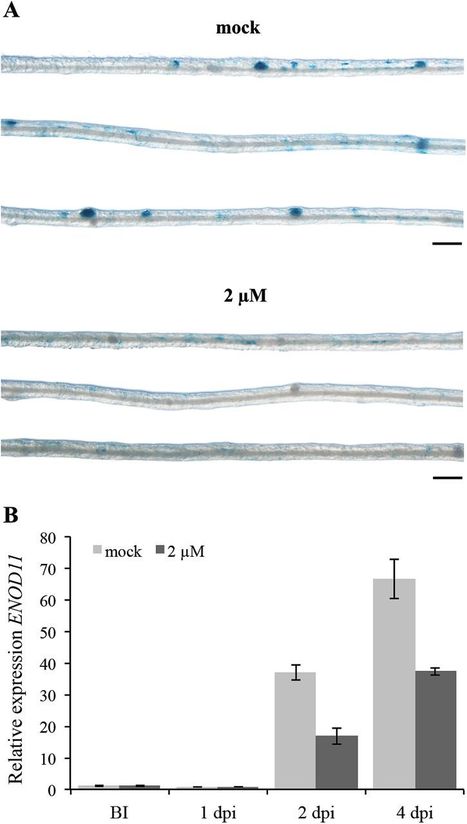
In the rhizosphere, strigolactones not only act as crucial signalling molecules in the communication of plants with parasitic weeds and arbuscular mycorrhiza, but they also play a key role in regulating different aspects of the root system. Here we investigated how strigolactones influence the root architecture of Medicago truncatula. We provide evidence that addition of the synthetic strigolactone analogue GR24 has an inhibitory effect on the lateral root density. Moreover, treatment with GR24 of Sinorhizobium meliloti-inoculated M. truncatula plants affects the nodule number both positively and negatively, depending on the concentration. Plants treated with 0.1 µM GR24 had a slightly increased number of nodules, whereas concentrations of 2 and 5 µM strongly reduced it. This effect was independent of the autoregulation of nodulation mechanism that is controlled by SUPER NUMERIC NODULE. Furthermore, we demonstrate that GR24 controls the nodule number through crosstalk with SICKLE-dependent ethylene signalling. Additionally, because the expression of the nodulation marker EARLY NODULATION11 was strongly reduced in GR24-treated plants, we concluded that strigolactones influence nodulation at a very early stage of the symbiotic interaction.
|
|
Scooped by
Jean-Michel Ané
November 4, 2014 11:11 AM
|
Lettuce is one of the most common raw foods world-wide, but occasionally also involved in pathogen outbreaks. To understand the correlative structure of the bacterial community as a network, we studied root microbiota of eight ancient and modern Lactuca sativa cultivars and the wild ancestor L. serriola by pyrosequencing of 16S rRNA gene amplicon libraries. The lettuce microbiota was dominated by Proteobacteria and Bacteriodetes, as well as abundant Chloroflexi and Actinobacteria. Cultivar-specificity comprised 12.5% of the species. Diversity indices were not different between lettuce cultivar groups but higher than in L. serriola, suggesting that domestication lead to bacterial diversification in lettuce root system. Spearman correlations between OTUs showed that co-occurrence prevailed over co-exclusion, and complementary FISH-CLSM analyses revealed that this pattern results from both potential interactions and habitat sharing. Predominant taxa, such as Pseudomonas, Flavobacterium, and Sphingomonadaceae rather suggested interactions, even though these are not necessarily part of significant modules in the co-occurrence networks. Without any need for complex interactions, single organisms are able to invade into this microbial network and to colonize lettuce plants; a fact which can influence the susceptibility to pathogens. The approach to combine co-occurrence analysis and FISH-CLSM allows reliably reconstructing and interpreting microbial interaction networks.
|
|
Scooped by
Jean-Michel Ané
November 4, 2014 11:09 AM
|
Plant-associated microorganisms affect the health of their hosts in diverse ways, yet the distribution of these organisms within individual plants remains poorly understood. To address this knowledge gap, we assessed the spatial variability in bacterial community diversity and composition found on and in aboveground tissues of individual Ginkgo biloba trees. We sampled bacterial communities from > 100 locations per tree, including leaf, branch, and trunk samples, and used high-throughput sequencing of the 16S rRNA gene to determine the diversity and composition of these communities. Bacterial community structure differed strongly between bark and leaf samples, with bark samples harboring much greater bacterial diversity and a community composition distinct from leaves. Within sample types, we observed clear spatial patterns in bacterial diversity and community composition that corresponded to the samples’ proximity to the exterior of the tree. The composition of the bacterial communities found on trees is highly variable, but this variability is predictable and dependent on sampling location. Moreover, this work highlights the importance of carefully considering plant spatial structure when characterizing the microbial communities associated with plants and their impacts on plant hosts.
|
|
Scooped by
Jean-Michel Ané
November 4, 2014 11:07 AM
|
Elongation of the primary root during post germination of Medicago truncatula seedlings is a multigenic trait responsive to exogenous nitrate. Quantitative trait loci approach suggested the involvement of the nitrate transporter MtNPF6.8 in the inhibition of primary root elongation by high exogenous nitrate. In the present work, the inhibitory effect of nitrate on the elongation of primary roots via the inhibition of the elongation of root cortical cells was abolished in npf6.8 knockdown lines. Accordingly we propose that MtNPF6.8 mediates nitrate inhibitory effect on primary root growth in M. truncatula. pMtNPF6.8/GUS promoter-reporter fusions in Agrobacterium rhizogenes-generated transgenic roots showed the expression of MtNPF6.8 in the pericycle region of primary and lateral roots (LR) and in LR primordia and tips. MtNPF6.8 expression is insensitive to IAA and stimulated by ABA, which restored the inhibitory effect of nitrate in npf6.8 knockdown lines. It is then proposed that ABA acts downstream MtNPF6.8 in this nitrate-signaling pathway. Furthermore, MtNPF6.8 was shown to transport ABA in Xenopus oocytes suggesting an additional role of MtNPF6.8 in ABA root to shoot translocation. 15NO3--influx experiments showed that only the inducible component of the low-affinity transport system (iLATS) was affected in npf6.8 knockdown mutants. This indicates that MtNPF6.8 is a major contributor to the iLATS. The short-term induction (within 30 min) by nitrate of the expression of NR1 and NR2, genes that encode two nitrate reductase isoforms, was greatly reduced in the npf6.8 knockdown lines supporting a role of MtNPF6.8 in primary nitrate response in M. truncatula.
|
|
Scooped by
Jean-Michel Ané
November 3, 2014 9:31 PM
|
Almost all plant species form symbioses with soil fungi, and nutrient transfer to plants is largely mediated through this partnership. Studies of fungal nutrient transfer to plants have largely focused on the transfer of limiting soil nutrients, such as nitrogen and phosphorous, by mycorrhizal fungi. However, certain fungal endophytes, such as Metarhizium andBeauveria, are also able to transfer nitrogen to their plant hosts. Here, we review recent studies that have identified genes and their encoded transporters involved in the movement of nitrogen, phosphorous, and nonlimiting soil nutrients between symbionts. These recent advances in our understanding could lead to applications in agricultural and horticultural settings, and to the development of model fungal systems that could further elucidate the role of fungi in these symbioses.
|
|
Scooped by
Jean-Michel Ané
November 1, 2014 11:22 PM
|
Reverse transcription-quantitative PCR (RT-qPCR) has been widely adopted to measure differences in mRNA levels; however, biological and technical variation strongly affects the accuracy of the reported differences. RT-qPCR specialists have warned that, unless researchers minimize this variability, they may report inaccurate differences and draw incorrect biological conclusions. The Minimum Information for Publication of Quantitative Real-Time PCR Experiments (MIQE) guidelines describe procedures for conducting and reporting RT-qPCR experiments. The MIQE guidelines enable others to judge the reliability of reported results; however, a recent literature survey found low adherence to these guidelines. Additionally, even experiments that use appropriate procedures remain subject to individual variation that statistical methods cannot correct. For example, since ideal reference genes do not exist, the widely used method of normalizing RT-qPCR data to reference genes generates background noise that affects the accuracy of measured changes in mRNA levels. However, current RT-qPCR data reporting styles ignore this source of variation. In this commentary, we direct researchers to appropriate procedures, outline a method to present the remaining uncertainty in data accuracy, and propose an intuitive way to select reference genes to minimize uncertainty. Reporting the uncertainty in data accuracy also serves for quality assessment, enabling researchers and peer reviewers to confidently evaluate the reliability of gene expression data.
Hitherto fungi have rarely been considered in conservation biology, but this is changing as the field moves from addressing single species issues to an integrative ecosystem-based approach. The current emphasis on biodiversity as a provider of ecosystem services throws the spotlight on the vast diversity of fungi, their crucial roles in terrestrial ecosystems, and the benefits of considering fungi in concert with animals and plants. We reviewed the role of fungi in ecosystems and composed an overview of the current state of conservation of fungi. There are 5 areas in which fungi can be readily integrated into conservation: as providers of habitats and processes important for other organisms; as indicators of desired or undesired trends in ecosystem functioning; as indicators of habitats of conservation value; as providers of powerful links between human societies and the natural world because of their value as food, medicine, and biotechnological tools; and as sources of novel tools and approaches for conservation of megadiverse organism groups. We hope conservation professionals will value the potential of fungi, engage mycologists in their work, and appreciate the crucial role of fungi in nature.
Via Francis Martin
|
|
Scooped by
Jean-Michel Ané
November 1, 2014 11:17 AM
|
The potential of bacterial endophytes to improve symbiotic efficiency through synergistic interactions with rhizobia can help to improve nodulation and nitrogen fixation in legume plants. In the present study, we compared the effect of endophytic plant growth-promoting bacteria on nodulation and effective rhizobial symbiosis in soybean. Nodule endophyte Bacillus megaterium LNL6 isolated from root nodules of Lesperdeza sp. and plant endophyte Methylobacterium oryzae CBMB20 isolated from rice leaves were selected as endophytic co-inoculants. Treatment of Bradyrhizobium japonicum MN110 along with B. megaterium LNL6 and M. oryzae CBMB20 exhibited an increase in nodule number in pots at 35 days after sowing compared to single inoculation of MN110. Additionally, both the co-inoculation treatments showed significant increase in nodule activity which was measured in terms of nodule leghemoglobin content, nodulated root ARA and total plant nitrogen content compared to solitary inoculation of B. japonicum MN110. Though ACCD activity of the co-inoculated strains can be attributed to increase in nodule number, the observed increase in root nitrogenase activity and leghemoglobin content in the nodules is understood as due to plant growth promotion traits of the specific endophytic strains. High levels of IAA produced by B. megaterium LNL6 can be considered to have aided development of mature nodules which thereby improved the nodular nitrogen fixation. Thus, endophytic lifestyle combined with plant growth-promoting traits, such as IAA production, ACC deaminase, cellulase and nitrogenase activity by B. megaterium LNL6 and M. oryzae CBMB20, contributes to the improvement of overall symbiotic nitrogen fixation by the plant.
|
|
|
Scooped by
Jean-Michel Ané
November 5, 2014 10:10 PM
|
Plant symbiotic interactions with nitrogen-fixing bacteria could be used in agricultural and forest soils under harsh conditions and for land reclamation. These associations include rhizobia interacting with legumes species and the actinobacterium Frankia interacting with actinorhizal plants. These plants are distributed worldwide and suffer in many areas – especially in arid and semiarid regions from harsh biotic and abiotic conditions. Abiotic stress conditions include climatic conditions, soil characteristics, water and nutrient availability, salinity, and soil contamination by heavy metals, xenobiotics, and toxins. Thus, the improvement of symbiotic nitrogen fixation under stress conditions may rely on strategies devised to select more tolerant plant-bacteria associations and to use successfully efficient synergistic systems such as those involving mycorrhizal fungi and rhizobacteria, particularly plant growth-promoting rhizobacteria (PGPR). This chapter focuses on main stress conditions affecting plant-bacteria symbioses with emphasis on mechanisms that underpin plant resistance to stress. Biological strategies involving microbial inoculants aiming to protect and improve plant symbioses against detrimental effects of abiotic stresses so as to enhance the crop production in such conditions are discussed. In addition, plant-bacteria symbioses can also be used to promote the establishment of perennial vegetation that might limit the heavy metal pollution of soils and consequently represent an effective management procedure in disturbed soils. This chapter also focuses on main techniques successfully used for the purpose of land reclamation by plant-bacteria symbioses.
|
|
Scooped by
Jean-Michel Ané
November 5, 2014 10:07 PM
|
Legume-rhizobia symbioses are of practical importance in provision of sustained food supply. Currently, it provides approximately 45 % of N used in agriculture. This quantity will have to be augmented as the world’s population increases and natural resources used in production of fertilizer-N diminish. The major constraints for food security are soil salinity, sodicity, nutrient deficiency, and toxicity which are driven by indiscriminate use of agrochemicals including chemical fertilizers and pesticides, utilization of excess water resource coupled with climate changes, and periodic droughts. In this scenario, legume-rhizobia symbioses are nonpolluting, cost-effective ways to enhance high N2-fixing potential under stress conditions. Several symbiotic systems that are tolerant in extreme conditions of salinity, alkalinity, acidity, drought, toxic doses of fertilizer, and metal toxicity have been identified including rhizobial symbiosis in arid region. Extreme environmental conditions adversely affect rhizobia-legume interactions wherein rhizobial partner utilizes endogenous or exogenous osmolytes and secretes specific proteins to alleviate the problem of aridity, salinity, and toxicity. Thus, change in rhizobial population can be an indicator of soil fertility. Hence, osmoadapted rhizobial strains can be used as biofertilizers for salt-sensitive crops in saline soils. In this context, interaction among rhizobia, plant growth-promoting rhizobacteria (PGPR), and mycorrhiza are also important. Here, we give an account of relevance of biological nitrogen fixation (BNF) in sustained food supply, effects of extreme conditions on legume-rhizobia symbiosis, as well as interaction of rhizobia with belowground microbial diversity including mycorrhiza and adaptive strategies of rhizobia under condition of stress. We also discuss about models wherein osmotolerant rhizobia can be used as biofertilizers and sustain green revolution to evergreen revolution.
|
|
Scooped by
Jean-Michel Ané
November 5, 2014 9:14 PM
|
Soils encompass a huge diversity of organisms which mostly remains to be characterized due to a number of methodological and logistical issues. Nonetheless, remarkable progress has been made in recent years toward developing strategies to characterize and describe soil biodiversity, especially thanks to the development of molecular approaches relying on direct DNA extraction from the soil matrix.
Metabarcoding can be applied to DNA from any environment or organism, and is gaining increasing prominence in biodiversity studies. This approach is already commonly used to characterize soil microbial communities and its application is now being extended to other soil organisms, i.e. meso- and macro-fauna.
These developments offer unprecedented scientific and operational opportunities in order to better understand soil biodiversity distribution and dynamics, and to propose tools and strategies for biodiversity diagnosis. However, these opportunities also come with challenges that the scientific community must face. Such challenges are related to i) clarification of terminology, (ii) standardisation of methods and further methodological development for additional taxonomic groups, (iii) development of a common database, and (iv) ways to avoid waste of information and data derived from metabarcoding. In order to facilitate common application of metabarcoding in soil biodiversity assessment, we discuss these opportunities and challenges and propose solutions towards a more homogeneous framework.
|
|
Scooped by
Jean-Michel Ané
November 5, 2014 9:06 PM
|
|
|
Scooped by
Jean-Michel Ané
November 4, 2014 2:26 PM
|
36th New Phytologist Symposium: Cell biology at the plant-microbe interface. Eden Hotel Wolff, Munich, Germany 29 November - 1 December, 2015.
|
|
Scooped by
Jean-Michel Ané
November 4, 2014 11:14 AM
|
One of the ultimate goals in plant systems biology is to elucidate the genotype-phenotype relationship in plant cellular systems. Integrated network analysis that combines omics data with mathematical models has received particular attention. Here we focus on the latest cutting-edge computational advances that facilitate their combination. We highlight (1) network visualization tools, (2) pathway analyses, (3) genome-scale metabolic reconstruction, and (4) the integration of high-throughput experimental data and mathematical models. Multi-omics data that contain the genome, transcriptome, proteome, and metabolome and mathematical models are expected to integrate and expand our knowledge of complex plant metabolisms.
|
|
Scooped by
Jean-Michel Ané
November 4, 2014 11:10 AM
|
Plant-associated bacteria are intensively investigated concerning their characteristics for plant growth promotion, biocontrol mechanisms and enhanced phytoremediation efficiency. To obtain endophytes, different sampling and isolation protocols are used although their representativeness is not always clearly demonstrated. The objective of this study was to acquire representative pictures of the cultivable bacterial root, stem and leaf communities for all Brassica napus L. individuals growing on the same field.
For each plant organ genotypic identifications of the endophytic communities were performed using 3 replicates. Root replicates were composed of 3 total root systems, whereas stem and leaf replicates needed to consist of 6 independent plant parts in order to be representative. Greater variations between replicates were found when considering phenotypic characteristics. Correspondence analysis revealed reliable phenotypic results for roots and even shoots, but less reliable ones for leaves. Additionally, realistic Shannon-Wiener biodiversity indices were calculated for all 3 organs and showed similar Evenness factors.
Furthermore, it was striking that all replicates and thus the whole plant contained Pseudomonas and Bacillus strains although above- and below-ground plant tissues differed in most dominant bacterial genera and characteristics.
|
|
Scooped by
Jean-Michel Ané
November 4, 2014 11:09 AM
|
The methane emitted from rice fields originates to a large part (up to 60%) from plant photosynthesis and is formed on the rice roots by methanogenic archaea. To investigate to which extent root colonization controls CH4 emission, we pulse-labeled rice microcosms with 13CO2 to determine the rates of 13CH4 emission exclusively derived from photosynthates. We also measured emission of total CH4 (12+13CH4), which was largely produced in the soil. The total abundances of archaea and methanogens on the roots and in the soil were analyzed by quantitative PCR of the archaeal 16S rRNA gene and the mcrA gene coding for a subunit of the methyl coenzyme M reductase, respectively. The composition of archaeal and methanogenic communities was determined with terminal restriction fragment length polymorphism (T-RFLP). During the vegetative growth stages, emission rates of 13CH4 linearly increased with the abundance of methanogenic archaea on the roots and then decreased during the last plant growth stage. Rates of 13CH4 emission and the abundance of methanogenic archaea were lower when the rice was grown in quartz-vermiculite with only 10% rice soil. Rates of total CH4 emission were not systematically related to the abundance of methanogenic archaea in soil plus roots. The composition of the archaeal communities was similar under all conditions; however, the analysis of mcrA genes indicated that the methanogens differed between the soil and root. Our results support the hypothesis that rates of photosynthesis-driven CH4 emission are limited by the abundance of methanogens on the roots.
|
|
Scooped by
Jean-Michel Ané
November 4, 2014 10:00 AM
|
There is wide breadth of root function within ecosystems that should be considered when modeling the terrestrial biosphere. Root structure and function are closely associated with control of plant water and nutrient uptake from the soil, plant carbon (C) assimilation, partitioning and release to the soils, and control of biogeochemical cycles through interactions within the rhizosphere. Root function is extremely dynamic and dependent on internal plant signals, root traits and morphology, and the physical, chemical and biotic soil environment. While plant roots have significant structural and functional plasticity to changing environmental conditions, their dynamics are noticeably absent from the land component of process-based Earth system models used to simulate global biogeochemical cycling. Their dynamic represen- tation in large-scale models should improve model veracity. Here, we describe current root inclusion in models across scales, ranging from mechanistic processes of single roots to parameterized root processes operating at the landscape scale. With this foundation we discuss how existing and future root functional knowledge, new data compilation efforts, and novel modeling platforms can be leveraged to enhance root functionality in large-scale terrestrial biosphere models by improving parameterization within models, and introducing new components such as dynamic root distribution and root functional traits linked to resource extraction.
|
|
Scooped by
Jean-Michel Ané
November 3, 2014 3:25 PM
|
The effective volume of the root system is massively increased.
Increased drought tolerance
Improved stress resistance
Phosphorous, Nitrogen and other key nutrients are more readily available to the host plant
Plants are less prone to attacks from pathogens and undesirables
Increase in resistance to ‘Rose replant disease’
Soil structure will be improved
|
|
Scooped by
Jean-Michel Ané
November 1, 2014 11:56 AM
|
We present a guided-inquiry biology lesson, using the plant–rhizobium symbiosis as a model system. This system provides a rich environment for developing connections between the big ideas in biology as outlined in the College Board’s new AP Biology Curriculum. Students gain experience with the practice of scientific investigation, from designing and conducting experiments to making claims based on the data they collect. We include one example of a piloted classroom experiment that can easily be modified to test a variety of interesting ecological and evolutionary hypotheses.
|
|
Scooped by
Jean-Michel Ané
November 1, 2014 11:18 AM
|
A silica-based propagation medium was developed for large-scale production of ectomycorrhizal (ECM) fungal inoculum by solid state fermentation. Development of the medium was started by screening for an optimal growth medium among six different semisynthetic agar media traditionally used in cultivation of ECM fungi. The majority (65 %) of the twenty tested ECM fungal strains that typically colonize Norway spruce (Picea abies) seedlings grew best on modified Melin-Norkrans (MMN) medium with reduced sugar content (½MMN). In order to develop a nutritionally similar medium for large-scale cultivation of the ECM fungi, we chose silica to form a solid matrix and light brewery malt extract to provide nutrients. The medium was supplemented with a commercial humic acid product that was shown to boost fungal growth. The optimal concentration of the constituents was screened for in two assays by determining the growth rates of seven potential inoculant ECM fungal strains (Amphinema sp., Cenococcum geophilum, Hebeloma sp., Meliniomyces bicolor, Paxillus involutus, Piloderma byssinum, and Tylospora asterophora). As a result, we composed a silica-based mass propagation medium (pH 5.8) containing 2.5 % brewery malt extract and 0.5 g/l humic acid product Lignohumate AM. This medium is easily produced and supported good growth of even the slowly growing and rarely studied Athelioid ECM strains. Furthermore, root systems of Norway spruce nursery seedlings were colonized by the tested ECM fungi by using solid inoculum formulated from the silica medium.
|


 Scoop.it!