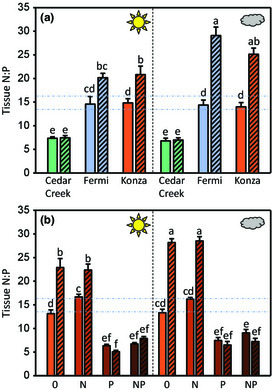
Mycorrhizal phenotypes arise from interactions among plant and fungal genotypes and the environment. Differences in the stoichiometry and uptake capacity of fungi and plants make arbuscular mycorrhizal (AM) fungi inherently more nitrogen (N) limited and less phosphorus (P) limited than their host plants. Mutualistic phenotypes are most likely in P-limited systems and commensal or parasitic phenotypes in N-limited systems. Carbon (C) limitation is expected to cause phenotypes to shift from mutualism to commensalism and even parasitism. Two experiments compared the influence of fertilizer and shade on mycorrhizas in Andropogon gerardii across three naturally N-limited or P-limited grasslands. A third experiment examined the interactive effects of N and P enrichment and shade on A. gerardii mycorrhizas. Our experiments generated the full spectrum of mycorrhizal phenotypes. These findings support the hypothesis that mutualism is likely in P-limited systems and commensalism or parasitism is likely in N-limited systems. Furthermore, shade decreased C-assimilation and generated less mutualistic mycorrhizal phenotypes with reduced plant and fungal biomass. Soil fertility is a key controller of mycorrhizal costs and benefits and the Law of the Minimum is a useful predictor of mycorrhizal phenotype. In our experimental grasslands arbuscular mycorrhizas can ameliorate P-limitation but not N-limitation.
The genus Amanita encompasses both symbiotic, ectomycorrhizal fungi and asymbiotic litter decomposers; all species are derived from asymbiotic ancestors. Symbiotic species are no longer able to degrade plant cell walls. The carbohydrate esterases family 1 (CE1s) is a diverse group of enzymes involved in carbon metabolism, including decomposition and carbon storage. CE1 genes of the ectomycorrhizal A. muscaria appear diverged from all other fungal homologues, and more similar to CE1s of bacteria, suggesting a horizontal gene transfer (HGT) event.In order to test whether AmanitaCE1s were acquired horizontally, we built a phylogeny of CE1s collected from across the tree of life, and describe the evolution of CE1 genes among Amanita and relevant lineages of bacteria.CE1s of symbiotic Amanita were very different from CE1s of asymbiotic Amanita, and are more similar to bacterial CE1s. The protein structure of one CE1 gene of A. muscaria matched a depolymerase that degrades the carbon storage molecule poly((R)-3-hydroxybutyrate) (PHB). Asymbiotic Amanita do not carry sequence or structural homologues of these genes.The CE1s acquired through HGT may enable novel metabolisms, or play roles in signaling or defense. This is the first evidence for the horizontal transfer of carbohydrate metabolism genes into ectomycorrhizal fungi.
We hear a lot about how agriculture affects climate change and other environmental issues, but we hear little about how these issues affect agriculture. When we look at both sides of the issues, we can develop better solutions for sustainable agriculture without adversely affecting the environment. Agroecology, Ecosystems, and Sustainability explores a modern vision of ecology and agricultural systems, so that crop production can be sustainably developed without further environmental degradation. With contributions from experts from more than 20 countries, the book describes how to make the transition to modern agroecology to help the environment. It examines the global availability of natural resources and how agroecology could allow the world population to reach the goal of global sustainable ecological, agricultural, and food production systems. The book discusses important principles that regulate agroecological systems, including crop production, soil management, and environment preservation. Making the link between theory and practices, the book includes examples of agroecology such as an interdisciplinary framework for the management of integrated production and conservation landscapes and the use of mechanized rain-fed farming and its ecological impact on drylands. An examination of how ecology and agriculture can be allied to ensure food production and security without threatening our environment, the text shows you how natural resources can be used in a manner to create a "symbiosis" to preserve ecological systems and develop agriculture.
Endophytic fungi live asymptomatically within plants. They are usually regarded as nonpathogenic or even mutualistic, but whether plants respond antagonistically to their presence remains unclear, particularly in the little-studied associations between endophytes and nongraminoid herbaceous plants. We investigated the effects of the endophyte Chaetomium cochlioides on leaf chemistry in Cirsium arvense. Plants were sprayed with spores; leaf material from both subsequent new growth and the sprayed leaves was analysed 2 wk later. Infection frequency was 91% and 63% for sprayed and new growth, respectively, indicating that C. cochlioides rapidly infects new foliage. Metabolomic analyses revealed marked changes in leaf chemistry with infection, especially in new growth. Changes in several novel oxylipin metabolites were detected, including arabidopsides reported here for the first time in a plant species other than Arabidopsis thaliana, and a jasmonate-containing galactolipid. The production of these metabolites in response to endophyte presence, particularly in newly infected foliage, suggests that endophytes elicit similar chemical responses in plants to those usually produced following wounding, herbivory and pathogen invasion. Whether endophytes benefit their hosts may depend on a complex series of chemically mediated interactions between the plant, the endophyte, other microbial colonists and natural enemies.
Nodules play an important role in fixing atmospheric nitrogen for soybean growth. Premature senescence of nodules can negatively impact on nitrogen availability for plant growth and as such we need a better understanding of nodule development and senescence. Cysteine proteases are known to play a role in nodule senescence, but knowledge is still fragmented regarding the function their inhibitors (cystatins) during the development and senescence of soybean nodules. This study provides the first data with regard to cystatin expression during nodule development combined with biochemical characterization of their inhibition strength.ResultsSeventy nine non-redundant cysteine protease gene sequences with homology to papain, belonging to different subfamilies, and several legumain-like cysteine proteases (vacuole processing enzymes) were identified from the soybean genome assembly with eighteen of these cysteine proteases actively transcribed during nodule development and senescence. In addition, nineteen non-redundant cystatins similar to oryzacystatin-I and belonging to cystatin subgroups A and C, were identified from the soybean genome assembly with seven actively transcribed in nodules. Most cystatins had preferential affinity to cathepsin L-like cysteine proteases. Transcription of cystatins Glyma05g28250, Glyma15g12211, Glyma15g36180 particularly increased during onset of senescence, possibly regulating proteolysis when nodules senesce and undergo programmed cell death. Both actively transcribed and non-actively transcribed nodule cystatins inhibited cathepsin-L- and B-like activities in different age nodules and they also inhibited papain and cathepsin-L activity when expressed and purified from bacterial cells.ConclusionsOverlap in activities and specificities of actively and non-actively transcribed cystatins raises the question if non-transcribed cystatins provide a reservoir for response to particular environments. This data might be applicable to the development of strategies to extend the active life span of nodules or prevent environmentally induced senescence.
Mature Nicotiana benthamiana shows stable resistance to the oomycete pathogen Phytophthora infestans. Induction of phytoalexin (capsidiol) production is essential for the resistance, which is upregulated via a mitogen-activated protein kinase (MAPK) cascade (NbMEK2-WIPK/SIPK) followed by ethylene signaling. In this study, NbNup75 (encodes a nuclear pore protein Nucleoporin75) was identified as an essential gene for resistance of N. benthamiana to P. infestans. In NbNup75-silenced plants, initial events of elicitor-induced responses such as phosphorylation of MAPK and expression of defense-related genes were not affected, whereas induction of later defense responses such as capsidiol production and cell death induction was suppressed or delayed. Ethylene production induced by either INF1 or NbMEK2 was reduced in NbNup75-silenced plants, whereas the expression of NbEAS (a gene for capsidiol biosynthesis) induced by ethylene was not affected, indicating that Nup75 is required for the induction of ethylene production but not for ethylene signaling. Given that nuclear accumulation of polyA RNA was increased in NbNup75-silenced plants, efficient export of mRNA from nuclei via nuclear pores would be important for the timely upregulation of defense responses. Collectively, Nup75 is involved in the induction of a later stage of defense responses, including the ethylene-mediated production of phytoalexin for the resistance of N. benthamiana to P. infestans.
Hemoglobins (Hbs) corresponding to non-symbiotic (nsHb) and truncated (tHb) Hbs have been identified in rice (Oryza). This review discusses the major findings from the current studies on rice Hbs. At the molecular level, a family of the nshb genes, consisting of hb1, hb2, hb3, hb4 and hb5, and a single copy of the thb gene exist in Oryza sativa var. indica and O. sativa var. japonica, Hb transcripts coexist in rice organs and Hb polypeptides exist in rice embryonic and vegetative organs and in the cytoplasm of differentiating cells. At the structural level, the crystal structure of rice Hb1 has been elucidated, and the structures of the other rice Hbs have been modeled. Kinetic analysis indicated that rice Hb1 and 2, and possibly rice Hb3 and 4, exhibit an extremely high affinity for O2, whereas rice Hb5 and tHb possibly exhibit a low to moderate affinity for O2. Based on the accumulated information on the properties of rice Hbs and data from the analysis of other plant and non-plant Hbs, it is likely that Hbs play a variety of roles in rice organs, including O2-transport, O2-sensing, NO-scavenging and redox-signaling. From an evolutionary perspective, an outline for the evolution of rice Hbs is available. Rice nshb and thb genes vertically evolved through different lineages, rice nsHbs evolved into clade I and clade II lineages and rice nshbs and thbs evolved under the effect of neutral selection. This review also reveals lacunae in our ability to completely understand rice Hbs. Primary lacunae are the absence of experimental information about the precise functions of rice Hbs, the properties of modeled rice Hbs and the cis-elements and trans-acting factors that regulate the expression of rice hb genes, and the partial understanding of the evolution of rice Hbs.
Altered disturbance regimes and novel introductions are causing rapid shifts in the distribution of pines (Pinus L.). The functionally obligate symbiosis between pines and ectomycorrhizal (EM) fungi dictates that shifts in the distribution of one partner will affect the distribution of the other. In this review, we examine evidence for three hypotheses. (1) The loss of photosynthates through stress or tree mortality decreases the abundance of EM fungi and selects for less carbon-demanding species. (2) Pine introductions initiate establishment of novel EM fungal communities. (3) The extent of shifts in EM fungal abundance and community composition is mediated by surrounding vegetation. We find support for these hypotheses though changes in EM fungal abundance are variable and context-dependent. We posit that the consequences of shifts in EM fungal abundance and community composition extend beyond the individual tree to the landscape; these changes may affect population dynamics of both symbionts, ecosystem processes, and the conservation and evolution of fungi. In addition to conducting baseline surveys to assess the distribution of EM fungi, increasing our understanding of their function, morphology, propagation, and controls on host-specificity, and shifts would also assist in predicting the trajectory of ecosystems following the loss or gain of pine.
The family Frankiaceae, within the order Actinomycetales, contains bacteria isolated mainly from root nodules and occasionally from soil. Members of the genus Frankia have been found associated with the roots of 23 genera of dicots belonging to eight families. Historically, strains isolated in pure culture were grouped into two physiological categories, those that use carbohydrates and those that do not. Newer genomic information indicated that frankiae in general differ markedly in their complements of genes. Besides physiological grouping, these isolates were placed into four plant-compatibility groups (1-infective on Alnus and Myrica, 2-infective on Casuarina and Myrica, 3-infective on Elaeagnaceae and Myrica, 4-infective only on Elaeagnaceae). A 16S rRNA gene-based phylogenetic study, comprising non-isolated endophytes, yielded four clusters or clades, three of which are symbiotic (1-infective on Alnus and Casuarinaceae except Gymnostoma, 2-non-isolated strains in nodules of Rosaceae-Datisca-Coriaria-Rhamnaceae, 3-infective on Elaeagnaceae and Gymnostoma) and a fourth cluster that groups non-infective and non-effective strains. These groupings have been confirmed on the whole by analysis of other loci. DNA-DNA hybridization studies have yielded 12–15 genospecies, only one of which has been named, Frankia alni; one Candidatus Frankia datiscae was recently named to accommodate the genome of an endophyte in nodules of Datisca glomerata. The family Frankiaceae is close to Acidothermus, Cryptosporangium, Geodermatophilaceae (Geodermatophilus, Modestobacter, Blastococcus), Nakamurella, Sporichthya, and Fodinicola and was grouped into suborder Frankineae. A recent rearrangement has resulted in the elevation of suborder Frankineae to order Frankiales (Normand and Benson 2012b) containing families Acidothermaceae, Cryptosporangiaceae, Frankiaceae, Geodermatophilaceae, Nakamurellaceae, and Sporichthyaceae as well as the incertae sedis Fodinicola feengrottensis.
Time lapse sequence shot using Pentax K110D and Harbortronics DigiSnap 2100 set to take a frame each 29 minutes 45 seconds. The time lapse spans 10 days. Two...
A $2.5 million grant from the National Science Foundation and the Biotechnology and Biological Sciences Research Council in the United Kingdom allows Udvardi and his collaborators to explore this. (The project is split among researchers at the Noble Foundation, Montana State University, the University of Wisconsin-Madison and the Massachusetts Institute of Technology in the U.S., and the John Innes Center and Oxford University in the UK.)
One approach would be to genetically alter a form of rhizobia to allow the same chemical crosstalk that takes place in legumes to happen in another species. Another possibility is enabling other bacteria to work like rhizobia.
"There's a suite of microorganisms that will colonize plants, but they aren't really supplying nitrogen," said John Peters of Montana State University, who is also working on the project. "Typically they're not feeding the plant with significant amounts of fixed nitrogen. What we're trying to do is strengthen these associations."
But first the genetic instructions involved in the nitrogen fixation process have to be identified. Then the researchers must figure out how active these genes need to be and in what metabolic systems of the bacterial cell. For example, if the bacteria produce ammonia, scientists want to be sure that it is ferried on to the plant and not used by the microbe itself.
"This is the first time a group of scientists have come together to try to manipulate both the plant and the bacteria," Udvardi said. "If we can work out the rules of engagement – the ways microbes and plants can live together – we can develop novel nitrogen-fixing systems to reduce the amount of nitrogen fertilizer used in agriculture, which will be a win-win situation for agriculture and the environment."
BioMed Research International (formerly titled Journal of Biomedicine and Biotechnology) is a peer-reviewed, open access journal that publishes original research articles as well as review articles in several areas of life sciences. The journal’s Editorial Board is divided into the 55 subject areas included within the journal’s scope.
Ecological interactions are frequently conserved across evolutionary time. In the case of mutualisms, these conserved interactions may play a large role in structuring mutualist communities. We hypothesized that phylogenetic trait conservation could play a key role in determining patterns of association in the ectomycorrhizal symbiosis, a globally important trophic mutualism. We used the association between members of the pantropical plant tribe Pisonieae and its fungal mutualist partners as a model system to test the prediction that Pisonieae-associating ectomycorrhizal fungi will be more closely related than expected by chance, reflecting a conserved trait. We tested this prediction using previously published and newly generated sequences in a Bayesian framework incorporating phylogenetic uncertainty. We report that phylogenetic trait conservation does exist in this association. We generated a five-marker phylogeny of members of the Pisonieae and used this phylogeny in a Bayesian relaxed molecular clock analysis. We established that the most recent common ancestors of Pisonieae species and Pisonieae-associating fungi sharing phylogenetic conservation of their patterns of ectomycorrhizal association occurred no more recently than 14.2 Ma. We therefore suggest that phylogenetic trait conservation in the Pisonieae ectomycorrhizal mutualism association represents an inherited syndrome which has existed for at least 14 Myr.
Iron–sulfur clusters are a universal biological motif. They carry out electron transfer, redox chemistry and even oxygen sensing, in diverse processes including nitrogen fixation, respiration and photosynthesis. Their low-lying electronic states are key to their remarkable reactivity, but they cannot be directly observed. Here, we present the first ever quantum calculation of the electronic levels of [2Fe–2S] and [4Fe–4S] clusters free from any model assumptions. Our results highlight the limitations of long-standing models of their electronic structure. In particular, we demonstrate that the widely used Heisenberg double exchange model underestimates the number of states by one to two orders of magnitude, which can conclusively be traced to the absence of Fe d d excitations, thought to be important in these clusters. Furthermore, the electronic energy levels of even the same spin are dense on the scale of vibrational fluctuations and this provides a natural explanation for the ubiquity of these clusters in catalysis in nature.
Aims To evaluate the diversity of endophytic fungi from the leaves of the common bean and the genetic diversity of endophytic fungi from the genus Colletrotricum using IRAP (inter-retrotransposon amplified polymorphism) and REMAP (retrotransposon-microsatellite amplified polymorphism) analyses.
Methods and Results The fungi were isolated by tissue fragmentation and identified by analyzing the morphological features and sequencing the internal transcribed spacer (ITS) regions and the rDNA large subunit (LSU). Twenty-seven different taxa were identified. Colletotrichum was the most commonly isolated genera from the common bean (32.69% and 24.29% of the total isolates from the Ouro Negro and Talismã varieties, respectively). The IRAP and REMAP analyses revealed a high genetic diversity in the Colletotrichum endophytic isolates and were able to discriminate these isolates from the phytopathogen C. lindemuthianum.
Conclusions Fungi from the genus Colletotrichum are abundant in the Phaseolus vulgaris endophytic community and the IRAP and REMAP markers can be used to rapidly distinguish between C. lindemuthianum and other Colletotrichum members that are frequently found as endophytes.
Significance and Impact of the Study This is the first report of the diversity of endophytic fungi present in the common bean and the use of IRAP and REMAP markers to assess the genetic diversity of endophytic fungi from the genus Colletotrichum.
The phyllosphere—the aerial surfaces of plants, including leaves—is a ubiquitous global habitat that harbors diverse bacterial communities. Phyllosphere bacterial communities have the potential to influence plant biogeography and ecosystem function through their influence on the fitness and function of their hosts, but the host attributes that drive community assembly in the phyllosphere are poorly understood. In this study we used high-throughput sequencing to quantify bacterial community structure on the leaves of 57 tree species in a neotropical forest in Panama. We tested for relationships between bacterial communities on tree leaves and the functional traits, taxonomy, and phylogeny of their plant hosts. Bacterial communities on tropical tree leaves were diverse; leaves from individual trees were host to more than 400 bacterial taxa. Bacterial communities in the phyllosphere were dominated by a core microbiome of taxa including Actinobacteria, Alpha-, Beta-, and Gammaproteobacteria, and Sphingobacteria. Host attributes including plant taxonomic identity, phylogeny, growth and mortality rates, wood density, leaf mass per area, and leaf nitrogen and phosphorous concentrations were correlated with bacterial community structure on leaves. The relative abundances of several bacterial taxa were correlated with suites of host plant traits related to major axes of plant trait variation, including the leaf economics spectrum and the wood density–growth/mortality tradeoff. These correlations between phyllosphere bacterial diversity and host growth, mortality, and function suggest that incorporating information on plant–microbe associations will improve our ability to understand plant functional biogeography and the drivers of variation in plant and ecosystem function.
Neighbouring plants are known to vary from having similar to dissimilar arbuscular mycorrhizal fungal (AMF) communities. One possibility is that closely related plants have more similar AMF communities than more distantly related plants, an indication of phylogenetic host specificity. Here, we investigated the structure of AMF communities among dominant grassland plants at three sites in the Northern Great Plains to test whether the pairwise phylogenetic distance among plant species was correlated with pairwise AMF community dissimilarity. For eight dominant and co-occurring grassland plant species, we reconstructed a phylogeny based on DNA data and characterized the AMF communities of their roots at each site. Community analyses revealed that AMF communities varied among sites and among plant species. Contrary to expectations for phylogenetic host specificity, we found that within a site more closely related plants had more distinct AMF communities despite their having similar phenologies. Associations with unique AMF communities may enhance the functional complementarity of related species and promote their coexistence.
Arbuscular mycorrhizal (AM) fungi can affect many different micronutrients and macronutrients in plants and also influence host volatile compound synthesis. Their effect on the edible portions of plants is less clear. Two separate studies were performed to investigate whether inoculation by AM fungi (Rhizophagus irregularis, Funneliformis mosseae, or both) can affect the food quality of tomato fruits, in particular common minerals, antioxidants, carotenoids, a suite of vitamins, and flavor compounds (sugars, titratable acids, volatile compounds). It was found that AM fungal inoculation increased the nutrient quality of tomato fruits for most nutrients except vitamins. Fruit mineral concentration increased with inoculation (particularly N, P, and Cu). Similarly, inoculated plants had fruit with higher antioxidant capacity and more carotenoids. Furthermore, five volatile compounds were significantly higher in AM plants compared with non-AM controls. Taken together, these results show that AM fungi represent a promising resource for improving both sustainable food production and human nutritional needs.
Rhizobiaceae is a family of Rhizobiales order into Alphaproteobacteria class that presents genera associated with soil and planta hosts. Rhizobium is the type genus and encompasses the largest number of species into the family. Taxonomy is mostly supported by phylogenetic analyses based on 16S rRNA sequences and nomenclature in Rhizobiaceae is one issue that has caused much discussion. Bacteria are phenotypically heterogeneous, predominately aerobic, and Gram-negative rod-shaped. Many species present large plasmids which harbor a large proportion of genome generally including genes involved in interaction with specific hosts. Some members of the Rhizobiaceae family are characterized by their ability to establish symbiotic associations with host plants and develop the process of biological nitrogen fixation. In contrast, others are able to establish pathogenicity against plants. Both skills can be exploited for applied purposes. The selection of efficient strains from Rhizobium and Ensifer designed to plant inoculants is one of important research viewing the production of microbial inoculants to help plant development. Considering Agrobacterium tumesfaciens, the management of its natural ability to transform plants is directed to obtaining disarmed strains and clone vectors widely applied to recombinant DNA technology and plant biotechnology. Finally, some genera in Rhizobiaceae family have intriguing metabolisms which allow degradation of potentially toxic molecules and thus could be applied as biomarkers or in bioremediation.
In the present study, soil bacterial and fungal communities across vanilla continuous cropping time-series fields were assessed through deep pyrosequencing of 16S ribosomal RNA (rRNA) genes and internal transcribed spacer (ITS) regions. The results demonstrated that the long-term monoculture of vanilla significantly altered soil microbial communities. Soil fungal diversity index increased with consecutive cropping years, whereas soil bacterial diversity was relatively stable. Bray-Curtis dissimilarity cluster and UniFrac-weighted principal coordinate analysis (PCoA) revealed that monoculture time was the major determinant for fungal community structure, but not for bacterial community structure. The relative abundances (RAs) of the Firmicutes, Actinobacteria, Bacteroidetes, and Basidiomycota phyla were depleted along the years of vanilla monoculture. Pearson correlations at the phyla level demonstrated that Actinobacteria, Armatimonadetes, Bacteroidetes, Verrucomicrobia, and Firmicutes had significant negative correlations with vanilla disease index (DI), while no significant correlation for fungal phyla was observed. In addition, the amount of the pathogen Fusarium oxysporum accumulated with increasing years and was significantly positively correlated with vanilla DI. By contrast, the abundance of beneficial bacteria, including Bradyrhizobium and Bacillus, significantly decreased over time. In sum, soil weakness and vanilla stem wilt disease after long-term continuous cropping can be attributed to the alteration of the soil microbial community membership and structure, i.e., the reduction of the beneficial microbes and the accumulation of the fungal pathogen.
We report on the contamination of commercial 15-nitrogen (15N) N2 gas stocks with 15N-enriched ammonium, nitrate and/or nitrite, and nitrous oxide. 15N2 gas is used to estimate N2 fixation rates from incubations of environmental samples by monitoring the incorporation of isotopically labeled 15N2 into organic matter. However, the microbial assimilation of bioavailable 15N-labeled N2 gas contaminants, nitrate, nitrite, and ammonium, is liable to lead to the inflation or false detection of N2 fixation rates. 15N2 gas procured from three major suppliers was analyzed for the presence of these 15N-contaminants. Substantial concentrations of 15N-contaminants were detected in four Sigma-Aldrich 15N2 lecture bottles from two discrete batch syntheses. Per mole of 15N2 gas, 34 to 1900 µmoles of 15N-ammonium, 1.8 to 420 µmoles of 15N-nitrate/nitrite, and ≥21 µmoles of 15N-nitrous oxide were detected. One 15N2 lecture bottle from Campro Scientific contained ≥11 µmoles of 15N-nitrous oxide per mole of 15N2 gas, and no detected 15N-nitrate/nitrite at the given experimental 15N2 tracer dilutions. Two Cambridge Isotopes lecture bottles from discrete batch syntheses contained ≥0.81 µmoles 15N-nitrous oxide per mole 15N2, and trace concentrations of 15N-ammonium and 15N-nitrate/nitrite. 15N2 gas equilibrated cultures of the green algae Dunaliella tertiolecta confirmed that the 15N-contaminants are assimilable. A finite-differencing model parameterized using oceanic field conditions typical of N2 fixation assays suggests that the degree of detected 15N-ammonium contamination could yield inferred N2 fixation rates ranging from undetectable, <0.01 nmoles N L−1 d−1, to 530 nmoles N L−1 d−1, contingent on experimental conditions. These rates are comparable to, or greater than, N2 fixation rates commonly detected in field assays. These results indicate that past reports of N2 fixation should be interpreted with caution, and demonstrate that the purity of commercial 15N2 gas must be ensured prior to use in future N2 fixation rate determinations.
Plants rapidly release photoassimilated carbon (C) to the soil via direct root exudation and associated mycorrhizal fungi, with both pathways promoting plant nutrient availability. This study aimed to explore these pathways from the root's vascular bundle to soil microbial communities. Using nanoscale secondary ion mass spectrometry (NanoSIMS) imaging and 13C-phospho- and neutral lipid fatty acids, we traced in-situ flows of recently photoassimilated C of 13CO2-exposed wheat (Triticum aestivum) through arbuscular mycorrhiza (AM) into root- and hyphae-associated soil microbial communities. Intraradical hyphae of AM fungi were significantly 13C-enriched compared to other root-cortex areas after 8 h of labelling. Immature fine root areas close to the root tip, where AM features were absent, showed signs of passive C loss and co-location of photoassimilates with nitrogen taken up from the soil solution. A significant and exclusively fresh proportion of 13C-photosynthates was delivered through the AM pathway and was utilised by different microbial groups compared to C directly released by roots. Our results indicate that a major release of recent photosynthates into soil leave plant roots via AM intraradical hyphae already upstream of passive root exudations. AM fungi may act as a rapid hub for translocating fresh plant C to soil microbes.
Up till now various plant–fungal interactions have been extensively studied in the form of mycorrhizal, parasitic or endophytic lifestyles. Many of those interactions are beneficial to the host plants and a few are detrimental. Several investigations have pointed towards the interconversion of one fungal lifestyle into another while interact the plant system meaning endophyte may become parasite or vice versa. In such case, it is necessary to realize whether these different lifestyles are interconnected at some points either by physiological, biochemical or molecular routes and to identify the factors that trigger the change in fungal lifestyle, which is entirely different than earlier one and affects the host plant significantly. This review highlights the possible mechanisms of switching among the lifestyles of fungi based on recent findings and discusses the factors affecting plant fungal interactions. It also underlines the need for studying this important facet of plant–fungal interactions in depth which may in future help to fetch more advantages and to avoid the severe consequences in agriculture and other related fields.
To get content containing either thought or leadership enter:
To get content containing both thought and leadership enter:
To get content containing the expression thought leadership enter:
You can enter several keywords and you can refine them whenever you want. Our suggestion engine uses more signals but entering a few keywords here will rapidly give you great content to curate.


 Your new post is loading...









Excellent paper... very cool study.