Mycorrhizal Fungi, a totally natural organism which has been around for 500 million years but has never been needed more than it is today. It naturally draws the soils nutrients to your plants, helps them through drought and holds Carbon dioxide - C02 - in the soil.
The root knot nematodes (RKN), Meloydogine spp., particularly Meloidogyne incognita and Meloidogyne javanica species, parasitize several plant species and are responsible for large annual yield losses all over the world. Only a few available chemical nematicides are still authorized for RKN control owing to environmental and health reasons. Thus, plant resistance is currently considered the method of choice for controlling RKN, and research performed on the molecular interactions between plants and nematodes to identify genes of interest is of paramount importance. The present work aimed to identify the differential accumulation of root proteins of a resistant cowpea genotype (CE-31) inoculated with M. incognita (Race 3) in comparison with mock-inoculated control, using 2D electrophoresis assay, mass spectrometry identification and gene expression analyses by RT-PCR. The results showed that at least 22 proteins were differentially represented in response to RKN challenge of cowpea roots mainly within 4–6 days after inoculation. Amongst the up-represented proteins were SOD, APX, PR-1, β-1,3-glucanase, chitinases, cysteine protease, secondary metabolism enzymes, key enzymes involved in ethylene biosynthesis, proteins involved in MAPK pathway signaling and, surprisingly, leghemoglobin in non-rhizobium-bacterized cowpea. These findings show that an important rearrangement in the resistant cowpea root proteome occurred following challenge with M. incognita.
Plant production systems globally must be optimized to produce stable high yields from limited land under changing and variable climates. Demands for food, animal feed, and feedstocks for bioenergy and biorefining applications, are increasing with population growth, urbanization and affluence. Low-input, sustainable, alternatives to petrochemical-derived fertilizers and pesticides are required to reduce input costs and maintain or increase yields, with potential biological solutions having an important role to play. In contrast to crops that have been bred for food, many bioenergy crops are largely undomesticated, and so there is an opportunity to harness beneficial plant–microbe relationships which may have been inadvertently lost through intensive crop breeding. Plant–microbe interactions span a wide range of relationships in which one or both of the organisms may have a beneficial, neutral or negative effect on the other partner. A relatively small number of beneficial plant–microbe interactions are well understood and already exploited; however, others remain understudied and represent an untapped reservoir for optimizing plant production. There may be near-term applications for bacterial strains as microbial biopesticides and biofertilizers to increase biomass yield from energy crops grown on land unsuitable for food production. Longer term aims involve the design of synthetic genetic circuits within and between the host and microbes to optimize plant production. A highly exciting prospect is that endosymbionts comprise a unique resource of reduced complexity microbial genomes with adaptive traits of great interest for a wide variety of applications.
Background Nitrogen-fixing symbiosis between Rhizobium bacteria and legumes leads to the formation of a new organ, the root nodule. The development of the nodule requires the differentiation of plant root cells to welcome the endosymbiotic bacterial partner. This development includes the formation of an efficient vascular tissue which allows metabolic exchanges between the root and the nodule, the formation of a barrier to oxygen diffusion necessary for the bacterial nitrogenase activity and the enlargement of cells in the infection zone to support the large bacterial population. Inside the plant cell, the bacteria differentiate into bacteroids which are able to reduce atmospheric nitrogen to ammonia needed for plant growth in exchange for carbon sources. Nodule functioning requires a tight regulation of the development of plant cells and bacteria.
Scope of the review Nodule functioning requires a tight regulation of the development of plant cells and bacteria. The importance of redox control in nodule development and N-fixation is discussed in this review. The involvement of reactive oxygen and nitrogen species and the importance of the antioxidant defense are analyzed.
Major conclusions Plant differentiation and bacterial differentiation are controlled by reactive oxygen and nitrogen species, enzymes involved in the antioxidant defense and antioxidant compounds.
General significance The establishment and functioning of nitrogen-fixing symbiosis involve a redox control important for both the plant–bacteria crosstalk and the consideration of environmental parameters. This article is part of a Special Issue entitled Redox regulation of differentiation and de-differentiation.
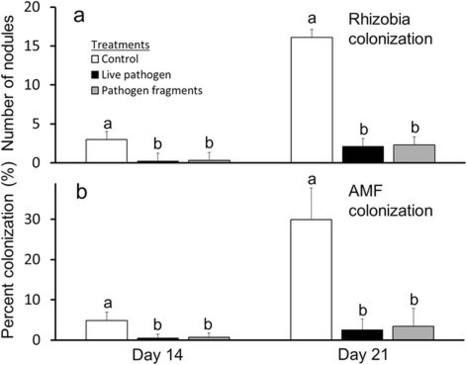
Induced aboveground plant defenses against pathogens can have negative effects on belowground microbial symbionts. While there are a considerable number of studies using chemical elicitors to experimentally induce such defenses, there is surprisingly little evidence that actual aboveground pathogens affect root-associated microbes. We report here that an aboveground fungal pathogen of common bean (Phaseolus vulgaris) induces a defense response that inhibits both the belowground formation of root nodules elicited by rhizobia and the colonization with arbuscular mycorrhizal fungi (AMF).
Results:
Foliage of plants inoculated with either rhizobia or AMF was treated with both live Colletotrichum gloeosporioides?a generalist hemibiotrophic plant pathogen?and C. gloeosporioides fragments. Polyphenol oxidase (PPO), chitinase and ?-1,3-glucanase activity in leaves and roots, as well as the number of rhizobia nodules and the extent of AMF colonization, were measured after pathogen treatments. Both the live pathogen and pathogen fragments significantly increased PPO, chitinase and ?-1,3-glucanase activity in the leaves, but only PPO activity was increased in roots. The number of rhizobia nodules and the extent of AMF colonization was significantly reduced in treatment plants when compared to controls.
Conclusion:
We demonstrate that aboveground fungal pathogens can affect belowground mutualism with two very different types of microbial symbionts?rhizobia and AMF. Our results suggest that systemically induced PPO activity is functionally involved in this above-belowground interaction. We predict that the top-down effects we show here can drastically impact plant performance in soils with limited nutrients and water; abiotic stress conditions usually mitigated by microbial belowground mutualists.
This review article concisely describes methodology of biotechnological processes with the use of cultures of higher fungi, their application in bioremediation and to obtain biologically active preparations. Advantages and disadvantages of biotechnological methods used to cultivate mushrooms are analyzed. This paper contains overview of higher fungi species most commonly used in biotechnological processes, of cultivation methods applied to produce fungal biomass, of enzymes and bioactive metabolites and of the strategies for submerged cultivation of the mycelial cultures. The problems of optimization of strains and biotechnological processes are briefly discussed.
Evidence is mounting that the immense diversity of microorganisms and animals that live belowground contributes significantly to shaping aboveground biodiversity and the functioning of terrestrial ecosystems. Our understanding of how this belowground biodiversity is distributed, and how it regulates the structure and functioning of terrestrial ecosystems, is rapidly growing. Evidence also points to soil biodiversity as having a key role in determining the ecological and evolutionary responses of terrestrial ecosystems to current and future environmental change. Here we review recent progress and propose avenues for further research in this field.
The cell wall is the foremost interface at which interactions take place between plants and a wide range of other organisms including insects, nematodes, pathogenic, or symbiotic microorganisms.
This Research Topic includes Mini Reviews, Reviews, Original Research Articles, and Perspective Articles that provide novel insights and detailed overviews on the dynamics of the plant cell wall in plant defense, parasitism, and symbiosis and describes experimental approaches to study plant cell wall modifications occurring during interaction of plants with different organisms.
Mycorrhiza helper bacteria (MHB) are known to increase host root colonization by mycorrhizal fungi but the molecular mechanisms and potential tripartite interactions are poorly understood. Through an effort to study Populus microbiome, we isolated 21 Pseudomonas strains from native Populus deltoides roots. These bacterial isolates were characterized and screened for MHB effectiveness on the Populus-Laccaria system. Two additional Pseudomonas strains (i.e., Pf-5 and BBc6R8) from existing collections were included for comparative purposes. We analyzed the effect of co-cultivation of these 23 individual Pseudomonas strains on Laccaria bicolor “S238N” growth rate, mycelial architecture and transcriptional changes. Nineteen of the 23 Pseudomonas strains tested had positive effects on L. bicolor S238N growth, as well as on mycelial architecture, with strains GM41 and GM18 having the most significant effect. Four of seven L. bicolor reporter genes, Tra1, Tectonin2, Gcn5, and Cipc1, thought to be regulated during the interaction with MHB strain BBc6R8, were induced or repressed, while interacting with Pseudomonas strains GM17, GM33, GM41, GM48, Pf-5, and BBc6R8. Strain GM41 promoted the highest roots colonization across three Populus species but most notably in P. deltoides, which is otherwise poorly colonized by L. bicolor. Here we report novel MHB strains isolated from native Populus that improve L. bicolor root colonization on Populus. This tripartite relationship could be exploited for Populus species/genotypes nursery production as a means of improving establishment and survival in marginal lands.
Strawberry growers in the UK may be able to maintain yields and reduce irrigation inputs by up to 40%, by inoculating plants with naturally-occurring beneficial soil-dwelling fungi (arbuscular mycorrhizal fungi or AMF).
Ecologists have long sought to understand global patterns of biological diversity (1, 2). Most work on this topic has focused on visible aboveground organisms that can easily be counted, such as birds, butterflies, reptiles, and plants. In contrast, knowledge of the global ecology of most belowground organism groups is limited because of their microscopic size and hidden existence. Rapid advances in molecular techniques for analyzing soil communities are now offering unprecedented opportunities for understanding soil biodiversity (3, 4). On page 10.1126/science.1256688 of this issue, Tedersoo et al. (5) use pyrosequencing of soil samples to provide a comprehensive global study of a major group of soil organisms: soil fungi.
Pathogens can colonize all plant organs and tissues. To prevent this, each cell must be capable of autonomously triggering defence. Therefore, it is generally assumed that primary sensors of the immune system are constitutively present. One major primary sensor against bacterial infection is the FLAGELLIN SENSING 2 (FLS2) pattern recognition receptor (PRR). To gain insights into its expression pattern, the FLS2 promoter activity in β-glucuronidase (GUS) reporter lines was monitored. The data show that pFLS2::GUS activity is highest in cells and tissues vulnerable to bacterial entry and colonization, such as stomata, hydathodes, and lateral roots. GUS activity is also high in the vasculature and, by monitoring Ca2+ responses in the vasculature, it was found that this tissue contributes to flg22-induced Ca2+ burst. The FLS2 promoter is also regulated in a tissue- and cell type-specific manner and is responsive to hormones, damage, and biotic stresses. This results in stimulus-dependent expansion of the FLS2 expression domain. In summary, a tissue- and cell type-specific map of FLS2 expression has been created correlating with prominent entry sites and target tissues of plant bacterial pathogens.
Truffles are the fruiting body of fungi, members of the Ascomycota phylum endowed with major gastronomic and commercial value. The development and maturation of their reproductive structure are dependent on melanin synthesis. Since anandamide, a prominent member of the endocannabinoid system (ECS), is responsible for melanin synthesis in normal human epidermal melanocytes, we thought that ECS might be present also in truffles. Here, we show the expression, at the transcriptional and translational levels, of most ECS components in the black truffle Tuber melanosporum Vittad. at maturation stage VI. Indeed, by means of molecular biology and immunochemical techniques, we found that truffles contain the major metabolic enzymes of the ECS, while they do not express the most relevant endocannabinoid-binding receptors. In addition, we measured anandamide content in truffles, at different maturation stages (from III to VI), through liquid chromatography–mass spectrometric analysis, whereas the other relevant endocannabinoid 2-arachidonoylglycerol was below the detection limit.
Overall, our unprecedented results suggest that anandamide and ECS metabolic enzymes have evolved earlier than endocannabinoid-binding receptors, and that anandamide might be an ancient attractant to truffle eaters, that are well-equipped with endocannabinoid-binding receptors.
Plants are sessile organisms that need to respond to environmental changes quickly and efficiently. They can accomplish this by triggering specialized signaling pathways often mediated by protein phosphorylation and dephosphorylation. Phosphorylation is a fast response that can switch on or off a myriad of biological pathways and processes. Proteomics and mass spectrometry (MS) are the main tools employed in the study of protein phosphorylation. Advances in the technologies allow simultaneous identification and quantification of thousands of phosphopeptides and proteins that are essential to understanding the sophisticated biological systems and regulations. In this review we summarize the advances in phosphopeptide enrichment and quantitation, MS for phosphorylation site mapping and new data acquisition methods, databases and informatics, interpretation of biological insights and crosstalk with other PTMs, as well as future directions and challenges in the field of phosphoproteomics.
Nitrate transporters received little attention in legumes probably because these species are able to adapt to N starvation by developing biological N2 fixation. Still it is important to study nitrate transport systems in legumes because nitrate intervenes as a signal in regulation of nodulation probably through nitrate transporters. The aim of the present work was to achieve a molecular characterization of NRT2 and NAR2 (NRT3) families in order to allow further works that would unravel their involvement in nitrate transport and signaling. Browsing the latest version of the M. truncatula genome annotation (v4 version) revealed three putative NRT2 members that we have named MtNRT2.1 (Medtr4g057890.1), MtNRT2.2 (Medtr4g057865.1) and MtNRT2.3 (Medtr8g069775.1) and two putative NAR2 members we named MtNAR2.1 (Medtr4g104730.1) and MtNAR2.2 (Medtr4g104700.1). The regulation and the spatial expression profiles of MtNRT2.1, the coincidence of its expression with that of MtNAR2.1 and MtNAR2.2 and the size of the encoded protein with 12 TM spanning regions strongly support the idea that MtNRT2.1 is a nitrate transporter with a major contribution to the HATS, while a very low level of expression characterized MtNRT2.2. Unlike MtNRT2.1, MtNRT2.3 showed a lower level of expression in the root system but was expressed in the shoots and in the nodules thus suggesting an involvement of the encoded protein in nitrate transport inside the plant and/or in nitrate signaling pathways controlling post-inoculation processes that govern nodule functioning.
Arbuscular mycorrhizal fungi (AMF) are an important biotic factor that influences tropical ecological succession and differently affect the woody species belonging to different successional stages. However, little is known about the influence of AMF on growth and reproduction of herbaceous and shrubby species of early phases of tropical succession. Thus, we assessed the effect of AMF on the development of 27 heliophilous herbaceous and shrubby tropical species. Plants were grown in greenhouse, in low- and high-fertility soils, with or without AMF, for 100 d. Most species grown with AMF exhibited high root infection intensity (≈80%), irrespective of soil fertility. In the low-fertility soil, non-mycorrhizal plants exhibited about 88% less shoot dry mass (SDM) than mycorrhizal plants, and AMF were crucial for the survival of most species. Non-mycorrhizal plants also had lower relative growth rate (RGR), total leaf area (TLA), leaf area expansion (LAE) and total root length (TRL). Six species flowered in the low-fertility soil, and flowering increased with AMF in one plant species and four species only flowered when mycorrhizal. In the high-fertility soil, non-mycorrhizal plants exhibited about 13% less SDM than mycorrhizal plants and also exhibited lower TLA, LAE, and nutrient concentrations in shoots. On the other hand, no major changes were observed for RGR, TRL and root dry mass for most of the species. Sixteen plant species flowered in the high-fertility soil, but most had earlier (11) and more abundant (10) flowering when mycorrhizal. Thus, AMF have different influences on the survival, growth and flowering of herbaceous and shrubby tropical species, depending on soil fertility: in low-fertility soil, AMF especially affect the survival, growth and flowering, whereas in high-fertility soil, AMF mainly influence the shoot nutrient concentrations and flowering.
Five plant growth promoting rhizobacteria (PGPRs) of different genera, newly isolated from healthy tomato rhizosphere, were characterized with phosphate solubilizing and root colonizing ability. Treatment with these isolates recorded a significant increase in seed germination and seedling vigor as well as tomato growth and fruit weight which might be partly attributed to the ability of the PGPRs to produce IAA and enhance nutrient uptake and chlorophyll content in treated plants. More importantly, a strong protection against early blight disease was observed in PGPR-pretreated tomato plants infected with Alternaria solani which is in accordance with the presence of siderophores, HCN, chitinase and glucanase in the isolated PGPRs. Additionally, a significantly enhanced accumulation of antioxidant peroxidase (POX) and polyphenol oxidase (PPO) enzymes was observed in the PGPR-pretreated plants with or without pathogen infection in comparison with water or pathogen control. Notably, the highest increase in POX and PPO accumulations was recorded in tomato plants raised from seeds primed with TN_Vel-35 strain. A significant upregulation of POX and PPO in tomato plants subjected to similar treatment with TN_Vel-35 versus respective control was also noticed, further strengthening that the PGPR-induced POX and PPO biosyntheses also contribute to PGPR-mediated protection against early blight disease in tomato plants.
Arbuscular mycorrhizal (AM) symbioses involve transfer of soil nutrients to plants and plant-derived organic compounds to AM fungi. Many experiments have shown that individual symbioses are ‘mutualistic’ (Table 1). However, outcomes in relation to the nonmycorrhizal (NM) state are not always positive for plants, although they are for all AM fungi, which are obligate symbionts. Different AM fungi produce different growth-related responses in individual plants and there are large differences in responsiveness among different plant taxa in relation to colonization by the same AM fungal taxon (Klironomos, 2003). Neutral outcomes for the plant may be termed ‘commensal’, and negative ones ‘parasitic’ (Table 1). Outcomes are influenced by many abiotic and biotic factors (Johnson et al., 1997).
The recent increase in anthropogenic emissions of reactive nitrogen from northeastern Asia and the subsequent enhanced deposition over the extensive regions of the North Pacific Ocean (NPO) have led to a detectable increase in the nitrate (N) concentration of the upper ocean. The rate of increase of excess N relative to phosphate (P) was found to be highest (∼0.24 micromoles per kilogram per year) in the vicinity of the Asian source continent, with rates decreasing eastward across the NPO, consistent with the magnitude and distribution of atmospheric nitrogen deposition. This anthropogenically driven increase in the N content of the upper NPO may enhance primary production in this N-limited region, potentially leading to a long-term change of the NPO from being N-limited to P-limited.
Cooperation involving Plant Growth-Promoting Rhizobacteria results in improvements of plant growth and health. While pathogenic and symbiotic interactions are known to induce transcriptional changes for genes related to plant defense and development, little is known about the impact of phytostimulating rhizobacteria on plant gene expression. This study aims at identifying genes significantly regulated in rice roots upon Azospirillum inoculation, considering possible favored interaction between a strain and its original host cultivar. Genome-wide analyzes of Oryza sativa japonica cultivars Cigalon and Nipponbare were performed, by using microarrays, seven days post-inoculation with Azospirillum lipoferum 4B (isolated from Cigalon) or Azospirillum sp. B510 (isolated from Nipponbare) and compared to the respective non-inoculated condition. A total of 7384 genes were significantly regulated, which represent about 16% of total rice genes. A set of 34 genes is regulated by both Azospirillum strains in both cultivars, including a gene orthologous to PR10 of Brachypodium, and these could represent plant markers of Azospirillum-rice interactions. The results highlight a strain-dependent response of rice, with 83% of the differentially expressed genes being classified as combination-specific. Whatever the combination, most of the differentially expressed genes are involved in primary metabolism, transport, regulation of transcription and protein fate. When considering genes involved in response to stress and plant defense, it appears that strain B510, a strain displaying endophytic properties, leads to the repression of a wider set of genes than strain 4B. Individual genotypic variations could be the most important driving force of rice roots gene expression upon Azospirillum inoculation. Strain-dependent transcriptional changes observed for genes related to auxin and ethylene signaling highlight the complexity of hormone signaling networks in the Azospirillum-rice cooperation.
Cooperation involving Plant Growth-Promoting Rhizobacteria results in improvements of plant growth and health. While pathogenic and symbiotic interactions are known to induce transcriptional changes for genes related to plant defense and development, little is known about the impact of phytostimulating rhizobacteria on plant gene expression. This study aims at identifying genes significantly regulated in rice roots upon Azospirillum inoculation, considering possible favored interaction between a strain and its original host cultivar. Genome-wide analyzes of Oryza sativa japonica cultivars Cigalon and Nipponbare were performed, by using microarrays, seven days post-inoculation with Azospirillum lipoferum 4B (isolated from Cigalon) or Azospirillum sp. B510 (isolated from Nipponbare) and compared to the respective non-inoculated condition. A total of 7384 genes were significantly regulated, which represent about 16% of total rice genes. A set of 34 genes is regulated by both Azospirillum strains in both cultivars, including a gene orthologous to PR10 of Brachypodium, and these could represent plant markers of Azospirillum-rice interactions. The results highlight a strain-dependent response of rice, with 83% of the differentially expressed genes being classified as combination-specific. Whatever the combination, most of the differentially expressed genes are involved in primary metabolism, transport, regulation of transcription and protein fate. When considering genes involved in response to stress and plant defense, it appears that strain B510, a strain displaying endophytic properties, leads to the repression of a wider set of genes than strain 4B. Individual genotypic variations could be the most important driving force of rice roots gene expression upon Azospirillum inoculation. Strain-dependent transcriptional changes observed for genes related to auxin and ethylene signaling highlight the complexity of hormone signaling networks in the Azospirillum-rice cooperation.
Medicago truncatula, a close relative of alfalfa (Medicago sativa), is a model legume used for studying symbiotic nitrogen fixation, mycorrhizal interactions and legume genomics. JCVI (formerly TIGR) has been involved in M. truncatula genome sequencing and annotation since 2002 and has maintained a web-based resource providing data to the community for this entire period. The web site (http://www.MedicagoGenome.org) has seen major updates in the past year, where it currently hosts the latest version of the genome (Mt4.0), associated data and legacy project information, presented to users via a rich set of open-source tools. A JBrowse-based genome browser interface exposes tracks for visualization. Mutant gene symbols originally assembled and curated by the Frugoli lab are now hosted at JCVI and tie into our community annotation interface, Medicago EuCAP (to be integrated soon with our implementation of WebApollo). Literature pertinent to M. truncatula is indexed and made searchable via the Textpresso search engine. The site also implements MedicMine, an instance of InterMine that offers interconnectivity with other plant “mines” like ThaleMine and PhytoMine, and other Model Organism Databases (MODs). In addition to these new features, we continue to provide keyword and locus identifier based searches served via a Chado-backed Tripal Instance, a BLAST search interface, and bulk downloads of datasets from the iPlant Data Store (iDS). Finally, we maintain an email helpdesk, facilitated by a JIRA issue tracking system, where we receive and respond to questions about the website and requests for specific datasets from the community.
Medicago truncatula, a close relative of alfalfa (Medicago sativa), is a model legume used for studying symbiotic nitrogen fixation, mycorrhizal interactions and legume genomics. JCVI (formerly TIGR) has been involved in M. truncatula genome sequencing and annotation since 2002 and has maintained a web-based resource providing data to the community for this entire period. The web site (http://www.MedicagoGenome.org) has seen major updates in the past year, where it currently hosts the latest version of the genome (Mt4.0), associated data and legacy project information, presented to users via a rich set of open-source tools. A JBrowse-based genome browser interface exposes tracks for visualization. Mutant gene symbols originally assembled and curated by the Frugoli lab are now hosted at JCVI and tie into our community annotation interface, Medicago EuCAP (to be integrated soon with our implementation of WebApollo). Literature pertinent to M. truncatula is indexed and made searchable via the Textpresso search engine. The site also implements MedicMine, an instance of InterMine that offers interconnectivity with other plant “mines” like ThaleMine and PhytoMine, and other Model Organism Databases (MODs). In addition to these new features, we continue to provide keyword and locus identifier based searches served via a Chado-backed Tripal Instance, a BLAST search interface, and bulk downloads of datasets from the iPlant Data Store (iDS). Finally, we maintain an email helpdesk, facilitated by a JIRA issue tracking system, where we receive and respond to questions about the website and requests for specific datasets from the community.
Microbial dinitrogen (N2) fixation has been reported as an additional N source for terrestrial carnivorous plant species. Sirová et al. assess the importance of fixed N in the nutrition of rootless, aquatic, carnivorous Utricularia species (bladderworts), and find that although traps harbour abundant N2-fixing micro-organisms and provide conditions highly suitable for N2-fixation, the fixation rates are low and plant uptake of fixed N is negligible. High mineral N concentrations in the traps, resulting from rapid turnover of organic matter, seem to inhibit the N2-fixation process, and thus they conclude that it is unlikely to contribute significantly to the N nutrition of aquatic carnivorous plants under their typical growth conditions.
Legume-cereal cover crop mixes are often promoted because they combine the ability of legumes to add atmospheric nitrogen to the system through biological fi...
To get content containing either thought or leadership enter:
To get content containing both thought and leadership enter:
To get content containing the expression thought leadership enter:
You can enter several keywords and you can refine them whenever you want. Our suggestion engine uses more signals but entering a few keywords here will rapidly give you great content to curate.


 Your new post is loading...