The details of how soil microorganisms contribute to stable soil organic carbon pools are a pressing knowledge gap with direct implications for soil health and climate mitigation. It is now recognized that microbial necromass contributes substantially to the formation of stable soil carbon. However, the quantification of necromass in soils has largely been limited to model molecules such as aminosugar biomarkers. The abundance and chemical composition of other persistent microbial residues remain unresolved, particularly concerning how these pools may vary with microbial community structure, soil texture, and management practices. Here we use yearlong soil incubation experiments with an isotopic tracer to quantify the composition of persistent residues derived from microbial communities inhabiting sand or silt dominated soil with annual (corn) or perennial (switchgrass) monocultures. Persistent microbial residues were recovered in diverse soil biomolecular pools including metabolites, proteins, lipids, and mineral-associated organic matter (MAOM). The relative abundances of microbial contributions to necromass pools were consistent across cropping systems and soil textures. The greatest residue accumulation was not recovered in MAOM but in the light density fraction of soil debris that persisted after extraction by chemical fractionation using organic solvents. Necromass abundance was positively correlated with microbial biomass abundance and revealed a possible role of cell wall morphology in enhancing microbial carbon persistence; while gram-negative bacteria accounted for the greatest contribution to microbial-derived carbon by mass at one year, residues from gram-positive Actinobacteria and Firmicutes showed greater durability. Together these results offer a quantitative assessment of the relative importance of diverse molecular classes for generating durable soil carbon.
The symbiotic association of legumes with rhizobia results in the formation of new root organs called nodules. However, the lifespan of nodules is limited by the senescence process. Increased proteolytic activity is one of the hallmarks of nodule senescence. In Medicago truncatula, a papain cysteine protease encoding gene, MtCP6, is a marker for the onset of nodule senescence under both developmental and stress-induced pathways.
To identify promoter regions conferring MtCP6 senescence-related expression, progressive MtCP6 promoter deletions were generated and the resulting sequences were fused with a reporter gene for promoter::GUS fusion analysis in transgenic M. truncatula roots.
In planta, a minimal promoter sequence of 67 bp was identified as sufficient for specific spatiotemporal transcriptional activation of MtCP6 in nodules. The functionality of this cis-regulatory sequence, thereafter named Nodule Senescence (NS), was validated by both gain- and loss-of-function approaches.
ERF091, an AP2/ERF family transcription factor, was identified in a yeast one-hybrid (Y1H) screen as an NS-box interacting factor, and shown to mediate transcription activation of a NS-box:GUS reporter in transactivation assays in Nicotiana benthamiana.
This work uncovered a new senescence-related nodule specific cis-regulatory region (NS-box) and provided evidence for the likely involvement of a stress-related ERF family member in the regulation of MtCP6, at the onset of nodule senescence.
The maturation and installation of the active site metal cluster (FeMo-co, Fe7S9CMo-R-homocitrate) in Mo-dependent nitrogenase requires the protein product of the nifB gene for production of the FeS cluster precursor (NifB-co, [Fe8S9C]) and the action of the maturase complex composed of the protein products from the nifE and nifN genes. However, some putative diazotrophic bacteria, like Roseiflexus sp. RS-1, lack the nifEN genes, suggesting an alternative pathway for maturation of FeMo-co that does not require NifEN. In this study, the Roseiflexus NifH, NifB, and apo-NifDK proteins produced in Escherichia coli are shown to be sufficient for FeMo-co maturation and insertion into the NifDK protein to achieve active nitrogenase. The E. coli expressed NifDKRS contained P-clusters but was devoid of FeMo-co (referred to as apo-NifDKRS). Apo-NifDKRS could be activated for N2 reduction by addition of preformed FeMo-co. Further, it was found that apo-NifDKRS plus E. coli produced NifBRS and NifHRS were sufficient to yield active NifDKRS when incubated with the necessary substrates (homocitrate, molybdate, and S-adenosylmethionine [SAM]), demonstrating that these proteins can replace the need for NifEN in maturation of Mo-nitrogenase. The E. coli produced NifHRS and NifBRS proteins were independently shown to be functional. The reconstituted NifDKRS demonstrated reduction of N2, protons, and acetylene in ratios observed for Azotobacter vinelandii NifDK. These findings reveal a distinct NifEN-independent pathway for nitrogenase activation involving NifHRS, NifBRS, and apo-NifDKRS.
Transposable elements (TEs) are repetitive DNA sequences that excise or create copies that are inserted elsewhere in the genome. Their expansion shapes genome variability and evolution by impacting gene expression and rearrangement rates. Arbuscular mycorrhizal fungi (AMF) are beneficial plant symbionts with large, TE-rich genomes, and recent findings showed these elements vary significantly in abundance, evolution, and regulation among model AMF strains. Here, we aimed to obtain a more comprehensive understanding of TE function and evolution in AMF by investigating assembled genomes from representatives of all known families. We uncovered multiple, family-specific bursts of insertions in different species, indicating variable past and ongoing TE activity contributing to the diversification of AMF lineages. We also found that TEs are preferentially located within and around candidate effectors/secreted proteins, as well as in proximity to promoters. Altogether, these findings support the role of TEs in promoting the diversity in proteins involved in molecular dialogues with hosts and, more generally, in driving gene regulation. The mechanisms of TEs evolution we observed in these prominent plant symbionts bear striking similarities to those of many filamentous plant pathogens.
Arbuscular mycorrhizal (AM) fungi (e.g., Rhizophagus species) recruit specific bacterial species in their hyphosphere. However, the chemical interplay and the mutual benefit of this intricate partnership have not been investigated yet, especially as it involves bacteria known as strong producers of antifungal compounds such as Bacillus velezensis. Here, we show that the soil-dwelling B. velezensis migrates along the hyphal network of the AM fungus R. irregularis, forming biofilms and inducing cytoplasmic flow in the AM fungus that contributes to host plant root colonization by the bacterium. During hyphosphere colonization, R. irregularis modulates the biosynthesis of specialized metabolites in B. velezensis to ensure stable coexistence and as a mechanism to ward off mycoparasitic fungi and bacteria. These mutual benefits are extended into a tripartite context via the provision of enhanced protection to the host plant through the induction of systemic resistance.
Caroline Gutjahr studied Biology in Freiburg (Germany) and Aberdeen (Scotland). She earned her doctoral degree at the University of Lausanne (Switzerland) in the lab of Uta Paszkowski where she worked on molecular mechanisms underlying the development of arbuscular mycorrhiza, a symbiosis between plants and fungi. After a short postdoc in the same lab, she moved to the Ludwig-Maximilians University Munich (LMU) as a group leader at the chair of Martin Parniske and obtained an Emmy Noether group leader fellowship from the DFG in 2015. In 2017, she was appointed Professor at the Technical University of Munich (TUM). Since 2023 she has been Director at the Max-Planck-Institute of Molecular Plant Physiology in Potsdam-Golm. She was awarded starting (2017) and consolidator (2023) ERC grants to study the regulation of plant cell remodeling to host arbuscules of symbiotic fungi and the regulation of nutrient exchange between the symbionts, respectively.
Hairy vetch (Vicia villosa Roth) is a commonly grown cover crop throughout the U.S., which can contribute nitrogen for subsequent cash crops through biological nitrogen fixation (BNF) in association with Rhizobium leguminosarum biovar viciae (Rlv) bacteria. Hairy vetch is one of the few cover crops sufficiently cold-tolerant to over-winter in the Upper Midwestern U.S. However, nitrogen contributions by hairy vetch vary across locations, potentially due to cold impacts on the legume/rhizobia symbiosis. The traditional route to improve BNF in legumes involves selecting superior rhizobia strains to create more effective inoculants to apply at planting, but inoculants often fail to compete and survive in agricultural soils. Instead, this study tested the effects of temperature and host plant ecotype on hairy vetch BNF and Rlv community composition in nodules, with the goal of potentially identifying vetch ecotypes able to select beneficial Rlv strains from the soil community. Four hairy vetch ecotypes trapped Rlv from three Minnesota soils, at warm or cold temperatures. Vetch ecotype was a key driver of BNF and nodule formation under warm and cold conditions. However, temperature and plant ecotype did not drive Rlv community composition in nodules, and Rlv community composition did not affect plant productivity. Taken together, these results suggest that the best strategy to improve BNF at low temperatures in hairy vetch likely depends on breeding for improved biomass accumulation and nitrogen fixation in host plants, rather than focusing on host plant selection of beneficial rhizobia.
Maize is an important plant for both global food security and genetics research. As the importance of microorganisms to plant health is becoming clearer, there is a growing interest in understanding the relationship between maize and its associated microbiome; i.e., the collection of microorganisms living on, around, and inside the plant. The ultimate goal of this research is to use these microbial communities to support more robust and sustainable maize production. Here, we provide an overview of recent progress in the field of maize microbiome research. We discuss the major microbiome compartments (rhizosphere, phyllosphere, and endosphere) and known functions of the microbiome. We also review the methods currently available to study the maize microbiome and its functions, and discuss how to carry out maize microbiome experiments, including both a general workflow (suitable for most microbiome analyses) and maize-specific experimental considerations.
Microbial natural products are widely explored for their therapeutic potential. Understanding the underlying evolutionary and adaptive forces driving their production remains a fundamental question in biology. Amphiphilic cyclic lipopeptides (CLPs), a prominent category of bacterial specialized metabolites, show strong antimicrobial activity, particularly against phytopathogens. It is thus assumed that these compounds are deployed by soil- or rhizosphere-dwelling bacteria as microbial weapons in competitive natural environments. Here, we challenge this reductionist perspective and present evidence that Bacillus CLPs are prominent chemical mediators of ecological interactions. They help Bacillus to communicate, compete, defend against predators, or cooperate and establish mutualistic relationships with other (micro)organisms. Additional parallel examples are highlighted in other genera, such as Pseudomonas. This broader perspective underscores the need for further investigation into the role of CLPs in shaping the adaptive strategies of key rhizobacterial species.
Nitrogen (N)-fixing symbiosis is critical to terrestrial ecosystems, yet possession of this trait is known for few plant species. Broader presence of the symbiosis is often indirectly determined by phylogenetic relatedness to taxa investigated via manipulative experiments. This data gap may ultimately underestimate phylogenetic, spatial, and temporal variation in N-fixing symbiosis. Still needed are simpler field or collections-based approaches for inferring symbiotic status. N-fixing plants differ from non-N-fixing plants in elemental and isotopic composition, but previous investigations have not tested predictive accuracy using such proxies. Here we develop a regional field study and demonstrate a simple classification model for fixer status using nitrogen and carbon content measurements, and stable isotope ratios (δ15N and δ13C), from field-collected leaves. We used mixed models and classification approaches to demonstrate that N-fixing phenotypes can be used to predict symbiotic status; the best model required all predictors and was 80–94% accurate. Predictions were robust to environmental context variation, but we identified significant variation due to native vs. non-native (exotic) status and phylogenetic affinity. Surprisingly, N content—not δ15N—was the strongest predictor, suggesting that future efforts combine elemental and isotopic information. These results are valuable for understudied taxa and ecosystems, potentially allowing higher-throughput field-based N-fixer assessments.
Deciphering root exudate composition of soil-grown plants is considered a crucial step to better understand plant–soil–microbe interactions affecting plant growth performance. In this study, two genotypes of Zea mays L. (WT, rth3) differing in root hair elongation were grown in the field in two substrates (sand, loam) in custom-made, perforated columns inserted into the field plots. Root exudates were collected at different plant developmental stages (BBCH 14, 19, 59, 83) using a soil-hydroponic-hybrid exudation sampling approach. Exudates were characterized by LC-MS based non-targeted metabolomics, as well as by photometric assays targeting total dissolved organic carbon, soluble carbohydrates, proteins, amino acids, and phenolics. Results showed that plant developmental stage was the main driver shaping both the composition and quantity of exuded compounds. Carbon (C) exudation per plant increased with increasing biomass production over time, while C exudation rate per cm² root surface area h−1 decreased with plant maturity. Furthermore, exudation rates were higher in the substrate with lower nutrient mobility (i.e., loam). Surprisingly, we observed higher exudation rates in the root hairless rth3 mutant compared to the root hair-forming WT sibling, though exudate metabolite composition remained similar. Our results highlight the impact of plant developmental stage on the plant–soil–microbe interplay.
Although positive effects of arbuscular mycorrhizal (AM) fungi on plant performance under drought have been well documented, how AM fungi regulate soil functions and multifunctionality requires further investigation. In this study, we first performed a meta-analysis to test the potential role of AM fungi in maintaining soil functions under drought. Then, we conducted a greenhouse experiment, using a pair of hyphal ingrowth cores to spatially separate the growth of AM fungal hyphae and plant roots, to further investigate the effects of AM fungi on soil multifunctionality and its resistance against drought. Our meta-analysis showed that AM fungi promote multiple soil functions, including soil aggregation, microbial biomass and activities of soil enzymes related to nutrient cycling. The greenhouse experiment further demonstrated that AM fungi attenuate the negative impact of drought on these soil functions and thus multifunctionality, therefore, increasing their resistance against drought. Moreover, this buffering effect of AM fungi persists across different frequencies of water supply and plant species. These findings highlight the unique role of AM fungi in maintaining multiple soil functions by mitigating the negative impact of drought. Our study highlights the importance of AM fungi as a nature-based solution to sustaining multiple soil functions in a world where drought events are intensifying.
pon first glance, plant roots seem distinct from animal guts. However, like the intestines, roots are responsible for nutrient acquisition, they interact with robust microbial communities, and both are split into segments with different functions.1-3 As roots wind their way through the soil, they create an underground network responsible for anchoring a plant’s above-ground portion, absorbing water, and communicating with the environment. Different root segments, including the differentiation zone, elongation zone, and root tip, are heterogeneous in their architecture, gene expression, immune state, and metabolic profiles, all of which may influence the root microbiota.
The rhizosphere, where plant roots meet soil, is a hub of biogeochemical activity with ecosystem impacts on carbon stocks. Root derived carbon has been found to contribute more to soil carbon stocks than aboveground litter. Nonetheless, the molecular chemodiversity of root exudates remains poorly understood due to limited characterization and annotation. Here our goal was to discover the molecular chemodiversity of metabolites and lipids in root exudates to advance our understanding of plant root inputs belowground. We worked with mature, field-grown tall wheatgrass (Thinopyrum ponticum) and optimized exudate collection protocols to enable the capture of non-polar lipids in addition to polar and semi-polar metabolites. Rates of carbon input via hydrophobic exudates were approximately double that of aqueous exudates and carbon/nitrogen ratios were markedly higher in hydrophobic compared to aqueous exudates, emphasizing the importance of lipids, due to their high carbon content. To maximize molecular coverage of exudate chemodiversity, we used liquid chromatography coupled tandem mass-spectrometry for paired untargeted metabolomics and lipidomics or ‘metabo-lipidomics’. We substantially increased the characterization of exudate chemodiversity by employing both tandem mass spectral library searching and deep learning-based chemical class assignment. Notably, in this unprecedented characterization of intact lipids in root exudates, we discovered a diverse variety of lipids, including substantial levels of triacylglycerols (∼19 μg/g fresh root per min), fatty acyls, sphingolipids, sterol lipids, and glycerophospholipids. Comparison of the root exudate and tissue lipidomes revealed minimum glycerophospholipids in exudates, suggesting the exudate protocol did not extract lipids from root cell membranes.
Soil microbiota can confer fitness advantages to plants and increase crop resilience to drought and other abiotic stressors. However, there is little evidence on the mechanisms correlating a microbial trait with plant abiotic stress tolerance. Here, we report that Streptomyces effectively alleviate drought and salinity stress by producing spiroketal polyketide pteridic acid H (1) and its isomer F (2), both of which promote root growth in Arabidopsis at a concentration of 1.3 nM under abiotic stress. Transcriptomics profiles show increased expression of multiple stress responsive genes in Arabidopsis seedlings after pteridic acids treatment. We confirm in vivo a bifunctional biosynthetic gene cluster for pteridic acids and antimicrobial elaiophylin production. We propose it is mainly disseminated by vertical transmission and is geographically distributed in various environments. This discovery reveals a perspective for understanding plant-Streptomyces interactions and provides a promising approach for utilising beneficial Streptomyces and their secondary metabolites in agriculture to mitigate the detrimental effects of climate change.
Increasing biological nitrogen (N) fixation (BNF) in maize production could reduce the environmental impacts of N fertilizer use, but reactive N in the rhizosphere of maize limits the BNF process. Using non-transgenic methods, we developed gene-edited strains of Klebsiella variicola (Kv137-2253) and Kosakonia sacchari (Ks6-5687) bacteria optimized for root-associated BNF and ammonium excretion in N-rich conditions. The aim of this research was to elucidate the mechanism of action of these strains. We present evidence from in vitro, in planta and field experiments that confirms that our genetic remodeling strategy derepresses BNF activity in N-rich systems and increases ammonium excretion by orders of magnitude above the respective wildtype strains. BNF is demonstrated in controlled environments by the transfer of labeled 15N2 gas from the rhizosphere to the chlorophyll of inoculated maize plants. This was corroborated in several 15N isotope tracer field experiments where inoculation with the formulated, commercial-grade product derived from the gene-edited strains (PIVOT BIO PROVEN® 40) provided on average 21 kg N ha-1 to the plant by the VT-R1 growth stages. Data from small-plot and on-farm trials suggest that this technology can improve crop N status pre-flowering and has potential to mitigate the risk of yield loss associated with a reduction in synthetic N fertilizer inputs.
The symbiosis between Mesorhizobium japonicum R7A and Lotus japonicus Gifu is an important model system for investigating the role of bacterial exopolysaccharides (EPS) in plant-microbe interactions. Previously, we showed that R7A exoB mutants that are affected at an early stage of EPS synthesis and in lipopolysaccharide (LPS) synthesis induce effective nodules on L. japonicus Gifu after a delay, whereas exoU mutants affected in the biosynthesis of the EPS side chain induce small uninfected nodule primordia and are impaired in infection. The presence of a halo around the exoU mutant when grown on Calcofluor-containing media suggested the mutant secreted a truncated version of R7A EPS. A nonpolar ΔexoA mutant defective in the addition of the first glucose residue to the EPS backbone was also severely impaired symbiotically. Here, we used a suppressor screen to show that the severe symbiotic phenotype of the exoU mutant was due to the secretion of an acetylated pentasaccharide, as both monomers and oligomers, by the same Wzx/Wzy system that transports wild-type exopolysaccharide. We also present evidence that the ΔexoA mutant secretes an oligosaccharide by the same transport system, contributing to its symbiotic phenotype. In contrast, ΔexoYF and polar exoA and exoL mutants have a similar phenotype to exoB mutants, forming effective nodules after a delay. These studies provide substantial evidence that secreted incompatible EPS is perceived by the plant, leading to abrogation of the infection process.
Receptor signaling shapes cellular functions and specificity in the signaling output is central for delineating biological processes. In legume root cells, very similar and structurally conserved chitin and Nod factor receptor kinases activate immunity, or symbiosis, respectively after perception of chitinous ligands. Here we show that individual residues in the intracellular part of the Nod factor receptor NFR1 determine signal specificity and efficiency distinguishing immunity and symbiotic signaling. Functional investigation of CERK6, NFR1 and receptor variants hereof revealed a conserved motif that we term Symbiosis Determinant 1 in the juxtamembrane region of the kinase domain that is key for symbiotic signaling. We demonstrate that two residues in Symbiosis Determinant 1 are indispensable hallmarks for NFR1 receptors and are sufficient to convert Lotus CERK6 and barley RLK4 functioning in immunity, to initiate symbiotic signaling.
Gibberellin (GA) is a classical plant hormone that regulates many physiological processes, such as plant growth, development, and environmental responses. GA inhibits arbuscular mycorrhizal (AM) symbiosis, the most ancient and widespread type of mycorrhizal symbiosis. Knowledge about mycorrhizal symbioses at the molecular level has been obtained mainly in model plants such as legumes and rice. In contrast, molecular mechanisms in non-model plants are still unclear. Recent studies have revealed the novel roles of GA in mycorrhizal symbioses: its positive effect in Paris-type AM symbiosis in Eustoma grandiflorum and its negative effect on both seed germination and mycorrhizal symbiosis in orchids. This review focuses on the recent data on GA function in AM and orchid mycorrhizal symbioses.
Background Potassium (K) is an essential nutrient for plant growth and development. Maize (Zea mays) is a widely planted crops in the world and requires a huge amount of K fertilizer. Arbuscular mycorrhizal fungi (AMF) are closely related to the K uptake of maize. Genetic improvement of maize K utilization efficiency will require elucidating the molecular mechanisms of maize K uptake through the mycorrhizal pathway. Here, we employed transcriptome and gene family analysis to elucidate the mechanism influencing the K uptake and utilization efficiency of mycorrhizal maize.
Methods and results The transcriptomes of maize were studied with and without AMF inoculation and under different K conditions. AM symbiosis increased the K concentration and dry weight of maize plants. RNA sequencing revealed that genes associated with the activity of the apoplast and nutrient reservoir were significantly enriched in mycorrhizal roots under low-K conditions but not under high-K conditions. Weighted gene correlation network analysis revealed that three modules were strongly correlated with K content. Twenty-one hub genes enriched in pathways associated with glycerophospholipid metabolism, glycerolipid metabolism, starch and sucrose metabolism, and anthocyanin biosynthesis were further identified. In general, these hub genes were upregulated in AMF-colonized roots under low-K conditions. Additionally, the members of 14 gene families associated with K obtain were identified (ARF: 38, ILK: 4, RBOH: 12, RUPO: 20, MAPKK: 89, CBL: 14, CIPK: 44, CPK: 40, PIN: 10, MYB: 174, NPF: 79, KT: 19, HAK/HKT/KUP: 38, and CPA: 8) from maize. The transcript levels of these genes showed that 92 genes (ARF:6, CBL:5, CIPK:13, CPK:2, HAK/HKT/KUP:7, PIN:2, MYB:26, NPF:16, RBOH:1, MAPKK:12 and RUPO:2) were upregulated with AM symbiosis under low-K conditions.
Conclusions This study indicated that AMF increase the resistance of maize to low-K stress by regulating K uptake at the gene transcription level. Our findings provide a genome-level resource for the functional assignment of genes regulated by K treatment and AM symbiosis in K uptake-related gene families in maize. This may contribute to elucidate the molecular mechanisms of maize response to low K stress with AMF inoculation, and provided a theoretical basis for AMF application in the crop field.
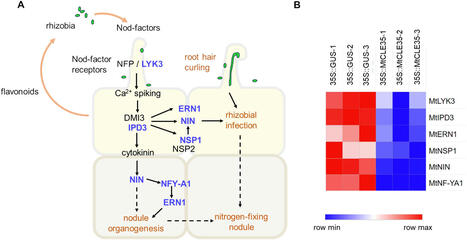
CLE (CLAVATA3/ENDOSPERM SURROUNDING REGION-related) peptides are systemic regulators of legume-rhizobium symbiosis that negatively control the number of nitrogen-fixing nodules. In Medicago truncatula, the expression of the MtCLE35 gene is activated in response to rhizobial inoculation and nitrate treatment, and its overexpression systemically inhibits nodulation. However, little is known about the molecular mechanisms underlying MtCLE35-mediated inhibition of nodulation. In order to elucidate target genes regulated by the MtCLE35-induced signaling cascade, we analyzed the transcriptome of MtCLE35-overexpressing roots inoculated by rhizobia using MACE (Massive Analysis of cDNA Ends) sequencing. Totally, 1390 genes were found to be differentially expressed between MtCLE35-overexpressing (35S::MtCLE35) and control (35S::GUS) roots after rhizobial inoculation, among them 268 genes were upregulated and 1122 genes were downregulated. Among downregulated genes, many known regulators of legume-rhizobia symbiosis were found. Genes upregulated in rhizobia-inoculated MtCLE35-overexpressing roots included ones associated with defense response and cellular redox status. Furthermore, stable transgenic plants overexpressing the MtCLE35 gene were obtained in this study, and gene expression qPCR analysis of selected differentially expressed genes in rhizobia-inoculated roots was performed in such plants. Collectively, our data suggest that overexpression of the MtCLE35 gene prevents the induction of nodulation program, which is accompanied by the expression of defense-related gene in MtCLE35-overexpressing rhizobia-inoculated M. truncatula roots.
Molecular inter-species dialogue between leguminous plants and nitrogen-fixing rhizobia results in the development of symbiotic root nodules. This is initiated by several nodulation-related receptors present on the surface of root hair epidermal cells. We have shown previously that specific subunits of heterotrimeric G proteins and their regulatory RGS (regulator of G-protein signaling) proteins act as molecular links between the receptors and downstream components during nodule formation in soybeans. Nod factor receptor 1 (NFR1) interacts with and phosphorylates RGS proteins to regulate the G-protein cycle. Symbiosis receptor-like kinases (SymRK) phosphorylate Gα to make it inactive and unavailable for Gβγ. We now show that like NFR1, SymRK also interacts with the RGS proteins to phosphorylate them. Phosphorylated RGS has higher GTP accelerating activity, which favors conversion of active Gα to its inactive form. Phosphorylation of RGS proteins is physiologically relevant, as overexpression of a phospho-mimic version of RGS protein enhances nodule formation in soybean. These results reveal an intricate fine-tuning of the G-protein signaling during nodulation, where a negative regulator (Gα) is effectively deactivated by RGS due to the concerted efforts of several receptor proteins to ensure adequate nodulation.
In Arabidopsis, the enzymatically active lysin motif-containing receptor-like kinase (LysM-RLK) CHITIN ELICITOR RECEPTOR KINASE 1 (CERK1) and the pseudokinases LYSIN MOTIF-CONTAINING RECEPTOR-LIKE KINASE 5 (LYK5) and LYK4 are the core components of the canonical chitin receptor complex. CERK1 dimerizes and autophosphorylates upon chitin binding, resulting in activation of chitin signaling. In this study, we clarified and further elucidated the individual contributions of LYK4 and LYK5 to chitin-dependent signaling using mutant (combination)s and stably transformed Arabidopsis plants expressing fluorescence-tagged LYK5 and LYK4 variants from their endogenous promoters. Our analyses revealed that LYK5 interacts with CERK1 upon chitin treatment, independently of LYK4 and vice versa. We show that chitin-induced autophosphorylation of CERK1 is predominantly dependent on LYK5, whereas chitin-triggered ROS generation is almost exclusively mediated by LYK4. This suggests specific signaling functions of these two co-receptor proteins apart from their redundant function in mitogen-activated protein kinase (MAPK) signaling and transcriptional reprogramming. Moreover, we demonstrate that LYK5 is subject to chitin-induced and CERK1-dependent ubiquitination, which serves as a signal for chitin-induced internalization of LYK5. Our experiments provide evidence that a combination of phosphorylation and ubiquitination events controls LYK5 removal from the plasma membrane via endocytosis, which likely contributes to receptor complex desensitization.
12th International Conference on Mycorrhiza (ICOM12). 4-9 August, 2024 - Manchester, United Kingdom.
Workshop No. 7: “Natural selection in arbuscular mycorrhizal symbioses” Organizer: César Marín Chairs: César Marín and Nancy Collins Johson
PROGRAM - César Marín - Introduction (0:00). - César Marín, Universidad Santo Tomás, Chile - “A tripartite framework for defining units of selection in mycorrhizal symbioses” (1:05). - Sander van Otterdijk, Vrije Universiteit Amsterdam, The Netherlands - “Nuclei as Units of Selection” (18:27). - Letian Wang, China Agricultural University, China - “A core microbiome in the hyphosphere of arbuscular mycorrhizal fungi has functional significance in organic phosphorus mineralization” (36:46). - James D. Bever, University of Kansas, United States - “Building a predictive multilevel selection framework for the dynamics of the mycorrhizal mutualism: Theory and tests within AMF” (55:26). - Nancy Collins Johnson, Northern Arizona University, United States - “Evolution of plant holobionts through Selection of Functional Teams" (1:14:15).
Video by: Patricia Silva-Flores
WORKSHOP ABSTRACT Multilevel Selection (MLS) occurs when natural selection operates simultaneously in at least two levels of the biological hierarchy (from molecules to ecosystems). Hundreds of studies have recognized MLS in natural and laboratory populations, and it may be a useful heuristic model for understanding the evolution of mycorrhizal symbioses. Historically, there has been a conflation of the units involved in natural selection and uncoupling them may be enlightening. We argue that recognizing three distinct units of natural selection may facilitate a MLS paradigm for the evolution of mycorrhizal symbioses. One unit interacts with the environment and leads to differential fitness (interactors), the second unit generates inheritance (replicators/reproducers/reconstitutors), and the third unit manifests accumulated or optimized adaptations (manifestors of adaptations). These three different evolutionary functions do not need to occur at the same level of the biological hierarchy. We suggest this tripartite framework of units of selection could help explain phenomena such as the unusual nuclear dynamics of arbuscular mycorrhizal fungi, their sporocarp formation, and the presence of a core, nutrient-mineralizing microbiome in the mycorrhizal hyphosphere. This workshop aims to explore how natural selection operates across the biological hierarchy in mycorrhizal systems, from nuclei to groups of plant holobionts and ecosystems. We anticipate that this workshop will illuminate debates regarding individuality and holobionts in mycorrhizal systems and help advance the development of theories and experimental systems to elucidate mechanisms of mycorrhizal evolution. This knowledge is necessary before mycorrhizal symbioses can be effectively managed in agriculture and ecosystem restoration.
Plants have a remarkable ability to generate organs with a different identity to the parent organ, called ‘trans-organogenesis’. An example of trans-organogenesis is the formation of roots from stems (a type of adventitious root), which is the first type of root that arose during plant evolution. Despite being ancestral, stem-borne roots are often contextualised through lateral root research, implying that lateral roots precede adventitious roots. In this review we challenge that idea, highlight what is known about stem-borne root development across the plant kingdom, the remarkable diversity in form and function, and the many remaining evolutionary questions. Exploring stem-borne root evolutionary development can enhance our understanding of developmental decision making and the processes by which cells acquire their fates.
To get content containing either thought or leadership enter:
To get content containing both thought and leadership enter:
To get content containing the expression thought leadership enter:
You can enter several keywords and you can refine them whenever you want. Our suggestion engine uses more signals but entering a few keywords here will rapidly give you great content to curate.


 Your new post is loading...