Your new post is loading...

|
Scooped by
Jean-Michel Ané
February 25, 2015 9:55 PM
|
Specific subsets of microbes are capable of assembly into plant-associated communities that influence the fitness of both the host and the microbes. While there is a large spectrum of plant phenotypes cause by microbes, the microbial community members benefit from living in protected and nutrient rich plant-associated environments. Recent advances in ‘-omics’ technologies have provided researchers with the ability to identify and assign functions to even unculturable microbes inhabiting both above-ground and below-ground plant tissues. Thus, we are beginning to unravel the molecular mechanisms of microbiome assembly and activities that contribute to overall plant health, not only for individuals, but also at the community-level.
“Many studies have established that arbuscular mycorrhizal fungi transfer N to the host plant. However, the role and importance of arbuscular mycorrhiza (AM) in plant N nutrition is still uncertain, as are the C/N interactions within the symbiosis. Published reports provide differing, and often contradictory, results that are difficult to combine in a coherent framework. This review explores questions such as: What makes the difference between a positive and a negative effect of AM on plant N nutrition? Is the mycorrhizal N response (MNR) correlated to the mycorrhizal growth response (MGR), and how or under which conditions? Is the MNR effect on plant growth C mediated? Is plant C investment on fungal growth related to N needs or N benefit? How is the N for C trade between symbionts regulated? The patternless nature of current knowledge is made evident, and possible reasons for this are discussed.”
Via Daniel Wipf
|
|
Scooped by
Jean-Michel Ané
February 25, 2015 11:55 AM
|
Mycorrhizae are fungi that live in a symbiotic relationship with plants in which energy and nutrient exchange benefit both organisms. The relationship results in improved survival and growth, increased rooting amidst more efficient soil structure, and bio-balance pathogens or other plant species. It is thought that as many as 90% of vascular land plants participate in such a relationship; many could not survive on their own.
|
|
Scooped by
Jean-Michel Ané
February 25, 2015 11:45 AM
|
Bradyrhizobium sp. DOA9 isolated from the legume Aeschynomene americana exhibited a broad host range and divergent nodulation (nod) genes compared with other members of the Bradyrhizobiaceae. Genome analysis of DOA9 revealed that its genome comprised a single chromosome of 7.1 Mbp and a plasmid of 0.7 Mbp. The chromosome showed highest similarity with that of the nod gene-harboring soybean symbiont B. japonicum USDA110, whereas the plasmid showed highest similarity with pBBta01 of the nod gene-lacking photosynthetic strain BTAi1, which nodulates Aeschynomene species. Unlike in other bradyrhizobia, the plasmid of DOA9 encodes genes related to symbiotic functions including nodulation, nitrogen fixation, and type III/IV protein secretion systems. The plasmid has also a lower GC content (60.1%) than the chromosome (64.4%). These features suggest that the plasmid could be the origin of the symbiosis island that is found in the genome of other bradyrhizobia. The nod genes of DOA9 exhibited low similarity with those of other strains. The nif gene cluster of DOA9 showed greatest similarity to those of photosynthetic bradyrhizobia. The type III/IV protein secretion systems of DOA9 are similar to those of nod gene-harboring B. elkanii and photosynthetic BTAi1. The DOA9 genome exhibited intermediate characteristics between nod gene-harboring bradyrhizobia and nod gene-lacking photosynthetic bradyrhizobia, thus providing the evidence for the evolution of the Bradyrhizobiaceae during ecological adaptation.
|
|
Scooped by
Jean-Michel Ané
February 25, 2015 11:42 AM
|
Rhizobium bacteria have long been known to be handy in agriculture due to their ability to 'fix' nitrogen, but a new study suggests that long term applications of fertiliser might upset the delicate plant-microbe relationship.
|
|
Scooped by
Jean-Michel Ané
February 25, 2015 11:38 AM
|
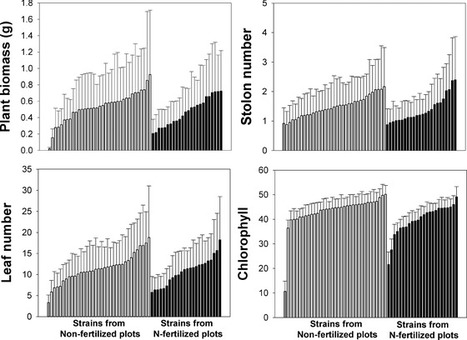
Human activities have altered the global nitrogen (N) cycle, and as a result, elevated N inputs are causing profound ecological changes in diverse ecosystems. The evolutionary consequences of this global change have been largely ignored even though elevated N inputs are predicted to cause mutualism breakdown and the evolution of decreased cooperation between resource mutualists. Using a long-term (22 years) N-addition experiment, we find that elevated N inputs have altered the legume–rhizobium mutualism (where rhizobial bacteria trade N in exchange for photosynthates from legumes), causing the evolution of less-mutualistic rhizobia. Plants inoculated with rhizobium strains isolated from N-fertilized treatments produced 17–30% less biomass and had reduced chlorophyll content compared to plants inoculated with strains from unfertilized control plots. Because the legume–rhizobium mutualism is the major contributor of naturally fixed N to terrestrial ecosystems, the evolution of less-cooperative rhizobia may have important environmental consequences.
|
|
Scooped by
Jean-Michel Ané
February 25, 2015 11:30 AM
|
My favorite critter is the mycorrhizae fungi,” said Towery at a presentation during the Farmland Forum, organized by The Chicago Farmers. The fungi can reach out and bring in water and nutrients that normally would not be available,” he said. “It’s like making your plant’s root system larger. Fungi in the soil are delicate, Towery noted. The population gets knocked back every time you do tillage. It takes several years for them to change populations,” he said.
|
|
Scooped by
Jean-Michel Ané
February 25, 2015 11:26 AM
|
Small, post-translationally modified and secreted peptides regulate diverse plant developmental processes. Due to low natural abundance, it is difficult to isolate and identify these peptides. Using an improved peptide isolation protocol and Orbitrap mass spectrometry, nine 15-amino-acid CEP peptides were identified that corresponded to the two domains encoded by Medicago truncatula CEP1 (MtCEP1). Novel arabinosylated and hydroxylated peptides were identified in root cultures overexpressing MtCEP1. The five most abundant CEP peptides were hydroxylated and these species were detected also in low amounts in vector control samples. Synthetic peptides with different hydroxylation patterns differentially affected root development. Notably, the domain 1 peptide hydroxylated at Pro4 and Pro11 (D1:HyP4,11) imparted the strongest inhibition of lateral root emergence when grown with 5mM KNO3 and stimulated the highest increase in nodule number when grown with 0mM KNO3. Inhibition of lateral root emergence by D1:HyP4,11 was not alleviated by removing peptide exposure. In contrast, the domain 2 peptide hydroxylated at Pro11 (D2:HyP11) increased stage III–IV lateral root primordium numbers by 6-fold (P < 0.001) which failed to emerge. Auxin addition at levels which stimulated lateral root formation in wild-type plants had little or no ameliorating effect on CEP peptide-mediated inhibition of lateral root formation or emergence. Both peptides increased and altered the root staining pattern of the auxin-responsive reporter GH3:GUS suggesting CEPs alter auxin sensitivity or distribution. The results showed that CEP primary sequence and post-translational modifications influence peptide activities and the improved isolation procedure effectively and reproducibly identifies and characterises CEPs.
|
|
Scooped by
Jean-Michel Ané
February 24, 2015 3:33 PM
|
Protein tyrosine (Tyr) nitration is a post-translational modification yielding 3-nitrotyrosine (NO2–Tyr). Formation of NO2–Tyr is generally considered as a marker of nitro-oxidative stress and is involved in some human pathophysiological disorders, but has been poorly studied in plants. Leghemoglobin (Lb) is an abundant hemeprotein of legume nodules that plays an essential role as an O2 transporter. Liquid chromatography coupled to tandem mass spectrometry was used for a targeted search and quantification of NO2–Tyr in Lb. For all Lbs examined, Tyr30, located in the distal heme pocket, is the major target of nitration. Lower amounts were found for NO2–Tyr25 and NO2–Tyr133. Nitrated Lb and other as yet unidentified nitrated proteins were also detected in nodules of plants not receiving and were found to decrease during senescence. This demonstrates formation of nitric oxide (˙NO) and by alternative means to nitrate reductase, probably via a ˙NO synthase-like enzyme, and strongly suggests that nitrated proteins perform biological functions and are not merely metabolic byproducts. In vitro assays with purified Lb revealed that Tyr nitration requires + H2O2 and that peroxynitrite is not an efficient inducer of nitration, probably because Lb isomerizes it to . Nitrated Lb is formed via oxoferryl Lb, which generates nitrogen dioxide and tyrosyl radicals. This mechanism is distinctly different from that involved in heme nitration. Formation of NO2–Tyr in Lb is a consequence of active metabolism in functional nodules, where Lb may act as a sink of toxic peroxynitrite and may play a protective role in the symbiosis.
|
|
Scooped by
Jean-Michel Ané
February 24, 2015 10:48 AM
|
Microbial adaptation to salinity can be achieved through synthesis of organic osmolytes, which requires high amounts of energy; however, a single addition of plant residues can only temporarily improve energy supply to soil microbes. Therefore, a laboratory incubation experiment was conducted to evaluate the responses of soil microbes to increasing salinity with repeated additions of plant residues using a loamy sand soil with an electrical conductivity in saturated paste extract (ECe) of 0.6 dS m−1. The soil was kept non-saline or salinized by adding different amounts of NaCl to achieve ECe of 12.5, 25.0 and 50.0 dS m−1. The non-saline soil and the saline soils were amended with finely ground pea residues at two rates equivalent to 3.9 and 7.8 g C kg−1 soil on days 0, 15 and 29. The soils receiving no residues were included as a control. Cumulative respiration per g C added over 2 weeks after each residue addition was always greater at 3.9 than 7.8 g C kg−1 soil and higher in the non-saline soil than in the saline soils. In the saline soils, the cumulative respiration per g C added was higher after the second and third additions than after the first addition except with 3.9 g C kg−1 at ECe of 50 dS m−1. Though with the same amount of C added (7.8 g C kg−1), salinity reduced soil respiration to a lesser extent when 3.9 g C kg−1 was added twice compared to a single addition of 7.8 g C kg−1. After the third residue addition, the microbial biomass C concentration was significantly lower in the soils with ECe of 25 and 50 dS m−1 than in the non-saline soil at 3.9 g C kg−1, but only in the soil with ECe of 50 dS m−1 at 7.8 g C kg−1. We concluded that repeated residue additions increased the adaptation of soil microbial community to salinity, which was likely due to high C availability providing microbes with the energy needed for synthesis of organic osmolytes.
|
|
Scooped by
Jean-Michel Ané
February 24, 2015 10:47 AM
|
• Key message
Several aspects of the life cycle of the Périgord black truffle have been elucidated only recently, while others remain either controversial or unstudied. In this paper, we present a revised life cycle of this fungus and highlight key aspects that have yet to be addressed or require further understanding.
• Context
The hypogeous sporophores of several Tuber species, renowned for their aromatic and gustatory qualities, are widely commercialized. One of the most valuable species is Tuber melanosporum Vittad., the Périgord black truffle also known as “the black diamond”. However, many aspects of T. melanosporum life cycle remain unsolved.
• Aims
In this work, we examine past and recent findings on the life cycle of T. melanosporum, currently regarded as a model system for Tuber species, with the view of highlighting aspects of its life cycle which remain unsolved.
• Results
Several aspects of its life cycle have recently been elucidated (i.e. characterization of two mating type genes, heterothallism, prevalence of sexual reproduction on vegetative propagation, exclusion of one mating type by its opposite on ectomycorrhizas, dependency of ascocarps on their host for carbon allocation), while others remain unaddressed.
• Conclusion
Numerous additional aspects of the T. melanosporum life cycle remain unsolved, such as exclusion or competition mechanisms between ectomycorrhizal mating types, factors involved in ascocarp initiation, the nature of the connection linking ascocarps and mycorrhizas and atmospheric nitrogen fixation.
|
|
Scooped by
Jean-Michel Ané
February 24, 2015 10:40 AM
|
tevia rebaudiana (Bertoni) produces steviol glycosides (SGs) – stevioside (stev) and rebaudioside-A (reb-A) that are valued as low calorie sweeteners. Inoculation with arbuscular mycorrhizal fungi (AMF) augments SGs production, though the effect of this interaction on SGs biosynthesis has not been studied at molecular level. In this study transcription profiles of eleven key genes grouped under three stages of the SGs biosynthesis pathway were compared. The transcript analysis showed upregulation of genes encoding 2-C-methyl-D-erythritol-4-phosphate (MEP) pathway enzymes viz.,1-deoxy-d-xylulose 5-phospate synthase (DXS), 1-deoxy-d-xylulose 5-phospate reductoisomerase (DXR) and 2-C-methyl-D-erytrithol 2,4-cyclodiphosphate synthase (MDS) in mycorrhizal (M) plants. Zn and Mn are imperative for the expression of MDS and their enhanced uptake in M plants could be responsible for the increased transcription of MDS. Furthermore, in the second stage of SGs biosynthesis pathway, mycorrhization enhanced the transcription of copalyl diphosphate synthase (CPPS) and kaurenoic acid hydroxylase (KAH). Their expression is decisive for SGs biosynthesis as CPPS regulates flow of metabolites towards synthesis of kaurenoid precursors and KAH directs these towards steviol synthesis instead of gibberellins. In the third stage glucosylation of steviol to reb-A by four specific uridine diphosphate (UDP)-dependent glycosyltransferases (UGTs) occurs. While higher transcription of all the three characterized UGTs in M plants explains augmented production of SGs; higher transcript levels of UGT76G1, specifically improved reb-A to stev ratio implying increased sweetness. The work signifies that AM symbiosis upregulates the transcription of all eleven SGs biosynthesis genes as a result of improved nutrition and enhanced sugar concentration due to increased photosynthesis in M plants.
|
|
Scooped by
Jean-Michel Ané
February 24, 2015 10:08 AM
|
During recent years, it has become clear that many species of archaea and bacteria are polyploid and contain more than 10 copies of their chromosome. In this contribution, eight examples are discussed to highlight different aspects of polyploidy in prokaryotes. The species discussed are the bacteria Azotobacter vinelandii, Deinococcus radiodurans, Sinorhizobium meliloti, and Epulopiscium as well as the archaea Methanocaldococcus jannaschii, Methanococcus maripaludis, Haloferax volcanii, and haloarchaeal isolates from salt deposits. The topics include possible laboratory artifacts, resistance against double-strand breaks, long-term survival, relaxation of DNA segregation and septum formation, enforced polyploidy by a eukaryotic host, genome equalization by gene conversion, and the nongenetic usage of genomic DNA as a phosphate storage polymer. Together, the selected topics give an overview of the biodiversity of polyploidy in archaea and bacteria.
|
|
|
Scooped by
Jean-Michel Ané
February 25, 2015 9:50 PM
|
Cadmium (Cd) is a toxic, biologically non-essential and highly mobile metal that has become an increasingly important environmental hazard to both wildlife and humans. In contrast to conventional remediation technologies, phytoremediation based on legume–rhizobia symbiosis has emerged as an inexpensive decontamination alternative which also revitalize contaminated soils due to the role of legumes in nitrogen cycling. In recent years, there is a growing interest in understanding symbiotic legume–rhizobia relationship and its interactions with Cd. The aim of the present review is to provide a comprehensive picture of the main effects of Cd in N2-fixing leguminous plants and the benefits of exploiting this symbiosis together with plant growth promoting rhizobacteria to boost an efficient reclamation of Cd-contaminated soils.
|
|
Scooped by
Jean-Michel Ané
February 25, 2015 9:46 PM
|
Mechanisms underlying Nod factor signaling downstream of the Nod factor receptors (NFR) have not been fully characterized. In this study, a clathrin heavy chain (CHC1) was shown to interact with the ROP GTPase ROP6, an interaction partner of Nod Factor Receptor 5 (NFR5) in Lotus japonicus. The CHC1 gene was found to be expressed constitutively in all plant tissues and be induced in Mesorhizobium-infected root hairs and nodule primordia. When expressed in leaves of Nicotiana benthamiana, CHC1 and ROP6 were co-localized at the cell circumference and within cytoplasmic punctate structures. In Mesorhizobium-infected root hairs, the CHC protein was detected in cytoplasmic punctate structures near the infection pocket, along the infection thread membrane and the plasma membrane of the host cells. Transgenic plants expressing the CHC1-Hub domain, a dominant negative effector of clathrin-mediated endocytosis, were found to suppress early nodulation gene expression and to impair Mesorhizobium infection resulting in reduced nodulation. Treatment with tyrphostin A23, an inhibitor of clathrin-mediated endocytosis of plasma membrane cargoes, had a similar effect on down-regulation of early nodulation genes. These findings demonstrate an important role of clathrin in the leguminous symbiosis with rhizobia.
|
|
Rescooped by
Jean-Michel Ané
from Plants and Microbes
February 25, 2015 11:53 AM
|
The last 20 years have provided a sophisticated understanding of how plants recognise relatively conserved microbial patterns to activate defence. In recent years DNA sequencing allowed genomes and transcriptomes of eukaryotic rusts and mildew pathogens to be studied and high-throughput imaging permit the study and visualisation of intracellular interactions during pathogenesis and defence.
We will present many aspects of plant- microbe interactions including:
- gene discovery
- genome analysis
- intra-cellular interactions with high-throughput imaging technology
- mechanistic understanding of cellular and molecular processes to translational activities
The focus on the dynamic and interactive practical sessions will naturally promote strong interactions between lecturers and participants.
Via Kamoun Lab @ TSL
|
|
Rescooped by
Jean-Michel Ané
from Microbe-Microbe Interactions
February 25, 2015 11:44 AM
|
Bacteria have been observed to grow with fungi, and those that associate with ectomycorrhizal fungi have often been thought of as symbionts that may either increase or decrease ectomycorrhizal formation rate or provide other unaccounted benefits. To explore this symbiosis from a community ecology perspective, we sampled ectomycorrhizal root tips over a 3-year period and used 454 pyrosequencing to identify the bacteria that live inside the ectomycorrhizal root tips. The results showed that fungal community composition within the same soil core and fungal taxonomic identity had a stronger effect on bacterial community composition than sample year or site. Members of the Burkholderiales and Rhizobiales were most highly represented, reflecting many previous reports of these bacteria in association with fungi. The repeated occurrences of these two bacterial orders suggest that they may be symbiotic with their fungal hosts, although the nature of such mechanisms, be it symbiotic diazotrophy or otherwise, remains to be thoroughly tested.
Via Kemen Lab
|
|
Scooped by
Jean-Michel Ané
February 25, 2015 11:40 AM
|
Champenoux/ Halle(Saale)/ Leipzig. The life style of ectomycorrhiza fungi is some 100 million years younger than the one of their ancestors within white and brown rot fungi. The key genome adaptation enabling fungi to associate to roots for establishing a symbiosis evolved a repeatedly amount of time. This conclusion was drawn by an international team of researchers who performed the first comprehensive comparative phylogenomic analysis on mycorrhiza fungi, now appearing in the reputed scientific journal Nature Genetics. These sequences provide crucial information on how the symbiosis between fungi and trees evolved.
|
|
Scooped by
Jean-Michel Ané
February 25, 2015 11:33 AM
|
When exposed to nitrogen fertilizer over a period of years, nitrogen-fixing bacteria called rhizobia evolve to become less beneficial to legumes - the plants they normally serve, researchers report in a new study.
|
|
Scooped by
Jean-Michel Ané
February 25, 2015 11:29 AM
|
With apologies to the poet John Donne, and based on recent work from the U.S. Department of Energy Joint Genome Institute (DOE JGI), a DOE Office of Science user facility, it can be said that no plant is an island, entire of itself. Unseen by the human eye, plants interact with many species of fungi and other microbes in the surrounding environment, and these exchanges can impact the plant's health and tolerance to stressors such as drought or disease, as well as the global carbon cycle.
|
|
Scooped by
Jean-Michel Ané
February 24, 2015 3:40 PM
|
As a young scientist at Washington University, she led the team of researchers that produced the first genetically-modified plant. Chilton moved to North Carolina in the early 1980s to begin her corporate career and has continued to conduct research that shapes the agricultural production of corn, cotton, and other crops. Chilton has authored more than 100 scientific publications and was awarded the World Food Prize in 2013. She will also be inducted into the National Inventors Hall of Fame later this year. At the age of 76, she still spends most of her time in the laboratory at Syngenta, where she serves as the principal scientist, but her other passions include John Grisham novels, shopping, and spending time outdoors with her family.
|
|
Scooped by
Jean-Michel Ané
February 24, 2015 10:49 AM
|
Communities of arbuscular mycorrhizal fungi (AMF) are strongly affected by land use intensity and soil type. The impact of tillage practices on AMF communities is still poorly understood, especially in organic farming systems. Our objective was to investigate the impact of soil cultivation on AMF communities in organically managed clay soils of a long-term field experiment located in the Sissle valley (Frick, Switzerland) where two different tillage (reduced and conventional mouldboard plough tillage) and two different types of fertilization (farmyard manure & slurry, or slurry only) have been applied since 2002. In addition, a permanent grassland and two conventionally managed croplands situated in the neighborhood of the experiment were analyzed as controls. Four different soil depths were studied including top-soils (0–10 and 10–20 cm) of different cultivation regimes and undisturbed sub-soils (20–30 and 30–40 cm). The fungi were directly isolated from field soil samples, and additionally spores were periodically collected from long-term trap culture (microcosm) systems. In total, >50,000 AMF spores were identified on the species level, and 53 AMF species were found, with 38 species in the permanent grassland, 33 each in the two reduced till organic farming systems, 28–33 in the regularly plowed organic farming systems, and 28–33 in the non-organic conventional farming systems. AMF spore density and species richness increased in the top-soils under reduced tillage as compared to the ploughed plots. In 10–20 cm also the Shannon–Weaver AMF diversity index was higher under reduced tillage than in the ploughed plots. Our study demonstrates thatAMF communities in clay soils were affected by land use type, farming system, tillage as well as fertilization strategy and varying with soil depth. Several AMF indicator species especially for different land use types and tillage strategy were identified from the large data set.
|
|
Scooped by
Jean-Michel Ané
February 24, 2015 10:47 AM
|
As climates shift in space, tree species ranges are predicted to shift as well. While range shifts due to climate change have been typically modelled based on abiotic factors alone, interactions among species in diverse communities may alter these range dynamics by inhibiting or enhancing establishment of propagules along the leading edge, or by increasing or decreasing tolerance to novel climates at the trailing edge. Here, we investigated how the rate of expansion at leading, and contraction at trailing, range margins of temperate tree species in response to both past and current climate change related to an important species interaction - whether they associate with arbuscular (AM) or ectomycorrhizal (EM) fungal symbionts. Mycorrhizal symbioses can mediate plant stress tolerance, and lack of EM fungal mutualists has been linked to establishment failures of EM tree species in new ranges. We found no difference in rates of leading edge expansion between the two guilds. However, EM tree taxa showed reduced contraction at their trailing edge compared to AM taxa in response to both past and current climate change. Since the mycorrhizal guild of the dominant trees may affect ecosystem properties, differential range dynamics between these functional groups of trees may have consequences for the functioning of future forests.
|
|
Scooped by
Jean-Michel Ané
February 24, 2015 10:46 AM
|
The Périgord black truffle (Tuber melanosporum Vittad.), considered a gastronomic delicacy worldwide, is an ectomycorrhizal filamentous fungus that is ecologically important in Mediterranean French, Italian, and Spanish woodlands. In this study, we developed a novel resource of single nucleotide polymorphisms (SNPs) for T. melanosporum using Illumina high-throughput re-sequencing. The genome from six T. melanosporum geographic accessions was sequenced to a depth of ~20×. These geographic accessions were selected from different populations within the northern and southern regions of the geographical species distribution. Approximately 80% of the reads for each of the six re-sequenced geographic accessions mapped against the reference T. melanosporum genome assembly, estimating the core genome size of this organism to be ~110 Mbp. A total of 442,326 SNPs corresponding to 3,540 SNPs/Mbps were identified as being included in all seven genomes. The SNPs occurred more frequently in repeated sequences (85%), although 4,501 SNPs were also identified in the coding regions of 2,587 genes. Using the ratio of non-synonymous mutations per non-synonymous site (pN) to synonymous mutations per synonymous site (pS) and Tajima's D index scanning the whole genome, we were able to identify genomic regions and genes potentially subjected to positive or purifying selection. The SNPs identified represent a valuable resource for future population genetics and genomics studies.
|
|
Scooped by
Jean-Michel Ané
February 24, 2015 10:15 AM
|
Mycorrhizal fungi can form common mycelial networks (CMNs) that interconnect plants. Here, we provide an insight into recent findings demonstrating that CMNs can be conduits for interplant signalling, influencing defence against insect herbivores and foliar necrotrophic fungi. A likely mechanism is direct transfer of signalling molecules within hyphae. However, electrical signals, which can be induced by wounding, may also enable signalling over relatively long distances, because the biophysical constraints imposed by liquid transport in hyphae and interaction with soil are relieved. We do not yet understand the ecological, evolutionary and agronomic implications of interplant signalling via CMNs. Identifying the mechanism of interplant signalling will help to address these gaps.
|


 Scoop.it!