This study was undertaken to investigate the factors explaining the results of our previous study revealing that selenium (Se) may enhance the nodulation of alfalfa (Medicago sativa L.) via improved carbohydrate metabolism. Symbiotic and non-symbiotic alfalfa plants were cultivated without or with low (1 µM) Se addition at low (2 mM) and adequate (10 mM) N supply levels. The plants were analyzed for root nodulation, photosynthesis and growth parameters. The antioxidative defense and glutathione (GSH) redox state were also investigated. In the inoculated low-nitrogen (N) plants, Se markedly increased the number and fresh weight (FW) of the nodules without any effect on nitrogenase activity. Particularly in the nodulated low-N plants, it also significantly increased the net assimilation rate and soluble sugars, and enhanced protein synthesis. Though Se generally diminished the activity of antioxidative enzymes, the concentrations of hydrogen peroxide (H2O2) and superoxide radical (O2• –) remained constant or even significantly diminished. This gives evidence that Se enhanced the protection of plants against oxidative damage. Se tended to increase GSH particularly in the leaves, and significantly increased the reduced glutathione/oxidized glutathione (GSH/GSSG) particularly in the low-N plants. We suggest that Se exerts its positive effect on the carbohydrate metabolism via modulation in the glutathione redox state.
Background The growing concern regarding the use of agricultural land for the production of biomass for food/feed or energy is dictating the search for alternative biomass sources. Photosynthetic microorganisms grown on marginal or deserted land present a promising alternative to the cultivation of energy plants and thereby may dampen the ‘food or fuel’ dispute. Microalgae offer diverse utilization routes. Results A two-stage energetic utilization, using a natural mixed population of algae (Chlamydomonas sp. and Scenedesmus sp.) and mutualistic bacteria (primarily Rhizobium sp.), was tested for coupled biohydrogen and biogas production. The microalgal-bacterial biomass generated hydrogen without sulfur deprivation. Algal hydrogen production in the mixed population started earlier but lasted for a shorter period relative to the benchmark approach. The residual biomass after hydrogen production was used for biogas generation and was compared with the biogas production from maize silage. The gas evolved from the microbial biomass was enriched in methane, but the specific gas production was lower than that of maize silage. Sustainable biogas production from the microbial biomass proceeded without noticeable difficulties in continuously stirred fed-batch laboratory-size reactors for an extended period of time. Co-fermentation of the microbial biomass and maize silage improved the biogas production: The metagenomic results indicated that pronounced changes took place in the domain Bacteria, primarily due to the introduction of a considerable bacterial biomass into the system with the substrate; this effect was partially compensated in the case of co-fermentation. The bacteria living in syntrophy with the algae apparently persisted in the anaerobic reactor and predominated in the bacterial population. The Archaea community remained virtually unaffected by the changes in the substrate biomass composition. Conclusion Through elimination of cost- and labor-demanding sulfur deprivation, sustainable biohydrogen production can be carried out by using microalgae and their mutualistic bacterial partners. The beneficial effect of the mutualistic mixed bacteria in O2 quenching is that the spent algal-bacterial biomass can be further exploited for biogas production. Anaerobic fermentation of the microbial biomass depends on the composition of the biogas-producing microbial community. Co-fermentation of the mixed microbial biomass with maize silage improved the biogas productivity.
Intensive tillage was the method that supported the expansion of agriculture in the United States to the point that our country exports more farm products than any other. There is no denying that fact, but today we face many new challenges that require solutions. We can’t afford to simply say “this is the way we have always done it and this is the way we will continue”. The soil is a natural resource that can be depleted by erosion and loss of nutrients and organic matter as the result of too much tillage.
Rhizobium bacteria live in nodules on the roots of legumes like the hairy vetch (Vicia villosa) and convert atmospheric nitrogen into a form the plant can use to make essential molecules.
Giles Oldroyd, Project Leader Department of Cell & Developmental Biology, John Innes Centre School of Integrative Plant Science seminar April 15, 2015 More s...
Rhizobia induce nitrogen-fixing nodules on host legumes, which is important in agriculture and ecology. Lipopolysaccharide (LPS) produced by rhizobia is required for infection or bacteroid survival in host cells. Genes required for LPS biosynthesis have been identified in several Rhizobium species. However, the regulation of their expression is not well understood. Here, Sinorhizobium meliloti LsrB, a member of the LysR family of transcriptional regulators, was found to be involved in LPS biosynthesis by positively regulating the expression of the lrp3-lpsCDE operon. An lsrB in-frame deletion mutant displayed growth deficiency, sensitivity to the detergent sodium dodecyl sulfate, and acidic pH compared to the parent strain. This mutant produced slightly less LPS due to lower expression of the lrp3 operon. Analysis of the transcriptional start sites of the lrp3 and lpsCDE gene suggested that they constitute one operon. The expression of lsrB was positively autoregulated. The promoter region of lrp3 was specifically precipitated by anti-LsrB antibodies in vivo. The promoter DNA fragment containing TN11A motifs was bound by the purified LsrB protein in vitro. These new findings suggest that S. meliloti LsrB is associated with LPS biosynthesis, which is required for symbiotic nitrogen fixation on some ecotypes of alfalfa plants.
Symbiosis may have played a far greater role in biological evolution than was previously thought. The symbiosis that made the colonization of land by plants possible was as a consequence of the development of arbuscular mycorrhizae. However, the present review draws attention to the role of lichens in assisting in this transition and to the phenomenon of lichenization. The recent discovery of lichen fossils in marine phosphorites in China and molecular clock estimates indicate that lichenized fungi were already present in Precambrian seas and, like contemporary species, played a role as pioneers in occupying new habitats. There is evidence that the holistic properties of associations between fungi and cyanobacteria and/or green algae facilitated the transition onto land and the subsequent colonization of terrestrial habitats. A key role in this process was played by poikilohydry. The algal components of delichenized fungi, along with lichens and photosynthetic aquatic organisms all contributed to the increase in atmospheric oxygen. Lichens, fungi and cyanobacteria settling on land were undoubtedly important in the formation of soils and thereafter enhancing their fertility. It is suggested that vascular and other green plants were able grow on these primitive soils that were stabilized by the growth of lichens, algae and cyanobacteria in a similar way to those which play a role in desert crusts at the present time.
The increasing knowledge on the functional relevance of endogenous small RNAs (esRNAs) as riboregulators has stimulated the identification and characterization of these molecules in numerous eukaryotes. In the basal fungus Mucor circinelloides, an emerging opportunistic human pathogen, esRNAs that regulate the expression of many protein coding genes have been described. These esRNAs share common machinery for their biogenesis consisting of an RNase III endonuclease Dicer, a single Argonaute protein and two RNA-dependent RNA polymerases. We show in this study that, besides participating in this canonical dicer-dependent RNA interference (RNAi) pathway, the rdrp genes are involved in a novel dicer-independent degradation process of endogenous mRNAs. The analysis of esRNAs accumulated in wild type and silencing mutants demonstrates that this new rdrp-dependent dicer-independent regulatory pathway, which does not produce sRNA molecules of discrete sizes, controls the expression of target genes promoting the specific degradation of mRNAs by a previously unknown RNase. This pathway mainly regulates conserved genes involved in metabolism and cellular processes and signaling, such as those required for heme biosynthesis, and controls responses to specific environmental signals. Searching the Mucor genome for candidate RNases to participate in this pathway, and functional analysis of the corresponding knockout mutants, identified a new protein, R3B2. This RNase III-like protein presents unique domain architecture, it is specifically found in basal fungi and, besides its relevant role in the rdrp-dependent dicer-independent pathway, it is also involved in the canonical dicer-dependent RNAi pathway, highlighting its crucial role in the biogenesis and function of regulatory esRNAs. The involvement of RdRPs in RNA degradation could represent the first evolutionary step towards the development of an RNAi mechanism and constitutes a genetic link between mRNA degradation and post-transcriptional gene silencing.
The integration of shade trees in coffee production can positively contribute to increased yields in these cropping systems. However, little work has examined nutrient-microbial dynamics in the rhizosphere of coffee under shade trees. In this study, we compared nutrient concentrations and nitrifier populations in rhizosphere soil of coffee under shade and in monoculture as well as in rhizosphere versus bulk soils. Our study was performed in a low altitude, wet coffee zone of Costa Rica, at a 12-year-old agroforestry experimental farm with coffee (Coffea arabica) grown under full sun and under the commonly used dinitrogen (N2) fixing shade tree, Erythrina poeppigiana. Rhizosphere and bulk soils were collected and analyzed for inorganic N, available P, exchangeable base cations and pH status. Real-time PCR was used to determine the relative abundance of ammonia oxidizing bacteria (AOB). We show a nutrient increase (11–158%), particularly nitrates, in the rhizosphere soil compared to bulk soil of coffee. Moreover, this accumulation was greater in the rhizosphere of coffee associated with E. poeppigiana than under monoculture. AOB abundance was strongly related to soil pH (r = 0.83; P = 0.002) across both treatments, while AOB abundance varied with soil ammonium:nitrate ratios (r = −0.82; P = 0.0420) exclusively under monoculture coffee. Our study, for the first time to our knowledge, illustrates soil nutrient differences and nutrient–microbial relationships under coffee in monoculture and in a N2-fixing shade tree system.
A significant challenge facing the study of arbuscular mycorrhiza is the establishment of suitable non-mycorrhizal treatments that can be compared with mycorrhizal treatments. A number of options are available, including soil disinfection or sterilisation, comparison of constitutively mycorrhizal and non-mycorrhizal plant species, comparison of plants grown in soils with different inoculum potential and the comparison of mycorrhiza-defective mutant genotypes with their mycorrhizal wild-type progenitors. Each option has its inherent advantages and limitations. Here, the potential to use mycorrhiza-defective mutant and wild-type genotype plant pairs as tools to study the functioning of mycorrhiza is reviewed. The emphasis of this review is placed on non-legume plant species, as mycorrhiza-defective plant genotypes in legumes have recently been extensively reviewed. It is concluded that non-legume mycorrhiza-defective mutant and wild-type pairs are useful tools in the study of mycorrhiza. However, the mutant genotypes should be well characterised and, ideally, meet a number of key criteria. The generation of more mycorrhiza-defective mutant genotypes in agronomically important plant species would be of benefit, as would be more research using these genotype pairs, especially under field conditions.
Plant–soil feedback is receiving increasing interest as a factor influencing plant competition and species coexistence in grasslands. However, we do not know how spatial distribution of plant–soil feedback affects plant below-ground interactions. We investigated the way in which spatial heterogeneity of soil biota affects competitive interactions in grassland plant species. We performed a pairwise competition experiment combined with heterogeneous distribution of soil biota using four grassland plant species and their soil biota. Patches were applied as quadrants of ‘own’ and ‘foreign’ soils from all plant species in all pairwise combinations. To evaluate interspecific root responses, species-specific root biomass was quantified using real-time PCR. All plant species suffered negative soil feedback, but strength was species-specific, reflected by a decrease in root growth in own compared with foreign soil. Reduction in root growth in own patches by the superior plant competitor provided opportunities for inferior competitors to increase root biomass in these patches. These patterns did not cascade into above-ground effects during our experiment. We show that root distributions can be determined by spatial heterogeneity of soil biota, affecting plant below-ground competitive interactions. Thus, spatial heterogeneity of soil biota may contribute to plant species coexistence in species-rich grasslands.
by Hirotoshi Sato, Akifumi S. Tanabe, Hirokazu Toju Root-associated fungi, including ectomycorrhizal and root-endophytic fungi, are among the most diverse and important belowground plant symbionts in dipterocarp rainforests.
This study was initiated to isolate, characterize and select symbiotically effective rhizobia nodulating lentil (Lens culinaris medic) and to enumerate of indigenous rhizobia nodulating lentil in some Ethiopian soils. More than 84 nodule and soil samples were collected. In sand culture, only 62 isolates were authenticated as rhizobia nodulating lentil. Analyses of variance indicated that most of the parameters measured were significantly (p< 0.05) improved by inoculation except root length. Inoculation increased the shoot length, shoot dry weight, and plant total nitrogen as 82.3%, 196.7% and 452%, respectively, over negative control. Tested isolates was found to be very effective (20.9%), effective (77.4%), and only one ineffective isolate. Indigenous rhizobia in investigated soils ranged from 30 to 5.8x10³ cell g-1 of dry soil. A pot experiment with selected rhizobia and nitrogen fertilizer on Chefedonsa and Debrezeit soils did not show any significant difference in shoot dry weight at P <0.05. From the study it was observed that most Ethiopian soils were inhabited with moderate to high number of indigenous rhizobia and also rhizobia inoculation did not improve lentil productivity in investigated soils.
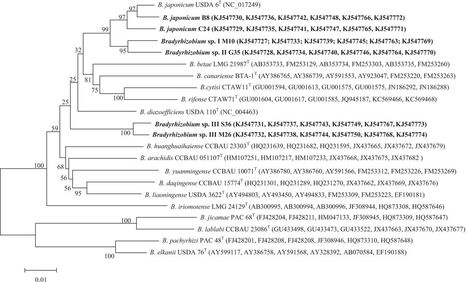
To investigate the effects of land use and crop management on soybean rhizobial communities, 280 nodule isolates were trapped from 7 fields with different land use and culture histories. Besides the known Bradyrhizobium japonicum, three novel genospecies were isolated from these fields. Grassland (GL) maintained a higher diversity of soybean bradyrhizobia than the other cultivation systems. Two genospecies (Bradyrhizobium spp. I and III) were distributed widely in all treatments, while Bradyrhizobium sp. II was found only in GL treatment. Cultivation with soybeans increased the rhizobial abundance and diversity, except for the soybean monoculture (S-S) treatment. In monoculture systems, soybeans favored Bradyrhizobium sp. I, while maize and wheat favored Bradyrhizobium sp. III. Fertilization decreased the rhizobial diversity indexes but did not change the species composition. The organic carbon (OC) and available phosphorus (AP) contents and pH were the main soil parameters positively correlated with the distribution of Bradyrhizobium spp. I and II and Bradyrhizobium japonicum and negatively correlated with Bradyrhizobium sp. III. These results revealed that different land uses and crop management could not only alter the diversity and abundance of soybean rhizobia, but also change interactions between rhizobia and legume or nonlegume plants, which offered novel information about the biogeography of rhizobia.
Extra-slow-growing bradyrhizobia from root nodules of field-grown soybeans harbor abundant insertion sequences (ISs) and are termed highly reiterated sequence–possessing (HRS) strains. We analyzed the genome organization of HRS strains with the focus on IS distribution and symbiosis island structure. Using pulsed-field gel electrophoresis, we consistently detected several plasmids (0.07–0.4 Mb) in the HRS strains (NK5, NK6, USDA135, 2281, USDA123, and T2), whereas no plasmids were detected in the non-HRS strain USDA110. The chromosomes of the six HRS strains (9.7–10.7 Mb) were larger than that of USDA110 (9.1 Mb). Using MiSeq sequences of 6 HRS and 17 non-HRS strains mapped to the USDA110 genome, we found that the copy numbers of ISRj1, ISRj2, ISFK1, IS1632, ISB27, ISBj8, and IS1631 were markedly higher in HRS strains. Whole-genome sequencing showed that the HRS strain NK6 had four small plasmids (136–212 kb) and a large chromosome (9780 kb). Strong co-linearity was found between 7.4-Mb core regions of NK6 and USDA110 chromosomes. USDA110 symbiosis islands mainly corresponded to five small regions (S1–S5) within two variable regions, V1 (0.8 Mb) and V2 (1.6 Mb), of the NK6 chromosome. USDA110 nif gene cluster (nifDKENXSBZHQW/fixBCX) was split into two regions, S2 and S3, where ISRj1-mediated rearrangement occurred between nifS and nifB. ISs were also scattered in NK6 core regions, and ISRj1 insertion often disrupted some genes important for survival and environmental responses. These results suggest that HRS strains of soybean bradyrhizobia were subjected to IS-mediated symbiosis island shuffling and core genome degradation.
Although the biogeography of rhizobia has been investigated extensively, little is known about the adaptive molecular evolution of rhizobia influenced by soil environments and selected by legumes. In this study, microevolution of Mesorhizobium strains nodulating Caragana in a semi-fixing desert belt in northern China was investigated. Five core genes—atpD, glnII, gyrB, recA, and rpoB, six heat-shock factor genes—clpA, clpB, dnaK, dnaJ, grpE, and hlsU, and five nodulation genes—nodA, nodC, nodD, nodG, and nodP, of 72 representative mesorhizobia were studied in order to determine their genetic variations. A total of 21 genospecies were defined based on the average nucleotide identity (ANI) of concatenated core genes using a threshold of 96% similarity, and by the phylogenetic analyses of the core/heat-shock factor genes. Significant genetic divergence was observed among the genospecies in the semi-fixing desert belt (areas A–E) and Yunnan province (area F), which was closely related to the environmental conditions and geographic distance. Gene flow occurred more frequently among the genospecies in areas A–E, and three sites in area B, than between area F and the other five areas. Recombination occurred among strains more frequently for heat-shock factor genes than the other genes. The results conclusively showed that the Caragana-associated mesorhizobia had divergently evolved according to their geographic distribution, and have been selected not only by the environmental conditions but also by the host plants.
Plants are continuously monitoring the presence of microorganisms to establish an adapted response. Plants commonly use pattern recognition receptors (PRRs) to perceive microbe- or pathogen-associated molecular patterns (MAMPs/PAMPs) which are microorganism molecular signatures. Located at the plant plasma membrane, the PRRs are generally receptor-like kinases (RLKs) or receptor-like proteins (RLPs). MAMP detection will lead to the establishment of a plant defense program called MAMP-triggered immunity (MTI). In this review, we overview the RLKs and RLPs that assure early recognition and control of pathogenic or beneficial bacteria. We also highlight the crucial function of PRRs during plant-microbe interactions, with a special emphasis on the receptors of the bacterial flagellin and peptidoglycan. In addition, we discuss the multiple strategies used by bacteria to evade PRR-mediated recognition.
Field studies have revealed the impact of changing water regimes on the structure of arbuscular mycorrhizal fungal (AMF) communities, but it is not known what happens to the abundance of individual AMF species within the community when the water conditions in the rhizosphere change. The behavior of four AMF species isolated from the Arabian desert (Diversispora aurantia, Diversispora omaniana, Septoglomus africanum, and an undescribed Paraglomus species) was investigated when assembled in microcosms containing Sorghum bicolor as host plant, and treated with various water regimes. Furthermore, the impact of invasion of these assemblages by Rhizophagus irregularis, an AMF species widely used in commercial inocula, was studied. The abundance of each AMF species in sorghum roots was measured by determining the transcript numbers of their large ribosomal subunit (rLSU) by real-time PCR, using cDNA and species-specific primers. Plant biomass and length of AMF extraradical hyphae were also measured. The abundance of each AMF species within the sorghum roots was influenced by both the water regime and the introduction of R. irregularis. Under dry conditions, the introduction of R. irregularis reduced the total abundance of all native AMF species in roots and also led to a reduction in the amount of extraradical mycelium, as well as to a partial decrease in plant biomass. The results indicate that both water regime and the introduction of an invasive AMF species can strongly alter the structure of an AMF native assemblage with a consequent impact on the entire symbiotic mycorrhizal relationship.
To get content containing either thought or leadership enter:
To get content containing both thought and leadership enter:
To get content containing the expression thought leadership enter:
You can enter several keywords and you can refine them whenever you want. Our suggestion engine uses more signals but entering a few keywords here will rapidly give you great content to curate.


 Your new post is loading...


 Scoop.it!