 Your new post is loading...
Slides from a workshop on academic writing and publishing, including discussions of the peer review process and ethics
Via Mary Williams

|
Scooped by
Jean-Michel Ané
October 9, 2015 2:33 AM
|
Fertilizer application is a common anthropogenic alteration to terrestrial systems. Increased nutrient input can impact soil microbial diversity or function directly through altered soil environments, or indirectly through plant-microbe feedbacks, with potentially important effects on ecologically-important plant-associated mutualists. We investigated the impacts of plant fertilizer, containing all common macro and micronutrients on symbiotic nitrogen-fixing bacteria (rhizobia), a group of bacteria that are important for plant productivity and ecosystem function. We collected rhizobia nodule isolates from natural field soil that was treated with slow-release plant fertilizer over a single growing season and compared phenotypic traits related to free-living growth and host partner quality in these isolates to those of rhizobia from unfertilized soils. Through a series of single inoculation assays in controlled glasshouse conditions, we found that isolates from fertilized field soil provided legume hosts with higher mutualistic benefits. Through growth assays on media containing variable plant fertilizer concentrations, we found that plant fertilizer was generally beneficial for rhizobia growth. Rhizobia isolated from fertilized field soil had higher growth rates in the presence of plant fertilizer compared to isolates from unfertilized field soil, indicating that plant fertilizer application favoured rhizobia isolates with higher abilities to utilize fertilizer for free-living growth. We found a positive correlation between growth responses to fertilizer and mutualism benefits among isolates from fertilized field soil, demonstrating that variable plant fertilizer induces context-dependent genetic correlations, potentially changing the evolutionary trajectory of either trait through increased trait dependencies. Our study shows that short-term application is sufficient to alter the composition of rhizobia isolates in the population or community, either directly though changes in the soil chemistry or indirectly through altered host legume feedbacks, and is potentially a strong selective agent acting on natural rhizobia populations.
|
|
Scooped by
Jean-Michel Ané
October 9, 2015 2:29 AM
|
Although induced systemic resistance (ISR) is well-documented in the context of plant–beneficial bacteria interactions, knowledge about the local and systemic molecular and biochemical defense responses before or upon pathogen infection in grapevine is very scarce. In this study, we first investigated the capacity of grapevine plants to express immune responses at both above- and below-ground levels upon interaction with a beneficial bacterium, Pseudomonas fluorescens PTA-CT2. We then explored whether the extent of priming state could contribute to the PTA-CT2-induced ISR in Botrytis cinerea–infected leaves. Our data provide evidence that this bacterium colonized grapevine roots but not the above-ground plant parts and altered the plant phenotype that displayed multiple defense responses both locally and systemically. The grapevine roots and leaves exhibited distinct patterns of defense-related gene expression during root colonization by PTA-CT2. Roots responded faster than leaves and some responses were more strongly upregulated in roots than in leaves and vice versa for other genes. These responses appear to be associated with some induction of cell death in roots and a transient expression of HSR, a hypersensitive response-related gene in both local (roots) and systemic (leaves) tissues. However, stilbenic phytoalexin patterns followed opposite trends in roots compared with leaves but no phytoalexin was exuded during plant-bacterium interaction, suggesting that roots could play an important role in the transfer of metabolites contributing to immune response at the systemic level. Unexpectedly, in B. cinerea–infected leaves PTA-CT2-mediated ISR was accompanied in large part by a downregulation of different defense-related genes, including HSR. Only phytoalexins and glutathion-S-transferase 1 transcripts were upregulated, while the expression of anthocyanin biosynthetic genes was maintained at a higher level than the control. This suggests that decreased expression of HSR, as a marker of cell death, and activation of secondary metabolism pathways could be responsible for a reduced B. cinerea colonization capacity in bacterized plants.
|
|
Scooped by
Jean-Michel Ané
October 9, 2015 2:27 AM
|
Cell biology is the study of the structure and function of the unit or units of living organisms. Enabled by current and evolving technologies, cell biologists today are embracing new scientific challenges that span many disciplines. The eclectic nature of cell biology is core to its future and remains its enduring legacy.
|
|
Scooped by
Jean-Michel Ané
October 9, 2015 2:26 AM
|
Mars received quite a bit of attention last week as NASA revealed for the first time they found liquid water in brine deposits. Using a combination of spectral readings and computerized analysis, they learned the most valuable chemical to life is not only there, but flowing. This in turn has sparked the debate over whether colonization of Mars and its subsequent terraforming might be more than a speculative fiction dream.
|
|
Scooped by
Jean-Michel Ané
October 9, 2015 2:18 AM
|
|
|
Scooped by
Jean-Michel Ané
October 9, 2015 2:12 AM
|
Nodules of legume plants are highly integrated symbiotic systems shaped by millions of years of evolution. They harbor nitrogen-fixing rhizobium bacteria called bacteroids. Several legume species produce peptides called nodule-specific cysteine-rich (NCR) peptides in the symbiotic nodule cells which house the bacteroids. NCR peptides are related to antimicrobial peptides of innate immunity. They induce the endosymbionts into a differentiated, enlarged, and polyploid state. The bacterial symbionts, on their side, evolved functions for the response to the NCR peptides. Here, we identified the bclA gene of Bradyrhizobium sp. strains ORS278 and ORS285, which is required for the formation of differentiated and functional bacteroids in the nodules of the NCR peptide-producing Aeschynomene legumes. The BclA ABC transporter promotes the import of NCR peptides and provides protection against the antimicrobial activity of these peptides. Moreover, BclA can complement the role of the related BacA transporter of Sinorhizobium meliloti, which has a similar symbiotic function in the interaction with Medicago legumes.
|
|
Scooped by
Jean-Michel Ané
October 9, 2015 2:06 AM
|
Nitrogen fixation in the legume-rhizobium symbiosis is a crucial area of research for more sustainable agriculture. Our knowledge of the plant cascade in response to the perception of bacterial Nod Factors has increased in recent years. However, the discovery that NFs are not involved in the Aeschynomene/Bradyrhizobia interaction suggests that alternative molecular dialogues may exist in the legume family. We evaluated the conservation of the signalling pathway common to other endosymbioses using three candidate genes: CCaMK, which plays a central role in cross signalling between nodule organogenesis and infection processes, and SYMRK and HK1, which act upstream and downstream of CCaMK, respectively. We showed that CCAMK, SYMRK and HK1 are required for efficient nodulation in Aeschynomene evenia. Our results demonstrate that CCAMK and SYMRK are recruited in NF-independent symbiosis and hence may be be conserved in all vascular plant endosymbioses described so far.
|
|
Scooped by
Jean-Michel Ané
October 8, 2015 2:16 PM
|
Life on Earth as we know it would not be possible without the evolution of plants, and without the transition of plants to live on land. Land plants (also known as embryophytes) are a monophyletic lineage embedded within the green algae. Green algae as a whole are among the oldest eukaryotic lineages documented in the fossil record, and are well over a billion years old, while land plants are about 450–500 million years old. Much of green algal diversification took place before the origin of land plants, and the land plants are unambiguously members of a strictly freshwater lineage, the charophyte green algae. Contrary to single-gene and morphological analyses, genome-scale phylogenetic analyses indicate the sister taxon of land plants to be the Zygnematophyceae, a group of mostly unbranched filamentous or single-celled organisms. Indeed, several charophyte green algae have historically been used as model systems for certain problems, but often without a recognition of the specific phylogenetic relationships among land plants and (other) charophyte green algae. Insight into the phylogenetic and genomic properties of charophyte green algae opens up new opportunities to study key properties of land plants in closely related model. This review will outline the transition from single-celled algae to modern-day land plants, and will highlight the bright promise studying the charophyte green algae holds for better understanding plant evolution.

|
Suggested by
Francis Martin
October 6, 2015 1:41 AM
|
When the algal ancestor of modern land plants made the transition from aquatic environments to an inhospitable shore 450 million years ago, it changed the world by dramatically altering climate and setting the stage for the vast array of terrestrial life. The genetic and developmental innovations plants used to make the leap to land have been enduring secrets of nature. Now, an international team of researchers, writing this week (Oct. 5, 2015) in the Proceedings of the National Academy of Sciences (PNAS), reveals that the aquatic algae from which terrestrial plant life first arose were genetically pre-adapted to form the symbiotic relationships with microorganisms that most land plants need to acquire nutrients from the soil.
|
|
Scooped by
Jean-Michel Ané
October 6, 2015 1:27 AM
|
A mounting body of research suggests that invasive non-native earthworms substantially alter microbial communities, including arbuscular mycorrhizal fungi (AMF). These changes to AMF can cascade to affect plant communities and vertebrate populations. Despite these research advances, relatively little is known about: (1) the mechanisms behind earthworms' effects on AMF, and (2) the factors that determine the outcomes of earthworm-AMF interactions (i.e., whether AMF abundance is increased or decreased, and subsequent effects on plants). We predict that AMF-mediated effects of non-native earthworms on ecosystems are nearly universal because: (1) AMF are important components of most terrestrial ecosystems, (2) non-native earthworms have become established in nearly every type of terrestrial ecosystem, and (3) non-native earthworms, due to their burrowing and feeding behavior, greatly affect AMF with potentially profound concomitant effects on plant communities. We highlight the multiple direct and indirect effects of non-native earthworms on plants and review what is currently known about the interaction between earthworms and AMF. We also illustrate how the effects of non-native earthworms on plant-AMF mutualisms can alter the structure and stability of aboveground plant communities, as well as the vertebrate communities relying on these habitats. Integrative studies that assess the interactive effects of earthworms and AMF can provide new insights into the role that belowground ecosystem engineers play in altering aboveground ecological processes. Understanding these processes may improve our ability to predict the structure of plant and animal communities in earthworm-invaded regions and to develop management strategies that limit the numerous undesired impacts of earthworms.
|
|
Scooped by
Jean-Michel Ané
October 6, 2015 1:17 AM
|
Background
Induced aboveground plant defenses against pathogens can have negative effects on belowground microbial symbionts. While a considerable number of studies have utilized chemical elicitors to experimentally induce such defenses, there is surprisingly little evidence that actual aboveground pathogens affect root-associated microbes. We report here that an aboveground fungal pathogen of common bean (Phaseolus vulgaris) induces a defense response that inhibits both the belowground formation of root nodules elicited by rhizobia and the colonization with arbuscular mycorrhizal fungi (AMF).
Results
Foliage of plants inoculated with either rhizobia or AMF was treated with both live Colletotrichum gloeosporioides—a generalist hemibiotrophic plant pathogen—and C. gloeosporioides fragments. Polyphenol oxidase (PPO), chitinase and β-1,3-glucanase activity in leaves and roots, as well as the number of rhizobia nodules and the extent of AMF colonization, were measured after pathogen treatments. Both the live pathogen and pathogen fragments significantly increased PPO, chitinase and β-1,3-glucanase activity in the leaves, but only PPO activity was increased in roots. The number of rhizobia nodules and the extent of AMF colonization was significantly reduced in treatment plants when compared to controls.
Conclusion
We demonstrate that aboveground fungal pathogens can affect belowground mutualism with two very different types of microbial symbionts—rhizobia and AMF. Our results suggest that systemically induced PPO activity is functionally involved in this above-belowground interaction. We predict that the top-down effects we show here can drastically impact plant performance in soils with limited nutrients and water; abiotic stress conditions usually mitigated by microbial belowground mutualists.
|
|
Scooped by
Jean-Michel Ané
October 6, 2015 1:05 AM
|
High-throughput transcriptome profiling (RNAseq) has uncovered large and heterogeneous populations of small noncoding RNA species (sRNAs) with potential regulatory roles in bacteria. These sRNAs act mostly by protein-assisted base-pairing with target mRNAs to fine-tune post-transcriptional reprogramming of gene expression underlying bacterial responses to changing environments. Riboregulation impacts virtually any physiological process, and has been shown to largely influence virulence of pathogenic bacteria. Here, we review our current knowledge on the structure, conservation and function of the noncoding transcriptome of the α-rhizobia Sinorhizobium meliloti, the nitrogen-fixing symbiotic partner of alfalfa and related medics. Several RNAseq-based surveys in S. meliloti have shown abundant transcription from hitherto regarded as noncoding intergenic regions (IGRs), strikingly high numbers of mRNA-derived RNAs and pervasive antisense transcription of protein-coding genes. sRNAs encoded within IGRs constitute the most extensively studied group of bacterial riboregulators. They are differentially expressed and modulate translation and/or stability of trans-encoded target mRNAs by short antisense interactions that, in enteric model bacteria, are facilitated by the RNA chaperone Hfq. Among symbiotic rhizobia, regulatory sRNAs have been functionally characterized only in S. meliloti to date. The trans-sRNAs AbcR1 and AbcR2 are examples of Hfq-dependent sRNAs whereas EcpR1 does not bind Hfq. We will provide insights into the transcriptional regulation and activity mechanisms of these sRNAs for the targeting and control of multiple mRNAs involved in nutrient uptake (AbcR1/2) and cell cycle progression (EcpR1).
|
|
|
Scooped by
Jean-Michel Ané
October 9, 2015 2:34 AM
|
Water is an increasingly scarce resource that limits crop productivity in many parts of the world, and the frequency and severity of drought are predicted to increase as a result of climate change. Improving tolerance to drought stress is therefore important for maximizing future crop yields.
|
|
Scooped by
Jean-Michel Ané
October 9, 2015 2:30 AM
|
No tree is an island, and no place is this truer than the forest. Hidden beneath the soil of the forest understory is a labyrinth of fungal connections between tree roots that scientists call the mycorrhizal network. Others have called it the wood-wide web.
|
|
Scooped by
Jean-Michel Ané
October 9, 2015 2:27 AM
|
Studies on chilling stress damage and its mitigation through microorganisms in members of family Solanaceae is limited, despite their economic importance. We studied chilling stress alleviation in tomato plants colonized by psychrotolerant bacterial strains Pseudomonas vancouverensis OB155-gfp and P. frederiksbergensis OS261-gfp. Log phase cultures of bacterial strains were coated on surface-sterilized seeds (bacterization) before sowing and nonbacterized (control) seeds were coated with sterile bacterial growth medium. All plants were grown at temperatures of 30 and 25°C and at the end of 4 weeks, chilling treatment (12 and 10°C) was imposed for 1 week on half of the bacterized and control plants. Under normal conditions (30 and 25°C), no significant difference was observed in antioxidant activity, proline accumulation, and expression of cold acclimation genes in tomato leaf tissues of both control and bacterized plants. However, plants exposed to temperatures of 12 and 10°C were found to decrease in robustness and nutrient uptake, accompanied by increased membrane damage. Chilling resistance in bacterized plants was evident from reduced membrane damage and reactive oxygen species levels, improved antioxidant activity in leaf tissues, and high expression of cold acclimation genes LeCBF1 and LeCBF3 compared with control plants. Confocal microscopy confirmed effective colonization and intercellular localization of cold-adapted bacterial strains OB155-gfp and OS261-gfp.
|
|
Scooped by
Jean-Michel Ané
October 9, 2015 2:27 AM
|
Plant species richness (PSR) increases nutrient uptake which depletes bioavailable nutrient pools in soil. No such relationship between plant uptake and availability in soil was found for phosphorus (P). We explored PSR effects on P mobilisation [phosphatase activity (PA)] in soil. PA increased with PSR. The positive PSR effect was not solely due to an increase in Corg concentrations because PSR remained significant if related to PA:Corg. An increase in PA per unit Corg increases the probability of the temporal and spatial match between substrate, enzyme and microorganism potentially serving as an adaption to competition. Carbon use efficiency of microorganisms (Cmic:Corg) increased with increasing PSR while enzyme exudation efficiency (PA:Cmic) remained constant. These findings suggest the need for efficient C rather than P cycling underlying the relationship between PSR and PA. Our results indicate that the coupling between C and P cycling in soil becomes tighter with increasing PSR.
|
|
Scooped by
Jean-Michel Ané
October 9, 2015 2:23 AM
|
Legumes form beneficial associations with nitrogen-fixing rhizobial bacteria, resulting in the formation of nitrogen-fixing nodules on the roots. This process can only be initiated within a specific zone of the root, referred to as the susceptibility zone. Changes in auxin and cytokinin are necessary and sufficient for nodule organogenesis in a legume and it seems likely that the restrictions in the root zonation that allow nodule development is associated with the status of auxin and cytokinins within the susceptibility zone.
Robustness in plant development is associated with tissues tightly coordinating their meristematic, growth and differentiation activities both spatially and temporally. Over the last decade, we have increased our understanding, through a combination of molecular biology and computational modelling, of the establishment and regulation of root meristem zones in Arabidopsis. Particularly important roles have emerged for the hormones auxin and cytokinin. This PhD project will dissect the molecular underpinnings that create the susceptibility zone within the legume root, where nodulation is initiated. The student will make use of the recent advances in understanding of the Arabidopsis root to elucidate the hormonal regulation of the legume susceptibility zone. By adapting the Arabidopsis root computational framework for use in legumes, new hypotheses will be generated to explain the susceptibility zone’s regulation. Experimental testing of these hypotheses will add mechanistic insight into how legume root development has been reprogrammed by symbiotic bacteria.
The student will be based in the both the Grieneisen and Oldroyd labs and will be mentored in the wide array of mathematic and experimental approaches involved.
|
|
Scooped by
Jean-Michel Ané
October 9, 2015 2:13 AM
|
Nitric oxide (NO) is involved in various plant-microbe interactions. In the symbiosis between the soil bacterium Sinorhizobium meliloti and the model legume Medicago truncatula NO is required for an optimal establishment of the interaction but is also a signal for nodule senescence. Little is known about the molecular mechanisms responsible for NO effects in the legume-rhizobium interaction. Here we investigate the contribution of the bacterial NO response to the modulation of a plant protein post-translational modification in nitrogen fixing nodules. We made use of different bacterial mutants to finely modulate NO levels inside M. truncatula root nodules and examine the consequence on tyrosine nitration of the plant Glutamine synthetase (GS), a protein responsible for assimilation of the ammonia released by nitrogen fixation. Our results reveal that S. meliloti possesses several proteins which limit inactivation of plant enzyme activity via NO-mediated post-translational modifications. This is the first demonstration that rhizobia can impact the course of nitrogen fixation by modulating the activity of a plant protein.
|
|
Scooped by
Jean-Michel Ané
October 9, 2015 2:10 AM
|
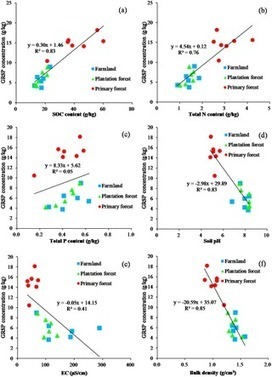
The glycoprotein known as glomalin-related soil protein (GRSP) is abundantly produced on the hyphae and spores of arbuscular mycorrhizal fungi (AMF) in soil and roots. Few studies have focused on its amount, composition and associations with soil properties and possible land-use influences, although the data hints at soil rehabilitation. By choosing a primary forest soil as a non-degraded reference, it is possible to explore whether afforestation can improve degraded farmland soil by altering GRSP. In this paper, close correlations were found between various soil properties (soil organic carbon, nitrogen, pH, electrical conductivity (EC), and bulk density) and the GRSP amount, between various soil properties and GRSP composition (main functional groups, fluorescent substances, and elements). Afforestation on farmland decreased the EC and bulk density (p < 0.05). The primary forest had a 2.35–2.56-fold higher GRSP amount than those in the plantation forest and farmland, and GRSP composition (tryptophan-like and fulvic acid-like fluorescence; functional groups of C–H, C–O, and O–H; elements of Al, O, Si, C, Ca, and N) in primary forest differed from those in plantation forest and farmland (p < 0.05). However, no evident differences in GRSP amount and composition were observed between the farmland and the plantation forest. Our finding highlights that 30 years poplar afforestation on degraded farmland is not enough to change GRSP-related properties. A longer period of afforestation with close-to-nature managements may favor the AMF-related underground recovery processes.
|
|
Scooped by
Jean-Michel Ané
October 9, 2015 2:03 AM
|
With the opening of its expanded Littlehampton, UK production site, BASF is strengthening its ability to sustainably meet the growing global demand for biological solutions for agriculture and horticulture. At this site, BASF increases its production volumes of beneficial nematodes and inoculants, moving ahead with its strategy to develop solutions beyond conventional crop protection.
“We are making significant investments in innovating and delivering the best in biological and chemical solutions. This will support our customers to produce more efficiently with an even better outcome while meeting the evolving expectations of society. Now and for the long-term we are committed to being an innovative partner in this dynamic area,” said Philipp Rosendorfer, Vice President R&D Functional Crop Care.
|
|
Scooped by
Jean-Michel Ané
October 6, 2015 2:22 AM
|
Colonization of land by plants was a major transition on Earth, but the developmental and genetic innovations required for this transition remain unknown. Physiological studies and the fossil record strongly suggest that the ability of the first land plants to form symbiotic associations with beneficial fungi was one of these critical innovations. In angiosperms, genes required for the perception and transduction of diffusible fungal signals for root colonization and for nutrient exchange have been characterized. However, the origin of these genes and their potential correlation with land colonization remain elusive. A comprehensive phylogenetic analysis of 259 transcriptomes and 10 green algal and basal land plant genomes, coupled with the characterization of the evolutionary path leading to the appearance of a key regulator, a calcium- and calmodulin-dependent protein kinase, showed that the symbiotic signaling pathway predated the first land plants. In contrast, downstream genes required for root colonization and their specific expression pattern probably appeared subsequent to the colonization of land. We conclude that the most recent common ancestor of extant land plants and green algae was preadapted for symbiotic associations. Subsequent improvement of this precursor stage in early land plants through rounds of gene duplication led to the acquisition of additional pathways and the ability to form a fully functional arbuscular mycorrhizal symbiosis.
|
|
Scooped by
Jean-Michel Ané
October 6, 2015 1:33 AM
|
Beneficial microbial endophytes increase productivity and induce stress tolerance, which could contribute to developing a low input and sustainable bioenergy crop production system. We tested for the first time, the effects of microbial endophytes on growth and leaf-level physiology of switchgrass (Panicum virgatum) under a moderate drought preconditioning and a successive severe drought stress. Burkholderia phytofirmans strain PsJN-inoculated switchgrass plants were 23.6% taller (p < 0.0001) and possessed 116% more tillers (p < 0.0001) during the moderate drought. Pre-drought conditioned PsJN-inoculated switchgrass had higher photosynthetic rates (Ps) at all levels of water stress; whereas, control switchgrass only benefited from pre-drought when leaf water potential (LWP) dropped below −1 MPa. Both PsJN inoculation and drought stress accelerated the leaf senescence and the strain promoted tillering/height ratio, which indicated more rapid development. In sum, enhancement of drought tolerance of switchgrass by PsJN was indicated by this study.
|
|
Scooped by
Jean-Michel Ané
October 6, 2015 1:26 AM
|
Forest trees are an integral part of the coffee ecosystem. In fact, all shade grown Indian coffee farms are a mosaic of coffee plants and natural forests. The characteristic feature of Indian coffee Plantations is that they are shade grown under the canopy of tall evergreen forests.
The coffee farms are home to a variety of trees and not just confined to a monoculture of selective trees (Single species). The biological diversity reaches its zenith inside the coffee mountain. These vast mountains are microcosms of insects, plants and animals. Only a handful of countries in the world grow coffee in an ecofriendly manner like the way India does.
|
|
Scooped by
Jean-Michel Ané
October 6, 2015 1:11 AM
|
Researchers are going back to the future in looking at biological solutions to improve crop yields.
In recent years, there has been an increased interest in biological crop products by public and private researchers.
“It is tried and well-established,” says Sonya Franklin, Monsanto biotechnology microbial traits program director.
“Microbes have been in used in agriculture for millennia.”
|


 Scoop.it!










Awesome