Your new post is loading...

|
Scooped by
Jean-Michel Ané
April 15, 2016 4:07 PM
|
In 1998, a toxic mine spill polluted a 55-km2 area in a basin southward to Doñana National Park (Spain). Subsequent attempts to restore those trace element-contaminated soils have involved physical, chemical, or biological methodologies. In this study, the restoration approach included application of different types and doses of organic amendments: biosolid compost (BC) and leonardite (LEO). Twelve years after the last addition, molecular analyses of arbuscular mycorrhizal (AM) fungal communities associated with target plants (Lamarckia aurea and Chrysanthemum coronarium) as well as analyses of trace element concentrations both in soil and in plants were performed. The results showed an improved soil quality reflected by an increase in soil pH and a decrease in trace element availability as a result of the amendments and dosages. Additionally, the phylogenetic diversity of the AM fungal community increased, reaching the maximum diversity at the highest dose of BC. Trace element concentration was considered the predominant soil factor determining the AM fungal community composition. Thereby, the studied AM fungal community reflects a community adapted to different levels of contamination as a result of the amendments. The study highlights the long-term effect of the amendments in stabilizing the soil system.
|
|
Scooped by
Jean-Michel Ané
April 15, 2016 4:03 PM
|
Biochar may alleviate plant water stress in association with arbuscular mycorrhizal (AM) fungi but research has not been conclusive. Therefore, a glasshouse experiment was conducted to understand how interactions between AM fungi and plants respond to biochar application under water-stressed conditions. A twin chamber pot system was used to determine whether a woody biochar increased root colonisation by a natural AM fungal population in a pasture soil (‘field’ chamber) and whether this was associated with increased growth of extraradical AM fungal hyphae detected by plants growing in an adjacent (‘bait’) chamber containing irradiated soil. The two chambers were separated by a mesh that excluded roots. Subterranean clover was grown with and without water stress and harvested after 35, 49 and 63 days from each chamber. When biochar was applied to the field chamber under water-stressed conditions, shoot mass increased in parallel with mycorrhizal colonisation, extraradical hyphal length and shoot phosphorus concentration. AM fungal colonisation of roots in the bait chamber indicated an increase in extraradical mycorrhizal hyphae in the field chamber. Biochar had little effect on AM fungi or plant growth under well-watered conditions. The biochar-induced increase in mycorrhizal colonisation was associated with increased growth of extraradical AM fungal hyphae in the pasture soil under water-stressed conditions.
|
|
Scooped by
Jean-Michel Ané
April 15, 2016 3:58 PM
|
Medicago truncatula is a model legume species used to investigate plant–microorganism interactions, notably root symbioses. Massive population genomic and transcriptomic data now available for this species open the way for a comprehensive investigation of genomic variations associated with adaptation of M. truncatula to its environment. Here we performed a fine-scale genome scan of selective sweep signatures in M. truncatula using more than 15 million single nucleotide polymorphisms identified on 283 accessions from two populations (Circum and Far West), and exploited annotation and published transcriptomic data to identify biological processes associated with molecular adaptation. We identified 58 swept genomic regions with a 15 kb average length and comprising 3.3 gene models on average. The unimodal sweep state probability distribution in these regions enabled us to focus on the best single candidate gene per region. We detected two unambiguous species-wide selective sweeps, one of which appears to underlie morphological adaptation. Population genomic analyses of the remaining 56 sweep signatures indicate that sweeps identified in the Far West population are less population-specific and probably more ancient than those identified in the Circum population. Functional annotation revealed a predominance of immunity-related adaptations in the Circum population. Transcriptomic data from accessions of the Far West population allowed inference of four clusters of coregulated genes putatively involved in the adaptive control of symbiotic carbon flow and nodule senescence, as well as in other root adaptations upon infection with soil microorganisms. We demonstrate that molecular adaptations in M. truncatula were primarily triggered by selective pressures from root-associated microorganisms.
|
|
Scooped by
Jean-Michel Ané
April 15, 2016 3:55 PM
|
A Postdoc position (income level German TVL E13) is available starting in June 2016 or later in the lab of Caroline Gutjahr at the Biocenter of the University of Munich (LMU), Germany. The position is initially available for one year and may be extended up to three years.
The Biocenter is equipped with state of the art instrumentation for molecular, biochemical and cell biological research and hosts a dynamic and international research community.
The Postdoc will be instrumental for a joint research project to investigate the impact of plant hormones and their signaling pathways on arbuscular mycorrhiza formation at basic and applied levels. Arbuscular mycorrhiza (AM) is a symbiosis between plant roots and fungi of the phylum Glomeromycota, which is based on the exchange of nutrients: The fungus receives organic carbon from its host and in turn provides mineral nutrients and especially phosphate to the plant. Due to resulting benefits for plant growth the symbiosis is of interest to application in sustainable agriculture. Root colonization by arbuscular mycorrhiza fungi involves distinct and genetically separable developmental steps that are largely under plant control. These steps include drastic plant cell developmental changes that precede differentiation of fungal hyphae into particular shapes inside these plant cells.We are interested in signaling mechanisms required for shaping an arbuscular mycorrhiza and specifically in interconnections between plant and symbiosis development.
See our lab website for further information: http://www.genetik.bio.lmu.de/research/gutjahr/index.html
|
|
Scooped by
Jean-Michel Ané
April 15, 2016 2:34 PM
|
Trees all over the world partner up with underground fungi, giving them the carbon they pull from the atmosphere in exchange for hard-to-get nutrients like nitrogen and phosphorous. Now, it turns out that these mycorrhizal fungi (like the amethyst deceiver, whose above-ground ”fruiting body” is shown in the image above) form an underground pipeline that shuttles that carbon between trees, even those of different species. The discovery paints a new picture of forests as far more connected than previously thought. Using a 45-meter-tall crane that towered over the Swiss forest canopy, researchers spent 5 years pumping carbon dioxide over five Norway spruce trees (Picea abies). The gas contained a specific blend of isotopes that let the researchers track the carbon as it moved its way through the trees—and through the fungal network that connects them to their neighbors. The authors estimate that 40% of the carbon in a tree’s fine roots comes from its neighbors, in a paper published today in Science. Some even makes its way up the neighbors’ trunks, where it’s used to build structures like bark. Altogether, the researchers estimate that in each hectare of forest, an average of 280 kilograms of carbon is exchanged between trees each year—nearly 4% of all of the carbon that those trees pull annually from the atmosphere. This hidden carbon superhighway could be key to forests’ resilience through droughts and other damaging events.
|
|
Scooped by
Jean-Michel Ané
April 15, 2016 1:41 PM
|
In response to the presence of compatible rhizobium bacteria, legumes form symbiotic organs called nodules on their roots. These nodules house nitrogen-fixing bacteroids that are a differentiated form of the rhizobium bacteria. In some legumes, the bacteroid differentiation comprises a dramatic cell enlargement, polyploidization, and other morphological changes. Here, we demonstrate that a peptidoglycan-modifying enzyme in Bradyrhizobium strains, a DD-carboxypeptidase that contains a peptidoglycan-binding SPOR domain, is essential for normal bacteroid differentiation in Aeschynomene species. The corresponding mutants formed bacteroids that are malformed and hypertrophied. However, in soybean, a plant that does not induce morphological differentiation of its symbiont, the mutation does not affect the bacteroids. Remarkably, the mutation also leads to necrosis in a large fraction of the Aeschynomene nodules, indicating that a normally formed peptidoglycan layer is essential for avoiding the induction of plant immune responses by the invading bacteria. In addition to exopolysaccharides, capsular polysaccharides, and lipopolysaccharides, whose role during symbiosis is well defined, our work demonstrates an essential role in symbiosis for yet another rhizobial envelope component, the peptidoglycan layer.
Almost all land plants, including most trees, shrubs, and herbs, form symbiotic associations with mycorrhizal fungi (1). These soil fungi acquire nutrients that they transfer to their plant hosts in exchange for carbon (see the photo). Plants in natural vegetation can acquire up to 80% of nitrogen and phosphorus from their mycorrhizal associates (2). Individual mycorrhizal fungi can simultaneously colonize many plant hosts of the same species or different species. As a result, plants in natural communities are interconnected by mycorrhizal networks. Earlier studies with small tree seedlings revealed that carbon is transferred from one plant to another through these underground mycorrhizal pipelines (3). On page 342 of this issue, Klein et al. (4) show that interplant carbon transfer is not confined to tree seedlings.
Via Francis Martin
|
|
Scooped by
Jean-Michel Ané
April 14, 2016 9:54 PM
|
Seeds are involved in the vertical transmission of microorganisms from one plant generation to another and consequently act as reservoirs for the plant microbiota. However, little is known about the structure of seed-associated microbial assemblages and the regulators of assemblage structure. In this work, we have assessed the response of seed-associated microbial assemblages of Raphanus sativus to invading phytopathogenic agents, the bacterial strain Xanthomonas campestris pv. campestris (Xcc) 8004 and the fungal strain Alternaria brassicicola Abra43. According to the indicators of bacterial (16S rRNA gene and gyrB sequences) and fungal (ITS1) diversity employed in this study, seed transmission of the bacterial strain Xcc 8004 did not change the overall composition of resident microbial assemblages. In contrast seed transmission of Abra43 strongly modified the richness and structure of fungal assemblages without affecting bacterial assemblages. The sensitivity of seed-associated fungal assemblage to Abra43 is mostly related to changes in relative abundance of closely related fungal species that belong to the Alternaria genus. Variation in stability of the seed microbiota in response to Xcc and Abra43 invasions could be explained by differences in seed transmission pathways employed by these micro-organisms, which ultimately results in divergence in spatio-temporal colonization of the seed habitat.
|
|
Scooped by
Jean-Michel Ané
April 14, 2016 12:09 AM
|
We are looking for a highly motivated and enthusiastic postdoctoral researcher for this exciting NERC-funded post as part of a multidisciplinary team of scientists from the University of Leeds, Kew Royal Botanic Gardens, the Natural History Museum in London, University of Sheffield and the Sainsbury Laboratory in Cambridge.
Working as a key member of the research team, you will be based in the laboratory of Dr Katie Field (School of Biology) and undertake cutting-edge research to uncover the functioning of symbiotic fungal associations in early diverging clades of land plants. You will be responsible for growing and maintaining plants in controlled environment growth chambers and in axenic/monoxenic cultures, managing experiments using isotope tracers and analysing large biological datasets. You will be highly motivated and be able to manage multiple tasks, with a strong ability to assimilate and evaluate the relevant literature and write high quality, scientific papers.
You will have a PhD (or be close to completion) in plant science or plant/mycorrhizal physiology or a related discipline. You should have strong analytical and experimental skills and have experience in plant biology and physiology and/or biochemistry. You must have the ability to work well independently and as part of team, together with excellent time management, laboratory and communication skills.
|
|
Scooped by
Jean-Michel Ané
April 14, 2016 12:07 AM
|
I recently gave a hands-on workshop to graduate students in our department about using Twitter in science. As part of that workshop, I provided some bullet points about this social media tool, and I thought it might be useful to share these perspectives more broadly!
|
|
Scooped by
Jean-Michel Ané
April 12, 2016 11:32 PM
|
lants need nutrients to be able to grow. Unfortunately, many of these nutrients can be scarce in the soil and therefore hard to get hold of. To get around this problem, most plants are able to form friendly relationships – known as symbioses – with soil microbes that can provide them with certain nutrients in exchange for sugars.
Today, around 80% of land plants form symbioses with a group of fungi known as arbuscular mycorrhizal (AM) fungi (1). Fossil evidence suggests that this symbiosis first emerged around 450 million years ago. This is around the same time that plants first started to colonise land. The transition from water to the dry and harsh environments on land would have presented many challenges to the early land plants, for example, how to avoid losing too much water. Another challenge would have been how to access essential nutrients that their ancestor (a type of green algae) would have gained directly from the water.
|
|
Scooped by
Jean-Michel Ané
April 12, 2016 11:24 PM
|
Heat stress is likely to be a key factor in the negative impact of climate change on crop production. Heat stress significantly influences the functions of roots, which provide support, water and nutrients to other plant organs. Likewise, roots play an important role in the establishment of symbiotic associations with different microorganisms. Despite the physiological relevance of roots, few studies have examined their response to heat stress. In this study, we performed genome-wide transcriptomic and proteomic analyses on isolated root hairs, which are a single, epidermal cell type, and compared their response to stripped roots. On average, we identified 1,849 and 3,091 genes differentially regulated in root hairs and stripped roots, respectively, in response to heat stress. Our gene regulatory module analysis identified ten key modules that might control the majority of the transcriptional response to heat stress. We also conducted proteomic analysis on membrane fractions isolated from root hairs and compared these responses to stripped roots. These experiments identified a variety of proteins whose expression changed within 3 hours of application of heat stress. Most of these proteins were predicted to play a significant role in thermo-tolerance, as well as in chromatin remodeling and post-transcriptional regulation. The data presented represent an in-depth analysis of the heat stress response of a single cell type in soybean.
|
|
Scooped by
Jean-Michel Ané
April 12, 2016 11:21 PM
|
To compare the volatile compounds of Chinese black truffle and white truffle from Yunnan province, this study presents the application of a direct solvent extraction/solvent-assisted flavor evaporation (DSE-SAFE) coupled with a comprehensive two-dimensional gas chromatography (GC × GC) high resolution time-of-flight mass spectrometry (HR-TOF/MS) and an electronic nose. Both of the analytical methods could distinguish the aroma profile of the two samples. In terms of the overall profile of truffle samples in this research, more kinds of acids were detected via the method of DSE-SAFE. Besides, compounds identified in black truffle (BT), but not in white truffle (WT), or vice versa, and those detected in both samples at different levels were considered to play an important role in differentiating the two samples. According to the analysis of electronic nose, the two samples could be separated, as well.
|
|
|
Scooped by
Jean-Michel Ané
April 15, 2016 4:05 PM
|
The mutualism between plants and arbuscular mycorrhizal fungi (AMF) is widespread and has persisted for over 400 million years. Although this mutualism depends on fair resource exchange between plants and fungi, inequality exists among partners despite mechanisms that regulate trade. Here, we use 33P and 14C isotopes and a split-root system to test for preferential allocation and reciprocal rewards in the plant–AMF symbiosis by presenting a plant with two AMF that differ in cooperativeness. We found that plants received more 33P from less cooperative AMF in the presence of another AMF species. This increase in 33P resulted in a reduced 14C cost per unit of 33P from less cooperative AMF when alternative options were available. Our results indicate that AMF diversity promotes cooperation between plants and AMF, which may be an important mechanism maintaining the evolutionary persistence of and diversity within the plant–AMF mutualism.
|
|
Scooped by
Jean-Michel Ané
April 15, 2016 4:01 PM
|
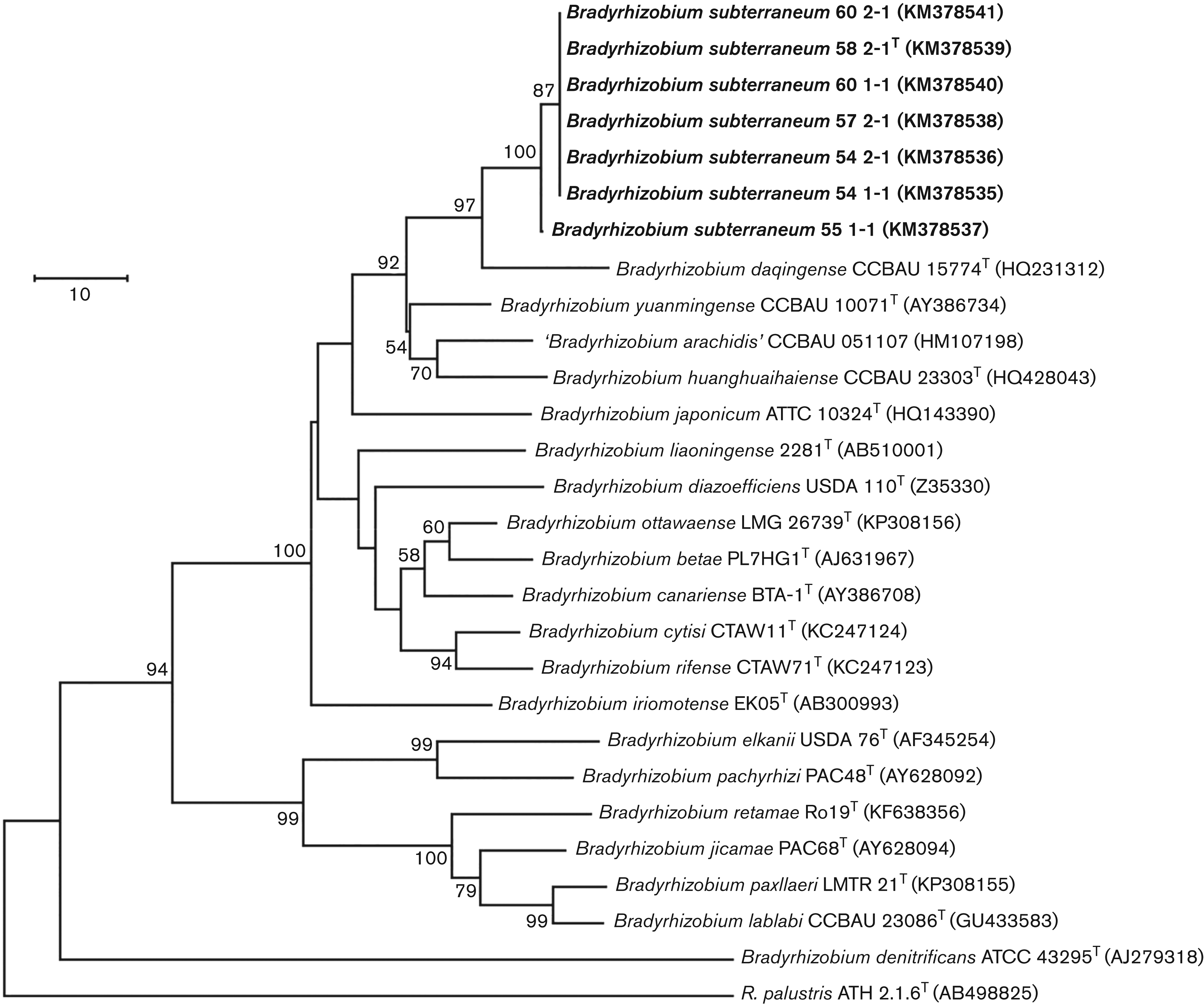
Seven strains of symbiotic bacteria from root nodules of local races of Bambara groundnut (Vigna subterranea) and peanuts (Arachis hypogaea) grown on subsistence farmers' fields in the Kavango region, Namibia, were previously characterized and identified as a novel group within the genus Bradyrhizobium. To corroborate their taxonomic status, these strains were further characterized using a polyphasic approach. All strains possessed identical 16S rRNA gene sequences with Bradyrhizobium yuanmingense CCBAU 10071T being the most closely related type strain in the 16S rRNA gene phylogenetic analysis, and Bradyrhizobium daqingense CCBAU 15774T in the ITS sequence analysis. Phylogenetic analysis of concatenated glnII-recA-rpoB-dnaK placed the strains in a highly supported lineage distinct from named species of the genus Bradyrhizobium, most closely related to Bradyrhizobium yuanmingense CCBAU 10071T. The species status was validated by results of DNA–DNA hybridization. Phylogenetic analysis of nifH genes placed the novel strains in a group with nifH of ‘Bradyrhizobium arachidis’ CCBAU 051107 that also nodulates peanuts. The combination of phenotypic characteristics from several tests including carbon source utilization and antibiotic resistance could be used to differentiate representative strains from recognized species of the genus Bradyrhizobium. Novel strain 58 2-1T induced effective nodules on V. subterranea, Vigna unguiculata and A. hypogaea, and some strains on Lablab purpureus. Based on the data presented, we conclude that our strains represent a novel species for which the name Bradyrhizobium subterraneum sp. nov. is proposed, with 58 2-1T [ = DSM 100298T = LMG 28792T = NTCCM0016T (Windhoek)] as the type strain. The DNA G+C content of strain 58 2-1T was 64.7 mol% (T m).
|
|
Scooped by
Jean-Michel Ané
April 15, 2016 3:56 PM
|
Biotrophic microbes feeding on plants must obtain carbon from their hosts without killing the cells. The symbiotic Arbuscular mycorrhizal (AM) fungi colonizing plant roots do so by inducing major transcriptional changes in the host that ultimately also reprogram the whole carbon partitioning of the plant. AM fungi obtain carbohydrates from the root cortex apoplast, in particular from the periarbuscular space that surrounds arbuscules. However, the mechanisms by which cortical cells export sugars into the apoplast for fungal nutrition are unknown. Recently a novel type of sugar transporter, the SWEET, able to perform not only uptake but also efflux from cells was identified. Plant SWEETs have been shown to be involved in the feeding of pathogenic microbes and are, therefore, good candidates to play a similar role in symbiotic associations. Here we have carried out the first phylogenetic and expression analyses of the potato SWEET family and investigated its role during mycorrhiza symbiosis. The potato genome contains 35 SWEETs that cluster into the same four clades defined in Arabidopsis. Colonization of potato roots by the AM fungus Rhizophagus irregularis imposes major transcriptional rewiring of the SWEET family involving, only in roots, changes in 22 of the 35 members. None of the SWEETs showed mycorrhiza-exclusive induction and most of the 12 induced genes belong to the putative hexose transporters of clade I and II, while only two are putative sucrose transporters from clade III. In contrast, most of the repressed transcripts (10) corresponded to clade III SWEETs. Promoter-reporter assays for three of the induced genes, each from one cluster, showed re-localization of expression to arbuscule-containing cells, supporting a role for SWEETs in the supply of sugars at biotrophic interfaces. The complex transcriptional regulation of SWEETs in roots in response to AM fungal colonization supports a model in which symplastic sucrose in cortical cells could be cleaved in the cytoplasm by sucrose synthases or cytoplasmic invertases and effluxed as glucose, but also directly exported as sucrose and then converted into glucose and fructose by cell wall-bound invertases. Precise biochemical, physiological and molecular analyses are now required to profile the role of each potato SWEET in the arbuscular mycorrhizal symbiosis.
|
|
Scooped by
Jean-Michel Ané
April 15, 2016 3:41 PM
|
oday’s inoculants, like Vault® HP from BASF and many others, help maximize nitrogen fixation, enhance nitrogen availability, add vigor to plants, protect against stress, and contribute to greater yield potential.
Yet for such a seemingly recent innovation, the practice of inoculating plants with beneficial bacteria has roots stretching back to the late 19th century.
The practice of mixing “naturally inoculated” soil with seeds was introduced in the 1890s, becoming a recommended method of legume inoculation in the United States. In 1896, Nitragin became the first patented product registered for plant inoculation with the beneficial bacterium rhizobium (a living microorganism in the soil).
So with such a deep history of use and a bright future as an increasingly innovative and important practice in agriculture, what actually is an inoculant?
|
|
Scooped by
Jean-Michel Ané
April 15, 2016 2:31 PM
|
The nature and direction of coevolutionary interactions between species is expected to differentiate among distinct environments. Consequently, locally coevolved symbiotic traits would be well matched in similar environments, but mismatched elsewhere. In a classic mutualistic trade-off, rhizobia provide nitrogen (N) to legume host plants in return for photosynthates. Despite earlier predictions, there is little evidence so far that spatial differences in soil N content mediate the coevolutionary outcome of the legume–Rhizobium mutualism. To test the existence of such selection mosaics, different genotypes of Vicia cracca and Rhizobium leguminosarum originating from spatially and environmentally highly differentiated sites were cross inoculated across different soil N regimes. In accordance with theoretical predictions, we found highly significant effects of genotype by genotype by environment (G×G×E) interactions, on both nodulation and plant growth, even when R. leguminosarum genotypes showed high genetic similarity. Our results show that the trajectory of the coevolutionary interactions between rhizobia and legumes is differentiated across different environments, and that selection mosaics may play an important role in shaping differences in the genetic composition of rhizobial populations.
|
|
Scooped by
Jean-Michel Ané
April 15, 2016 1:39 PM
|
GRAS proteins belong to a plant-specific protein family with many members and play essential roles in plant growth and development, functioning primarily in transcriptional regulation. Proteins in the family are minimally defined as containing the conserved GRAS domain. Here we have determined the structure of the GRAS domain of Os-SCL7 from Oryza sativa to 1.82Å. The structure includes cap and core sub-domains, and elucidates the features of the conserved GRAS LRI, VHIID, LRII, PFYRE, and SAW motifs. The structure is a dimer, with a clear groove to accommodate double-stranded DNA. Docking a DNA segment into the groove to generate an Os-SCL7/DNA complex provides insight into the DNA binding mechanism of GRAS proteins. Furthermore, the in vitro DNA binding property of Os-SCL7 and model-defined recognition residues are assessed by EMSA analysis and mutagenesis assays. These studies reveal the structure and preliminary DNA interaction mechanisms of GRAS proteins and open the door to in-depth investigation and understanding of the individual pathways in which they play important roles.
|
|
Scooped by
Jean-Michel Ané
April 14, 2016 9:58 PM
|
Grasses can be infected by endophytic fungi and arbuscular mycorrhizal (AM) fungi simultaneously. Here, we investigated the interactions of a native grass, Achnatherum sibiricum, with both endophytic and AM fungi (Glomus mosseae, GM and Glomus etunicatum, GE) at different nitrogen (N) and phosphorus (P) levels. The results showed that endophyte infection significantly suppressed the colonization rates and spore density of GE, but had no effect on those of GM. Endophyte infection increased shoot biomass regardless of the nutrient conditions. The effects of AM fungi on host growth were dependent on mycorrhizal species. There was no significant interaction between endophytic fungi and GE on host growth; however, a significant interaction between endophytic fungi and GE occurred in total phenolic concentrations and P uptake. As for GM, a significant interaction among endophytic fungi, AM fungi and nutrient availability occurred in shoot growth. Under sufficient N and P conditions, endophyte infection alleviated the detrimental effects of GM colonization on host growth.
|
|
Scooped by
Jean-Michel Ané
April 14, 2016 9:51 PM
|
In 1999, a team of scientists led by Christian Körner did what thousands of people do every Christmas: they wrapped Norway spruce trees in tubes. Except this was in March, not December. And the trees were 40-metre-tall giants in the middle of a Swiss forest, not 2-metre pipsqueaks in a living room. (The team had to use a crane). And the tubes had no lights or baubles on them. Instead, they had a series of tiny holes, which pumped out carbon dioxide.
For years, the team fumigated five of these wild spruces. They wanted to see how trees will cope with the high levels of atmospheric carbon dioxide that we’re pumping into the atmosphere. But in the process, and almost by accident, they showed that trees of different species exchange huge amounts of carbon via an internet of fungi—a “wood-wide web” that secretly connects their roots.
|
|
Scooped by
Jean-Michel Ané
April 14, 2016 12:07 AM
|
There is a now obvious need to better understand how climate and soil conditions regulate carbon fixation by woody legumes
|
|
Scooped by
Jean-Michel Ané
April 12, 2016 11:36 PM
|
It is with great sadness that the IS-MPMI community mourns the loss of Dr. Federico Sanchez. Dr. Sanchez was a member of the IS-MPMI Board of Directors from 2006-2012, serving as a director in 2006 and as president of IS-MPMI from 2007-2009. Dr. Sanchez also contributed to MPMI as an associate editor from 1998-2006. Dr. Sanchez will be remembered as an inspiring scientist and an outstanding leader of our community. A more in-depth look at his work and contributions will be available within the coming weeks.
|
|
Scooped by
Jean-Michel Ané
April 12, 2016 11:32 PM
|
Known collectively as ‘the soil food web,’ the bacteria, fungi, protozoa, nematodes, arthropods, and everybody else living underground cycle the nutrients that plants need to grow. It’s a friendly business relationship: plants secrete some of the sugars, proteins, and other compounds they make during photosynthesis through their roots. This buffet attracts beneficial soil organisms to the root zone where they perform many jobs for the plants, such as scavenging for nutrients and water, fixing atmospheric nitrogen into plant-usable forms, breaking down organic matter, aggregating soil particles so roots can easily penetrate soil, and out-competing pathogenic microbes.
|
|
Scooped by
Jean-Michel Ané
April 12, 2016 11:23 PM
|
Compositions comprising dried formulations of viable Methylobacterium as well as methods for making and using the formulations are provided. In particular the compositions provide for Methylobacterium formulations with improved viability, shelf-life, and plant or seed treatment characteristics.
|