Your new post is loading...

|
Scooped by
Jean-Michel Ané
January 13, 2019 6:42 PM
|
Interactions between fungi and plants, including parasitism, mutualism, and saprotrophy, have been invoked as key to their respective macroevolutionary success. Here we evaluate the origins of plant-fungal symbioses and saprotrophy using a time-calibrated phylogenetic framework that reveals linked and drastic shifts in diversification rates of each kingdom. Fungal colonization of land was associated with at least two origins of terrestrial green algae and preceded embryophytes (as evidenced by losses of fungal flagellum, ca. 720 Ma), likely facilitating terrestriality through endomycorrhizal and possibly endophytic symbioses. The largest radiation of fungi (Leotiomyceta), the origin of arbuscular mycorrhizae, and the diversification of extant embryophytes occurred ca. 480 Ma. This was followed by the origin of extant lichens. Saprotrophic mushrooms diversified in the Late Paleozoic as forests of seed plants started to dominate the landscape. The subsequent diversification and explosive radiation of Agaricomycetes, and eventually of ectomycorrhizal mushrooms, were associated with the evolution of Pinaceae in the Mesozoic, and establishment of angiosperm-dominated biomes in the Cretaceous.
|
|
Scooped by
Jean-Michel Ané
January 13, 2019 6:33 PM
|
Endophytic bacteria colonize inner plant tissues and thrive at the apoplast, which is considered its main reservoir. Because this niche is the place where the main molecular events take place between beneficial and pathogenic microorganisms, the aim of this work was to characterize culturable endophytic bacteria from apoplastic fluids obtained from field-grown canola leaves and analyze their potential for biological control of diseases caused by Xanthomonas campestris, Sclerotinia sclerotiorum, and Leptosphaeria maculans. Dual-culture analysis indicated that three isolates (Apo8, Apo11, and Apo12) were able to inhibit the growth of all three phytopathogens. Sequencing of the 16S ribosomal RNA and rpoD genes of these isolates revealed that they are closely related to Pseudomonas viridiflava. One of the isolates, Apo11, was able to diminish the propagation of X. campestris in whole-plant assays. At the same time, Apo11 inoculation reduced the necrotic lesions provoked by S. sclerotiorum on canola leaves. This protective effect might be due to the induction of resistance in the host mediated by salicylic and jasmonic acid signaling pathways or the production of compounds with antimicrobial activity. At the same time, Apo11 inoculation promoted canola plant growth. Thus, the isolate characterized in this work has several desirable characteristics, which make it a potential candidate for the formulation of biotechnological products to control plant diseases or promote plant growth.
|
|
Scooped by
Jean-Michel Ané
January 13, 2019 6:29 PM
|
Recent work demonstrates that habitat conditions exert striking effects on symbiont performance by mediating trade‐offs in plants, AM fungi and environmental interactions. However, how local temperature conditions influence the functional diversity of mycorrhizal symbioses and the genetics of coexisting AM fungi at the local scale remain unclear. In the present study, we conducted a reciprocal inoculation experiment to explore the performance of sympatric associations against allopatric associations under contrasting temperatures and the AM fungal community in colonized roots. No local adaptation of plant biomass was found under both temperature conditions investigated, but a consistent local versus foreign effect was found in AM fungal performance. The temperature and the origin of the inoculum relative to the plant origin were important in explaining symbiotic function. Correspondingly, the community structure and Nearest Relatedness Index of the AM fungal community of the root symbiont varied with inoculum source, and assemblages with more closely related taxa led to a decline in plant biomass and stronger disequilibrium among AM fungi in roots. Our findings suggest that functional divergence exists in naturally coexisting communities of AM fungi from contrasting climatic origins, and fungal relatedness is an important driver of plant growth.
|
|
Scooped by
Jean-Michel Ané
January 13, 2019 6:21 PM
|
Tomato is one of the major cash crops in the Golapar area of district Nainital in Uttarakhand (India), where farmers are facing the problem of diseases in tomato cultivation. In the present investigation, a survey of tomato fields in the Golapar area of Haldwani block was conducted. The survey revealed the occurrence of late blight, early blight, stem rot, and wilt diseases causing an average loss of 80% to tomato. To counter the above diseases, Trichoderma harzianum (Th43), Pseudomonas fluorescens (Pf173), Jas mycorrhiza (AMF), and the fungicide (Mancozeb) in different combinations applyed through soil application (SA), seedling treatment (ST), and foliar spray (FA) were evaluated for growth promotion and disease control in tomato at experimental and farmers’ fields. The results of the study revealed that in experimental field, the maximum plant height (43.67 cm), highest number of branches (7.33) per plant, highest weight of fruit (47 g), highest number of fruits (39) per plant, minimum plant mortality (4% at 30 DAT and 3.2% at 30–60 DAT), minimum plant disease index (6.85), maximum total yield (256.00 q/ha), and marketable yield (246.67 q/ha) were observed in Th+Pf+JM (SA) + Th+Pf (ST) + Mancozeb (FS). At farmer’s field, minimum plant mortality (7.31%) at 30 days after transplanting (DAT) (5.73%) in 30–60 DAT, minimum plant disease index (11.47), and maximum yield 249.91 q/ha were observed in Th+Pf+JM (SA) + Th+Pf (ST) + Mancozeb (FS) combination. So, it can be concluded that among all the treatments, integrated treatment comprising of soil application of T. harzianum, P. fluorescens, Jas mycorrhiza (AMF) + seedling treatment with T. harzianum and P. fluorescens + three foliar sprays of Mancozeb was found very effective in reducing the plant mortality, promoting the plant growth, and increasing the yield at experimental field as well as at farmers’ fields.
|
|
Scooped by
Jean-Michel Ané
January 13, 2019 6:19 PM
|
Members of the plant family Leguminosae (Fabaceae) are unique in that they have evolved a symbiotic relationship with rhizobia (a group of soil bacteria that can fix atmospheric nitrogen). Rhizobia infect and form root nodules on their specific host plants before differentiating into bacteroids, the symbiotic form of rhizobia. This complex relationship involves the supply of C4-dicarboxylate and phosphate by the host plants to the microsymbionts that utilize them in the energy-intensive process of fixing atmospheric nitrogen into ammonium, which is in turn made available to the host plants as a source of nitrogen, a macronutrient for growth. Although nitrogen-fixing bacteroids are no longer growing, they are metabolically active. The symbiotic process is complex and tightly regulated by both the host plants and the bacteroids. The metabolic pathways of carbon, nitrogen, and phosphate are heavily regulated in the host plants, as they need to strike a fine balance between satisfying their own needs as well as those of the microsymbionts. A network of transporters for the various metabolites are responsible for the trafficking of these essential molecules between the two partners through the symbiosome membrane (plant-derived membrane surrounding the bacteroid), and these are in turn regulated by various transcription factors that control their expressions under different environmental conditions. Understanding this complex process of symbiotic nitrogen fixation is vital in promoting sustainable agriculture and enhancing soil fertility.
|
|
Scooped by
Jean-Michel Ané
January 10, 2019 2:59 PM
|
Arbuscular mycorrhizal (AM) fungi confer heavy metal tolerance to plants, but this characteristic differs between different AM fungal strains. We tested the hypotheses if acclimatization of an AM fungus to Zn stress is possible and if this leads also to higher Zn tolerance of mycorrhizal plants. The AM fungus Rhizophagus irregularis was acclimatized in root organ cultures (Daucus carota L.) to Zn resulting in an acclimatized (Acc+) strain. The non-acclimatized (Acc-) strain remained untreated. Fungal development and RNA accumulation of a set of stress-related genes were analyzed in root organ cultures and the capacity of conferring Zn tolerance to maize plants was investigated in pot cultures. Development of Acc+ strain was significantly higher than Acc- strain, when strains were grown in Zn-enriched root organ cultures, whereas the growth of the Acc+ strain was reduced on normal medium probably due to a higher Zn demand compared to the Acc- strain. RNA accumulation analyses revealed different expression patterns of genes encoding glutathione S-transferase (RiGST), superoxide dismutase (RiSOD) and glutaredoxin (RiGRX) between the two strains. Plants inoculated with the Acc+ strain showed higher biomass and lower Zn content than those inoculated with the Acc- strain. The results showed that R. irregularis can be acclimatized to increased amounts of Zn. This acclimatization leads not only to improved fungal development in Zn-stress conditions, but also to an increase of mycorrhiza-induced Zn tolerance of colonized plants.
|
|
Scooped by
Jean-Michel Ané
January 9, 2019 5:14 PM
|
There is undeniable evidence showing that bacteria have strongly influenced the evolution and biological functions of multicellular organisms. It has been hypothesized that many host-microbial interactions have emerged so as to increase the adaptive fitness of the holobiont (the host plus its microbiota). Although this association has been corroborated for many specific cases, general mechanisms explaining the role of the microbiota in the evolution of the host are yet to be understood. Here we present an evolutionary model in which a network representing the host adapts in order to perform a predefined function. During its adaptation, the host network (HN) can interact with other networks representing its microbiota. We show that this interaction greatly accelerates and improves the adaptability of the HN without decreasing the adaptation of the microbial networks. Furthermore, the adaptation of the HN to perform several functions is possible only when it interacts with many different bacterial networks in a specialized way (each bacterial network participating in the adaptation of one function). Disrupting these interactions often leads to non-adaptive states, reminiscent of dysbiosis, where none of the networks the holobiont consists of can perform their respective functions. By considering the holobiont as a unit of selection and focusing on the adaptation of the host to predefined but arbitrary functions, our model predicts the need for specialized diversity in the microbiota. This structural and dynamical complexity in the holobiont facilitates its adaptation, whereas a homogeneous (non-specialized) microbiota is inconsequential or even detrimental to the holobiont's evolution. To our knowledge, this is the first model in which symbiotic interactions, diversity, specialization and dysbiosis in an ecosystem emerge as a result of coevolution. It also helps us understand the emergence of complex organisms, as they adapt more easily to perform multiple tasks than non-complex ones.
|
|
Scooped by
Jean-Michel Ané
January 9, 2019 5:10 PM
|
Microbiomes inhabiting plants are crucial for plant productivity and well-being. A plethora of interactions between roots, microbiomes, and soil shapes the self-organization of the microbial community associated with the root system. The rhizosphere (i.e., the soil close to the root surface) and endosphere (i.e., all inner root tissues) are critical interfaces for the exchange of resources between roots and the soil environment. In recent years, next-generation sequencing technologies have enabled systemic studies of root-associated microbiomes in the endosphere and interactions between roots and microbes at the root-soil interfaces. Genetic factors such as species and genotype of host plants are the driving force of microbial community differentiation and composition. In this mini-review, we will survey the role of these factors on plant–microbe interactions by highlighting the results of next-generation genomic and transcriptomic studies in the rhizosphere and endosphere of land plants. Moreover, environmental factors such as geography and soil type shape the microbiome. Relationships between the root-associated microbiome, architectural variations and functional switches within the root system determine the health and fitness of the whole plant system. A detailed understanding of plant–microbe interactions is of fundamental agricultural importance and significance for crop improvement by plant breeding.
|
|
Scooped by
Jean-Michel Ané
January 9, 2019 5:06 PM
|
Sorghum is an important crop grown world‐wide for feed and fibre. Like most plants, it has the capacity to benefit from symbioses with arbuscular mycorrhizal (AM) fungi and its diverse genotypes likely vary in their responses. Currently, the genetic basis of mycorrhiza‐responsiveness is largely unknown. Here we investigated transcriptional and physiological responses of sorghum accessions, founders of a bioenergy nested association mapping panel, for their responses to four species of AM fungi. Transcriptome comparisons across four accessions identified mycorrhiza‐inducible genes; stringent filtering criteria revealed 278 genes that show mycorrhiza‐inducible expression independent of genotype and 55 genes whose expression varies with genotype. The latter suggests variation in phosphate transport and defence across these accessions. The mycorrhiza growth and nutrient responses of eighteen sorghum accessions varied tremendously, ranging from mycorrhiza‐dependent to negatively mycorrhiza‐responsive. Additionally, accessions varied in the number of AM fungi to which they showed positive responses; from one to several fungal species. Mycorrhiza growth and phosphorus responses were positively correlated, while expression of two mycorrhiza‐inducible phosphate transporters, SbPT8 and SbPT9, correlated negatively with mycorrhizal growth responses. AM fungi improve growth and mineral nutrition of sorghum and the substantial variation between lines provides the potential to map loci influencing mycorrhiza responses.
|
|
Scooped by
Jean-Michel Ané
January 9, 2019 5:01 PM
|
The class 1 phytoglobin, LjGlb1-1, is expressed in various tissues of the model legume Lotus japonicus, where it may play multiple functions by interacting with nitric oxide (NO). One of such functions is the onset of a proper symbiosis with Mesorhizobium loti resulting in the formation of actively N2-fixing nodules. Stable overexpression lines (Ox1 and Ox2) of LjGlb1-1 were generated and phenotyped. Both Ox lines showed reduced NO levels in roots and enhanced nitrogenase activity in mature and senescent nodules relative to the wild-type (WT). Physiological and cytological observations indicated that overexpression of LjGlb1-1 delayed nodule senescence. The application to WT nodules of the NO donor S-nitroso-N-acetyl-D,L-penicillamine (SNAP) or the phytohormones abscisic acid (ABA) and the ethylene precursor 1-aminocyclopropane-1-carboxylic acid (ACC) repressed nitrogenase activity, induced the expression of three senescence-associated genes, and caused cytological changes evidencing nodule senescence. These effects were almost completely reverted by the NO scavenger 2-(4-carboxyphenyl)-4,4,5,5-tetramethylimidazoline-1-oxyl-3-oxide. Our results reveal that overexpression of LjGlb1-1 improves the activity of mature nodules and delays nodule senescence in the L. japonicus-M. loti symbiosis. These beneficial effects are probably mediated by the participation of LjGlb1-1 in controlling the concentration of NO that may be produced downstream in the phytohormone signaling pathway in nodules.
|
|
Scooped by
Jean-Michel Ané
January 9, 2019 4:59 PM
|
Quorum sensing (QS) plays an important role in the growth, nodulation, and nitrogen fixation of rhizobia. In this study, we show that water-soluble humic materials (WSHM) repress the expression of the QS related genes sinI, sinR, and expR in Sinorhizobium meliloti. This decreased the production of N-acetyl homoserine lactones (AHL) and exopolysaccharides (EPS), and ultimately increased S. meliloti cell density. We also identified a novel regulator, SMc03890 (renamed QsrR), which binds directly to the expR promoter. Deletion of qsrR increased expR expression. WSHM repressed the expression of expR by augmenting the interaction between QsrR and the expR promoter; this was determined by a bacterial-one-hybrid assay. These effects of WSHM on the QS system in S. meliloti may be the underlying mechanism by which WSHM increase the symbiotic nitrogen fixation of Medicago sativa inoculated with S. meliloti. This study provides the first evidence that humic acids regulate the QS of rhizobia and suggests that WSHM could be used as fertilizers to improve the efficiency of symbiotic nitrogen fixation.
|
|
Scooped by
Jean-Michel Ané
January 9, 2019 4:55 PM
|
Plants interact with a wide variety of fungi in a mutualistic, parasitic or neutral way. The associations formed depend on the exchange of nutrients and signalling molecules between the partners. This includes a diverse set of protein classes involved in defence, nutrient uptake or establishing a symbiotic relationship. Here, we have analysed the secretomes of the mutualistic, root-endophytic fungus Piriformospora indica and Arabidopsis thaliana when cultivated alone or in a co-culture. More than one hundred proteins were identified as differentially secreted, including proteins associated with growth, development, abiotic and biotic stress response and mucilage. While some of the proteins have been associated before to be involved in plant-microbial interaction, other proteins are newly described in this context. One plant protein found in the co-culture is PLAT1 (Polycystin, Lipoxygenase, Alpha-toxin and Triacylglycerol lipase). PLAT1 has not been associated with plant-fungal-interaction and is known to play a role in abiotic stress responses. In colonised roots PLAT1 shows an altered gene expression in a stage specific manner and plat1 knock-out plants are colonised stronger. It co-localises with Brassicaceae-specific endoplasmic reticulum bodies (ER-bodies) which are involved in the formation of the defence compound scopolin. We observed degraded ER-bodies in infected Arabidopsis roots and a change in the scopolin level in response to the presence of the fungus.
|
|
Scooped by
Jean-Michel Ané
January 9, 2019 4:49 PM
|
ABSTRACT
Herbaspirillum seropedicae is an endophytic bacterium that establishes an association with a variety of plants, such as rice, corn, and sugarcane, and can significantly increase plant growth. H. seropedicae produces polyhydroxybutyrate (PHB), stored in the form of insoluble granules. Little information is available on the possible role of PHB in bacterial root colonization or in plant growth promotion. To investigate whether PHB is important for the association of H. seropedicae with plants, we inoculated H. seropedicae strain SmR1 and mutants defective in PHB production (ΔphaP1, ΔphaP12, ΔphaC1, ΔphaR) or mobilization (ΔphaZ1.2) onto roots of Setaria viridis. The strains producing high amounts of PHB colonized roots, significantly increasing root area and the number of lateral roots compared to PHB negative strains. H. seropedicae grows under microaerobic conditions, which can be found in the rhizosphere. When grown in low oxygen conditions, only the parental strain and ΔphaP2 mutant exhibited normal growth. The lack of normal growth under low oxygen correlated with the inability to stimulate plant growth, although there was no effect on the level of root colonization. The data suggest that PHB is produced in the root rhizosphere and plays a role in maintaining normal metabolism under microaerobic conditions. To confirm this, we screened for GFP expression under the control of the H. seropedicae promoters of the PHA synthase and PHA depolymerase genes in the rhizosphere. PHB synthesis is active on the root surface and later PHB depolymerase expression is activated.
Importance
The application of bacteria as plant growth promoters is a sustainable alternative to mitigate the use of chemical fertilization in agriculture, reducing negative economic and environmental impacts. Several plant growth-promoting bacteria synthesize and accumulate the intracellular polymer polyhydroxybutyrate (PHB). However, the role of PHB in plant-bacterial interactions is poorly understood. Here, applying the C4 model grass Setaria viridis and several mutants in the PHB metabolism of the endophyte Herbaspirillum seropedicae we bring new findings on the importance of PHB for bacterial colonization of S. viridis roots. Taken together, the results show that deletion of genes involved in the synthesis and degradation of PHB reduced the ability of the bacteria to enhance plant growth but with little effect on overall root colonization. The data suggest that PHB metabolism likely plays an important role in supporting specific metabolic routes utilized by the bacteria to stimulate plant growth.
|
|
|
Scooped by
Jean-Michel Ané
January 13, 2019 6:36 PM
|
The well-being of the microbial community that densely populates the rhizosphere is aided by a plant’s root exudates. Maintaining a plant’s health is a key factor in its continued existence. As minute as rhizospheric microbes are, their importance in plant growth cannot be overemphasized. They depend on plants for nutrients and other necessary requirements. The relationship between the rhizosphere-microbiome (rhizobiome) and plant hosts can be beneficial, non-effectual, or pathogenic depending on the microbes and the plant involved. This relationship, to a large extent, determines the fate of the host plant’s survival. Modern molecular techniques have been used to unravel rhizobiome species’ composition, but the interplay between the rhizobiome root exudates and other factors in the maintenance of a healthy plant have not as yet been thoroughly investigated. Many functional proteins are activated in plants upon contact with external factors. These proteins may elicit growth promoting or growth suppressing responses from the plants. To optimize the growth and productivity of host plants, rhizobiome microbial diversity and modulatory techniques need to be clearly understood for improved plant health.
|
|
Scooped by
Jean-Michel Ané
January 13, 2019 6:32 PM
|
Ferns, as landplants in general, originally form a symbiosis involving Arbuscular Mycorrhizal Fungi (AMF), which are prevalent in habitats directly connected to the soil, including low epiphytic sites, but are largely absent in the high epiphytic habitat. High probabilities of AMF should be expected in chiefly terrestrial lineages whereas truly, fully adapted epiphytic lineages should be lacking fungal endophytes or may have switched to other types of fungi; e.g. Dark Septate Endophytes (DSE), a morphological class of mostly unspecified fungi that is often found in epiphytic ferns and may include potentially symbiotic ascomycetes. We used a Bayesian approach for a comparison of the ambiguous character of preferred substrate with the incompletely known mycorrhization status for an ancient lineage of ferns, the Hymenophyllaceae or filmy ferns. The majority of the analysed 167 species prefers either the saxicolous, terrestrial or epiphytic habitat (differentiated into low and high epiphytic), but there are also many generalists without clear preference. For the whole family Hymenophyllaceae and one of the two main clades of the subfamily Trichomanoidae, the terrestrial habitat and AMF received the highest probability for representing the ancestral state. For the subfamily Hymenophylloidae, the low epiphytic habitat and DSE received the highest probability as ancestral state, whereas that for AMF was very low. The other main clade of the subfamily Trichomanoidae as well as the whole subfamily was found most likely to be originally terrestrial; but in both cases the probability values did not differ much from the values for low epiphytism, with all values around 50 ± 5%. The high epiphytic habitat, which in its present condition is thought to be possible only in angiosperm-dominated vegetation, did not receive high probability to be the ancestral state in any clade. This decouples the evolution of epiphytism in filmy ferns in time from the advent of the angiosperms, which is hypothesized to have triggered the radiation of all other major epiphytic fern lineages.
|
|
Scooped by
Jean-Michel Ané
January 13, 2019 6:29 PM
|
Agroecology aims to maintain ecosystem services by minimizing the impact of agriculture and promoting the use of biological potential. Arbuscular mycorrhizal fungi (AMF) are elements which are key to improving crop productivity and soil quality. It is pertinent to understand how agricultural management in the tropics affects the AMF spatio-temporal community composition, especially in crops of global importance, such as coffee (Coffea arabica L.). Soil and root samples were collected from three localities under three management systems (agroecological, conventional and forest fragment), during the phenological stages of coffee (flowering, grain filling, harvesting). Spores were extracted for morphological identification and molecular community analysis by PCR–DGGE. Dendrograms were prepared and the bands were sequenced and analyzed by bioinformatics. No differences were observed in the richness of morphospecies between management systems, localities and period, but little is known about tropical species. Molecular analysis showed that the agroecological management system was similar to natural forest and with a higher diversity indices than conventional management. Locality and period of sample affect AMF community composition. It is necessary to associate classical taxonomic evaluations with molecular biological techniques because different approaches can lead to different outcomes. This study contributes to the understanding of the impact of agriculture management systems on AMF and provides evidence that agroecology is a management system applicable to sustainable coffee production.
|
|
Scooped by
Jean-Michel Ané
January 13, 2019 6:21 PM
|
Although ectomycorrhizal fungi have well-recognized effects on ecological processes ranging from plant community dynamics to carbon cycling rates, it is unclear if plants are able to actively influence the structure of these fungal communities. To address this knowledge gap, we performed two complementary experiments to determine (1) whether ectomycorrhizal plants can discriminate among potential fungal partners, and (2) to what extent the plants might reward better mutualists. In experiment 1, split-root Larix occidentalis seedlings were inoculated with spores from three Suillus species (S. clintonianus, S. grisellus, and S. spectabilis). In experiment 2, we manipulated the symbiotic quality of Suillus brevipes isolates on split-root Pinus muricata seedlings by changing the nitrogen resources available, and used carbon-13 labeling to track host investment in fungi. In experiment 1, we found that hosts can discriminate in multi-species settings. The split-root seedlings inhibited colonization by S. spectabilis whenever another fungus was available, despite similar benefits from all three fungi. In experiment 2, we found that roots and fungi with greater nitrogen supplies received more plant carbon. Our results suggest that plants may be able to regulate this symbiosis at a relatively fine scale, and that this regulation can be integrated across spatially separated portions of a root system.
|
|
Scooped by
Jean-Michel Ané
January 10, 2019 3:08 PM
|
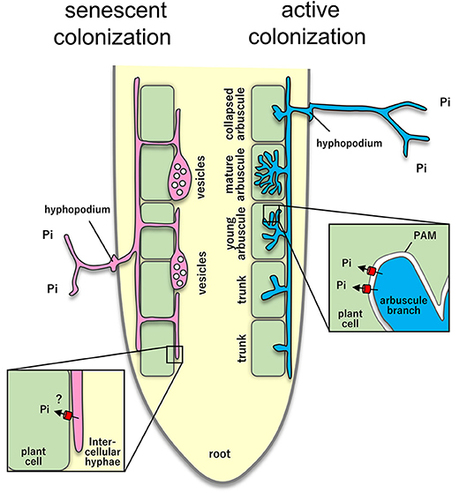
Many crops are colonized with arbuscular mycorrhizal fungi (AMF), which can efficiently absorb nutrients such as phosphate from the soil. The utilization of mycorrhizal symbioses is one of the most promising options for developing resource-saving and sustainable agricultural systems. Most laboratory studies have illustrated the roles of AM symbiosis by inoculating plants with limited AMF isolates. In the field, however, the roots of crops are co-colonized with multiple AMF species, which are difficult to separate and identify and may have different abilities regarding phosphate uptake. In addition, it is difficult to understand which AMF are functional due to the dynamics of AMF colonization processes and the largely unknown genomic structure. This review summarizes key discoveries supporting the importance of the dynamics of AM colonization and genomic structure, which potentially influence the characteristics of AM phosphate uptake. Moreover, this review aims to identify the research direction necessary to obtain a better understanding of the phosphate uptake systems of crops in the field.
|
|
Scooped by
Jean-Michel Ané
January 10, 2019 2:56 PM
|
Legume-rhizobia symbiosis is a remarkable and mutually beneficial association between higher plants and microbes, which is extremely important for sustainable agriculture and ecology. During this association, biological nitrogen fixation occurs in the nodule, which is a specialized accessory legume organ, generally formed on roots. In mature nodules, rhizobia convert inert atmospheric N2 into ammonia (NH3), essential for plant growth. In return, bacteria obtain photosynthetic carbon from the plant. The biologically fixed nitrogen during symbiosis accounts for approximately 65% of nitrogen use in agriculture (Burris and Roberts, 1993).
Due to its agricultural importance and interesting biological features, the legume-rhizobia symbiosis fascinated many researchers in the past decades. It has been discovered that the legume-rhizobia symbiosis is initiated through mutual chemical communication. The plant root releases flavonoids, which induce rhizobia to produce specific lipo-chitooligosaccharides (LCOs), called nodulation factors (Nod factors, or NFs) (Dénarié et al., 1996). These NFs are specifically recognized by the host plant and trigger a sophisticated symbiotic signaling cascade in the host root cells to coordinate rhizobial infection, nodule organogenesis and later on nitrogen fixation (Oldroyd et al., 2011). The main aim of this research topic was to assemble papers addressing and discussing the fundamental science of the molecular mechanisms of legume-rhizobia symbiosis. A total of nine articles were published under this research topic related to rhizobium characters (2), plant response to different type of bacteria (1), phytohormones (3), SYM pathway signals (2), and R genes determining specificity of rhizobia infection (1).
|
|
Scooped by
Jean-Michel Ané
January 9, 2019 5:12 PM
|
Phaseolus dumosus is an endemic species from mountain tops in Mexico that was found in traditional agriculture areas in Veracruz, Mexico. P. dumosus plants were identified by ITS sequences and their nodules were collected from agricultural fields or from trap plant experiments in the laboratory. Bacteria from P. dumosus nodules were identified as belonging to the phaseoli-etli-leguminosarum (PEL) or to the tropici group by 16S rRNA gene sequences. We obtained complete closed genomes from two P. dumosus isolates CCGE531 and CCGE532 that were phylogenetically placed within the tropici group but with a distinctive phylogenomic position and low average nucleotide identity (ANI). CCGE531 and CCGE532 had common phenotypic characteristics with tropici type B rhizobial symbionts. Genome synteny analysis and ANI showed that P. dumosus isolates had different chromids and our analysis suggests that chromids have independently evolved in different lineages of the Rhizobium genus. Finally, we considered that P. dumosus and Phaseolus vulgaris plants belong to the same cross-inoculation group since they have conserved symbiotic affinites for rhizobia.
|
|
Scooped by
Jean-Michel Ané
January 9, 2019 5:08 PM
|
Certain soil microorganisms can perform agriculturally valuable functions such as ethylene reduction, plant pathogen suppression, and soil nutrient solubilization.
Interest and investment in developing soil microbial inoculants to enhance these functions has recently surged, but in-field product success remains unpredictable and unreliable.
Microbial inoculants tend to be chosen based on their activity in controlled laboratory screenings and for ease of mass cultivation, with minimal regard for ecologically relevant traits that will both allow them to survive in the field during a target functional period and prevent excessive persistence.
We highlight the conflicting roles of microbial inoculant traits at each product stage, and how this may complicate selection for microorganisms that function as desired in the field.
|
|
Scooped by
Jean-Michel Ané
January 9, 2019 5:03 PM
|
The mycorrhizal association between fungi and plants is thought to be an important component of the functional diversity of plant communities, although evidence is weak. We explored community-level changes to mycorrhizal features and leaf traits along a primary successional gradient on a sedimentation coast. We found that community weighted mean values of mycorrhizal features and leaf traits varied systematically along the successional series, representing a transition from communities dominated by more stress-tolerant plant species (less mycorrhizal colonization and lower specific leaf area) to less stress-tolerant plant species (higher mycorrhizal colonization and specific leaf area). Despite the co-variation in leaf traits and mycorrhizal features at the community level, only mycorrhizal features showed an increasing functional diversity with successional age. These results suggest that mycorrhizal fungi should not be forgotten in trait-based plant community ecology.
|
|
Scooped by
Jean-Michel Ané
January 9, 2019 5:01 PM
|
Background
Plant phenology has crucial biological, physical, and chemical effects on the biosphere. Phenological drivers have largely been studied, but the role of plant microbiota, particularly rhizosphere microbiota, has not been considered.
Results
We discovered that rhizosphere microbial communities could modulate the timing of flowering of Arabidopsis thaliana. Rhizosphere microorganisms that increased and prolonged N bioavailability by nitrification delayed flowering by converting tryptophan to the phytohormone indole acetic acid (IAA), thus downregulating genes that trigger flowering, and stimulating further plant growth. The addition of IAA to hydroponic cultures confirmed this metabolic network.
Conclusions
We document a novel metabolic network in which soil microbiota influenced plant flowering time, thus shedding light on the key role of soil microbiota on plant functioning. This opens up multiple opportunities for application, from helping to mitigate some of the effects of climate change and environmental stress on plants (e.g. abnormal temperature variation, drought, salinity) to manipulating plant characteristics using microbial inocula to increase crop potential.
|
|
Scooped by
Jean-Michel Ané
January 9, 2019 4:56 PM
|
Salinity stress is an important cause of crop yield loss in many parts of the world. Here, we performed genome‐wide association studies (GWAS) of salinity‐stress responsive traits in 132 HapMap genotypes of the model legume Medicago truncatula. Plants grown in soil were subjected to a step‐wise increase in NaCl concentration, from 0 through 0.5% and 1.0% to 1.5%, and the following traits were measured: vigor, shoot biomass, shoot water content, leaf chlorophyll content, leaf size, and leaf and root concentrations of proline and major ions (Na+, Cl‐, K+, Ca2+ etc.). GWAS were carried out using 2.5 million single nucleotide polymorphisms (SNPs), and 12 genomic regions associated with at least four traits each were identified. Transcript level analysis of the top eight candidate genes in five extreme genotypes revealed association between salinity tolerance and transcript‐level changes for seven of the genes, encoding a vacuolar H+‐ATPase, two transcription factors, two proteins involved in vesicle trafficking, one peroxidase, and a protein of unknown function. Earlier functional studies on putative orthologues of two of the top eight genes (a vacuolar H+‐ATPase and a peroxidase) demonstrated their involvement in plant salinity tolerance.
|
|
Scooped by
Jean-Michel Ané
January 9, 2019 4:52 PM
|
One of the main problems for agriculture worldwide is the increasing salinization of farming lands. The use of soil beneficial microorganisms stands up as a way to tackle this problem. One approach is the use of rhizobial N2-fixing, nodule-forming bacteria. Salinity-stress causes leaf dehydration due to an imbalance between water lost through stomata and water absorbed by roots. The aim of the present study was to elucidate how rhizobial symbiosis modulates the water status of bean (Phaseolus vulgaris) plants under salinity-stress conditions, by assessing the effects on root hydraulic properties. Bean plants were inoculated or not with a Rhizobium leguminosarum strain and subjected to moderate salinity-stress. The rhizobial symbiosis was found to improve leaf water status and root osmotic water flow under such conditions. Higher content of nitrogen and lower values of sodium concentration in root tissues were detected when compared to not inoculated plants. In addition, a drop in the osmotic potential of xylem sap and increased amount of PIP aquaporins could favour higher root osmotic water flow in the inoculated plants. Therefore, it was found that rhizobial symbiosis may also improve root osmotic water flow of the host plants under salinity stress.
|