Your new post is loading...

|
Scooped by
Jean-Michel Ané
March 14, 2019 9:55 AM
|
Legume–rhizobia symbioses play a major role in food production for an ever growing human population. In this symbiosis, dinitrogen is reduced (“fixed”) to ammonia by the rhizobial nitrogenase enzyme complex and is secreted to the plant host cells, whereas dicarboxylic acids derived from photosynthetically produced sucrose are transported into the symbiosomes and serve as respiratory substrates for the bacteroids. The symbiosome membrane contains high levels of SST1 protein, a sulfate transporter. Sulfate is an essential nutrient for all living organisms, but its importance for symbiotic nitrogen fixation and nodule metabolism has long been underestimated. Using chemical imaging, we demonstrate that the bacteroids take up 20‐fold more sulfate than the nodule host cells. Furthermore, we show that nitrogenase biosynthesis relies on high levels of imported sulfate, making sulfur as essential as carbon for the regulation and functioning of symbiotic nitrogen fixation. Our findings thus establish the importance of sulfate and its active transport for the plant–microbe interaction that is most relevant for agriculture and soil fertility.
|
|
Rescooped by
Jean-Michel Ané
from Plant roots and rhizosphere
March 13, 2019 9:44 PM
|
The endophytic fungus Mortierella hyalina colonizes the roots of Arabidopsis thaliana and stimulates growth and biomass production of the aerial parts but not of roots. An exudate fraction from the fungus induces rapid and transient cytoplasmic Ca2+elevation in the roots. The Ca2+ response does not require the well-characterized (co)receptors BAK1, CERK1, and FLS2 for pathogen-associated molecular patterns, and the Ca2+ channels GLR-2.4, GLR-2.5, and GLR-3.3 or the vacuolar TWO PORE CHANNEL1, which might be involved in cytoplasmic Ca2+ elevation. We isolated an ethyl-methane-sulfonate–induced Arabidopsis mutant that is impaired in this Ca2+ response. The roots of the mutant are impaired in M. hyalina–mediated suppression of immune responses after Alternaria brassicae infection, i.e., jasmonate accumulation, generation of reactive oxygen species, as well as the activation of jasmonate-related defense genes. Furthermore, they are more colonized by M. hyalina than wild-type roots. We propose that the mutant gene product is involved in a Ca2+-dependent signaling pathway activated by M. hyalina to suppress immune responses in Arabidopsis roots.
Via Christophe Jacquet
|
|
Scooped by
Jean-Michel Ané
March 6, 2019 4:07 PM
|
Despite the presence of complex microbiota on the surfaces of all plants, the uptake of bacteria into plant cells and the subsequent accommodation in a membrane-enclosed compartment is restricted to the nitrogen-fixing root nodule and the Gunnera–Nostoc symbiosis. The plant cell wall and the outward-directed turgor pressure are major constraints for bacterial uptake because localised lysis of the cell wall endangers the integrity of the protoplast. Host cell integrity is consistently maintained by turgescent neighbours, connected via apoplastic polymers that seal a bacteria-containing extracellular compartment prior to localized cell wall lysis. Its unifying and almost exclusive phylogenetic distribution pinpoints the ability to take up bacteria into living plant cells as a key step during the evolution of the nitrogen-fixing root nodule symbiosis.
|
|
Scooped by
Jean-Michel Ané
March 6, 2019 11:48 AM
|
The intracellular accommodation of arbuscular mycorrhizal (AM) fungi is a paradigmatic feature of this plant symbiosis that depends on the activation of a dedicated signaling pathway and the extensive reprogramming of host cells, including striking changes in nuclear size and transcriptional activity.
By combining targeted sampling of early root colonization sites, detailed confocal imaging, flow cytometry and gene expression analyses, we demonstrate that local, recursive events of endoreduplication are triggered in the Medicago truncatula root cortex during AM colonization.
AM colonization induces an increase in ploidy levels and the activation of endocycle specific markers. This response anticipates the progression of fungal colonization and is limited to arbusculated and neighboring cells in the cortical tissue. Furthermore, endoreduplication is not induced in M. truncatula mutants for symbiotic signaling pathway genes.
On this basis, we propose endoreduplication as part of the host cell prepenetration responses that anticipate AM fungal accommodation in the root cortex.
|
|
Scooped by
Jean-Michel Ané
March 6, 2019 11:45 AM
|
Background
Tissue culture transformation of plants has an element of art to it, with protocols passed on between labs but often not directly compared. As Medicago truncatula has become popular as a model system for legumes, rapid transformation is critical, and many protocols exist, with varying results.
Results
The M. truncatula ecotypes, R108 and A17, were utilized to compare the effect of a modification to a previously used protocol based on shoot explants on the percentage of transformed plants produced from calli. This percentage was then compared to that of two additional transformation protocols based on root explants in the R108 ecotype. Variations in embryonic tissue sources, media components, time for transformation, and vectors were analyzed.
Conclusions
While no A17 transgenic plants were obtained, transgenic plantlets from the R108 ecotype were produced in as little as 4 months with a comparison of the two widely studied ecotypes under a single set of conditions. While the protocols tested gave similar results in percentage of transformed plants produced, considerations of labor and time to transgenics that vary between the root explant protocols tested were discovered. These considerations may influence which protocol to choose for introducing a single transgene versus creating lines with multiple mutations utilizing a CRISPR/Cas9 construct.
|
|
Scooped by
Jean-Michel Ané
February 24, 2019 10:36 AM
|
The root system displays a remarkable plasticity that enables plants to adapt to changing environmental conditions. This plasticity is tightly linked to the activity of root apical meristems (RAMs) and to the formation of lateral roots, both controlled by related hormonal crosstalks. In Arabidopsis thaliana, gibberellins (GAs) were shown to positively control RAM growth and the formation of lateral roots. However, we showed in Medicago truncatula that GAs negatively regulate root growth and RAM size as well as the number of lateral roots depending at least on the MtDELLA1 protein. By using confocal microscopy and molecular analyses, we showed that GAs primarily regulate RAM size by affecting cortical cell expansion and additionally negatively regulate a subset of cytokinin-induced root expansin encoding genes. Moreover, GAs reduce the number of cortical cell layers, resulting in the formation of both shorter and thinner roots. These results suggest contrasting effects of GA regulations on the root system architecture depending on plant species.
|
|
Scooped by
Jean-Michel Ané
February 21, 2019 11:54 AM
|
The wild legume Lotus japonicus engages in mutualistic symbiotic relationships with arbuscular mycorrhiza (AM) fungi and nitrogen-fixing rhizobia. Using plants grown in natural soil and community profiling of bacterial 16S rRNA genes and fungal internal transcribed spacers (ITS), we examined here the role of the Lotus symbiosis genes RAM1, NFR5, SYMRK, and CCaMK in structuring bacterial and fungal root-associated communities. We found host genotype-dependent community shifts in the root and rhizosphere compartments that were mainly confined to bacteria in nfr5 or fungi in ram1 mutants, whilst symRK and ccamk plants displayed major changes across both microbial kingdoms. We observed in all AM mutant roots an almost complete depletion of a large number of Glomeromycota taxa that was accompanied by a concomitant enrichment of Helotiales and Nectriaceae fungi, suggesting compensatory niche replacement within the fungal community. A subset of Glomeromycota whose colonization is strictly dependent on the common symbiosis pathway was retained in ram1 mutants, indicating that RAM1 is dispensable for intraradical colonization by some Glomeromycoyta fungi. However, intraradical colonization by certain Burkholderiaceae taxa is dependent on AM root infection, thereby revealing a microbial interkingdom interaction. Our findings imply a broad role for Lotus symbiosis genes in structuring the root microbiota.
|
|
Scooped by
Jean-Michel Ané
February 9, 2019 9:11 PM
|
During establishment of arbuscular mycorrhizal symbioses, fungal hyphae invade root cells producing transient tree-like structures, the arbuscules, where exchange of photosynthates for soil minerals occurs. Arbuscule formation and collapse lead to rapid production and degradation of plant and fungal membranes, their spatiotemporal dynamics directly influencing nutrient exchange. We determined the ultra-structural details of both membrane surfaces and the interstitial apoplastic matrix by transmission electron microscopy tomography during growth and senescence of Rhizophagus irregularis arbuscules in rice. Invasive growth of arbuscular hyphae was associated with abundant fungal membrane tubules (memtubs) and plant peri-arbuscular membrane evaginations. Similarly, the phylogenetically distant arbuscular mycorrhizal fungus, Gigaspora rosea, and the fungal maize pathogen, Ustilago maydis, developed memtubs while invading host cells, revealing structural commonalities independent of the mutualistic or parasitic outcome of the interaction. Additionally, extracellular vesicles formed continuously in the peri-arbuscular interface from arbuscule biogenesis to senescence, suggesting an involvement in inter-organismic signal and nutrient exchange throughout the arbuscule lifespan.
|
|
Scooped by
Jean-Michel Ané
February 5, 2019 10:59 PM
|
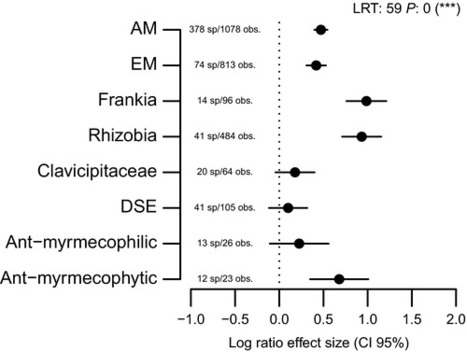
Almost all plant species interact with one or more symbioses somewhere within their distribution range.
Bringing together plant trait data and growth responses to symbioses spanning 552 plant species, we provide for the first time on a large scale (597 studies) a quantitative synthesis on plant performance differences between eight major types of symbiosis, including mycorrhizas, N‐fixing bacteria, fungal endophytes and ant–plant interactions.
Frequency distributions of plant growth responses varied considerably between different types of symbiosis, in terms of both mean effect and ‘risk’, defined here as percentage of experiments reporting a negative effect of symbiosis on plants. Contrary to expectation, plant traits were poor predictors of growth response across and within all eight symbiotic associations. Our analysis showed no systematic additive effect when a host plant engaged in two functionally different symbioses.
This synthesis suggests that plant species’ ecological strategies have little effect in determining the influence of a symbiosis on host plant growth. Reliable quantification of differences in plant performance across symbioses will prove valuable for developing general hypotheses on how species become engaged in mutualisms without a guarantee of net returns.
|
|
Scooped by
Jean-Michel Ané
February 5, 2019 10:55 PM
|
Bacterial quorum sensing plays a cardinal role in determining the outcomes of plant interactions with pathogenic and mutualistic bacteria. This review dwells on the current understanding of how bacterial quorum sensing molecules, their cognate receptors and signaling pathways enable bacteria to interact with a plant host as a community. Suitable habitat niches on the plant, nutritional abundance as well as stress situations can all contribute to the formation of bacterial biofilms on plants and the abundance of nutrients such as host sugar molecules can not only serve as signals, but also as energy substrates and building blocks for biofilm formation. While biofilm formation is increasingly shown to be key to pathogenesis of bacterial plant pathogens, the modulation of plant immunity through QS signals is critical to the tolerance and establishment of mutualistic plant-microbe relationships. A new role for the versatile stress hormone salicylic acid as a possible quorum quenching molecule in plant-pathogen interactions is emerging and will be discussed. Furthermore, genetic studies coupled with -omics scale analysis of gene expression, advances in microscopy and the recent use of interdisciplinary approaches including molecular modeling and docking simulations and in silico and in vitro screening of small molecule compound libraries have provided novel insights into plant biofilm processes. The potential in targeting quorum interactions to control bacterial diseases of plants is discussed.
|
|
Scooped by
Jean-Michel Ané
February 5, 2019 10:51 PM
|
Azolla is a small genus of diminutive aquatic ferns with a surprisingly vast potential to benefit the environment and agriculture, as well as to provide insight into the evolution of plant-cyanobacterial symbioses. This capability is derived from the unique relationship Azolla spp. have with their obligate, nitrogen-fixing cyanobacterial symbiont, Nostoc azollae, that resides in their leaves. Although previous work has specified the importance of the exchange of ammonium and sucrose metabolites between these two partners, we have yet to determine the underlying molecular mechanisms that make this symbiosis so successful. The newly sequenced and annotated reference genome of Azolla filiculoides has allowed us to investigate gene expression profiles of A. filiculoides—both with and without its obligate cyanobiont, N. azollae—revealing genes potentially essential to the Azolla-Nostoc symbiosis. We observed the absence of differentially expressed glutamine synthetase (GS) and glutamate synthase (GOGAT) genes, leading to questions about how A. filiculoides regulates the machinery it uses for nitrogen assimilation. Ushering A. filiculoides into the era of transcriptomics sets the stage to truly begin to understand the uniqueness of the Azolla-Nostoc symbiosis.
|
|
Scooped by
Jean-Michel Ané
February 5, 2019 10:35 PM
|
The formation of a common mycorrhizal network (CMN) between roots of different plant species enables nutrient transfers from one plant to another and their coexistence. However, almost all studies on nutrient transfers between CMN-connected plants have separately, but not simultaneously, been demonstrated under the same experimentation. Both conspecific and heterospecific seedlings of Cinnamomum camphora, Bidens pilosa, and Broussonetia papyrifera native to a karst habitat in southwest China were concurrently grown in a growth microcosm that had seven hollowed compartments (six around one in the center) being covered by 35.0-μm and/or 0.45-μm nylon mesh. The Ci. camphora in the central compartment was supplied with or without Glomus etunicatum and 15N to track N transfers between CMN-connected conspecific and heterospecific seedlings. The results showed as follows: significant greater nitrogen accumulations, biomass productions, 15N content, % Ntransfer, and the Ntransfer amount between receiver plant species ranked as Br. papyrifera≈Bi. pilosa > Ci. camphora under both M+ and M−, and as under M+ than under M− for Ci. camphora but not for both Bi. Pilosa and Br. papyrifera; the CMN transferred more nitrogen (15N content, % Ntransfer, and Ntransfer amount) from the donor Ci. camphora to the heterospecific Br. papyrifera and Bi. pilosa, with a lower percentage of nitrogen derived from transfer (%NDFT). These findings suggest that the CMN may potentially regulate the nitrogen transfer from a donor plant to individual heterospecific receiver plants, where the ratio of nitrogen derived from transfer depends on the biomass strength of the individual plants.
|
|
Scooped by
Jean-Michel Ané
February 5, 2019 11:43 AM
|
Mortierella and Ilyonectria include common species of soil fungi which are frequently detected as root endophytes in many plants including Populus spp. However, the ecological roles of these and other endophytic fungi with respect to plant growth and function are still not well understood. The functional ecology of two key taxa from the Populus rhizobiome, Mortierella elongata PMI93 and Ilyonectria europaea PMI82, was studied by coupling forest soil bioassays with environmental metatranscriptomics. Using soil bioassay experiments amended with fungal inoculants, M. elongata was observed to promote the growth of Populus. This response was cultivar independent. In contrast, I. europaea had no visible effect on Populus growth. Metatranscriptomic studies reveal that these fungi impact rhizophytic and endophytic activities in Populus and induce shifts in soil and root microbial communities. Differential expression of core genes in P. trichocarpa roots was observed in response to both fungal species. Expression of Populus genes for lipid signaling and nutrient uptake were up-regulated and expression of genes associated with gibberellin signaling were altered in plants inoculated with M elongata, but not I. europaea. Up-regulation of genes for growth promotion, down-regulation of genes for several LRR-receptors/kinases, and alteration of expression of genes associated with plant defense responses (e.g., JA/ET/SA pathways) also suggest that M. elongata manipulates plant defenses while promoting plant growth.
|
|
|
Scooped by
Jean-Michel Ané
March 14, 2019 9:51 AM
|
Drought is one of the major environmental factors limiting biomass and seed yield production in agriculture. In this research, we focused on plants from the Fabaceae family, which has a unique ability for the establishment of symbiosis with nitrogen-fixing bacteria, and are relatively susceptible to water limitation. We have presented the changes in nitrogenase activity and global gene expression occurring in Medicago truncatula and Lotus japonicus root nodules during water deficit. Our results proved a decrease in the efficiency of nitrogen fixation, as well as extensive changes in plant and bacterial transcriptomes, shortly after watering cessation. We showed for the first time that not only symbiotic plant components but also Sinorhizobium meliloti and Mesorhizobium loti bacteria residing in the root nodules of M. truncatula and L. japonicus, respectively, adjust their gene expression in response to water shortage. Although our results demonstrated that both M. truncatula and L. japonicus root nodules were susceptible to water deprivation, they indicated significant differences in plant and bacterial response to drought between the tested species, which might be related to the various types of root nodules formed by these species.
|
|
Scooped by
Jean-Michel Ané
March 6, 2019 4:08 PM
|
The symbiosis formed by nitrogen-fixing bacteria with plant hosts mainly in the legume family involves a very intimate interaction. Within the symbiotic organ (the nodule) the bacteria are fully internalized by the host cell to become an intracellular organelle surrounded by a host-derived membrane. This arrangement is probably necessary for the efficient provision of energy and the sequestration of free oxygen molecules, two conditions required for sustained nitrogen fixation. Recent advances made in model legume species, such as Medicago truncatula, are beginning to uncover the genetic components allowing rhizobia to access the host cytoplasm and establish chronic intracellular infections without overt detrimental effects. It is now known that the rhizobial compartment in M. truncatula cells, the symbiosome, retains some features of the extracellular space as the target for a redirected host protein secretory pathway. A set of vesicle trafficking proteins function specifically in symbiotic cells to ensure the faithful delivery of secretory proteins to the intracellular bacteria, or bacteroid. This system is co-opted from the more ancient association with arbuscular mycorrhizal fungi found in most land plants, highlighting the evolutionary origin of the legume–rhizobia symbiosis. In some legume lineages, this heightened capability to process secretory proteins is needed to deliver a large number of symbiosis-specific antimicrobial peptides to the bacteria. Known as NCR peptides, these molecules transform bacteroids into a state of terminal differentiation, where the microbe loses its ability to proliferate outside their host. Numbering in their hundreds, these peptides manipulate various aspects of rhizobial biology, and affect the outcome of this symbiosis in complex ways. The extreme size of the NCR peptide family seems to be the result of an evolutionary conflict between the two partners to extract maximum benefit from each other.
|
|
Scooped by
Jean-Michel Ané
March 6, 2019 11:50 AM
|
In filamentous fungi, the formation of hyphal branches is a critical process that supports the ability of mycelia to radiate across and colonize growth substrates. Branching can occur at hyphal tips (apical branching) or from subapical hyphal compartments (lateral branching). The primary focus of this review is on lateral branching. Current understanding of the physiological and molecular mechanisms that underlie the formation of lateral branches is summarized. This includes emphasis on the spatial regulation of branch formation as well as the roles of the morphogenetic machinery in branch emergence. An improved understanding of hyphal branching will provide greater insight into the morphological differentiation of fungal mycelia.
|
|
Scooped by
Jean-Michel Ané
March 6, 2019 11:47 AM
|
The microbial community in the rhizosphere soil highly affects plant health and vice versa. However, the differences in soil microbial communities associated with different pathogenic statuses in the same field and their causes have not been comprehensively investigated. Here, we deciphered the dissimilarities in the rhizosphere soils of lisianthus (Eustoma grandiflorum) with different pathogenic statuses in a field under uniform management strategies at multiple scales. The rhizosphere soils of diseased plants harbored higher bacterial abundances and diversities compared to that of healthy plants. The relative abundances of three keystone operational taxonomic units (OTUs) and cumulative relative abundance of members in the central module (the largest module) of microbial network significantly decreased by 51.1%, 49.4%, 47.6%, and 42.0% in the rhizosphere soil of infected plants and by 64.3%, 58.8%, 63.4%, and 61.8% in that of dying plants, while the relative abundances of Flavobacteriales, Sphingobacteriales, and Xanthomonadales significantly increased to 4.89-, 1.88-, and 1.44-fold in the rhizosphere soil of infected plants and to 2.89-, 1.55-, and 1.66-fold in that of dying plants, respectively compared with that of healthy plants. Some human disease-related pathways and fluorescein diacetate hydrolysis were more prevalent in the rhizosphere soils of diseased plants. Stochastic processes contributed more than 50.6% and 86.4% to the assembly of different bacterial and fungal communities in these soils, and plants further shaped the bacterial communities, compared to fungal communities, probably by actively recruiting some potential suppressive agents in their rhizosphere when attacked by the pathogen. Overall, here, we firstly reported that the keystone taxa and members in the central module were enriched in the rhizosphere soil of healthy plants, which might be a potential indicator for the soil supporting plant health.
|
|
Scooped by
Jean-Michel Ané
March 6, 2019 11:43 AM
|
|
|
Scooped by
Jean-Michel Ané
February 21, 2019 11:55 AM
|
Salt stress is an important environmental cue impeding poplar nitrogen nutrition. Here, we characterized the impact of salinity on proton‐driven nitrate fluxes in ectomycorrhizal roots and the importance of Hartig net for nitrate uptake.
We employed two Paxillus involutus strains for root colonization: MAJ, which forms typical ectomycorrhizal structures (mantle and Hartig net) and NAU, colonizing roots with a thin, loose hyphal sheath. Fungus‐colonized and non‐colonized Populus × canescens were exposed to NaCl and used to measure root surface pH, NO3‐ flux and transcription of nitrate transporters (PcNRT1.1, 1.2, 2.1) and plasmalemma H+‐ATPases (PcHA4, 8, 11).
Paxillus colonization enhanced root NO3‐ uptake, decreased surface pH, and stimulated NRTs and HA4 of the host regardless the presence or absence of a Hartig net. Under salt stress, non‐colonized roots exhibited strong net NO3‐ efflux, whereas beneficial effects of fungal colonization on surface pH and H+‐ATPases prevented NO3‐ loss. Inhibition of H+‐ATPases abolished NO3‐ influx under all conditions.
We found that stimulation of H+‐ATPases was crucial for the beneficial influence of ectomycorrhiza on NO3‐ uptake, whereas the presence of a Hartig net was not required for improved NO3‐ translocation. Mycorrhizas may contribute to host adaptation to salt‐affected environments by keeping up NO3‐ nutrition.
|
|
Scooped by
Jean-Michel Ané
February 9, 2019 9:15 PM
|
Disclosed are methods of enhancing plant growth, comprising treating plant seed or the plant that germinates from the seed with an effective amount of at least two lipo-chitooligosaccharides, wherein upon harvesting the plant exhibits at least one of increased plant yield measured in terms of bushels/acre, increased root number, increased root length, increased root mass, increased root volume and increased leaf area, compared to untreated plants or plants harvested from untreated seed.
|
|
Scooped by
Jean-Michel Ané
February 9, 2019 9:11 PM
|
During arbuscular mycorrhizal (AM) symbiosis, cells within the root cortex develop a matrix-filled apoplastic compartment in which differentiated AM fungal hyphae called arbuscules reside. Development of the compartment occurs rapidly, coincident with intracellular penetration and rapid branching of the fungal hypha, and it requires much of the plant cell’s secretory machinery to generate the periarbuscular membrane that delimits the compartment. Despite recent advances, our understanding of the development of the periarbuscular membrane and the transfer of molecules across the symbiotic interface is limited. Here, using electron microscopy and tomography, we reveal that the periarbuscular matrix contains two types of membrane-bound compartments. We propose that one of these arises as a consequence of biogenesis of the periarbuscular membrane and may facilitate movement of molecules between symbiotic partners. Additionally, we show that the arbuscule contains massive arrays of membrane tubules located between the protoplast and the cell wall. We speculate that these tubules may provide the absorptive capacity needed for nutrient assimilation and possibly water absorption to enable rapid hyphal expansion.
|
|
Scooped by
Jean-Michel Ané
February 5, 2019 10:56 PM
|
Symbiosis receptor-like kinase (SymRK) is a key protein mediating the legume-Rhizobium symbiosis. Our previous work has identified an MAP kinase kinase, SIP2, as a SymRK-interacting protein to positively regulate nodule organogenesis in Lotus japonicus, suggesting that an MAPK cascade might be involved in Rhizobium-legume symbiosis. In this study, LjMPK6 was identified as a phosphorylation target of SIP2. Stable transgenic L. japonicus with RNAi silencing of LjMPK6 decreased the numbers of nodule primordia (NP) and nodule, while plants overexpressing LjMPK6 increased the numbers of nodule, infection threads (ITs), and NP, indicating that LjMPK6 plays a positive role in nodulation. LjMPK6 could interact with a cytokinin receptor, LHK1 both in vivo and in vitro. LjMPK6 was shown to compete with LHP1 to bind to the receiver domain (RD) of LHK1and to downregulate the expression of two LjACS (1-aminocyclopropane-1-carboxylic acid synthase) genes and ethylene levels during nodulation. This study demonstrated an important role of LjMPK6 in regulation of nodule organogenesis and ethylene production in L. japonicus.
|
|
Scooped by
Jean-Michel Ané
February 5, 2019 10:52 PM
|
Soil microbes from dry grassland do not support plant performance on abandoned fields.
•
The abandoned field microbial community enhances plant survival and size.
•
Seedling inoculation supports specialist species more than seed inoculation.
•
Mycorrhizal inoculation potential is not a good predictor of AMF root colonization.
•
AMF root colonization is not affected by soil community origin or plant specificity.
|
|
Scooped by
Jean-Michel Ané
February 5, 2019 10:37 PM
|
Aims
The function of strigolactone isomers in sorghum phosphorus acquisition efficiency (PAE) is still a matter of speculation. Therefore, the objective of this study was to investigate the effects of cultivar-specific strigolactone composition on sorghum growth indices, responsiveness of arbuscular mycorrhizal fungi (AMF), and PAE.
Methods
Two Striga-resistant (orobanchol-producing) and two Striga-susceptible (5-deoxystrigol-producing) sorghum (Sorghum bicolor (L.) Moench) cultivars were planted with and without AMF inoculation as well as with and without P fertilization. Growth indices and AMF colonization were measured 30 days after sowing from pot trial plants in a growth chamber.
Results
AMF colonization was highest in Tetron and lowest in IS9830, both Striga-resistant cultivars. Conversely, PAE was lowest in Tetron and highest in IS9830 and revealed strong positive relationships with root length, leaf area and shoot DW.
Conclusions
Although the strigolactone composition had no clear general effects on the growth indices of the four different sorghum cultivars, breeders should consider it for combining efficient AM symbiosis and high PAE values.
|
|
Scooped by
Jean-Michel Ané
February 5, 2019 10:35 PM
|
SNARE (soluble N-ethyl maleimide sensitive factor attachment protein receptor) proteins mediate membrane trafficking in eukaryotic cells. Both LjVAMP72a and LjVAMP72b are members of R-SNARE and belong to a symbiotic subgroup of VAMP72 in Lotus japonicus. Their sequences are closely related and both were induced in the root upon rhizobial inoculation. The expression level of LjVAMP72a in the nodules was higher than in the leaves or roots; however, LjVMAP72b was expressed constitutively in the leaves, roots, and nodules. Immunoblot analysis showed that not only LjVAMP72a but also LjVAMP72b were accumulated in a symbiosome-enriched fraction, suggesting its localization in the symbiosome membrane during nodulation. Since there was 89% similarity between LjVAMP72a and LjVAMP72b, knockdown mutant by RNAi suppressed both genes. The suppression of both genes impaired root nodule symbiosis (RNS). The number of bacteroids and the nitrogen fixation activity were severely curtailed in the nodules formed on knockdown roots (RNAi-LjVAMP72a/72b). Arbuscular mycorrhization (AM) was also attenuated in knockdown roots, indicating that LjVAMP72a and LjVAMP72b were required to establish not only RNS but also AM. In addition, transgenic hairy roots of RNAi-LjVAMP72a/72b suppressed the elongation of root hairs without infections by rhizobia or arbuscular mycorrhizal fungi. Amino acid alignment showed the symbiotic subclade of VAMP72s containing LjVAMP72a and LjVAMP72b were a conserved six amino acid region (HHQAQD) within the SNARE motif. Taken together, our data suggested that LjVAMP72a and LjVAMP72b positively controlled both symbioses and root hair formation by affecting the secretory pathway.
|