Your new post is loading...

|
Scooped by
Jean-Michel Ané
March 24, 2020 10:52 PM
|
Actin plays a critical role in the rhizobium–legume symbiosis. Cytoskeletal rearrangements and changes in actin occur in response to Nod factors secreted by rhizobia during symbiotic interactions with legumes. These cytoskeletal rearrangements are mediated by diverse actin-binding proteins, such as actin depolymerization factors (ADFs). We examined the function of an ADF in the Phaseolus vulgaris–rhizobia symbiotic interaction (PvADFE). PvADFE was preferentially expressed in rhizobia-inoculated roots and nodules. PvADFE promoter activity was associated with root hairs harbouring growing infection threads, cortical cell divisions beneath root hairs, and vascular bundles in mature nodules. Silencing of PvADFE using RNA interference increased the number of infection threads in the transgenic roots, resulting in increased nodule number, nitrogen fixation activity, and average nodule diameter. Conversely, overexpression of PvADFE reduced the nodule number, nitrogen fixation activity, average nodule diameter, as well as NODULE INCEPTION (NIN) and EARLY NODULIN2 (ENOD2) transcript accumulation. Hence, changes in ADFE transcript levels affect rhizobial infection and nodulation, suggesting that ADFE is fine-tuning these processes. View Full-Text
|
|
Scooped by
Jean-Michel Ané
March 24, 2020 10:49 PM
|
Soil type and domestication are the main factors that contribute to the determination of root-associated bacterial communities in soybean; however, to what extent these factors influence root-associated fungal communities remains unclear. Here, we grew wild soybean (Glycine soja) and cultivated soybean (Glycine max) in three soil suspensions (black, red and saline-sodic soil) and analyzed the soybean rhizosphere fungal internal transcribed spacer 1 (ITS1) region by high-throughput sequencing technology. The results showed that the fungal communities had significantly different richness and alpha-diversity indexes in the three soil suspensions; however, there was no marked difference in the rhizosphere fungal communities between the two wild and cultivated soybean varieties. Furthermore, soil type was a main factor in determining the distribution of arbuscular mycorrhizal fungi (AMF; Paraglomus and Rhizophagus) and soybean pathogenic fungi (Fusarium and Rhizoctonia). In addition, the abundant rhizosphere fungi from wild soybean exhibited diverse potential functions, while the functions of rhizosphere fungi from cultivated soybean were mainly related to plant nutrient uptake. The diversity and structure of the soybean rhizosphere fungal communities were mainly affected by soil type rather than soybean variety, and domestication caused wild and cultivated soybeans to recruit different rhizosphere fungi. Accordingly, a thorough understanding of soybean fungal communities and their influencing factors is important for improving the health and harvest of soybean.
|
|
Scooped by
Jean-Michel Ané
March 24, 2020 10:45 PM
|
Legume–rhizobium symbiosis leads to the formation of nitrogen-fixing root nodules. However, externally applied chemical nitrogen fertilizers (nitrate and ammonia) strongly inhibit nodule formation and nitrogen fixation. Here, we isolated several rhizobial strains exhibiting a superior nodulation and nitrogen fixation with soybean at high nitrate concentrations. The nodulation of soybean symbiont Bradyrhizobium diazoefficiens USDA110 was significantly inhibited at 12.5 mM nitrate; however, three isolates (NKS4, NKM2 and NKTG2) were capable of forming nitrogen-fixing nodules, even at 20 mM nitrate. These isolates exhibited higher nodulation competitiveness and induced larger nodules with higher nitrogen-fixation activity than USDA110 at 5 mM nitrate. Furthermore, these isolates induced more nodules than USDA110 even in nitrate-free conditions. These isolates had a distant lineage within the Bradyrhizobium genus; though they were relatively phylogenetically close to Bradyrhizobium japonicum, their morphological and growth characteristics were significantly different. Notably, in the presence of nitrate, expression of the soybean symbiosis-related genes (GmENOD40 and GmNIN) was significantly higher and expression of GmNIC1 that is involved in nitrate-dependent nodulation inhibition was lower in the roots inoculated with these isolates in contrast with inoculation of USDA110. These novel rhizobia serve as promising inoculants for soybeans cultivated in diverse agroecosystems, particularly on nitrate-applied soils.
|
|
Scooped by
Jean-Michel Ané
March 24, 2020 10:27 PM
|
Phosphorus (P) is a poorly available macronutrient essential for plant growth and development and consequently for successful crop yield and ecosystem productivity. To cope with P limitations plants have evolved strategies for enhancing P uptake and/or improving P efficiency use. The universal 450-million-yr-old arbuscular mycorrhizal (AM) (fungus-root) symbioses are one of the most successful and widespread strategies to maximize access of plants to available P. AM fungi biotrophically colonize the root cortex of most plant species and develop an extraradical mycelium which overgrows the nutrient depletion zone of the soil surrounding plant roots. This hyphal network is specialized in the acquisition of low mobility nutrients from soil, particularly P. During the last years, molecular biology techniques coupled to novel physiological approaches have provided fascinating contributions to our understanding of the mechanisms of symbiotic P transport. Mycorrhiza-specific plant phosphate transporters, which are required not only for symbiotic P transfer but also for maintenance of the symbiosis, have been identified. The present review provides an overview of the contribution of AM fungi to plant P acquisition and an update of recent findings on the physiological, molecular and regulatory mechanisms of P transport in the AM symbiosis.
|
|
Scooped by
Jean-Michel Ané
March 24, 2020 10:22 PM
|
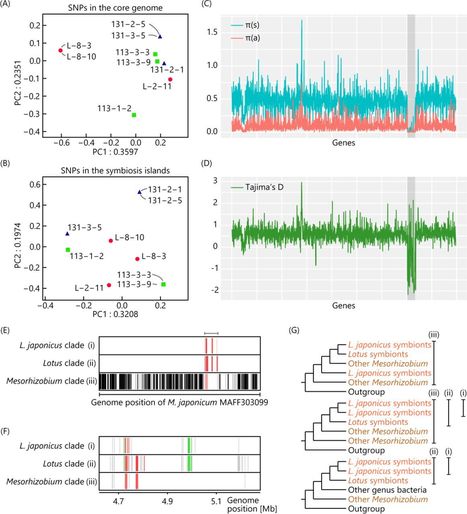
In diverse mutualistic relationships, genetic variations in impact on the growth of interacting partners—variations in partner quality—are common, despite the theoretical prediction that selection favoring high-quality partners should eliminate such variations. Here, we investigated how variations in partner quality could be maintained in the nitrogen-fixing mutualism between Lotus japonicus and Mesorhizobium bacteria. We reconstructed de novo assembled full-genome sequences from nine rhizobial symbionts, finding massive variations in the core genome and the contrastingly similar symbiotic islands, indicating recent horizontal gene transfer (HGT) of the symbiosis islands into diverse Mesorhizobium lineages. A cross-inoculation experiment using nine sequenced rhizobial symbionts and 15 L. japonicus accessions revealed extensive quality variations represented by plant growth phenotypes, including genotype-by-genotype interactions. Quality variations were not associated with the presence/absence variations of known symbiosis-related genes in the symbiosis island, but rather, showed significant correlations with the core genome variations, supported by SNP- and kinship matrix-based association analyses. These findings highlight the novel role of HGT of symbiosis islands, which indirectly supply mutations of core genomes into L. japonicus-associated bacteria, thereby contributing to the maintenance of variations in partner quality.
|
|
Scooped by
Jean-Michel Ané
March 24, 2020 10:21 PM
|
Despite the presence of arbuscular mycorrhizal fungi (AMF) in temperate forests, knowledge concerning their diversity and interactions with plants is still insufficient. Therefore, we studied the impact of overstorey species identity on AMF abundance and species richness and composition in relation to herbaceous plant cover and soil chemical properties. The effects of 14 tree species grown for 48 years in monospecific plots in the Siemianice Experimental Forest (western Poland) were compared, including the following groupings: deciduous vs coniferous; native to Poland/Europe vs alien; forming vs not forming arbuscular mycorrhizas (AM). Coniferous tree plots were characterised by lower pH values, plots with deciduous trees by higher concentrations of total Ca and exchangeable forms of Ca, K and Mg. AMF abundance in soils and roots increased along with increasing soil alkalinity and macronutrient levels. Concentrations of the PLFA 16:1ω5 AMF hyphal biomass marker were higher in the soils of deciduous and AM-type tree species than those of coniferous and non-AM types. In addition, concentrations of the NLFA 16:1ω5 AMF spore biomass marker were higher in the soils of deciduous tree species. No significant differences were found between groups of native and alien tree species. AMF spore and species numbers were low in comparison to other unforested ecosystems, averaging 77.5 and 1.2 per 50 g of soils, respectively. The presence of 8 AMF species, both widespread (e.g. Funneliformis constrictus) and rare (Acaulospora cavernata) was revealed. Significant divergence in AMF species composition was noted between plots of deciduous and coniferous species. Our study showed that tree species identity, considered as a single factor, has only a slight impact on determining AMF community characteristics. The disparity between AMF community characteristics results from the effects of several factors, as pH and element concentrations in soils, acting within tree species groups.
|
|
Scooped by
Jean-Michel Ané
March 24, 2020 10:15 PM
|
Frankia is a mycelium-forming actinobacterial genus that is found in actinorhizal plants as a nitrogen-fixing facultative endo-symbiont. Frankia has been a commonly uncultured endophytic actinobacteria with very slow growth germination. In the present study, the root nodules from Casuarina spp. were collected at hyper-saline and terrestrial habitats in Tamil Nadu, South India. The root nodules were surface-sterilized, dried, homogenized, and inoculated on the DPM medium with sodium propionate as a carbon source and biotin as a vitamin source. A total of 11 Frankia isolates were obtained from the specified habitats in a solid and liquid medium. The larger number of isolates was recorded in the hyper-saline habitats compared to terrestrial habitats. Finally, 2 predominant growth occurrences of isolates were selected; from each habitat, unique isolates were molecularly characterized and identified as Frankia sp. DDNSF-01 and Frankia casuarinae DDNSF-02. The physico-chemical property analysis of Casuarina rhizosphere soil of hyper-saline habitat showed higher pH, salinity and micro-nutrients like Fe−, Mn−, Cu−, and Zn− than terrestrial habitats, which could be the major factors responsible for the distribution dynamics of Frankia in hyper-saline habitats. Similarly, the biologically active metabolites of Frankia spp. were extracted by the ethyl acetate extraction method and tested by MIC assay, which was performed against emerging multi-host pathogens like Pseudomonas sp. and Candida sp. Likewise, the antibiofilm activity assay was done against the above pathogens. The biofilm inhibition of live/dead cells was confirmed by CLSM microscopic analysis. The F. casuarinae was inhibited the high level of biofilm formation of both pathogens when compared with Frankia sp. The present findings conclude the F. casuarinae is efficient in the control of emerging multi-host pathogens in actinorhizal plants.
|
|
Scooped by
Jean-Michel Ané
March 24, 2020 10:03 PM
|
Nitrogen (N) supply is one of the key factors for the success of forest plantations and the search for strategies that allow constant N inputs with reasonable cost is desirable. The ability to fix and accumulate large amounts of N confers adaptive characteristics to the legumes that excel over other species. Here we address the biological nitrogen fixation (BNF) as an ecological strategy in mixed-forest plantations, allowing N fixation to act positively on the development of non-N2-fixing species. We include a brief description on the BNF establishment and the taxonomy and efficiency of the relevant bacteria. In Brazil, the contribution of BNF in mixed-forest plantations, mainly the ones between Eucalyptus spp. and Acacia spp., has demonstrated that their use is improving the quality of the soil organic matter and the N status of the system. The productivity of the non-N2-fixing species increases, especially in oligotrophic soils, varying from 2 to 90%. Normally, the BNF contribution is higher in mixed plantations than in monocultures and the amount of biologically fixed N makes up 50–60 kg ha−1 year−1. The studies on nitrogen-fixing tree species and mixed-species stands recently were intensified. However, large-scale use of mixed forest plantations is still challenging.
|
|
Scooped by
Jean-Michel Ané
March 24, 2020 9:59 PM
|
Black Locust (Robinia pseudoacacia L.) is a woody legume with a worldwide distribution. Its ecological and economical importance is largely due to fast growth and dinitrogen (N2)-fixation ability with rhizobia. These features make Black Locust suitable as a model species for other woody legumes as well. However, its symbiotic association with mycorrhizal fungi has not gained much attention. The small body of literature published indicates that this mycorrhizal association interacts with symbiotic N2-fixation, greatly enhancing the ecological and physiological performance of Black Locust by improving its rate of growth, nutrition status and resistance to stress conditions, such as drought and salt and heavy metal accumulation. Here we summarize the current knowledge on the benefits of the association of Black Locust with arbuscular mycorrhizal fungi with the aim of providing future research directions on how this symbiotic partnership is involved in a tripartite symbiotic association including rhizobia. This association is of particular importance considering both the invasive nature of Black Locust, its economic and cultural importance and its use in restoration of degraded or contaminated landscapes.
|
|
Scooped by
Jean-Michel Ané
March 22, 2020 11:55 AM
|
Root nodules are agricultural-important symbiotic plant-microbe composites in which microorganisms receive energy from plants and reduce dinitrogen (N2) into fertilizers. Mimicking root nodules using artificial devices can enable renewable energy-driven fertilizer production. This task is challenging due to the necessity of a microscopic dioxygen (O2) concentration gradient, which reconciles anaerobic N2 fixation with O2-rich atmosphere. Here we report our designed electricity-powered biological|inorganic hybrid system that possesses the function of root nodules. We construct silicon-based microwire array electrodes and replicate the O2 gradient of root nodules in the array. The wire array compatibly accommodates N2-fixing symbiotic bacteria, which receive energy and reducing equivalents from inorganic catalysts on microwires, and fix N2 in the air into biomass and free ammonia. A N2 reduction rate up to 6.5 mg N2 per gram dry biomass per hour is observed in the device, about two orders of magnitude higher than the natural counterparts.
|
|
Scooped by
Jean-Michel Ané
March 18, 2020 10:52 PM
|
Despite the evident importance of arbuscular mycorrhizal fungi (AM fungal) associated with the root and rhizosphere system of elevation gradients, limit is known about the difference in AM fungal diversity between root and rhizosphere and their influencing factors along elevation gradients. AM fungal Here, we designed an elevation gradient experiment, which covered six elevations and three vegetation types, and collected plant and soil samples. We used Illumina gene sequencing to analyze AM fungal diversity in roots and rhizosphere soils; other potential factors, such as plant diversity, leaf C, N, and P, litter, soil and microbial biomass, extracellular enzymes activity, and the bacterial and ITS broad-fungal diversity, were also determined. We found that AM fungal diversity differences between root and rhizosphere soil diminished as elevation increased, despite that AM fungal diversity had a well-known pattern with elevation (unimodal patterns). Compared with plant characteristics, soil properties (soil C, N, P, C:N, C:P, N:P) were stronger effect on AM fungal diversity between root and rhizosphere. Particularly, soil extracellular enzymes activity and bacterial and ITS broad-fungal diversity explained more variation in AM fungal diversity dynamics along the elevation gradients. Our findings indicate that the diminishment of AM fungal diversity in root and rhizosphere soil are a response to elevation gradients through changes of soil extracellular enzymes activity and the bacterial and fungi communities, which provided evidence that AM fungal community dynamics link to climate change.
|
|
Scooped by
Jean-Michel Ané
March 18, 2020 10:48 PM
|
We investigated arbuscular mycorrhizal (AM) fungal communities in secondary forests and/or Chamaecyparis obtusa plantations at eight study sites in Japan’s temperate region. In the secondary forests, AM plants of the families Lauraceae, Sapindaceae, Rutaceae, Araliaceae, Rosaceae, Magnoliaceae, Cornaceae, Piperaceae, and Anacardiaceae were found. The AM fungal communities were evaluated based on compositions of the AM fungal operational taxonomic units (OTUs), which were clustered at a 97% similarity threshold of the sequences of a partial small subunit of a nuclear ribosomal RNA gene obtained from the plant roots. The compositions of AM fungal OTUs were significantly correlated with the plant family compositions and were significantly differentiated among the study sites and between the study forests. Interestingly, only 19 OTUs remained after selecting for those that had more than 1.0% of the total reads, and these 19 OTUs accounted for 86.3% of the total rarefied reads that were classified into 121 OTUs. Furthermore, three dominant OTUs constituted 48.0% of the total reads, and the most dominant OTU was found at all study sites, except at one. These results indicate that AM fungal communities are primarily constituted by limited AM fungal taxa in the forest ecosystems with diverse plant taxa in Japan’s temperate region. The results of basic local algorithm search tool (BLAST) searches against MaarjAM, a database of AM fungal sequences, also revealed that the AM fungi which were the three dominant OTUs are distributed in forest ecosystems on a worldwide scale.
|
|
Scooped by
Jean-Michel Ané
March 18, 2020 10:46 PM
|
A polyphasic study was conducted with 11 strains trapped by Mimosa pudica and Phaseolus vulgaris grown in soils of the Brazilian Atlantic Forest. In the phylogenetic analysis of the 16S rRNA gene, one clade of strains (Psp1) showed higher similarity with Paraburkholderia piptadeniae STM7183T (99.6%), whereas the second (Psp6) was closely related to Paraburkholderia tuberum STM678T (99%). An MLSA (multilocus sequence analysis) with four (recA, gyrB, trpB and gltB) housekeeping genes placed both Psp1 and Psp6 strains in new clades, and BOX-PCR profiles indicated high intraspecific genetic diversity within each clade. Values of digital DNA–DNA hybridization (dDDH) and average nucleotide identity (ANI) of the whole genome sequences were of 56.9 and 94.4% between the Psp1 strain CNPSo 3157T and P. piptadeniae; and of 49.7% and 92.7% between the Psp6 strain CNPSo 3155T and P. tuberum, below the threshold for species delimitation. In the nodC analysis, Psp1 strains clustered together with P. piptadeniae, while Psp6 did not group with any symbiotic Paraburkholderia. Other phenotypic, genotypic and symbiotic properties were evaluated. The polyphasic analysis supports that the strains represent two novel species, for which the names Paraburkholderia franconis sp. nov. with type strain CNPSo 3157T (= ABIP 241, = LMG 31644) and Paraburkholderia atlantica sp. nov. with type strain CNPSo 3155T (= ABIP 236, = LMG 31643) are proposed.
|
|
|
Scooped by
Jean-Michel Ané
March 24, 2020 10:51 PM
|
Legumes interact with a wide range of microbes in their root systems, ranging from beneficial symbionts to pathogens. Symbiotic rhizobia and arbuscular mycorrhizal glomeromycetes trigger a so‐called common symbiotic signalling pathway (CSSP), including the induction of nuclear calcium spiking in the root epidermis.
By combining gene expression analysis, mutant phenotypic screening and analysis of nuclear calcium elevations, we demonstrate that recognition of an endophytic Fusarium solani strain K (FsK) in model legumes is initiated via perception of chitooligosaccharidic molecules and is, at least partially, CSSP‐dependent.
FsK induced the expression of Lysin‐motif receptors for chitin‐based molecules, CSSP members and CSSP‐dependent genes in Lotus japonicus. In LysM and CSSP mutant/RNAi lines, root penetration and fungal intraradical progression was either stimulated or limited, whereas FsK exudates triggered CSSP‐dependent nuclear calcium spiking, in epidermal cells of Medicago truncatula root organ cultures.
Our results corroborate CSSP being involved in the perception of signals from other microbes beyond the restricted group of symbiotic interactions sensu stricto.
|
|
Scooped by
Jean-Michel Ané
March 24, 2020 10:49 PM
|
Plants and other organisms in the ecosystem compete for the limited nitrogen (N) in the soil. Formation of a symbiotic relationship with arbuscular mycorrhizal fungi (AMF) may influence plant competitiveness for N. However, the effects of AMF on plant nitrate (NO3–) uptake capacity remain unknown. In this study, a pot experiment was conducted to investigate the effects of N application and Rhizophagus irregularis inoculation on the root absorbing area, uptake kinetics of NO3–, and the expression of NO3– transporter (NRT) genes in Populus × canadensis ‘Neva’. The results showed that R. irregularis colonized more than 70% of the roots of the poplar and increased root active absorbing area/total absorbing area. The uptake kinetics of NO3– by poplar fitted the Michaelis–Menten equation. Mycorrhizal plants had a higher maximum uptake rate (Vmax) value than non-mycorrhizal plants, indicating that R. irregularis enhanced the NO3– uptake capacity of poplar. The expression of NRTs in roots, namely, NRT1;2, NRT2;4B, NRT2;4C, NRT3;1A, NRT3;1B, and NRT3;1C, was decreased by R. irregularis under conditions of 0 and 1 mM NH4NO3. This study demonstrated that the improved NO3– uptake capacity by R. irregularis was not achieved by up-regulating the expression of NRTs in roots. The mycorrhizal pathway might repress root direct pathway in the NO3– uptake by mycorrhizal plants.
|
|
Scooped by
Jean-Michel Ané
March 24, 2020 10:30 PM
|
Soybean (Glycine max (L.) Merrill) is one of the most important crops worldwide providing dietary protein and vegetable oil. Most of the nitrogen required by the crop is supplied through biological N2 fixation. Non-thermal plasma is a fast, economical, and environmental-friendly technology that can improve seed quality, plant growth, and crop yield. Soybean seeds were exposed to a dielectric barrier discharge plasma operating at atmospheric pressure air with superimposed flows of O2 or N2 as carrying gases. An arrangement of a thin phenolic sheet covered by polyester films was employed as an insulating barrier. We focused on the ability of plasma to improve soybean nodulation and biological nitrogen fixation. The total number of nodules and their weight were significantly higher in plants grown from treated seeds than in control. Plasma treatments incremented 1.6 fold the nitrogenase activity in nodules, while leghaemoglobin content was increased two times, indicating that nodules were fixing nitrogen more actively than control. Accordingly, the nitrogen content in nodules and the aerial part of plants increased by 64% and 23%, respectively. Our results were supported by biometrical parameters. The results suggested that different mechanisms are involved in soybean nodulation improvement. Therefore, the root contents of isoflavonoids, glutathione, auxin and cytokinin, and expansin (GmEXP1) gene expression were determined. We consider this emerging technology is a suitable pre-sowing seed treatment.
|
|
Scooped by
Jean-Michel Ané
March 24, 2020 10:25 PM
|
Because of their high level of diversity and complex evolutionary histories, most studies on plant receptor-like kinase subfamilies have focused on their kinase domains. With the large amount of genome sequence data available today, particularly on basal land plants and Charophyta, more attention should be paid to primary events that shaped the diversity of the RLK gene family. We thus focus on the motifs and domains found in association with kinase domains to illustrate their origin, organization, and evolutionary dynamics. We discuss when these different domain associations first occurred and how they evolved, based on a literature review complemented by some of our unpublished results.
|
|
Scooped by
Jean-Michel Ané
March 24, 2020 10:21 PM
|
Higher plants continually compete with microbes to conserve their predominance within the particular niche. Plants have evolved constant relationships with a suite of microbes, known as the phytomicrobiome. The associates of phytomicrobiome exhibit symbiotic relationship. Plant-microbe and microbe-microbe interactions within the phytomicrobiome are carried out through the release of signalling compounds. Bacterial community within the phytomicrobiome communicates among themselves through quorum-sensing mechanism. Diversity, stability and resilience of microbial community in phytomicrobiome are the major determinants of plant health and productivity. Therefore, phytomicrobiome is under intensive investigation to improve our understanding of its strong effects on plant development, health and resistance to parasites. Exploration of the plant-microbe interactions within the phytomicrobiome is a promising avenue to improve crop productivity and agricultural sustainability. Understanding the regulation and relatedness of plant and microbial community may aid in engineering plants with improved pathogen resistance and novel symbiotic interactions. Comprehensive study of phytomicrobiome, especially the molecular signalling pathway, may provide new insights into the mechanism of plant disease management, successively inspiring new plant breeding strategies.
|
|
Scooped by
Jean-Michel Ané
March 24, 2020 10:15 PM
|
The activation of calcium signaling is a crucial event for perceiving environmental stress. Colonization by Piriformospora indica, a growth-promoting root endosymbiont, activates cytosolic Ca2+ in Arabidopsis roots. In this study, we examined the role and functional relevance of calcium channels responsible for Ca2+ fluxes. Expression profiling revealed that CYCLIC NUCLEOTIDE GATED CHANNEL 19 (CNGC19) is an early-activated gene, induced by unidentified components in P. indica cell-wall extract. Functional analysis showed that loss-of-function of CNGC19 resulted in growth inhibition by P.indica, due to increased colonization and loss of controlled fungal growth. The cngc19 mutant showed reduced elevation of cytosolic Ca2+ in response to P. indica cell-wall extract in comparison to the wild-type. Microbe-associated molecular pattern-triggered immunity was compromised in the cngc19 lines, as evidenced by unaltered callose deposition, reduced cis-(+)-12-oxo-phytodienoic acid, jasmonate, and jasmonoyl isoleucine levels, and down-regulation of jasmonate and other defense-related genes, which contributed to a shift towards a pathogenic response. Loss-of-function of CNGC19 resulted in an inability to modulate indole glucosinolate content during P. indica colonization. CNGC19-mediated basal immunity was dependent on the AtPep receptor, PEPR. CNGC19 was also crucial for P. indica-mediated suppression of AtPep-induced immunity. Our results thus demonstrate that Arabidopsis CNGC19 is an important Ca2+ channel that maintains a robust innate immunity and is crucial for growth-promotion signaling upon colonization by P. indica.
|
|
Scooped by
Jean-Michel Ané
March 24, 2020 10:12 PM
|
Soybean cyst nematode (SCN; Heterodera glycines) is a widely occurring pathogen and the leading cause of soybean yield losses in the USA. There is a need to find additional SCN management strategies as sources of SCN resistance have become less effective in keeping SCN populations in check. Arbuscular mycorrhizal fungi (AMF) form symbiotic relationships with roots of most plants including soybean. Research has shown that AMF can reduce disease severity in plants caused by pathogens and pests, including plant parasitic nematodes. The goal of this study was to determine if AMF could suppress SCN. In one experiment, all five AMF species tested (Claroideoglomus claroideum, Diversispora eburnean, Dentiscutata heterogama, Funneliformis mosseae, and Rhizophagus intraradices) reduced (P < 0.05) the number of cysts on soybean roots by 59% to 81% compared to soybean roots without AMF. In two other experiments, F. mosseae reduced the counts of SCN juveniles (J2-J3 stages) in soybean roots by 60% and was able to suppress egg hatching by as much as 30%. These experiments showed that AMF were able to suppress SCN cyst counts and at least with F. mosseae, reduce SCN juveniles in roots and suppress egg-hatching. Further research is needed to exploit the potential usefulness of these AMF in field conditions and to determine the usefulness and potential of the compounds associated with SCN hatching suppression by F. mosseae with the goal of providing another management tool to reduce the impact of SCN on soybean production.
|
|
Scooped by
Jean-Michel Ané
March 24, 2020 10:03 PM
|
Background and Aims
Recent findings indicate that Nod factor signalling is tightly interconnected with phytohormonal regulation that affects the development of nodules. Since the mechanisms of this interaction are still far from understood, here the distribution of cytokinin and auxin in pea (Pisum sativum) nodules was investigated. In addition, the effect of certain mutations blocking rhizobial infection and subsequent plant cell and bacteroid differentiation on cytokinin distribution in nodules was analysed.
Methods
Patterns of cytokinin and auxin in pea nodules were profiled using both responsive genetic constructs and antibodies.
Key Results
In wild-type nodules, cytokinins were found in the meristem, infection zone and apical part of the nitrogen fixation zone, whereas auxin localization was restricted to the meristem and peripheral tissues. We found significantly altered cytokinin distribution in sym33 and sym40 pea mutants defective in IPD3/CYCLOPS and EFD transcription factors, respectively. In the sym33 mutants impaired in bacterial accommodation and subsequent nodule differentiation, cytokinin localization was mostly limited to the meristem. In addition, we found significantly decreased expression of LOG1 and A-type RR11 as well as KNOX3 and NIN genes in the sym33 mutants, which correlated with low cellular cytokinin levels. In the sym40 mutant, cytokinins were detected in the nodule infection zone but, in contrast to the wild type, they were absent in infection droplets.
Conclusions
In conclusion, our findings suggest that enhanced cytokinin accumulation during the late stages of symbiosis development may be associated with bacterial penetration into the plant cells and subsequent plant cell and bacteroid differentiation.
|
|
Scooped by
Jean-Michel Ané
March 24, 2020 9:59 PM
|
Utilization of arbuscular mycorrhizal (AM) resources to improve, or even maintain agroecosystem sustainability requires a thorough understanding of the biotic and abiotic factors that impact AM fungal communities. AM symbiosis is important in mango and litchi trees, two economically important fruit crops in China, but there is little information on the AM fungi associated with these trees or their responses to organic fertilizer. Using Illumina high-throughput sequencing we analyzed AM colonization, spore density, and community composition and diversity in the rhizospheric soil from 16 mango orchards and 16 litchi orchards located in southern China. Ours was a regional scale study and in general, we found that the majority of AM fungi OTUs belonged to the families Glomeraceae, followed by Gigasporaceae, Paraglomeraceae, Acaulosporaceae and Diversisporaceae. Glomus and Paraglomus were the genera that differed most in abundance between the rhizospheric soil of mango and litchi. AMF community composition was impacted by latitude and longitude and soil characteristics such as, NO3−-N, NH4+-N, available-P, and soil organic carbon (SOC). The sampling sites were in areas of medium to low altitude, and there was no significant correlation between altitude and AM fungal richness. We found that higher soil nutrient content, particularly available-P, was negatively correlated with AM colonization. Our results also showed that some of the AM genera responded differently to environmental variables. Structural equation modeling (SEM) demonstrated that SOC not only had a direct positive effect on AMF richness, but also an indirect negative effect, due to increased soil fertility. Our findings have enabled a deeper insight into the impacts of organic fertilizer on AM fungal communities, which will be valuable when considering AM symbiosis in orchard management.
|
|
Scooped by
Jean-Michel Ané
March 18, 2020 10:55 PM
|
Nitrogen-fixing microbial associations with cereals have been of intense interest for more than a century (Roesch et al., Plant Soil 2008;302:91–104; Triplett, Plant Soil 1996;186:29–38; Mus et al., Appl. Environ. Microbiol. 2016;82:3698–3710; Beatty and Good, Science 2011;333:416–417). A recent report demonstrated that an indigenous Sierra Mixe maize landrace, characterized by an extensive development of aerial roots that secrete large amounts of mucilage, can acquire 28–82% of its nitrogen from atmospheric dinitrogen (Van Deynze et al., PLoS Biol. 2018;16:e2006352). Although the Sierra Mixe maize landrace is unique in the large quantity of mucilage produced, other cereal crops secrete mucilage from underground and aerial roots and we hypothesize that this may represent a general mechanism for cereals to support associations with microbial diazotrophs. We propose a model for the association of nitrogen-fixing microbes with maize mucilage and identify the four main functionalities for such a productive diazotrophic association.
|
|
Scooped by
Jean-Michel Ané
March 18, 2020 10:51 PM
|
Lycopods are tracheophytes in the Kingdom Plantae and represent one of the oldest lineages of living vascular plants. Symbiotic interactions between these plants with fungi and bacteria, including fine root endophytes in Endogonales, have been hypothesized to have helped early diverging plant lineages colonize land. However, attempts to study the lycopod rhizobiome in its natural environment are still limited. In this study, we used Illumina amplicon sequencing to characterize fungal and bacterial diversity in nine Lycopodiaceae (club moss) species collected in New Zealand. This was done with generic fungal ITS rDNA primers, as well as Endogonales- and arbuscular mycorrhizal fungi (AMF)-selective primer sets targeting the 18S rDNA, and generic bacterial primers targeting the V4 region of the 16S rDNA. We found that the Lycopodiaceae rhizobiome was comprised of an unexpected high frequency of Basidiomycota and Ascomycota coincident with a low abundance of Endogonales and Glomerales. The distribution and abundance of Endogonales varied with host lycopod, and included a novel taxon as well as a single operational taxonomic unit (OTU) that was detected across all plant species. The Lycopodiaceae species with the greatest number and also most unique OTUs was Phlegmariurus varius, while the plant species that shared the most fungal OTUs were Lycopodiella fastigiatum and Lycopodium scariosum. The bacterial OTU distribution was generally not consistent with fungal OTU distribution. For example, community dissimilarity analysis revealed strong concordance between the evolutionary histories of host plants with the fungal community but not with the bacterial community, indicating that Lycopodiaceae have evolved specific relationships with their fungal symbionts. Notably, nearly 16% of the ITS rDNA fungal diversity detected in the Lycopodiaceae rhizobiome remained poorly classified, indicating there is much plant-associated fungal diversity left to describe in New Zealand.
|
|
Scooped by
Jean-Michel Ané
March 18, 2020 10:46 PM
|
A recent study by Sugiura and coworkers reported the non‐symbiotic growth and spore production of an arbuscular mycorrhizal (AM) fungus, Rhizophagus irregularis, when the fungus received an external supply of certain fatty acids, myristates (C:14). This discovery follows the insight that AM fungi receive fatty acids from their hosts when in symbiosis. If this result holds up and can be repeated under non‐sterile conditions and with a broader range of fungi, it has numerous consequences for our understanding of AM fungal ecology, from the level of the fungus, at the plant community level, and to functional consequences in ecosystems. In addition, myristate may open up several avenues from a more applied perspective, including improved fungal culture and supplementation of AM fungi or inoculum in the field. We here map these potential opportunities, and additionally offer thoughts on potential risks of this potentially new technology. Lastly, we discuss the specific research challenges that need to be overcome to come to an understanding of the potential role of myristate in AM ecology.
|