Your new post is loading...

|
Scooped by
Jean-Michel Ané
January 26, 2021 6:41 PM
|
Calcium-dependent protein kinase (CDPK or CPK) and CDPK-related kinase (CRK) play an important role in plant growth, development, and adaptation to environmental stresses. However, their gene families had been yet inadequately investigated in Medicago truncatula. In this study, six MtCRK genes were computationally identified, they were classified into five groups with MtCDPKs based on phylogenetic relationships. Six pairs of segmental duplications were observed in MtCDPK and MtCRK genes and the Ka/Ks ratio, an indicator of selection pressure, was below 0.310, indicating that these gene pairs underwent strong purifying selection. Cis-acting elements of morphogenesis, multiple hormone responses, and abiotic stresses were predicted in the promoter region. The spatial expression of MtCDPKs and MtCRKs displays diversity. The expression of MtCDPKs and MtCRKs could be regulated by various stresses. MtCDPK4, 14, 16, 22, and MtCRK6 harbor both N-myristoylation site and palmitoylation site and were anchored on plasma membrane, while MtCDPK7, 9, and 15 contain no or only one N-acylation site and were distributed in cytosol and nucleus, suggesting that the N-terminal acylation sites play a key role in subcellular localization of MtCDPKs and MtCRKs. In summary, comprehensive characterization of MtCDPKs and MtCRKs provide a subset of candidate genes for further functional analysis and genetic improvement against drought, cold, salt and biotic stress
|
|
Scooped by
Jean-Michel Ané
January 26, 2021 4:53 PM
|
The amino sugar, N-acetylglucosamine (GlcNAc), has emerged as an attractive messenger of signaling in the pathogenic yeast Candida albicans, given its multifaceted role in cellular processes, including GlcNAc scavenging, import and metabolism, morphogenesis (yeast to hyphae and white to opaque switch), virulence, GlcNAc induced cell death (GICD), etc. During signaling, the exogenous GlcNAc appears to adopt a simple mechanism of gene regulation by directly activating Ngs1, a novel GlcNAc sensor and transducer, at the chromatin level, to activate transcriptional response through the promoter acetylation. Ngs1 acts as a master regulator in GlcNAc signaling by regulating GlcNAc catabolic gene expression and filamentation. Ndt80-family transcriptional factor Rep1 appears to be involved in the recruitment of Ngs1 to GlcNAc catabolic gene promoters. For promoting filamentation, GlcNAc adopts a little modified strategy by utilizing a recently evolved transcriptional loop. Here, Biofilm regulator Brg1 takes up the key role, getting up-regulated by Ngs1, and simultaneously induces Hyphal Specific Genes (HSGs) expression by down-regulating NRG1 expression. GlcNAc kinase Hxk1 appears to play a prominent role in signaling. Recent developments in GlcNAc signaling have made C. albicans a model system to understand its role in other eukaryotes as well. The knowledge thus gained would assist in designing therapeutic interventions for the control of candidiasis and other fungal diseases.
|
|
Scooped by
Jean-Michel Ané
January 26, 2021 4:50 PM
|
Arbuscular mycorrhiza fungi (AMF) are beneficial soil fungi that can promote the growth of their host plants. Accurate quantification of AMF in plant roots is important because the level of colonization is often indicative of the activity of these fungi. Root colonization is traditionally measured with microscopy methods which visualize fungal structures inside roots. Microscopy methods are labor-intensive, and results depend on the observer. In this study, we present a relative qPCR method to quantify AMF in which we normalized the AMF qPCR signal relative to a plant gene. First, we validated the primer pair AMG1F and AM1 in silico, and we show that these primers cover most AMF species present in plant roots without amplifying host DNA. Next, we compared the relative qPCR method with traditional microscopy based on a greenhouse experiment with Petunia plants that ranged from very high to very low levels of AMF root colonization. Finally, by sequencing the qPCR amplicons with MiSeq, we experimentally confirmed that the primer pair excludes plant DNA while amplifying mostly AMF. Most importantly, our relative qPCR approach was capable of discriminating quantitative differences in AMF root colonization and it strongly correlated (Spearman Rho = 0.875) with quantifications by traditional microscopy. Finally, we provide a balanced discussion about the strengths and weaknesses of microscopy and qPCR methods. In conclusion, the tested approach of relative qPCR presents a reliable alternative method to quantify AMF root colonization that is less operator-dependent than traditional microscopy and offers scalability to high-throughput analyses.
|
|
Scooped by
Jean-Michel Ané
January 25, 2021 10:57 AM
|
Empowering smallholder farmers to raise productivity by adopting sustainable practices sits at the heart of feeding the world’s rapidly growing population. Professor Esperanza Martínez-Romero is addressing this challenge by harnessing the power of beneficial bacteria to promote plant health. She received the 2020 L’Oréal-UNESCO For Women in Science International Award for Latin America in recognition of her pioneering work on the use of environmentally friendly bacteria to support plant growth for increased agricultural productivity while reducing the use of chemical fertilizers. Her significant discoveries in understanding the role of local nitrogen- fixing bacteria in increasing crop yields, particularly in cereal and legume crops, stand to support global food security and improve smallholders’ livelihoods. They could even lead to a reduction in the use of synthetic fertilisers, helping to protect the environment and safeguard biodiversity.
|
|
Scooped by
Jean-Michel Ané
January 24, 2021 4:13 PM
|
•The spatial variation in N2 fixation of naturally grown A. sparsifolia is a plastic response to the salinity gradient of groundwater.
•Symbiotic nitrogen fixation of A. sparsifolia is more salt-tolerant than the nitrate assimilation process.
•N acquisition strategies of A. sparsifolia in the Taklimakan Desert are under the control of rhizosphere salinity levels.
|
|
Scooped by
Jean-Michel Ané
January 24, 2021 4:08 PM
|
Nitrogen is a major determinant of plant growth and productivity and the ability of legumes to form a symbiotic relationship with nitrogen-fixing rhizobia bacteria allows legumes to exploit nitrogen-poor niches in the biosphere. But hosting nitrogen-fixing bacteria comes with a metabolic cost, and the process requires regulation. The symbiosis is regulated through three signal transduction pathways: in response to available nitrogen, at the initiation of contact between the organisms, and during the development of the nodules that will host the rhizobia. Here we provide an overview of our knowledge of how the three signaling pathways operate in space and time, and what we know about the cross-talk between symbiotic signaling for nodule initiation and organogenesis, nitrate dependent signaling, and autoregulation of nodulation. Identification of common components and points of intersection suggest directions for research on the fine-tuning of the plant’s response to rhizobia.
|
|
Scooped by
Jean-Michel Ané
January 24, 2021 12:39 PM
|
Arbuscular mycorrhizal (AM) fungal extraradical hyphae exude their metabolites into the soil. Root exudate metabolites are affected by plant species and P status. However, the effect of P status on AM hyphal exudate metabolites has been unknown. This study aimed to examine hyphal exudate metabolite composition of two AM fungal species and their response to P deficiency through metabolite profiling. Rhizophagus clarus and R. irregularis were grown in a two-compartment in vitro culture system of Linum usitatissimum roots on solid modified Strullu-Romand medium in combination with two P levels (3 µM (P3) and 30 µM (P30)). Hyphal exudates were collected from the hyphal compartment at 118 days after inoculation (DAI). The metabolite composition of the hyphal exudates was determined by capillary electrophoresis/time-of-flight mass spectrometry, resulting in the identification of a total of 141 metabolites at 118 DAI. In the hyphal exudates of R. clarus, the concentrations of 18 metabolites, including sugars, amino acids, and organic acids, were significantly higher (p < 0.05) under P3 than under P30 conditions. In contrast, the concentrations of 10 metabolites, including sugar and amino acids, in the hyphal exudates of R. irregularis were significantly lower (p < 0.05) under P3 than under P30 conditions. These findings suggest that the extraradical hyphae of AM fungi exude diverse metabolites of which concentrations are affected by P conditions and differ between AM fungal species.
|
|
Scooped by
Jean-Michel Ané
January 24, 2021 12:33 PM
|
Whereas the role of calcium ions (Ca2+) in plant signaling is well studied, the physiological significance of pH‐changes remains largely undefined.
Here we developed CapHensor, an optimized dual‐reporter for simultaneous Ca2+ and pH ratio‐imaging and studied signaling events in pollen tubes (PTs), guard cells (GCs), and mesophyll cells (MCs). Monitoring spatio‐temporal relationships between membrane voltage, Ca2+‐ and pH‐dynamics revealed interconnections previously not described.
In tobacco PTs, we demonstrated Ca2+‐dynamics lag behind pH‐dynamics during oscillatory growth, and pH correlating more with growth than Ca2+. In GCs, we demonstrated abscisic acid (ABA) to initiate stomatal closure via rapid cytosolic alkalization followed by Ca2+ elevation. Preventing the alkalization blocked GC ABA‐responses and even opened stomata in the presence of ABA, disclosing an important pH‐dependent GC signaling node. In MCs, a flg22‐induced membrane depolarization preceded Ca2+‐increases and cytosolic acidification by ~2 min, suggesting a Ca2+/pH‐independent early pathogen signaling step. Imaging Ca2+ and pH resolved similar cytosol and nuclear signals and demonstrated flg22, but not ABA and H2O2 to initiate rapid membrane voltage‐, Ca2+‐ and pH responses.
We propose close interrelation in Ca2+‐ and pH signaling that is cell type‐ and stimulus specific and pH having crucial roles in regulating PT growth and stomata movement.
|
|
Scooped by
Jean-Michel Ané
January 24, 2021 12:31 PM
|
This study aimed to evaluate effects of Funneliformis mosseae on plant growth and root exudate compositions and contents, soil and root phosphatase activity, soil glomalin concentrations, and thus soil aggregate stability and distribution in trifoliate orange under well-watered (75% of maximum water holding capacity) and drought stress (55% of maximum water holding capacity) conditions. After eight weeks of drought treatment, mycorrhizal fungal inoculation improved plant growth and exhibited altered composition of root exudates than non-inoculated treatment. Mycorrhizal fungal inoculation dramatically increased the relative abundance of phenolics (e.g., 2H,8H-Benzo[1,2-b:3,4-b’] dipyran-2-one,8,8-dimethyl), terpenoids (e.g., geijerene), and acids (n-hexadecanoic acid), while notably reduced the relative abundance of alkanes (e.g., tridecane, 2-methyl-), esters (e.g.,hexanedioic acid and dimethyl ester), and amides (e.g.,13-docosenamide) in root exudates. Mycorrhizal fungal colonization profoundly increased easily extractable and total glomalin-related soil protein levels under two soil water regimes, which cemented soil macroaggregate (2-4 mm size) formation, thereby, improving soil aggregate stability. Mycorrhizal fungal-inoculated plants represented higher soil acid, alkaline and total phosphatase activities, irrespective of well-watered and drought treatment. The results suggest that mycorrhizal plants had improved root microenvironment to mitigate drought damage through changes in root exudate components along with glomalin, phosphatase, and soil aggregate stability in the mycorrhizosphere.
|
|
Scooped by
Jean-Michel Ané
January 24, 2021 12:09 PM
|
Basil (Ocimum basilicum L.) is a high-value medicinal herb cultivated for economical applications, especially pharmaceutical purposes. There is less information on the effects of arbuscular mycorrhizal (AM) fungi, drought stress, and phosphorus (P) supply on important phenolic compounds like caffeic (CA) and rosmarinic (RA) acids. Therefore, an experiment was performed to examine whether treatments: AM (inoculated with Glomus hoi and non-inoculated (NM) plants; drought stress (60% field capacity (FC)) and well-irrigated (90% FC) and phosphorus supply (0.1, 0.2 and 0.3 g/kg of soil) could influence plant growth and contents of total phenols (TPC), RA, CA and phenylalanine ammonia-lyase (PAL) activity. The experiment was conducted as a factorial oriented by completely random design with three repetitions. Shoots of 8-week-old plants that were subjected to all mentioned treatments were harvested and analyzed. High-performance liquid chromatography (HPLC) was used to quantify RA and CA contents. Results indicated that both P supply and AM inoculation enhanced plant growth, tissue P content, RA and CA production and PAL activity. There was an increase of 1.84, 1.59, and 2.22 times for TPC, RA and CA contents respectively in AM plants compared to NM plants in P2 levels and in drought stress. There was a positive relationship between the phenol content and PAL activity for all the treatments. Consequently, mycorrhizal inoculation and application of an appropriate level of P could serve as an adaptive strategy to enhance productivity and plant synthesis of phenolic compounds under restricted irrigation with health-promoting activities.
|
|
Scooped by
Jean-Michel Ané
January 24, 2021 11:45 AM
|
Genetic studies of legume symbiosis with nitrogen-fixing rhizobial bacteria have traditionally focused on nodule and nitrogen-fixation phenotypes when hosts are inoculated with a single rhizobial strain. These approaches overlook the potential effect of host genes on rhizobial fitness (i.e. how many rhizobia are released from host nodules) and strain-specific effects of host genes (i.e. genome × genome interactions). Using Medicago truncatula mutants in the recently described nodule-specific PLAT domain (NPD) gene family, we show how inoculating plants with a mixed inoculum of 68 rhizobial strains (Ensifer meliloti) via a select-and-resequence approach can be used to efficiently assay host mutants for strain-specific effects of late-acting host genes on interacting bacteria. The deletion of a single NPD gene (npd2) or all five members of the NPD gene family (npd1–5) differentially altered the frequency of rhizobial strains in nodules even though npd2 mutants had no visible nodule morphology or N-fixation phenotype. Also, npd1–5 nodules were less diverse and had larger populations of colony-forming rhizobia despite their smaller size. Lastly, NPD mutations disrupt a positive correlation between strain fitness and wild-type host biomass. These changes indicate that the effects of NPD proteins are strain dependent and that NPD family members are not redundant with regard to their effects on rhizobial strains. Association analyses of the rhizobial strains in the mixed inoculation indicate that rhizobial genes involved in chromosome segregation, cell division, GABA metabolism, efflux systems, and stress tolerance play an important role in the strain-specific effects of NPD genes.
|
|
Scooped by
Jean-Michel Ané
January 24, 2021 11:39 AM
|
Legume plants form nitrogen (N)-fixing symbiotic nodules when mineral N is limiting in soils. As N fixation is energetically costly compared to mineral N acquisition, these N sources, and in particular nitrate, inhibit nodule formation and N fixation. Here, in the model legume Medicago truncatula, we characterized a CLAVATA3-like (CLE) signaling peptide, MtCLE35, the expression of which is upregulated locally by high-N environments and relies on the Nodule Inception-Like Protein (NLP) MtNLP1. MtCLE35 inhibits nodule formation by affecting rhizobial infections, depending on the Super Numeric Nodules (MtSUNN) receptor. In addition, high N or the ectopic expression of MtCLE35 represses the expression and accumulation of the miR2111 shoot-to-root systemic effector, thus inhibiting its positive effect on nodulation. Conversely, ectopic expression of miR2111 or downregulation of MtCLE35 by RNA interference increased miR2111 accumulation independently of the N environment, and thus partially bypasses the nodulation inhibitory action of nitrate. Overall, these results demonstrate that the MtNLP1-dependent, N-induced MtCLE35 signaling peptide acts through the MtSUNN receptor and the miR2111 systemic effector to inhibit nodulation.
|
|
Scooped by
Jean-Michel Ané
January 24, 2021 11:17 AM
|
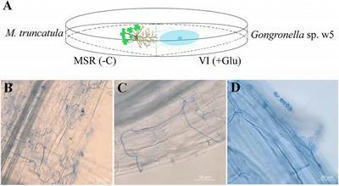
Mucoromycotina is one of the earliest fungi to establish a mutualistic relationship with plants in the ancient land. However, the detailed information on their carbon supply from the host plants is largely unknown. In this research, a free-living Mucoromycotina called Gongronella sp. w5 (w5) was employed to explore its effect on Medicago truncatula growth and carbon source utilization from its host plant during the interaction process. W5 promoted M. truncatula growth and caused the sucrose accumulation in M. truncatula root tissue at 16 days post-inoculation (dpi). The transportation of photosynthetic product sucrose to the rhizosphere by M. truncatula root cells seemed accelerated by upregulating the SWEET gene. A predicted cytoplasmic invertase (GspInv) gene and a sucrose transporter (GspSUT1) homology gene in the w5 genome upregulated significantly at the transcriptional level during w5–M. truncatula interaction at 16 dpi, indicating the possibility of utilizing plant sucrose directly by w5 as the carbon source. Further investigation showed that the purified GspInv displayed an optimal pH of 5.0 and a specific activity of 3380 ± 26 U/mg toward sucrose. The heterologous expression of GspInv and GspSUT1 in Saccharomyces cerevisiae confirmed the function of GspInv as invertase and GspSUT1 as sugar transporter with high affinity to sucrose in vivo. Phylogenetic tree analysis showed that the ability of Mucoromycotina to utilize sucrose from its host plant underwent a process of “loss and gain.” These results demonstrated the capacity of Mucoromycotina to interact with extant land higher plants and may employ a novel strategy of directly up-taking and assimilating sucrose from the host plant during the interaction.
|
|
|
Scooped by
Jean-Michel Ané
January 26, 2021 4:56 PM
|
•Microbiome assists in plant growth and resilience to environmental conditions.
•Restructuring of microbiome provides environmental adaptive capabilities to plants.
•An intricate molecular cross-talk regulates plant microbiome interactions.
•Microbiome is enriched in novel enzymes and natural products.
•Enzymatic and non-enzymatic functions of microbiome have industrial implications.
|
|
Scooped by
Jean-Michel Ané
January 26, 2021 4:53 PM
|
Arbuscular mycorrhizal fungi (AMF) rely on their host plants to provide them with fatty acids (FA), but the precise form(s) in which they are supplied is still unclear. Here we show that ectopic expression of the transcription factor REQUIRED FOR ARBUSCULAR MYCORRHIZATION 1 (RAM1) can drive secretion of 2-monoacylglycerols (2MGs) from Medicago truncatula roots and that their main FA moiety is palmitic acid, although myristic acid and stearic acid were also detected. RAM1-dependent 2MG secretion requires the acyl-acyl carrier protein thioesterase FATM, the glycerol-3-phosphate (G3P) acyltransferase RAM2 and the ATP binding cassette transporter STR. Furthermore, 14C glycerol labelling experiments using mycorrhizal M. truncatula roots that are deficient in glycerol kinase, FAD-dependent G3P dehydrogenase and the G3P acyltransferase RAM2 suggest that most of the glyceryl moieties in Rhizophagus irregularis storage lipids are provided by their host plant through the 2MG pathway. Taken together, our data support the hypothesis that the plant exports 2MGs across the peri-arbuscular membrane in mycorrhizal roots and that the AMF receive and utilise both the FA and glyceryl moieties to make their storage lipids.
|
|
Scooped by
Jean-Michel Ané
January 25, 2021 3:51 PM
|
Plants live in one place from the moment they germinate to the day they die. So, are plants aware of their surroundings? In recent years, research has been actively conducted to show that plants survive by interacting with microorganisms in the surrounding environment including the soil. So, do plants communicate with other plants? One answer to that is the observation that biotic and abiotic stimulation of plants results in the production of volatile substances that affect neighboring plants. Volatile compounds produced by one plant act as signals to transmit information to neighboring plants and reconstructing their rhizosphere microbiota.
|
|
Scooped by
Jean-Michel Ané
January 24, 2021 4:19 PM
|
While the effect of nitrogen (N) deposition on belowground carbon (C) cycling varies, emerging evidence shows that forest soils dominated by trees that associate with ectomycorrhizal fungi (ECM) store more C than soils dominated by trees that associate with arbuscular mycorrhizae (AM) with increasing N deposition. We hypothesized that this is due to unique nutrient cycling responses to N between AM and ECM dominated soils. ECM trees primarily obtain N through fungal mining of soil organic matter subsidized by root‐C. As such we expected the largest N induced responses of C and N cycling to occur in ECM rhizospheres and be driven by fungi. Conversely, as AM trees rely on bacterial scavengers in bulk soils to cycle N, we predicted the largest AM responses to be driven by shifts in bacteria and occur in bulk soils. To test this hypothesis, we measured microbial community composition, metatranscriptome profiles, and extracellular enzyme activity in bulk, rhizosphere, and organic horizon (OH) soils in AM and ECM dominated soils at Bear Brook Watershed in Maine, USA. After 27 years of N fertilization, fungal community composition shifted across ECM soils, but bacterial communities shifted across AM soils. These shifts were mirrored by enhanced C relative to N mining enzyme activities in both mycorrhizal types, but this occurred in different soil fractions. In ECM stands these shifts occurred in rhizosphere soils, but in AM stands they occurred in bulk soils. Additionally, ECM OH soils exhibited the opposite response with declines in C relative to N mining. As rhizosphere soils account for only a small portion of total soil volume relative to bulk soils, coupled with declines in C to N enzyme activity in ECM OH soils, we posit that this may partly explain why ECM soils store more C than AM soils as N inputs increase.
|
|
Scooped by
Jean-Michel Ané
January 24, 2021 4:09 PM
|
Soybean (Glycine max.) is one of the most important legumes cultivated worldwide. Its productivity can be altered by some biotic and abiotic stresses like global warming, soil metal pollution or over-application of herbicides like paraquat (1,1’-dimethyl-4,4’-bipyridinium dichloride). In this study, the effect of oxidative stress produced by paraquat addition (0, 20, 50 and 100 µM) during plant growth on symbiotic nitrogen fixation (SNF) and functionality of Bradyrhizobium diazoefficiens-elicited soybean nodules were evaluated. Results showed that the 50 µM was the threshold that B. diazoefficiens can tolerate under free-living conditions. In symbiosis with soybean, the paraquat addition statistically reduced the shoot and root dry weight of soybean plants, and number and development of the nodules. SNF was negatively affected by paraquat, which reduced total nitrogen content and fixed nitrogen close to 50% when 100 µM was added. These effects were due to the impairment of nodule functionality and the increased oxidative status of the nodules, as revealed by the lower leghaemoglobin content and the higher lipid peroxidation in soybean nodules from paraquat-treated plants
|
|
Scooped by
Jean-Michel Ané
January 24, 2021 12:40 PM
|
Aims
Phytoremediation of soil contaminated by trace elements is a technology using plants and microorganisms to sequester, inactivate, or extract contaminants from the soil. The assemblage formed by the partnership between plants and microorganisms is referred to as the plant holobiont concept. Among holobiont microorganisms, endophytes are associated with the plant at its earliest growth stage and are localized inside plant tissues. While plant tissues shelter endophytic microbial communities, mutualistic endophytes have shown a potential for plant growth promotion that will deeply and durably benefit the plant holobiont. In this review, we describe the state-of-the-art knowledge of the endophytes’ role in plant growth promotion and the prospects for phytoremediation technologies.
Results
Mutualistic symbionts have been demonstrated to improve plant growth, germination and yield. Indeed, they improve plant nutrition, increase plant resistance to bio-aggressors and stimulate plant metabolite productions. Research has shown that endophytes improve plant performance especially under extreme conditions such as drought, nitrogen deficiency, salinity and exposition to metal phytotoxicity. Endophyte inoculation has shown potential for plant growth promotion and has increased metal translocation in hyperaccumulator shoots by mitigating stresses from contaminated and naturally metal-rich soils.
Conclusions
Endophytes have demonstrated their potential to enhance the plant’s physiological status under metallic stress, the growth of both roots and shoots, as well as increasing metal uptake in the shoot biomass of a wide diversity of hyperaccumulating plants. Endophyte-assisted phytoremediation is a promising technology for the remediation of polluted or naturally metal-rich soils.
|
|
Scooped by
Jean-Michel Ané
January 24, 2021 12:37 PM
|
Although most invasive species engage in mutualism, we know little about how mutualism evolves as partners colonize novel environments. Selection on cooperation and standing genetic variation for mutualism traits may differ between a mutualism's invaded and native ranges, which could alter cooperation and coevolutionary dynamics. To test for such differences, we compare mutualism traits between invaded‐ and native‐range host‐symbiont genotype combinations of the weedy legume, Medicago polymorpha, and its nitrogen‐fixing rhizobium symbiont, Ensifer medicae, which have co‐invaded North America. We find that mutualism benefits for plants are indistinguishable between invaded‐ and native‐range symbioses. However, rhizobia gain greater fitness from invaded‐range mutualisms than from native‐range mutualisms, and this enhancement of symbiont fecundity could increase the mutualism's spread by increasing symbiont availability during plant colonization. Furthermore, mutualism traits in invaded‐range symbioses show lower genetic variance and a simpler partitioning of genetic variance between host and symbiont sources, compared to native‐range symbioses. This suggests that biological invasion has reduced mutualists’ potential to respond to coevolutionary selection. Additionally, rhizobia bearing a locus (hrrP) that can enhance symbiotic fitness have more exploitative phenotypes in invaded‐range than in native‐range symbioses. These findings highlight the impacts of biological invasion on the evolution of mutualistic interactions.
|
|
Scooped by
Jean-Michel Ané
January 24, 2021 12:31 PM
|
Microbial plant interaction plays a major role in the sustainability of plants. The understanding of phytomicrobiome interactions enables the gene-editing tools for the construction of the microbial consortia. In this interaction, microbes share several common secondary metabolites and terpenoid metabolic pathways with their host plants that ensure a direct connection between the microbiome and associated plant metabolome. In this way, the CRISPR-mediated gene-editing tool provides an attractive approach to accomplish the creation of microbial consortia. On the other hand, the genetic manipulation of the host plant with the help of CRISPR-Cas9 can facilitate the characterization and identification of the genetic determinants. It leads to the enhancement of microbial capacity for more trait improvement. Many plant characteristics like phytovolatilization, phytoextraction, phytodesalination and phytodegradation are targeted by these approaches. Alternatively, chemical communications by PGPB are accomplished by the exchange of different signal molecules. For example, quorum-sensing is the way of the cell to cell communication in bacteria that lead to the detection of metabolites produced by pathogens during adverse conditions and also helpful in devising some tactics towards understanding plant immunity. Along with quorum-sensing, different volatile organic compounds and N-acyl homoserine lactones play a significant role in cell to cell communication by microbe to plant and among the plants respectively. Therefore, it is necessary to get details of all the significant approaches that are useful in exploring cell to cell communications. In this review, we have described gene-editing tools and the cell to cell communication process by quorum-sensing based signaling. These signaling processes via CRISPR- Cas9 mediated gene editing can improve the microbe-plant community in adverse climatic conditions.
|
|
Scooped by
Jean-Michel Ané
January 24, 2021 12:16 PM
|
In natural ecosystems, positive effects of plant diversity on ecosystem functioning have been widely observed, yet whether this is true in cropping systems remains unclear. Here we assessed the impact of crop diversification on soil microbial diversity, soil multifunctionality (SMF) and crop yields in 155 cereal fields across a 3,000 km north–south European gradient. Overall, crop diversity showed a relatively minor effect on soil microbial diversity, SMF and yields. In contrast, the proportion of time with crop cover (including cash crops, cover crops or forage leys) during the past ten-year crop rotation had a much stronger impact. This suggests that increasing crop cover can enhance both yields and soil functioning, while also providing habitat for soil microorganisms. We found that SMF did not positively contribute to crop yields, highlighting that care must be taken to balance the provision of food with environmentally beneficial functions and services, since they do not always go hand in hand.
|
|
Scooped by
Jean-Michel Ané
January 24, 2021 12:06 PM
|
Plants face a constant struggle to acquire nutrients and defend themselves against herbivores. Mycorrhizae are fungal mutualists that provide nutrients that can increase plant growth and alter resistance to herbivores. The beneficial effects of mycorrhizae for nutrient acquisition can depend on the quantity and type of soil nutrients available, with plants usually benefiting more in terms of growth from mycorrhizae when nutrients are limited. However, it is unclear how the addition of different nutrients might shift mycorrhizal conferred resistance to herbivores by changing defensive secondary chemistry and nutrient availability.
We conducted two concurrent greenhouse experiments to test how three levels of fertilizer (low, medium, and high) and three types of fertilizer (organic, organically derived, and inorganic) altered mycorrhizae‐conferred resistance to herbivores in tomato plants. In addition, we looked at whether mycorrhizae‐conferred resistance was driven by plant secondary metabolites or the nutrient content of the leaves.
Association with mycorrhizae was associated with an increase in biomass at low levels of fertilization and decreased biomass at high levels of fertilization. Interestingly, mycorrhizae increased resistance to herbivores at medium levels of fertilization, but had no effect at low and high levels of fertilization. Mycorrhizae improved resistance most strongly when plants were fertilized with a phosphorus rich, organically derived fertilizer. In both experiments, increased resistance was correlated with changes in the plant’s foliar nitrogen content.
Synthesis and applications: Our study supports the potential for mycorrhizae to improve either crop growth or pest resistance under lower fertilizer conditions. However, mycorrhizae did not provide both growth and resistance benefits under any treatment. While mycorrhizae have the potential to benefit crops in in lower input systems, it may be challenging to maximize both growth and resistance benefits.
|
|
Scooped by
Jean-Michel Ané
January 24, 2021 11:39 AM
|
The components of the rhizosphere that can be engineered require a deep understanding of the molecular mechanisms involved in plant–microbe interactions in the rhizosphere. Various molecular mechanisms harmonize the interactions between plants and rhizomicrobiome microorganisms to increase plant productivity. This chapter reviews the different approaches used to engineer the rhizosphere along with the molecular mechanisms. Rhizosphere engineering encompasses tools and techniques used for the identification of rhizomicrobiome diversity and for understanding various aspects of plant–microbial interactions in the rhizosphere. The main aim of rhizosphere engineering is to generate stress‐resistant and high‐yielding crop plants. Thus, engineering of the components of the rhizosphere plays a very important role in enhancing plant productivity and contributing to sustainable modern agriculture. The interaction between plants and microorganisms depends mainly on the different signaling molecules secreted by both microorganisms and plants. Tools and techniques used to study and implement rhizosphere engineering for improving plant growth and productivity are discussed.
|
|
Scooped by
Jean-Michel Ané
January 24, 2021 11:38 AM
|
Symbiotic nitrogen fixation is benefit to sustainable agriculture and global nitrogen cycle. Many small peptides were identified as regulators involving in the interaction between rhizobia and legume. Here we reported Nodule Rich Protein 2 (MtNRP2) encoding a small peptide in Medicago truncatula, belonged to a group of nodule rich protein restricted in legume species. MtNRP2 expressed highly in root nodule and its promoter was active during the initiation and development of root nodule and lateral root. To investigate the function of MtNRP2 in nodulation, we generated MtNRP2-overexpression and MtNRP2-knockdown transgenic Medicago. MtNRP2-overexpression transgenic lines performed normal nodulation phenotype compared with vector control. However, in the MtNRP2-RNAi transgenic plants, the decrease of MtNRP2 expression lead to the increase of infection threads number (7 day post inoculation) and nodules number (3 week post inoculation); meanwhile, the expression of MtRGF3 and MtPUB1 was inhibited. These results suggested that MtNRP2 negatively regulated nodulation in Medicago truncatula.
|