 Your new post is loading...

|
Scooped by
Jean-Michel Ané
April 25, 4:47 PM
|
Mutualism in the symbiosis between arbuscular mycorrhizal fungi and plants is based upon the exchange of carbon for soil minerals, with phosphate being of central importance. The exchange of nutrients occurs when the fungus transiently colonises root cells, producing hyphal structures called arbuscules. The movement of phosphate from fungus to plant is well established, however its coordination and regulation at the ephemeral arbuscules remains elusive. Here, non-invasive imaging captures the complete growth and collapse of the arbuscules in unprecedented resolution, revealing heterogeneity in arbuscule development. Tracking the dynamics of rice PHosphate Transporter 1;11 (OsPHT1;11/ PT11) as a proxy for symbiotic phosphate transport shows consistent localisation across diverse arbuscules. However, we uncover phosphate-responsive variability in PT11 abundance, representing an essential, cellular-level layer of nutrient regulation. Such plasticity in arbuscule phosphate uptake capacity evidences uncoupling of arbuscule presence and arbuscule function, thereby demonstrating that arbuscules are not identical units of nutrient exchange.
|
|
Scooped by
Jean-Michel Ané
April 24, 5:05 PM
|
The search for life now extends beyond the traditional habitable zone to include the icy moons of Jupiter and Saturn. These moons feature ice-covered surfaces overlying substantial oceans formed primarily of liquid water and other potential constituents, such as ammonia. On Earth, ammonia supports biochemistry at low concentrations by providing nitrogen but becomes disruptive at higher concentrations. Ammonia could therefore influence the habitability of extraterrestrial oceans, yet this topic has received limited attention in the literature. This review synthesises current research on ammonia in Saturn’s icy moons, Enceladus and Titan, and its effects on terrestrial life. We summarize the celestial incorporation, speciation, and phase behaviour of ammonia and review data on its occurrence and concentration in icy moon oceans. We examine the role of ammonia in prebiotic chemistry, biochemistry, and toxicity. Focusing on bacteria, we compare known survival limits in ammonia to estimated ammonia concentrations on Enceladus and Titan. We find that bacterial survival limits exceed concentrations estimated on Enceladus, but are below those estimated on Titan, and propose that ammonia measurements are crucial for assessing extraterrestrial habitability. Finally, we highlight outstanding knowledge gaps and challenges that influence our understanding of how ammonia shapes the potential for life beyond Earth.
|
|
Scooped by
Jean-Michel Ané
April 21, 10:12 AM
|
Root exudation mediates the delivery of plant primary and secondary metabolites into soil, where they regulate plant–microbe interactions and terrestrial carbon cycling. Conventional exudate analyses quantify total root-released carbon yet obscure the spatial origin and rhizosphere influence of individual compounds. Here, we develop a rhizobacterial biosensor platform, named Suc-MAPP, to map local exudate profiles along the surface of colonized root tissues. Focusing on sucrose, we engineered sfGFP-based, sucrose-responsive gene circuits in Pseudomonas putida KT2440 for live imaging of exudate concentrations in the micromolar range. These biosensors reveal spatially structured sucrose exudation patterns across eudicots and monocots and implicate photoassimilated source–sink dynamics as a major determinant. We further apply this platform to phenotype exudation modulated by synthetic gene circuitry in Arabidopsis thaliana, identifying genetic design rules for graded sucrose release and quantifying how engineered export sculpts rhizosphere assembly of a defined bacterial community. Together, these results establish programmable rhizobacterial biosensors as tools to spatially resolve plant–environment carbon exchange in situ and provide a framework for extending this approach to diverse exudate targets.
|
|
Scooped by
Jean-Michel Ané
April 21, 10:05 AM
|
Legumes host nitrogen-fixing bacteria, called rhizobia, within specialised root structures called nodules, where carbon from the plant is exchanged for ammonia fixed from N2 by the bacteria. Legumes can host multiple bacterial strains at the same time, that vary in their fixation effectiveness, but legumes sanction nodules containing less effectively fixing strains by reducing the provision of nutrients. Understanding how sanctions are applied by plants and how bacteria may try to avoid them is important for understanding the stability of legume-rhizobial symbioses. Using near isogenic Rhizobium leguminosarum strains, on pea, we demonstrate that sanctions are sensitive to the proportion of nodules occupied by a less effective strain and by using split roots show that sanctions are applied based on a global comparison of nodules across the plant’s root system. By using several rhizobia with different levels of fixation, but all derived from the same parent, we show that pea plants can differentiate between bacteria with relatively small variations in fixation effectiveness. We demonstrate that peas integrate global signals to determine whether individual nodules are sanctioned. At the same time these results show that poorly fixing strains can avoid sanctions if they dominate nodulation.
|
|
Scooped by
Jean-Michel Ané
April 19, 11:07 AM
|
Desert ecosystems in Kuwait are increasingly affected by land degradation, resulting in nutrient-limited soils that constrain native plant establishment. Harnessing indigenous diazotrophic bacteria adapted to arid environments may provide a sustainable strategy to improve plant growth and nutrient acquisition. Free-living and root-associated nitrogen-fixing bacteria contribute substantially to nitrogen inputs in arid ecosystems and may enhance plant growth, performance and nutrient acquisition under nutrient-poor conditions. This study evaluated the growth performance and nutrient uptake ability of four native plant species of Kuwait following inoculation with a consortium of selected indigenous putative diazotrophs isolated from the Kuwait desert soils. The seedlings of Vachellia pachyceras were inoculated with both indigenous root-nodule bacteria isolated from Kuwait desert and a commercial inoculum to evaluate their symbiotic efficiency. The seedlings were cultivated under greenhouse conditions using either native desert soils or a potting mix substrate to assess the influence of growth medium or inoculation response. Across species, inoculation significantly enhanced plant dry mass and nutrient uptake compared to the non-inoculated controls. The magnitude of improvement varied among bacterial density, host plants, and growth substrate. These findings support the potential use of indigenous diazotrophs as biofertilizers to enhance plant growth and nutrient uptake of native plant species, and for restoration and revegetation efforts in arid environments. However, direct measurements of nitrogen fixation were not conducted and should be addressed in future field-based studies. This study represents the first evaluation of Kuwait’s native seedlings inoculated with indigenous diazotrophs, highlighting their potential for sustainable ecosystem restoration.
|
|
Scooped by
Jean-Michel Ané
April 17, 2:17 PM
|
Calreticulins are multifunctional proteins involved in calcium homeostasis, protein folding, and cellular signaling. In common bean (Phaseolus vulgaris), the molecular mechanisms that regulate infection and nodule development remain incompletely understood. The main objective of this study was to characterize the role of the calreticulin gene PvCRT08 during infection and nodulation processes. We first analyzed the calreticulin gene family in the P. vulgaris genome and identified three members, with PvCRT08 showing the highest transcript accumulation in roots and after inoculation with rhizobia. Spatial and temporal promoter analyses in transgenic composite bean roots revealed PvCRT08 activity in root hairs and in infected cells and vascular bundles of mature nodules. RNA interference (RNAi)-mediated PvCRT08 down-regulation in transgenic roots increased the number of infection threads and enhanced nitrogen fixation efficiency, leading to the formation of larger and more functional nodules, although total nodule number was unaffected. In contrast, overexpression of PvCRT08 impaired infection thread progression, reduced the expression of key nodulation marker genes (PvCyclin and PvNIN), decreased nodule number, and diminished nitrogen fixation capacity. These findings identify PvCRT08 as a key regulatory component of early infection events and nodule development in common bean. Furthermore, the study provides new insights into the molecular control of symbiotic efficiency and highlights PvCRT08 expression is critical to optimize the equilibrium between infection efficiency and nodule functionality.
|
|
Scooped by
Jean-Michel Ané
April 17, 2:03 PM
|
Reprogramming of differentiated root cortical cells into proliferative stem cells is a prerequisite for legume nodule organogenesis, yet the molecular trigger that confers stem-cell identity upon these cortical cells remains elusive. Here we demonstrate that, in soybean (Glycine max), the canonical root stem-cell regulator WUSCHEL-RELATED HOMEOBOX gene WOX5 is activated by rhizobia specifically in cortical cells that will give rise to nodule primordia. CRISPR–Cas9-mediated knockout of the three WOX5 homologs, wox5abc mutants, reduced nodule number and attenuated nitrogenase activity, attributable to a decrease in primordium density rather than impaired rhizobial infection. Promoter dissection identified a 442 bp legume-specific promoter fragment within the WOX5a promoter that is both necessary and sufficient for primordium-specific expression. Chromatin immunoprecipitation and dual-luciferase assays revealed that this promoter fragment is directly bound by the symbiosis-responsive transcription factor NF-YAc to activate expression of WOX5a. Loss of NF-YAc phenocopied wox5abc, and NF-YAc overexpression failed to rescue nodulation in wox5abc mutants. Collectively, our findings reveal that NF-YAc-mediated activation of WOX5 initiates a de novo stem-cell niche in root cortical cells, providing the critical developmental trigger for nodule primordium initiation in soybean.
|
|
Scooped by
Jean-Michel Ané
April 14, 4:27 PM
|
This study aimed to investigate the efficiency of arbuscular mycorrhizal fungi (AMF) and endophytic fungi to promote growth and fiber yield of Cannabis sativa subsp. sativa RPF3 (Hemp) and the impact on cannabinoid concentrations. A factorial pot experiment with six replications was conducted for 90 days. Two species of AMF (Rhizophagus aggregatus, R. prolifer) and two species of endophytic fungi (Lasiodiplodia theobromae, Macrophomina phaseolina) were selected as inocula and compared with two non-mycorrhizal controls, one without synthetic fertilizer and one with synthetic NPK fertilizer. Inoculation with AMF and endophytic fungi increased mass fractions of cellulose, acid detergent fiber, and neutral detergent fiber and mass fractions of cannabinoids, especially of cannabidiol, in leaves and shoots, with the strongest increase noted after inoculation with R. aggregatus and L. theobromae. Our study is the first to report the effectiveness of AMF and endophytic fungi on promoting growth, fiber content, and cannabinoid production in hemp. These results suggest the potential for hemp cultivation with AMF and endophytic fungi without the potential negative effects induced by high use of synthetic fertilizer.
|
|
Scooped by
Jean-Michel Ané
April 11, 7:30 PM
|
Pea (Pisum sativum L.) symbiosis with nodule bacteria supplying plants with additional nitrogen is a very specific plant-microbial interaction. Mutual recognition of the partners occurs through perception of bacterial signal molecules (Nod factors) by plant receptors, enabling bacterial entry via root hairs and formation of nitrogen-fixing nodules. The pea gene Sym2, described but not yet cloned, exists in different allelic forms defining the symbiotic specificity, and is therefore thought to encode a Nod factor receptor. The PsLykX gene is a strong candidate for the Sym2, since its alleles coincide with high or low symbiotic specificity; however, to date, no genetic evidence has been obtained for a role of PsLykX in symbiosis. Here, we knocked-out the PsLykX in European pea cultivar Caméor using Agrobacterium-mediated hairy root transformation and CRISPR-Cas9 editing. The roots with editing events confirmed by sequencing lost the ability to form nodules, providing direct functional evidence that PsLykX is essential, at least, for the symbiosis between pea cultivar Caméor and Rhizobium ruizarguesonis RCAM1026.
|
|
Scooped by
Jean-Michel Ané
April 10, 2:34 PM
|
Iron is a crucial micronutrient for plants, but its availability in soil is often limited. Iron deficiency compromises plant growth, and low iron content in crops contributes substantially to the ‘hidden hunger’ that affects human health globally. The elucidation of Strategy I (reduction-based) and Strategy II (phytosiderophore-based) for iron acquisition was a milestone in plant biology and enabled the development of biofortification concepts. However, recent genetic evidence reveals that the boundary between the two strategies is blurred, with many plants possessing elements of both. Here we show that plant iron uptake mechanisms are more complex and diverse than the classical dichotomy suggests. We review evidence for this integrative view and highlight the critical role of microbial siderophores. We explain how plants access iron from microbial siderophores not only indirectly through Strategy I and II pathways but also via the direct uptake of iron–siderophore complexes, an overlooked mechanism that we introduce as Strategy III. We propose three potential routes for this direct uptake and conclude that harnessing Strategy III holds great potential for novel agricultural interventions to enhance iron biofortification and improve human health.
|
|
Scooped by
Jean-Michel Ané
April 10, 10:59 AM
|
Ammonia (NH₃) is a critical molecule for agriculture, industry, and emerging energy applications. However, current industrial production by the Haber–Bosch process is energy-intensive and environmentally damaging, accounting for a significant portion of global CO₂ emissions. In contrast, biological nitrogen fixation (BNF) offers a sustainable alternative by converting atmospheric nitrogen (N₂) into NH₃ under ambient conditions through the action of nitrogenase enzymes. Among diazotrophic microorganisms, Azotobacter vinelandii stands out due to its ability to fix nitrogen aerobically, supported by unique physiological and genetic adaptations that protect its oxygen-sensitive nitrogenase. This review presents a comprehensive overview of NH₃ synthesis with A. vinelandii, highlighting its biochemical mechanisms, nitrogenase structure and function, and the protective strategies that enable aerobic nitrogen fixation. We further examine the diversity and advantages of Azotobacter strains, with a focus on A. vinelandii’s potential for engineered NH₃ production through synthetic biology, metabolic engineering, and emerging bio-based technologies such as photobiocatalysis and bioelectrochemistry. Recent innovations aimed at improving nitrogenase expression, cellular stability, and overall system efficiency are discussed in the context of advancing A. vinelandii as a robust chassis for industrially scalable, carbon-neutral NH₃ synthesis. The review emphasizes the importance of free-living nitrogen fixers in addressing the challenges of sustainable NH₃ production and provides insights into future directions for research and application.
|
|
Scooped by
Jean-Michel Ané
April 10, 10:33 AM
|
The circadian clock synchronizes a multitude of biological events with environmental changes, thereby optimizing plant growth and development. In legumes, nodule formation, a pivotal process that sustains symbiotic nitrogen fixation, is one such event regulated by the circadian clock. Nevertheless, the mechanisms underlying the circadian clock's regulation of nodule formation and nitrogen fixation are still poorly elucidated. Herein, we unveil that the core clock gene LUX ARRHYTHMO (LUX) exerts a crucial role in modulating nodule formation and root development via auxin biosynthesis pathways in the model legume Medicago truncatula. Our findings indicate that MtLUX directly associates with the promoter of MtRVE1, a clock output gene involved in auxin biosynthesis, both in vivo and in vitro, thereby repressing its expression. Biochemical and genetic data further corroborate that the MtLUX-MtRVE1 regulatory module adjusts root architecture and nodule formation through the fine-tuning of auxin biosynthesis. These discoveries reveal a mechanism whereby the circadian clock integrates hormonal pathways to regulate nodule formation, thereby linking circadian regulation, auxin biosynthesis, and nitrogen fixation in legumes. This research lays the groundwork for enhancing legume growth and nitrogen acquisition under fluctuating environmental conditions.
|
|
Scooped by
Jean-Michel Ané
April 10, 10:25 AM
|
An intriguing and intricate biological process, root nodule symbiosis is vital to the nitrogen cycle and potentially has far-reaching consequences for the long-term viability of agriculture. This chapter delves into the intricate mechanisms underlying root nodule symbiosis and explores the latest insights into its molecular, genetic, and ecological aspects. From the molecular signaling between host plants and nitrogen-fixing rhizobia to the environmental implications for plant–microbe interactions, we discuss the multifaceted nature of this symbiotic relationship. Furthermore, we highlight the practical applications of unraveling these mysteries, including developing sustainable agricultural practices, biofertilizers, and bioremediation strategies. By synthesizing the latest research findings, this chapter aims to comprehensively understand root nodule symbiosis and its potential implications for agriculture, ecology, and environmental sustainability. In this chapter, we will unravel the mysteries of root nodule symbiosis. We will explore the current landscape of plant–microbial–nanoparticle interactions better to understand the intricate relationships within root nodule symbiosis. This exploration will provide valuable insights and applications for furthering our knowledge in this fascinating field.
|
|
|
Scooped by
Jean-Michel Ané
April 25, 12:36 PM
|
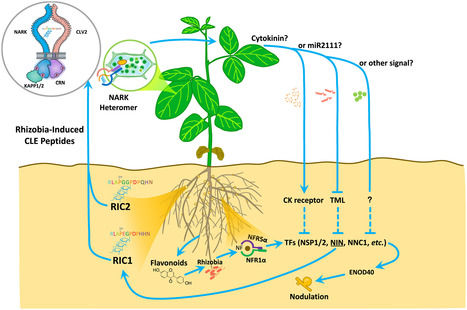
Legume-rhizobial symbiosis, involving the intracellular accommodation of rhizobia within host cells for nitrogen fixation, represents a unique model among plant-microbe interactions. While this symbiosis requires sophisticated regulatory networks, direct host control over symbiont proteins remains largely elusive. Here, we demonstrate that soybean Nodulation Receptor Kinase (GmNORK) interacts with and directly phosphorylates the Sinorhizobium fredii HH103 effector NopZ. This host-mediated phosphorylation promotes NopZ nuclear/perinuclear enrichment and is associated with enhanced NopZ interaction with the nucleoporin GmNENA at the nuclear envelope/nuclear pore complex, establishing a key signaling step that links membrane-proximal symbiotic signaling to the nuclear pore. Expression of phosphomimetic NopZ variants enhances soybean nodulation, whereas GmNENA-silencing in soybean roots reduces nodule numbers. Our findings reveal a previously unknown model for plant-microbe interactions, where the direct phosphorylation of a bacterial effector by a host receptor kinase provides an essential regulatory mechanism to direct effector localization and promote the symbiotic program.
|
|
Scooped by
Jean-Michel Ané
April 21, 10:21 AM
|
Plants exist as complex holobionts, whose health and productivity depend on dynamic interactions with diverse microbial partners. This chapter explores the ecological, molecular, and biotechnological dimensions of plant-microbe relationships, tracing the continuum from natural symbioses to their translation into microbe-based agricultural applications. It examines how plants actively structure their microbial communities across distinct yet interconnected compartments, such as the rhizosphere, phyllosphere, and endosphere, and how these microorganisms in turn modulate plant physiology, nutrient acquisition, and defense. Moving beyond the study of individual strains, we discuss the growing relevance of community-level approaches and synthetic microbial consortia as frameworks to decipher and replicate the ecological principles that sustain beneficial interactions. Finally, this chapter reflects on how the integration of ecological knowledge with emerging technologies such as synthetic biology, systems modeling, and artificial intelligence offers new opportunities to design resilient, predictable, and sustainable microbe-based solutions. By learning from these naturally optimized alliances, we can guide the transition to more adaptive and sustainable agricultural systems while sustaining plant health and productivity.
|
|
Scooped by
Jean-Michel Ané
April 21, 10:11 AM
|
Soybean plays a crucial role in meeting nitrogen demands through biological nitrogen fixation (BNF), a process highly dependent on phosphorus availability. Low-phosphorus (LP) stress significantly impairs nodule development, thereby affecting soybean growth and productivity. Genome-wide association study (GWAS) was conducted using the ratio of the nodule numbers (RNNs) under normal phosphorus condition and low-phosphorus condition in a natural population with 272 soybean accessions grown in three environments. A total of 21 novel single nucleotide polymorphisms (SNPs) related to nodule-related traits located on soybean chromosome 5 and chromosome 6 were repeatedly detected in two environments. Among them, 18 SNPs related to the ratio of the nodule number to the total plant weight under the normal phosphorus (NP) condition to that under the LP condition (RNP) formed a SNP cluster, and one SNP (AX-94275075) in this SNP cluster was detected simultaneously for multiple traits. A candidate gene, named GmbHLH135, which encodes a member of the basic helix-loop-helix (bHLH) family of transcription factors, was functionally characterized. The expression of GmbHLH135 was affected by low-phosphorus stress. Overexpressing and suppressing GmbHLH135 in soybean hairy roots resulted in a decreased and increased nodule number, respectively. GmbHLH135-overexpressing transgenic soybean lines presented decreased nodule number, brassinosteroids (BR) contents, plant biomass and yields. These findings could highlight the role of identified significant SNPs and the candidate gene GmbHLH135 in regulating nodule development under LP stress, provide valuable insights into the molecular mechanisms underlying phosphorus-mediated nodule growth and offer potential targets for soybean breeding.
|
|
Scooped by
Jean-Michel Ané
April 20, 3:46 PM
|
Root nodule symbiosis (RNS) is found in approximately 16-18 widely-separated lineages within the "nitrogen-fixing nodulation clade (NFNC)". Although modeling of trait gain and loss across approximately 13,000 species within the rosid group indicates multiple gains and losses, there is no consensus about whether RNS had a single or multiple origins; and our understanding is fragmentary regarding the molecular mechanisms underlying those changes. Evolution of a new organ and functions involves many thousands of genes; but the evolutionary histories for many of these genes may be uninformative regarding RNS evolution. A portion of the genes, however, are likely to be derived from prior gene duplications and to have acquired new functions or to have come under new regulatory patterns. Whole genome duplications (WGDs) could conceivably enable the necessary neo-or sub-functionalization for new roles in the nodule. All species that exhibit RNS share a history of several ancient WGDs; but the last such common WGD for these species was the "gamma" paleohexaploidy that occurred early in the core eudicot lineage, ~120 Mya. This presents a puzzle: If legume RNS within the NFNC only arose in the Late Cretaceous, several tens of millions of years after the gamma event, what explains the long, seemingly quiescent interval and the many eudicot lineages without RNS? This study focuses on a collection of gene superfamilies with additional independent WGDs that appear to have occurred in the interim period, after the gamma triplication and prior to the evolution of RNS, identifying several that are both essential for RNS and that show evidence of critical roles of both ancient WGDs and more recent local duplications.
|
|
Scooped by
Jean-Michel Ané
April 17, 2:18 PM
|
Legumes establish symbiotic partnerships with soil bacteria that convert atmospheric nitrogen into plant-available forms. Symbiotic bacteria enter through root hairs following recognition by cell surface receptors that help identify compatible symbionts. However, many root hairs express these receptors, and it has long remained unclear why only a small fraction become infected. Here, we use single-cell transcriptomics to show that legumes pre-specify a rare root hair population for infection before bacterial contact. These susceptible root hairs represent less than one percent of the total, express infection-associated genes prior to encountering symbionts and are conserved in distantly related legumes. Their abundance is regulated by the hormone ethylene and correlates with infection capacity. Our findings reveal that root hair cells do not respond uniformly to symbionts but are instead transcriptionally specialised in advance to control infection entry points. This pre-specification provides a mechanism to balance symbiotic benefits against pathogen infection risks and may exemplify a more general strategy used by multicellular hosts to spatially restrict microbial access.
|
|
Scooped by
Jean-Michel Ané
April 17, 2:15 PM
|
Arbuscular mycorrhizal fungi (AMF) are widespread root symbionts increasingly used as bioinoculants. Because symbiotic efficiency depends on interactions with other plant-beneficial microbes, identifying compatible taxa and positive interaction patterns across hosts and niches could improve the design of crop-specific AMF-based inocula. Using amplicon sequencing and co-occurrence network analyses, microbial communities (AMF, fungi and bacteria) from the rhizosphere and roots of wheat were characterized and compared with those of two highly mycotrophic plant species: leek (monocotyledon) and clover (dicotyledon). Results showed that AMF diversity associated with wheat roots was 1.37- and 1.24-fold lower than that observed in leek and clover, respectively. Across all plant species, Glomus and Rhizophagus taxa dominated root-associated communities, whereas Diversispora prevailed in the rhizosphere. In contrast, wheat harboured the highest bacterial and fungal richness compared with leek and clover, whereas leek and clover roots were enriched in several functional bacterial groups, including nitrogen-fixing bacteria, denitrifying and nitrifying bacteria and plant growth promoting bacteria. Co-occurrence network analyses revealed niche partitioning with bacterial interactions predominant in roots and fungal interactions in the rhizosphere, but with fewer and less-positive connections in wheat than in leek and clover. AMF showed positive associations with beneficial bacterial taxa (e.g. Rhizobium, Pseudomonas, Streptomyces) and fungal taxa (e.g. Serendipita), with interaction patterns varying among plant species. Together, these results demonstrate that plant identity and niche jointly shape the diversity and interaction patterns of root and rhizosphere-associated microbial communities, and they highlight specific AMF-microbe assemblages as promising candidates for the development of generalist or crop-specific AMF-based inocula.
|
|
Scooped by
Jean-Michel Ané
April 14, 4:32 PM
|
Plant-microbe interactions are important for plant development, particularly mutualisms where host promiscuity allows associations with diverse microbial partners. This flexibility is crucial for adaptation, especially in invasive species. Understanding microbial community dynamics is therefore key to explain invasion success. Acacia longifolia, a member of the Fabaceae family, is an aggressive invader capable of establishing symbioses with several microorganisms including rhizobia within root nodules. These interactions promote growth and play a role in its invasive capacity. However, the nodulation process remains poorly understood, regarding microbial succession and the dynamics of these communities, following nodule development. We assessed microbial profiles in root nodules from 1-year-old saplings in two habitats using Next-Generation Sequencing, targeting 16 S and 25-28 S rRNA genes. Nodules were classified by size as a proxy for developmental stage. Our findings show that (i) different developmental stages have a characteristic microbial community; (ii) there is a shift in dominance (i.e., abundance) from early to fully developed stage, with nodules containing respectively more microbes from seed or from soil; (iii) microbial partners change in each habitat. The microbial succession indicates a shift in abundance over time, highlighting mostly the changes in recruitment: while several genera that dominate early-stage nodules are mostly found in seeds, fully developed nodules have a community mostly acquired from the surrounding soils and showed a much more specialized fungal community. Our study shows a dynamic assembly of root nodules communities within invasive range that might contribute to the plasticity and adaptative strategy of A. longifolia in these new habitats.
|
|
Scooped by
Jean-Michel Ané
April 12, 12:40 PM
|
Accurate quantification of root nodules is essential for understanding legume–rhizobia symbiosis and improving biological nitrogen fixation. Fluorescently labeled rhizobial strains enable clear visualization of nodules; however, automated segmentation and counting remain challenging under data-limited conditions. In this study, we present a systematic benchmarking framework to evaluate three complementary approaches for fluorescent root nodule segmentation and quantification: a rule-based computer vision pipeline with optimized color-space thresholding, supervised deep learning using YOLOv12-seg transfer learning, and the training-free Segment Anything Model (SAM). Experiments were conducted on a pilot-scale dataset comprising 16 fluorescent images of Pisum sativum roots with manually annotated blue and yellow nodules. To address instability associated with small test sets, a 4-fold cross-validation strategy was employed, and performance was reported as mean ± standard deviation across folds. Model performance was evaluated using pixel-level overlap metrics (IoU, Dice), instance-level precision, recall, and F1-score, and total nodule counting error (MAE and
). The rule-based approach achieved strong segmentation and counting accuracy when fluorescence provided clear chromatic separation, demonstrating near-zero bias in total counts. Among deep learning models, YOLOv12-m provided the most balanced performance, achieving high segmentation accuracy while minimizing counting error and inter-fold variability. Larger YOLO variants did not consistently improve quantitative outcomes, suggesting overfitting under data-scarce conditions. SAM produced stable segmentation masks without training, but systematically underestimated nodule counts and lacked intrinsic class discrimination. Overall, the results highlight that segmentation fidelity alone is insufficient for reliable biological phenotyping and that accurate nodule counting must be explicitly considered. While limited in scope, this study establishes a reproducible benchmarking framework for fluorescent nodule phenotyping and provides practical guidance on method selection under constrained data and computational resources. The findings are intended as a proof-of-concept and motivate future work on larger, publicly available fluorescent datasets and hybrid segmentation strategies.
|
|
Scooped by
Jean-Michel Ané
April 11, 7:28 PM
|
Understanding how specificity emerges in mutualistic symbioses remains a central challenge in evolutionary ecology. In orchids, mycorrhizal specificity ranges from strict specialization to broad generalism. Although many orchids show low physiological specificity in vitro, natural populations associate with much narrower subsets of partners, indicating that realized specificity reflects constraints rather than compatibility alone. To provide a unified explanation and testable predictions for this discrepancy, we propose a multidimensional filtering framework that distinguishes physiological compatibility, representing the fundamental niche, from ecological filters that determine realized associations. Physiological compatibility, mediated by signal recognition and immune modulation, establishes the fundamental prerequisites for symbiosis. However, the transition to realized specificity is constrained by four hierarchical ecological filters. Phylogeny and biogeography first delineate the potential regional lineage pool, while local environmental heterogeneity restricts fungal availability. Subsequently, host-specific nutritional demands drive active partner selection, and interspecific competition enforces niche differentiation. This synthesis clarifies the observed discrepancy between fundamental and realized mycorrhizal niches and provides a conceptual foundation that may inform conservation strategies for endangered orchids through targeted ecological matching.
|
|
Scooped by
Jean-Michel Ané
April 10, 11:14 AM
|
Aspects of the present disclosure relate to methods of cultivating genetically altered plants with increased activity of one or more of a NODULATION SIGNALING PATHWAY 1 (NSP1) protein or a NODULATION SIGNALING PATHWAY 2 (NSP2) protein that have increased mycorrhization and/or promoted symbiotic responses under high phosphate and/or high nitrate conditions. Further aspects of the present disclosure relate to methods of cultivating genetically altered plants with increased activity of a C-TERMINALLY ENCODED PEPTIDE (CEP peptide) that have increased mycorrhization and/or promoted symbiotic responses under high phosphate and/or high nitrate conditions. In addition, aspects of the present disclosure relate to methods of cultivating these plants that include exogenous application of strigolactones, karrikins, and/or CEP peptides to increase mycorrhization and/or promote symbiotic responses under specific nutrient conditions.
|
|
Scooped by
Jean-Michel Ané
April 10, 10:49 AM
|
Establishing the symbiosis between legumes and nitrogen-fixing rhizobia requires the precise modulation of auxin levels. However, our understanding of auxin’s regulatory roles, particularly rhizobia-derived auxins, remains limited. Our study reveals that the auxin biosynthesis gene YUC2a is essential for the spatiotemporal control of nodule development in soybean (Glycine max). This process is orchestrated by three transcription factors: Nuclear Factor-YA9 (NF-YA9), Lateral Organ Boundaries Domain 41 (LBD41), and Nodule Inception 1a (NIN1a). In the early stages of nodulation, rhizobial auxin stimulates NF-YA9 expression, NF-YA9 then activates YUC2a expression in the cortical cell layer, establishing optimal auxin levels for nodule initiation. In the middle stages, rhizobial auxin elevates LBD41 expression, and LBD41 suppresses YUC2a to control auxin levels, ensuring proper rhizobia colonization. In the late stages, rhizobial auxin inhibits NIN1a expression, which increases YUC2a expression in nitrogen-fixing symbiosomes, fine-tuning optimal auxin levels for nodule maturation. Disruption of YUC2a and its homologs impairs cell division in nodule primordia, reducing nodule density and nitrogen fixation capacity. Conversely, cortex-specific overexpression of YUC2a promotes nodule formation but inhibits rhizobia colonization. This dynamic auxin regulation optimizes nodule development in soybean, revealing rhizobia-derived auxin's critical role in nitrogen-fixing symbiosis.
|
|
Scooped by
Jean-Michel Ané
April 10, 10:27 AM
|
Nitrogen-fixing nodule symbiosis is an ecologically and economically important trait in legumes and some related species. A critical step in the evolution of nodulation is the recruitment of NODULE INCEPTION (NIN); a homolog of the nitrate-sensing NIN-LIKE PROTEIN (NLP) transcription factors. However, whether adaptations have occurred in the NIN protein upon its recruitment in symbiosis remains elusive. Here we show that non-symbiotic NIN orthologs can function in intracellular infection and even nodule initiation, indicating that these properties of NIN predate the evolution of nodulation. Concurrent with the evolution of nodulation, symbiotic NIN proteins were optimized for their role in symbiosis by acquiring nitrate independent functionality, including constitutive nuclear localization. A single amino acid substitution in the non-symbiotic Arabidopsis AtNLP2 enhances its nuclear localization under low nitrate conditions, making it functionally comparable to the symbiotic Parasponia PanNIN. Our study provides insight in the evolutionary trajectory and molecular adaptation that allowed NIN to function as the central regulator of nitrogen-fixing nodule symbiosis.
|




![Rhizobial auxin activates transcription factors to orchestrate YUC2-dependent auxin biosynthesis for soybean nodule development] | Plant-Microbe Symbiosis | Scoop.it](https://img.scoop.it/0o9xVUKb6K190DgY-pjFETl72eJkfbmt4t8yenImKBVvK0kTmF0xjctABnaLJIm9)





Great review