

Le Top 20 (et quelques) des outils SEO à utiliser en 2013. Support de conférence au SEO Campus 2013.
Via Isabelle Delignière-Léglise


Une veille sur la santé numérique en France et à l’international : politiques publiques, données, infrastructures, IA, services et usages. Études, rapports et retours de terrain sélectionnés par Lionel Reichardt, Pharmageek, pour comprendre les transformations et éclairer les décisions.
 Your new post is loading...
 Scoop.it! Le Top 20 (et quelques) des outils SEO à utiliser en 2013. Support de conférence au SEO Campus 2013. Via Isabelle Delignière-Léglise 
No comment yet.
Sign up to comment
Scoop.it!
Scoop.it!

In 2012, 10 Big Pharma companies (AstraZeneca, Bristol-Myers Squibb, Eli Lilly, GlaxoSmithKline, Johnson & Johnson, Merck & Co., Novartis, Pfizer, Roche and Sanofi) recorded combined sales of $14.8 billion from products that have been approved as new molecular entities (NMEs) by the FDA since 2007. This figure equates to just 4.9 percent of total branded revenues recorded by these same 10 players in 2012. Via Alexandre DUBOIS
Scoop.it!

Ce n’est un secret pour personne : être sur la première page des résultats sur Google est préférable pour générer d’avantage de trafic. C’est ici toute la finalité du SEO : bien « ranker » afin de générer davantage de clics et donc plus de trafic. Via Chanfimao
Scoop.it!

Mobile-health advocates have lobbied the federal government to issue final guidelines on the Food & Drug Administration's jurisdiction over consumer and medical wireless applications. Via Gilles Jourquin
Scoop.it!

La santé est-elle soluble dans les médias ? Via Festival Communication Santé
Scoop.it!

UN nouveau bracelet pour la tension sera bientôt sur le marché, l'appareil comporte des puces lui évitant de faire pression sur le poignet. . Via France Silver Eco
Scoop.it!

Next year, some family physicians likely will be using ingestible digital pills to keep track of patient's health, the New York Times' "Bits" reports (Bilton, "Bits", New York Times, 6/23).
Such pills feature an embedded microchip to transmit patient data to health care providers.
Last month, FDA said that it is easing federal oversight of the pills. FDA said it is amending the Federal Food, Drug and Cosmetic Act -- which gives the agency regulatory authority -- to categorize digital pill technology as a class 2 medical device. Traditionally, new devices are automatically labeled as class 3 devices, which is more restrictive than class 2.
In July 2012, FDA approved Proteus Digital Health's microchip, a silicon wafer that is embedded in an ingestible pill.
The device generates electricity when it makes contact with the stomach's digestive fluids and sends a signal to a patch on the patient's skin.
The disposable patch then can transmit information to a health care provider's mobile phone application, including data on: Time the pill is taken;Heart rate;Body position; andTemperature In addition to Proteus' digital pill technology, HQ -- a Florida company -- has developed a pill that has a built-in battery and sends real-time body temperature updates as it moves through a patient's body.
Meanwhile, Regina Dugan -- senior vice president for Motorola Mobility's advanced technology and projects group -- at a digital technology conference last month showed an example of a digital pill that can wirelessly communicate with a smartphone application ("Bits", New York Times, 6/23).

eMedToday's curator insight,
June 25, 2013 8:21 PM
This could be part of an e detailing program. WOW
Scoop.it!
From
www

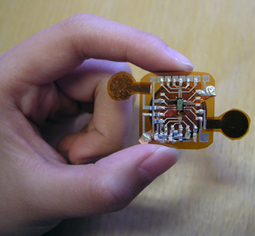
The future of health care could be found in a tiny, paper-thin skin patch that collects vital information. The Bio-patch sensor developed by researchers at KTH Royal Institute of Technology is inexpensive, versatile and, best of all, comfortable to wear.
Geng Yang, a researcher at JRC iPack centre at KTH, says that the Bio-patch measures bioelectrical signals through the skin, gathering data on different parts of the body depending on where it is placed.
“On the chest it provides electrocardiography (ECG), on the skull it measures brainwaves (EEC), and on the forearm it can measure muscle response to stimulation from the nervous system (EMG),” he says. It also has a built-in sensor that constantly monitors body temperature.
With a wireless connection, the patient can analyse the readings in their smartphone, or send the data via internet to a healthcare professional for diagnosis.
The thinking behind Bio-patch is that health care can be moved out of the hospitals and into the home, Yang says. “Bio-patch is a step towards what is known as self-care, which is valuable especially for patients discharged after an operation, or for the elderly living unassisted,” he says.
Bio-patch has resulted in several publications in prestigious scientific journals and successful development of a prototype. Yang says several companies have already shown interest in the product.
Via nrip
eMedToday's curator insight,
June 27, 2013 8:50 PM
This type of sensor can be used in small telemedicine cubicles to send vital data to a HCP
Scoop.it!

Scoop.it!
comScore publie une étude 2013 France Digital Future in Focus – Le Digital en France Inédite en France, l’étude présente les tendances clés de l’usag Via Esposito Christelle
Scoop.it!

My predictions include a meritocracy for doctors, a massive reduction in patient costs, and democratization of medical knowledge. Via JP DOUMENG
Scoop.it!

From
avaxho
Electronic Health Records (2nd Edition) by Byron Hamilton English | ISBN : 0073374393 | January 15, 2010 | 410 pages | PDF | 23,7 MB The availability of complete medical information when needed brought the innovation of storing the patient's ... Via Philippe Loizon
|
Scoop.it!

In a Harris Interactive/HealthDay survey released Tuesday, more than one-third of respondents who are online said they were "very" or "extremely" interested in using smartphones or tablets to ask t...
Scoop.it!

Managing the data deluge an electronic health system provides can be a seemingly onerous task, but corralling the information will improve your practice. Via Anneliz Hannan
Scoop.it!

From
lci
INFOGRAPHIE. En 2012, près de 4 Français sur 5 ont utilisé Internet au cours des trois derniers mois, contre 56% en 2007 et contre seulement 12% en 2000, selon une étude de l'Insee.
Scoop.it!

The BodyGuardian RMS is a smartphone-based system that continuously tracks the health of those with heart conditions and sends the data straight to doctors. Via Julie O'Donnell
Scoop.it!

From
gigaom
On the heels of strong growth, New York-based health tech startup ZocDoc is raising up to $55 million through a convertible debt note. Via Philippe Marchal
Scoop.it!

Emailing and texting lead the way on how popular certain physician/hospital services are online. Via Olivier Delannoy
eMedToday's curator insight,
June 25, 2013 7:54 PM
The 2012 online survey of 613 U.S. primary care and specialist physicians (PDF) yielded: 33%: Email/text with patients24%: Visit scheduling, test result access19%: Prescription refill tools15%: Telehealth consultations4%: Price data for routine services
Scoop.it!

Lors d'une conférence de presse tenue le 18 juin, Christian Dubosq, directeur général de l'agence régionale de santé (ARS) a présenté la e-santé et les objectifs fixés par l'ARS d'ici 2015. Via nathalie Bissot-Campos
Scoop.it!

WellDoc releases BlueStar, the first FDA-cleared, mobile prescription therapy for type 2 diabetes with insurance reimbursement. Via Matt Vaidis
Scoop.it!

Active bodies, healthy diets, and control of your health. The #GetFit campaign is beginning to accelerate and gather pace. Participants continue to make steady progress with a united vow to lead a healthier and more active lifestyle. Via Angel Gonzalez
Scoop.it!
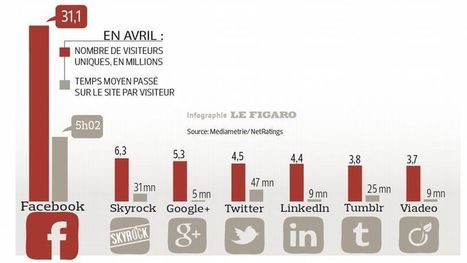
INFOGRAPHIE - Près de 80 % de nos concitoyens internautes sont inscrits à au moins un réseau social. Ils s'y connectent à tous les moments pour garder le contact avec leurs proches, grâce au mobile.

Olivier WebMarketing's curator insight,
June 27, 2013 3:18 AM
D'où l'importance pour les entreprise de développer la communication dans les réseaux sociaux |






